Origins of Blacktoft
Although Blacktoft does not appear in the Domesday book it almost certainly existed then. Blacktoft is an Old Scandinavian name that simply means Blæc –‘Black’ and –toft‘ homestead’. The other hamlets within the township – Clementhorpe, Gowthorpe and Staddlethorpe) all too have Scandinavian names suggesting that they too were settled at a similar time.
There were also two areas of Blacktoft, East and West with complicated boundaries.
Blacktoft’s absence from the 1086 survey might be because it was included with Welton or Brantingham to the east, as was part of Yokefleet.
Blacktoft in medieval times: the Hansard family
The first definite mention of the name occurs when the village of Blacktoft was granted by the bishop of Durham to Gilbert Hansard between 1165-85. Gilbert Hansard received Blacktoft and an area of marsh for a yearly rent of 12 marks plus a pig worth 16d and pannage.
Gilbert Hansard was also granted the right to construct a water-powered corn mill at Blacktoft and a water channel to ‘the said mill’ through his land from near Hive to the River Ouse at Blacktoft. In 1191 there was a mention of the ‘fosse of Gilbert Hansard’. The foss (ie. a channel/dyke) also provided drainage and was navigable by small craft. In 1276 ‘the great dyke in which runs the common waters of the countryside to the Ouse’ is mentioned. It is still in existence today and known as as ‘Hansard dam’ but nothing survives of the mill.
In 1199 Gilbert Hansard II came of age and was confirmed in his lands by King John.
In 1237 William de Melsonby was instituted as priest of the chapel of Brantingham with the chapelry of Blacktoft.
In 1291 Gilbert Hansard granted the manors of Blacktoft and Thornton in Lincolnshire to his son Robert.
In 1331 Bishop Lewis Beaumont of Durham was returning from London when the ship carrying his goods capsized in the River Ouse. Some goods were carried away by the people of Blacktoft, Faxfleet and Ousefleet.
In 1367 it is recorded that:
“during the previous reign, Sir Gilbert Hansard, deceased, while holding in fee the manor of Blacktoft worth 20 marks yearly, did side with the king’s enemies in Scotland and also sided with Gilbert Middleton (of Mitford, Northumberland) the traitor.”
Fishing
The grant of Blacktoft to Gilbert Hansard in the twelfth century had included a fishery on the Ouse. In 1279 Gilbert Hansard (III)’s fishery at Blacktoft was complained of by the city of York as an obstruction to navigation on the Ouse. Around 1348 there was a weir of fourteen spaces jutting out into the river, then being farmed by Thomas Trayleweng of Yokefleet. In the 1350s the fishery, with now sixteen spaces, was owned by Robert Hansard (II) and was being farmed by his neighbour Sir Thomas Metham (II), who was also farming the fishery at Yokefleet from Finchale priory. In April 1365 Beatrice, widow of Robert Hansard (II) brought a plea in Westminster against Sir Thomas to recover her ‘free fishery in the river Ouse’.
In 1379 there were 139 adults listed as paying the poll tax. The richest were Gilbert Bucolne [ probably a mis- reading of Lincoln], a franklin, and his wife Alice. Eight ‘fyshers’ or fishermen were also listed .
At this time Blacktoft was one of the largest Howdenshire villages due also to the river trade.
In 1418 Sir Richard Hansard (I) owned and operated a large vessel on the Humber, which called in at Hull. Blacktoft was probably its home port. Another vessel was the Clement de Blaktofte, one of the several vessels of Robert Jenetson, which sailed out of Hull with a cargo of wool in October 1472 and again in September 1473, apparently bringing back wine on its return voyage.
After the Hansards
In 1399 there was a complaint that:
“the watercourse called Blacktoft damme, otherwise Haunserdamme, which reacheth from the Foulney to the river of Ouse, was then obstructed and ought to be repaired by Richard Haunsard and the town of Blacktoft for their lands in Blacktoft, and the same ought to be 16 ft in breadth and 8 ft in depth.”
In 1459 there is mention of a Richard Hansard being summoned for offences – he was then a Lincolnshire squire married to Jane, daughter of John Aske of Aughton.
In 1522 William Hansard, the last male of the line died aged aged 19, and Blacktoft and other lands passed to his posthumous daughter Elizabeth. She married Francis Ayscough whose father, Sir William, had married her grandmother.
In 1564 Sir Christopher Alleyn of Ightam Mote, Kent who was also lord of Staddlethorpe manor [see later] sold the manor of Blacktoft to Richard Harpur, serjeant-at-law. By 1580 the manor had passed to another Richard Harpur, his younger son, who sold it and its belongings in Blacktoft, Staddlethorpe, Gowthorpe and Clementhorpe to a yeoman, William Harebred of Selby.
In 1613 William’s son Richard Harebred, who had moved to Wistow, conveyed the manors, houses and farms of West Blacktoft, East Blacktoft and Staddlethorpe to Richard Sutton’s agents, Richard Aldworth and John Wotton, for £2550. The manor itself was conveyed in 1630 to the Chartherhouse hospital founded by Richard, according to the terms of the will of his father Thomas Sutton (1532-1611) as an almshouse and school. The governors of Charterhouse held the manors of Blacktoft until the 18th century although they had problems
In 1657 they sent Master Cresset, a land agent, to survey Blacktoft. He said that:
“the truth is the inhabitants of that place are for the most part crafty, false and very moorish to deal with and seldom have I been with their ylke.”
The largest farmer from 1667 was James Dawson, who later occupied the manor house. His son John was later criticised for ploughing out old pasture land.
Amaziah Empson was involved in the affairs of the manor by 1733 when the Charterhouse was having difficulties with John Dawson. Amaziah and John Scholfield of Sandhall jointly leased a large part of Blacktoft and in a series of complicated land transfers in 1757 the governors of Charterhouse sold the manor of Blacktoft to Charles Pelham of Brocklesby who, in turn, sold it in 1761 to Amaziah Empson, whose family had lived at Goole Hall but who already owned much land at Yokefleet.
The sale included the former chantry of St Mary of Yokefleet, and 670 acres in Blacktoft, Staddlethorpe, Howden, Eastrington, Bellasize and Yokefleet along with rights to hold courts, a ferry and fisheries in the Ouse. Thereafter these areas became part of the Empsons’ Yokefleet estate.
Staddlethorpe
Today what remains of the settlement of Staddletorpe is three farms and the memory of Staddlethorpe Station, now renamed Gilberdyke. But in earlier times it was a separate settlement with its own manor house, pinfold and open fields.
The earliest mention of the name, dating from 1372, is Stertelthorp’ and is probably derived from a personal name Stertil. From the early 13th century a family called Lincoln lived there occupying two properties and around 120 acres. Thomas Lincoln, gentleman, was resident at Staddlethorpe in 1447 and was succeeded by a William Lincoln ‘of Staddlethorpe’ by 1461. In 1561 it was held along with Blacktoft by Sir Christopher Alleyn who had leased out the manor house of Staddlethorpe with associated closes, pasture and woods to Thomas Jackson, and then to Thomas’s son John. In 1590 the manors of Staddlethorpe and East Blacktoft were both held by Ralph Babthorpe esq. and Grace his wife, who sold them to William Harebred of Selby and George Blanshard of Clementhorpe. The manor was then sold by Richard Harebred, William’s son in 1613 to representatives of Richard Sutton and became part of the Charterhouse property.
Staddlethorpe Broad Lane (now known as Sparrowcroft Lane) was one of the routes by which beasts were moved seasonally from the village to Bishopsoil Common at a gate near Clementhorpe.
Staddlethorpe House probably stands on the site of the manor house of Staddlethorpe mentioned in 1561, as remains of a moat were once visible to the south of the house.
In the late nineteenth century it was the home of Thomas George Jacques. He died in 1897 as reported below:
The death of Mr Thomas George Jaques, of Staddiethorpe, Howden, took place after a somewhat lingering and painful illness. Deceased, who was in his 61st year, was a prominent Howdenshire agriculturist, and was associated with both the Howden and Selby Agricultural Clubs. For close upon five-and-thirty years he had taken an interest in public life, and during that time represented his parish on the Board of Guardians, the Rural Sanitary Authority, and the Highway Board. He was vice-chairman of the Rural District Council. On the elevation of Mr R. S. Schofield, of Sand Hall, Howden, to the aldermanic bench at the first meeting of the East Riding County Council, Mr Jaques was elected to the vacancy caused and has since been regularly returned unopposed. Deceased was a prominent Wesleyan, and had filled all the offices in the circuit open to laymen. He was universally esteemed in the parish of Blacktoft, where, although a Non-Conformist he was a churchwarden.
The house was sold [the land was sold separately], described as a farm house with buildings and two grass fields and 27 acres. ‘After considerabe competition this was knocked down to Mr Patchett for £5OO. It cost £1,030 in 1879’.
1930s/ 40s/50s John W Hoyle farmed at Staddlethorpe House
May 1955 Fire which broke out at Staddlethorpe House, Blacktoft, did much damage. A barn, 70 to 80 tons baled hay, three lorries, three carts, and a trailer were destroyed. A Dutch bam was partially destroyed . Mr. Philip Blee, 43-year-old farm hand employed for 30 years by farmer, Mr. J. w Hoyle, backed a blazing lorry out of near-by building affected by the flames, action, Mr. Blee saved the lorry just in ti e. As firemen fought the flames farm staff moved livestock The Dutch barns were so near the main farm buildings that at one stage of them and firemen sprayed the buildings just as a precaution. The cause of it is unknown
Staddlethorpe Grange The house was originally a fine three-bay, two-storeyed house of the earlier nineteenth century with hipped roof and central door. It was probably built by William Jewitt the younger soon after 1833, after he acquired its site in his enclosure allotment. At some later point the south side has been rebuilt.
1939 George Patchett
Staddlethorpe Station
The Hull & Selby railway line which ran across the northern end of the township opened in 1840. Initially a station halt, called Staddlethorpe was built within the township. Then in 1869 a junction was built west of the station for a branch line to Doncaster. The station was renamed Gilberdyke in 1975.
May 1871. Yesterday morning, a frightful accident took place at the Staddlethorpe Junction Station, on the Hull and Selby Railway. A number of passengers were waiting on the platform for the arrival of the market train from Selby to Hall, and two or three them had been joking with each other, when one them, Mr. Hare, of Gilberdyke, unfortunately overbalanced himself, and fell backwards from the platform to the line on which the train was just coming op to the station. Mr. D. Bristow and Mr. Evers jumped to the line after him, and tried to extricate him, but, unfortunately, were unable to save him. The train was just on the point of stopping, but the engine and the first three carriages passed over him, and he was fearfully crushed and injured. Mr. Bristow had a narrow escape, being caught by the buffer of the engine and hurt in the back, though it is hoped not seriously. Mr. Hare was extricated as soon as possible, but it was found he had sustained frightful injuries, both legs being cut off, his arm and hand crushed, and a severe gash cut across his forehead. He was able to speak just after he was taken up, but, although medical assistance was immediately sent for, he died shortly after. Mrs. Hare waa standing at the time her husband fell, and witnessed the whole catastrophe. Mr. Hare was well known in the district, having been for some years farm bailiff to Mr. Scholfield, late Faxfleet .
Gowthorpe
Gowthorpe is now a single farm but has a long history.
In 1550 lands in Gowthorpe belonged Sir Richard Bellingham, who owned also lands at Faxfleet. In 1630 Robert Wright ,a yeoman, lived at Gowthorpe. THe WRight family remained there until 1714 when it was sold to William Dawson of Skelton. We know from the hearth tax records that the Wrights’ house was assessed at four hearths in the 1670s, one of the largest residences in Blacktoft. In 1716 it was bought by Thomas Jewitt of East Linton, when it consisted of a house, seven closes containing nineteen acres, meadow land , the site of a former windmill, and land in the common fields of East Blacktoft. It eventually passed to the Coates family who lost their Howdenshire estate, on the death of John Coates in 1831. His estate was insolvent and was sold off to meet his debts. The Gowthorpe lands were bought by Amaziah Empson (II) in 1835 and became a farm on the Empson estate.
1892 Robert Reynolds, Gowthorpe house
The church we see today was built in the 1840s but the earlier church building was very ancient.
The first church
A chapel dedicated to St Clement existed at Blacktoft in the twelfth century. By 1237 it was described as a chapel of Brantingham. In 1268 a ‘stranger’ called Ralph of Willoughby sought sanctuary in the ecclesia of Blacktoft and confessed his guilt to the coroner. He swore to swear to leave the country as soon as possible and not return without the permission of the sovereign.
In 1552 an inventory of the contents of the church at Blacktoft was made. At that time John Gattertone was the curate and Richard Padley and Robert Nichol the churchwardens.
They recorded that there were in the church
one challis of Silver parcell gilt
5 vestments – 1 of black sattene – 1 of whyt bustian? – 1 of whyt fustian – 2 of divers colours
one cape of sage?
5 Albes
5 towels
5 altercloths
3 bells in the ‘Stepill’
1 handbell and a sanctus bell
a Cresmatarye of Coper
1 sirples and a rachet
1 corperer (copper urn?)
2 Crewettes
2 brass Candlesticks
1 cross of Coper
one pair of old ‘orgains’ lacking many pipes.
The presentation to the church of Brantingham and the free chapels of Blacktoft and Ellerker passed temporarily from the hands of Durham priory to Walter Jobson of Kingston upon Hull after its dissolution.
In 1575 a visitation said that Ellerker chapel was in poor repair. But that the tithes of Blacktoft chapel were owned by Giles Edwyn, who was described as ‘generosus’. In 1781 the lessee of the tithes was Ann Nelson who received 22¼ acres on Wallingfen in right of the the greater tithes of the parish.
Archbishop Grindal in this 1575 visitation also noted that Arthur Barker, the curate , failed to preach the required quarterly sermons or turn up for the visitation synod. Blacktoft does not seem to have had very good curates.
Probably the most unsatisfactory curate was Rev Thomas Fisher (c.1625-1635) His behaviour led to an action against him by his parishioners in the ecclesiastical court in 1629 to try and get him removed as as he had ‘at divers and sundry times carelessly neglected or wilfully refused to read Divine service’. He was also accused of drinking, brawling and gambling.
In 1662 the chancel roof collapsed (this was the responsibility of the tithe owner) and in 1670 the nave was said to be in ruins (this was the responsibility of the parish).
An emergency church rate was insufficient to pay the repair costs of £140, so the churchwardens proceeded in the York consistory court for a reasonable rate against James Dawson, then the largest freeholder in the parish and a defaulter. Dawson alleged the case was driven by personal malice against him by the wardens and their friends as he was a newcomer to the community.
The eventual repairs were never satisfactory leaving the tower and the nave only poorly joined. A fascinating document from 1743 exists in the Borthwick Institute in York which is freely available online on their Cause Papers site. Ref Cause Paper CP_I_1242
The many pages of evidence explain how a model of the church was produced and various witnesses called to explain how the nave roof had been lowered after a partial collapse and now did not line up with the tower properly. The churchwardens blamed William Blanchard who was the ‘farmer’ of the tithes and thus responsible for the tower.
Blacktoft parish registers
The chapel at Blacktoft kept its own registers, despite being part of the parish of Brantingham. Unfortunately, from before 1700 very little of them survived and even after that date the originals are in poor condition. Perhaps part of the reason can be found from the results of Archbishop Herring’s Visitation of 1743.
Blacktoft at that time only had fortnightly services held by the curate of Brantingham and it was reported that chapel was in trouble for not having a ‘parchment register’. Parchment registers were the regulation because, although more expensive, they stood up better to wear, tear and damp. Also in 1743 it was recorded that there were 38 families belonging to Blacktoft Chapel, one of them a Quaker family.
Nevertheless, from 1700 the registers are intact and cover a wide area between Eastrington and North Cave. In March 1774 John Parrat was buried at Blacktoft, having ‘drown’d at the new river’. This is the first mention of the nearby Market Weighton canal which, at that time, was under construction.
Occasionally the registers give a glimpse of village characters, such as when in May 1788 Ann Johnson, a widow of Blacktoft, died. The record of her burial describes how she was ‘commonly called Nanny Hart’ and was a pauper. Or again, two years later, when a 31-year-old Thomas Wilson, a shoemaker of Blacktoft, died in August 1790 ‘of a consumption’.
The new church
From 1785 Blacktoft was separated from Brantingham and had its own perpetual curate., albeit one shared with other parishes. Between 1806 and 1817 Robert Poole was perpetual curate of Laxton and Barmby as well ministering at Blacktoft. Edward Ward was perpetual curate from 1838 but did not live in the parish until the construction of the vicarage in 1842, travelling on horseback from his lodgings in Laxton.
We can glean some idea of the original church from maps. A small sketch of the church on the 1656 map of West Blacktoft shows a structure with a pinnacled west tower, nave and chancel. The tithe commissioners’ agent who visited Blacktoft in 1837 remarked on it as ‘a very small church.
In 1839 however the church was severely damaged in a storm with much of the tower collapsing and it was decided to rebuild it.
A subscription raised £1350 and the church was completed at a total cost of £1550 in 1842 to a design by John Harper of York. John Harper was an up and coming architect having already designed St Peter’s School in York.
The new church was consecrated with a dedication to the Holy Trinity on 11 April 1842. [nb it is believed that the Holy Trinity dedication may have been because of the Hull connection but it has now reverted to St Clements] Sadly John Harper who was only 33 died in November that year in Naples ‘of fever caught at Rome, universally regretted by all who had the pleasure of his acquaintance’.
A little survives of the medieval church including the font, which possibly dates to the thirteenth century, some interesting stones built into the back of the church and possibly the chancel arch which could be the reassembled former tower arch of the medieval church. A terrier of 1820 mentions three bells, possibly those mentioned in 1552, which were rehung in the present church. One was one subsequently recast in 1862.
Vicars
One of the longest serving vicars in the nineteenth century was Rev Edward Ward who saw the rebuilding of the church and was the first vicar [as opposed to curate] and the first incumbent to occupy the new vicarage.
His obituary gives us further detail
A native of Shropshire, it was principally through his acquaintance with the Rev. John King, who was curate of Wellington, in that county, that Mr. Ward came into Yorkshire. He was ordained to the curacies of Laxton and Blacktoft in 1821, where he laboured upwards of ten years.
At the suggestion of the same friend he removed to Hull in 1832, and became the fellow curate of Sculcoates with the Rev. W. Keary. When the living of Blacktoft became vacant in 1838, it was bestowed upon Mr. Ward by the Patrons, the Dean and Chapter of Durham, principally through the influence of the family of the Empsons, extensive owners of property.
At that time it was said ‘The loss to his flock and to the inmates of the workhouse will not be easily made up, and we are persuaded that a very general feeling of regret will pervade the town at the eventual removal from the town of one so calculated, by devotedness and consistency of life, to adorn the doctrine of God our Saviour.’
It being necessary to rebuild the church at Blacktoft, and also to erect a parsonage house, it was not till April, 1842, that Mr. Ward took up his residence there.’
Rev Ward remained at Blacktoft for the rest of his life. His wife Anne died in 1870 but his two daughters remained living with him. On January 1st 1875 the local community made a presentation to him, reported as follows
On New Year’s Day, at a meeting held in the schoolroom, a testimonial was presented to the Rev. E. Ward, vicar of Blacktoft, Yorkshire. It consisted of a silver tea coffee service and salver and a handsome timepiece, each bearing the following inscription Presented to Rev. Edward Ward, curate and vicar of Blacktoft for the last 56 years, his parishioners and friends, mark of their high esteem. January Ist, 1875,” There was also purse containing ten sovereigns. The chair was taken on the occasion by Mr T. G. Jaques, of Staddlethorpe, one the churchwardens, and the presentation was made by the Rev. J. Simpson, The speeches all bore grateful testimony the respect which the Rev. gentleman held, and to the affectionate esteem which his consistent Christian life and character, through a long course of years, have won from his friends aud parishioners. Several sacred songs were sung during the proceedings. The choir and others were afterwards regaled in the schoolroom with a bountiful tea, kindly provided by some of the Inhabitants of Blacktoft. The evening a concert was given Mr Smith, the schoolmaster, assisted by the Howden Society, and other friends.
Rev Ward died in 1878. He was buried under the chancel, the last person to be buried within the church.
Rev John Smeddle
Rev John Smeddle, born 1828, was appointed after the death of Rev Ward. He was originally from Durham and had previously been working in Bedlington. His first wife, Miriam Grace died in 1880 soon after arriving in the village and is buried at Blacktoft. They had one daughter. A brass plaque in the church commemorates her. Rev Smeddle married again two years later at Whitby. His wife Sarah was the daughter of ‘the late Captain Wood RN’ of Whitby.
Mrs Smeddle died in spring 1896 ‘after a long and painful illness, from dropsy. Much sympathy it was reported is expressed for the kindly old Vicar in his sad bereavement.
Only a few months later in November Rev Smeddle died after having ‘ a nasty fall’ . A memorial to him and to his second wife stands in the churchyard. The contents of the vicarage were sold in January when ‘ large company was conveyed to Blacktoft in packet boats from Goole, and in conveyances from Staddlethorpe Station.’
Rev William Turner
Rev Turner was the new vicar having formerly been curate at Gainford in Co Durham. He and his wife Harriet had three sons and six daughters [two other daughters were born at Blacktoft but died as babies].
One son Edmund Sanctuary Turner was killed in 1916 while serving with the Royal Garrison Artillery. Before joining up was he was an assistant master at Farlington Grammar School. He had gained his degree from Durham.
Sadly Rev Turner died suddenly in May 1908 at the age of 44.
Rev Allan Danson Rigby
The new vicar was Rev Allan Danson Rigby. He was an Oxford graduate.
While he was vicar, in 1930, there was a serious fire in the church which destroyed the vestry and many of the original parish registers. and other parish records.
He died in 1933 aged 70 years, and was buried at at Smithdown Road Cemetery, Liverpool,
Rev. Herbert Stanley Porter Coster was appointed in 1937. He had been the Rector of Middleham about fifteen months and was appointed Vicar of Laxton and Blacktoft . Mr. Coster had gone to Middleham from the Johannesburg Diocese in South Africa, where had been the Rector of Belgravia since 1928.
Blacktoft and the River Ouse
In the 16th century there were three staithes or jetties at Blacktoft. Flooding was always a problem and early in the 18th century there were exceptionally bad floods and the river banks were moved. Bundles of straw were kept at the bottom of the church porch door to keep out water until c.1930, by which time the banks had been strengthened.
In the early 19th century the Hope & Anchor pub was built by the riverbank, probably to serve the local ferry and steamers.
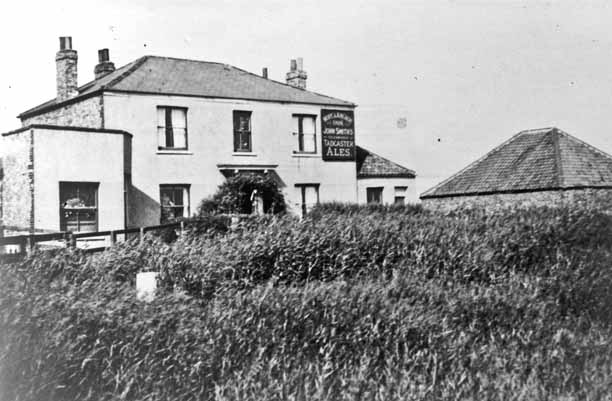
The Hope & Anchor, Blacktoft, viewed from the River Ouse
In Baines’ trade directory of 1823 it was remarked that:
“Opposite the village sometimes great quantities of vessels anchor, being considered a good road stead. The steam boats from Selby and Thorne pass daily on their way to and from Hull. A bed of sand, which at low water extends over several acres, serves for the ballasting of small craft.”
Between 1873-81 the local Aire & Calder Navigation Company built a jetty at Blacktoft. This was so that ships travelling to Goole could lie up at Blacktoft if they could not make the journey out to the Humber in one tide.
Blacktoft river tragedies
Due to its riverside location, Blacktoft saw its fair share of tragedies. Several victims were laid to rest in Blacktoft churchyard. In 1794 the burial register records:
“John Magnus, a native of Denmark, was drowned on Sunday 7th September as he was passing Trent mouth on his way from York to Hull in the Bonny Boatman’s Boat belonging to Trinity House at Hull.”
He was eventually washed up near Thornton Land and was buried on the 26th September 1794. A footnote in the register adds that ‘he seemed to be about 25 years of age.’
Exactly a year later, Timothy Rymer, a sailor, ‘was drowned in the Humber and was buried at Blacktoft’ and in January 1806 Samuel Wriglesworth, ‘a mariner’ of Hull, suffered the same fate.
A Goole sloop, Providence, captained by John Kitson and owned by Thomas Cliff of Knottingley, was lost near Blacktoft on 5th September 1846.
In May 1854 Captain William Turgoose of the sloop Oddfellow, while lying at Blacktoft, was moving his rifle off the hatch when he accidentally shot his two-year-old child.
On Monday 15th August 1859 a boy of five, Alfred Mark Chapman, son of Mr Benjamin Chapman, accidentally fell overboard from the vessel Brilliant which was lying at anchor in Blacktoft Roads. The body was not recovered until Saturday 27th August, when it was found near the Middle Lock, Goole after being in the river for nearly a fortnight.
In January 1864 it was noted in the Goole Times newspaper that:
“Mr Richard Eccles, the Blacktoft ferryman, put out in his boat to meet the York packet, ‘Ouse’. He sculled his boat ahead of the ‘Ouse’ and came into contact with her, causing him to be pitched overboard where he was caught in the fast current and drowned.”
Richard Eccles was the son of Mr Eccles, the ferryman at nearby Howdendyke.
Blacktoft in the 19th century
By 1809 Blacktoft was largely agricultural. It had an inn, the Bay Horse, kept by John Lister, several yeomen and a school, although in May of that year the schoolmaster, Mr William Atkinson, died aged 60.
Fourteen years later, in 1823, John Lister still kept the inn (which was on the corner near where the telephone box now stands). He was also a coal dealer, no doubt taking delivery of his stocks from the nearby jetty. Thomas Lister was the village tailor, William Taylor was the carpenter, Joseph Poppleton the constable, Solomon Scott the parish clerk, John Reynolds the blacksmith, and William Reynolds the shoemaker.
In 1830 the open fields of Blacktoft were enclosed, along with those of nearby Faxfleet, Gilberdyke and Hive. The commissioner was John Bell of Portington. The map drawn at the time provides a lot of information about the area. There were then about 15 dwellings in the village, as well as the old church and the manor house. The Blacktoft pinfold for stray animals appears to have been opposite the church, although it is not clear exactly where. The main street was described as ‘the Cave and Howden’ road, and was shown as 30 feet wide.
Blacktoft seems to have had three open fields – Church Field, between Hansard dam (marked Anser Dam on the map) and Sparrow Croft Lane; Mill Field, east of Sparrow Croft Lane up to Bishopsoil Drain; and Hook Field, to the south of the other two and abutting the river.
The existence of ‘Mill Field’ and the granting of a wide track into its centre, east of Sparrow Croft Lane, suggests that at some time Blacktoft may have had a windmill on this site (perhaps after the water mills at Blacktoft and Thornton Lands had fallen out of use?).
A large area of land north of Blacktoft, around Staddlethorpe and Gowthorpe, was also enclosed – giving a total area of 302 acres. The largest allotment, of 70 acres, went to Robert Plummer Weddall. The Weddall family were originally from Selby and acted as surveyors for two local enclosures. Robert surveyed the Eastrington, Bellasize and Sandholme enclosure (act 1813, award 1822), and John George Weddall was described as one of the principal landowners of Blacktoft. It was George Edward Weddall of Thornton House who transcribed the Blacktoft parish registers.
The Empson family – Reverend Richard Empson, Amaziah Empson, and Gervis Empson – were allotted approximately 125 acres between them. John Lister of the Bay Horse Inn received 14 acres, William Jewitt received 16 acres, John Phillips 8 acres, and the trustees of John Coates 40 acres.
William Jewitt was a member of a Howdenshire family of yeoman farmers who had possessions at Saltmarshe, Ousethorpe and Balkholme. In 1809 two William Jewitts (father and son) were both freeholders in Gilberdyke and Clementhorpe. In 1791 a notice, now in Blacktoft Church, noted that:
“A person unknown left 10- yearly for ever to the poor of Blacktoft, to be laid out in bread and given at different times, viz. at Easter, Whitsuntide and Christmas, chargeable on certain land called Oxpasture Hill in the township of Blacktoft, in possession of William Jewitt of Clementhorpe.”
The Hall family of Blacktoft
Another Blacktoft family were the Halls, who were the village blacksmiths from around 1860 to 1933. John Hall [1831-1908] was originally from Duffield and as a young man was apprenticed to the blacksmith at nearby Hemingbrough. He married Elizabeth Fairweather from Cliffe. Their two eldest children, Mary and William Fairweather, were born at Hemingbrough but by 1861 the family had moved to Blacktoft. Here their children Ann and Robert were born.
They lived at the blacksmith’s shop in Blacktoft, which was opposite the end of the lane leading to Gilberdyke.
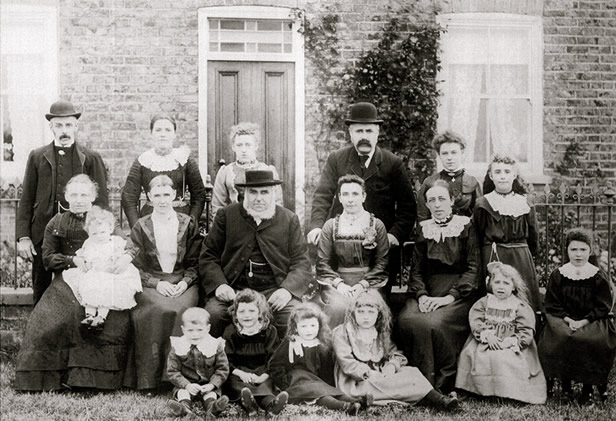
The Hall family, c.1902, outside the Smithy at Blacktoft. John Hall is seated middle row, centre.
John and Elizabeth lived the rest of their lives at Blacktoft and are buried in the churchyard there. Their gravestone shows that Elizabeth died in 1898 aged 64 and John died in 1908 aged 76.
John & Elizabeth Hall’s children:
Mary
Mary married John Cawood in 1881. John was a farmer and they lived at nearby Faxfleet with their daughters Annie, born 1886, and Doris, born 1901. Annie married James Pearson.
William Fairweather
William married Harriet Harland at Goole in 1884. He too was a blacksmith and in 1891 was living in Couper Street, Goole. They later moved to Beverley Street and by 1891 were in Parliament Street. William and Harriet had five children; two boys (John Robert and Walter Harland) and three girls (Emma, Ethel and Helen). John eventually went to work with his Uncle Robert at Blacktoft. Ethel married John Westerman and had a son called Harland. William Fairweather Hall died in Goole in 1922.
Ann
In 1881 Annie was living with the headmaster and his wife at Laxton and working as a pupil teacher at the school there. In 1901 she was at home, looking after her widowed father.
Robert
Robert followed in his father’s footsteps and was also the Blacktoft village blacksmith. He married Alice Walker in 1893 whom he met when she was working as a servant at Blacktoft vicarage. She was originally from Whitton, across the river in Lincolnshire.
Robert worked as the Blacktoft blacksmith until his death in 1933. His gravestone is in Blacktoft churchyard. His wife Alice died in 1935.
Robert and Alice had eight living children: Mary Eizabeth [Lizzie], Edith, Eva, John, Alice, Annie, Joyce and Eleanor.
Of Robert and Alice’s children, Lizzie married George Holmes from Hull, and Edith married Frederick Oldridge, whilst Eva married John H Thompson in 1921 and lived at Broomfleet. In 1928, both on the same day, Alice married Tom Houfe and John Hall married Bertha Blee. Annie married Fred Sims from Howden, whilst Joyce married Fred Neville. In 1934 Eleanor, known as Nellie, married Stanley Haigh of Newport.
Blacktoft Life & Memories
Blacktoft is unique in that not only is it an agricultural village, but for many years it was also visited by seamen from all over the world when ships moored at the jetty there (this does not happen as much today). Many of these men went for a drink at the local Hope & Anchor pub, creating quite a cosmopolitan atmosphere, and although the village had a full-time customs presence it was always said that some smuggling still went on. Another feature of the jetty was the very loud foghorn – the Blacktoft bull – which could be heard many miles away when there was fog on the river.
Blacktoft jetty masters
Robert Powell
Robert Powell, born at Blacktoft, was jetty or pier master there from the 1880s to 1905. But he had spent much of his life away from the village in the army and his story is not straightforward.
Robert Powell was born around 1828 at Blacktoft. He was listed as a farm servant when he joined the Royal Artillery at Kingston upon Hull in 1846 aged approximately 18. He was discharged in 1869 after 23 years service.
Whilst serving with the Royal Artillery in Canada he married in 1850 a French Canadian lady called Leocadie Lefevre, [often mispelled] Their daughter Elizabeth was born at Fort Henry, Montreal in 1856.
They had returned to England by the time their daughter Sarah was born in 1861. Son Robert was born in 1864 and Rose in 1866. Robert snr was then serving as a gunner in the Coastal Brigade. He was discharged in 1867 at Woolwich and subsequently was entitled to a pension.
But then the story becomes confusing. In 1871 Robert’s wife and family were living in Woolwich but he was absent and his French speaking wife was working as a laundress.
By 1881 Robert was back in Blacktoft with a different wife Emily/ Emmeline who was several years younger than him and born at Bielby near Pocklington. He was described as an army pensioner but by 1891 he was piermaster/jetty master and remained in post, living at Jetty House until his death in 1905.
But his wife Leocadie was still very much alive. She moved to London and died in 1898. On her death certificate she was described as wife of Robert Powell of Blacktoft, piermaster. So did Robert keep in touch with his wife and family and did his Blacktoft ‘wife’ know of them?
Robert is buried at Blacktoft. He left £470 to his ‘widow’ Emily who moved to York and worked as housekeeper in the Bluecoat School there.
William Howard
For a brief time after Robert Powell’s death the pier master was Captain David Jackson. But by 1911 it was William Howard whose children were all born at Blacktoft. But tragically he was killed in an accident .
On June 9th 1922 he was in a pony and trap being driven by Philip Blee, licensee of the Hope and Anchor. They were returning home from North Cave when they were in collision with a lorry loaded with oranges and lemons. The trap overturned and William was thrown out and killed.
His family however remained in Blacktoft. Marie, a teacher married Albert Bradley who served many years as Blacktoft churchwarden; Evelyn married Herbert Robinson a captain for Associated Humber Lines and as Evelyn Robinson was long time headteacher of Blacktoft School.
William’s sister Myra was married to Horace Bannister Collins who ran the village shop next to the Hope & Anchor.
Captain Dick Collier
From July 1941 the jetty master was Captain Dick Collier. By then, the pier house where he lived had mains water and a WC (the only one in the village) but there was no electricity, only paraffin lamps.
One night in 1946(?) Captain Collier received a phone call from Mr Rowland(?) Winn at Faxfleet. A bomber had crashed onto the mudflats where the Trent and Ouse meet and the crew could be heard shouting for help. Captain Collier met Mr Winn at the drain on the Blacktoft to Faxfleet road and, along with Norman Parker, set off in Mr Winn’s boat for the Trent training wall. They rescued the Canadian crew from the mud but then their engine failed. They, in turn, were rescued by a ship piloted by Tommy Mapplebeck from Goole.
The Collier family left Blacktoft in 1950.
The new jetty master was Frank Raywood. He remained there until the 1980s.
20th century Blacktoft families
Some Blacktoft inhabitants of the last century include: Harry and Nelly Blee, who lived at Bank House on the river side (Harry kept bees); Jack Drury and his wife who ran the village post office; Jim Drury, who was the village joiner; and past landlords of the Hope & Anchor who included Tom Tomlinson and Fred Lord.
There were also Mr and Mrs Hibberd, the Smalley and Reed families, the two Crisp families and Burt’s shop, while at Manor Farm lived the Thompson family. Harry Rutter, who married Pauline Collier, was the customs officer.
Blacktoft in 1935 [ from a newspaper article]
Lack of Houses Keeps Love Locked Out. Owing to the shortage of houses in Blacktoft several marriages are being delayed. “A few Council houses would ease the position,”
Blacktoft it should be explained is a village about six-and-a-half miles from Goole, as the crow flies. But a person who wants to go to Blacktoft in a hurry must be prepared to set aside three hours for the return even if he starts from Goole
A Yorkshire Evening Post reporter who wanted to pay an afternoon visit to the village was surprised when he was told that the afternoon would have to include the evening only on Saturdays. as the transport people go there only on Saturdays “You take the Hull ‘bus far as Gilberdyke, a guide explained, “and then you have a nice country walk of three or four miles to Blacktoft. When you reach the Ouse you will be there because Blacktoft adjoins the river, and you cannot walk any further
“Unfortunately many people assume that Blacktoft is at the end of the earth, and therefore that no one in the village wants to get married,” said one of the young men after our reporter had trudged into Blacktoft, and inquired about the alleged shortage of houses. “ There are strong local ties here. I have three acquaintances, all farm hands, who would get married tomorrow if they could find a nice little house at four or five shillings a week clear, which is all they can afford to pay.
“There is no doubt that Blacktoft people keep together, and in making friendships we do not go outside Gilberdyke, Faxfleet abd Staddlethorpe and why should we? A farm hand may work for a Faxfleet farmer one season. and he may return to Blacktoft the next season. But he seldom goes outside this radius for employment, and as we have not seen any building in Blacktoft for years. It is time a few builders put us on the map again.” A young woman whose views were identical said that even farmers’ sons contemplating matrimony found house hunting difficult. The trouble seems to be that as Blacktoft is so far off the beaten track no builder would bother to send a load of bricks down the country road that leads to the Ouse.
Unfortunately the village has no electric light and no water from the mains. The vicarage relies on a storage tank that holds 4,000 gallons, and the supply for the bath has to be pumped into a roof gravity tank Sufficient water for one bath requires 170 turns of the pump handle! Blacktoft had a vicar who stayed 27 years The Rev. J. H. Elphick came to the village only six months ago, and he admitted that he had not been there long enough to decide whether there was a housing shortage. But he did say that during the last three or four years there had been on the average one funeral, one christening and one wedding per year.
Blacktoft school
The old school, near the church, was built in 1851 and enlarged in 1873 after the Education Act was passed. For many years the master was Elliot Smith, who lived in Lister House and died in 1902. He was succeeded by Richard Hamlet, who wore a monocle.
In 1907 a new school was built and Richard Hamlet moved to become the headmaster of this new establishment. He remained there until 1936. Other teachers included Mrs Frances Smith, Miss Moses, Mrs Madge Taylor and Mrs Evelyn Robinson, who was the head when the school closed in 1964.
Interestingly in the late 1940s there were four sets of twins at the school – Dorothy and Kathleen Laverack, Geoffrey and Raymond Anson, Reginald and Douglas Sherman and Ray and Jean Lord.
The old school, having formerly been home to POWS and also used as a school canteen at one time, is currently in use as a village and church hall.
N.B. A history of Blacktoft has been written by Mr Robert Thompson of Manor Croft, Blacktoft, and is available to buy from Blacktoft Church. Proceeds are in aid of the church.
I have written two blog posts about the jetty and the Bristow family of Blacktoft. Follow the link to my blog and search Blacktoft