The village of Saltmarshe has been dominated by the Saltmarshe family since the time of the Norman Conquest; they have always been major landowners in the area and, although their fortunes rose and fell throughout the centuries, the Saltmarshe family always owned at least some land in the area.
By the beginning of the 19th century the Saltmarshe family owned almost all of the land and property in Saltmarshe. The estate land continued to be farmed by the Saltmarshe family until 1970, when Philip Saltmarshe, the last of his line, died. Subsequently the various Saltmarshe properties were sold off at auction and are now privately owned.
Saltmarshe in the medieval period
Shortly after the Norman Conquest, King William I granted the manor of Howdenshire to the Bishop of Durham. Domesday Book (1086) records that there were six carucates of land at Saltmarshe in the possession of the Bishop. Much of the manor of Howdenshire was then described as ‘waste’, no doubt a result of William the Conqueror’s harrying of the north – a policy of devastation which was carried out as a punishment for northern rebellion against him.During the 12th century, Bishop Hugh de Puiset subdivided the manor of Howdenshire into various smaller manors; a small part of Saltmarshe was made into a separate manor and granted entirely to the Saltmarshe family. This Saltmarshe Manor consisted of about 180 acres in total, probably made up of the parkland and the site of the current hall. However, perhaps wary of allowing too much power to gather in the hands of one local landowner, the Bishop instructed that the rest of the land at Saltmarshe – about 600 acres – was to remain in his own possession (it continued to be let copyhold to the villagers).
The Poll Tax of 1379
The tax was levied upon all subjects of King Richard II who were over 15 years of age. It gives an interesting snapshot of the village of Saltmarshe in the medieval period.”Thomas Saltmersh, Esquier’ was the only wealthy inhabitant, paying a tax of 20s.
There were twenty-three servants at Saltmarshe, each paying tax of just 3 or 4s, and twenty-one labourers who also paid a similar amount. Many of these servants and labourers would undoubtedly have been in the employ of Thomas Saltmarshe. There were also seven instances of ‘Husband’, ie. husbandmen or small farmers. Also named was a ‘Wryght’ (carpenter, from the old sense of the word ‘wright’, ie. ‘builder’), a ‘Merchant’, seven ‘Websters’ (weavers), and nine people described as ‘Braciatrice’ (female brewer).
Altogether, 43 married couples were listed in the village; allowing an average of four children per family, this gives us a rough total population of 300. Saltmarshe was clearly a flourishing village, with weaving, brewing and farming being the staple industries. The village would also have benefitted from its riverside location as the Ouse would have been an invaluable trade route.
Court Rolls 15th and 16th centuries
The Howden Court Rolls also provide an insight into life in medieval Saltmarshe, describing a variety of land and financial transactions between the villagers. For example, some brief extracts:
1429 “John Page surrendered 11 acres to John Gote.”
1434 “Robert atte Gote was elected to the office of ‘Taster of beer’ and took the oath.”
1443 “The jurors say that John Skynner has accounted for the money received for a certain wreck.”
1448 Autumn Court “A fine of 6d was paid to the Lord of the Manor for a lamb that had strayed now in possession of Richard Lauty.”
1448 Autumn Court “A presentment was made that the villagers should repair the bank of the river before the Feast of St. John under a penalty of 1/-.”
1514 “Edward Saltmarshe paid the lord 40/- for admission to 4 1/2 houses, 8 score acres of land, and 1 fishery after the death of John his father.”
The ‘Lord of the Manor’ here refers to the Bishop of Durham, who was the owner of the Manor of Howden.
The Court Rolls provide a lot of information as to the surnames of medieval villagers (some common ones were Gote, Proudfellow, Foreshore, Croysier, Bekson and Lawty – many surnames originated from a description of where the family lived, eg. ‘at the foreshore’ or ‘at the gote’ (goit, ie. dyke) becoming simply ‘Gote’ and ‘Foreshore’). The brewing of beer continued to be an important Saltmarshe industry, as we can see from the appointment of an official ‘Taster of beer’ in 1434. However, it is important to remember that in this period beer was regularly drunk by men, women and children at mealtimes in place of the local water, which was usually too dirty and unsafe to consume. Brewing was therefore a necessary and thriving industry in nearly all towns and villages.
Other entries related to strict regulations for the pasturing of livestock and maintenance of the river bank. From medieval times onward, there was a ferry at Saltmarshe across the river to Reedness, as well as multiple fisheries. The fisheries were an important source of food and trade for the village, and would have consisted of fish garths or weirs which extended out into the river and contained boxes in which to trap the river fish. The existence of the fisheries was preserved well into the twentieth century with the continuance of ‘Fishgarth Staithe’ (now removed; it was originally located close to Bank House Farm.
Seventeenth century Saltmarshe
Some old records relating to Saltmarshe in this century have survived. The village Poor Book gives information about those impoverished Saltmarshe residents who were receiving alms from their neighbours. In 1660, the Poor Book recorded the names of the well-off village inhabitants who were the paying poor rate; some prominent persons featured were Philip Saltmarshe Esq., Joseph Croysier, Laurence Grabourne (or Grayburn), Robert Athorpe, John Jewit (or Jewitt), John Paterick, Thomas Garton, Ralph Higdon, William Lawtie and John Audus.
They each gave a sum of money to be used for the relief of the poor, each villager being assessed at a rate of one penny per acre so that the wealthiest were required to give the most money. In 1660 there were four villagers each receiving poor relief of 2d weekly: Mary Dawson, Alexander Slingsby, Elizabeth Mayfield and Thomas Garton ‘for keeping a poore child’.
It is interesting to note that in 1660 Philip Saltmarshe, although the only Saltmarshe resident with ‘gentleman’ status, was only required to pay 2s 4d poor rate. In contrast, neighbours such as Robert Athorpe and Ralph Higdon were required to pay 4s 4d and 4s respectively, meaning that they each owned about twice as much land as Philip Saltmarshe did.
The seventeenth century saw the Saltmarshe family at their lowest ebb financially, and they were forced to sell off much of their copyhold lands to other Saltmarshe inhabitants. During this period the medieval hall which the family had been occupying also fell into disrepair; by 1700 the family had moved into a large farmhouse midway between the end of the present garden and the village. Traces of the old medieval Saltmarshe hall remained until the early 1800s, when they were destroyed during the warping of the ground in preparation for the construction of the new (current) Saltmarshe hall. Some masonry from the medieval hall was used in the foundations of the new hall.
Saltmarshe in the eighteenth & early nineteenth centuries
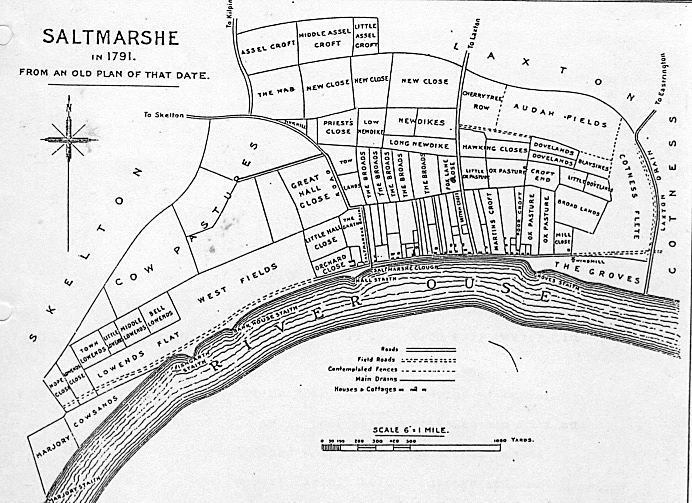
This map, based on a 1791 plan, shows Saltmarshe as it was before the building of the current hall and park. The old hall at that time was next to ‘Orchard Close’, whereas the current hall is in the area marked ‘West Fields’. Five staithes can be seen along the riverside, as well as the site of the old windmill in ‘The Groves’.
The population in 1800 was about 200; however, by the 1901 census Saltmarshe had just 84 residents. This population decrease was due to the formation of larger farms and the abolition of the smaller holdings throughout the century. At the start of the nineteenth century the village had a constable, a miller, a butcher, a tailor, a cobbler, a blacksmith, a boat builder and an innkeeper. By 1910, only the innkeeper remained. The constable had disappeared with the formation of the county police force (c. 1837); the butcher and tailor also disappeared early in the century; boat building was given up when the Parrott family sold their cottage; the blacksmith’s shop was closed c. 1885; Pratt the miller gave up grinding corn c. 1895, and Billy Bell was the last cobbler.
The opening of Saltmarshe Station on the Hull & Doncaster railway line, giving easy access to the flourishing towns of Goole and Hull, played a large part in the loss of these village trades, as well as being largely responsible for the great decline in river trade at Saltmarshe during this period.
Houses
Much information can be gained from a study of the census returns.
In the 1851 census, there were 37 individual houses listed in Saltmarshe. Bank House was not listed. The enumerator walked from west to east.
In the 1861 census the enumerator walked east to west. 35 properties were listed. Many small cottages seem to have been demolished between the hall and Sowby’s Farm during the 1850s. New properties were listed to west of hall, eg. the dairy, gamekeeper’s lodge.
1871 census – 35 properties listed. Enumerator walked west to east.
1911 census – 24 properties listed. Enumerator walked east to west.
Here is some information about the village farms and houses, beginning at the west end of the village.
Bank House Farm
Around 1860 Philip Saltmarshe built the property now known as Bank House Farm. It was built using bricks and other materials from the ‘old farm house in the park’, which had recently been pulled down.
In 1871 ‘Waterside Farm’, as it was then called, was being tenanted by George Mapples from Reedness, his wife Jane and their daughter Mary. Their son George was born here in 1873 but died in 1874. George was a farmer of 135 acres employing one labourer and three boys and a domestic servant. He died early in 1881 and Jane and Mary moved back to Reedness.
By 1891 John Hewson originally from Birkin and his family of four sons and a daughter were the new tenants. By 1911 John and Mary were farming alone with the help of four farm servants and a domestic servant. The house had nine rooms.
Bad Seasons at Saltmarshe
In 1920 the new tenant was William Barker who unfortunately could not make the farm pay. In 1924, his problems were described in a bankrutcy examination reported under the heading ‘Bad Seasons at Saltmarshe’. His liabilities were then £320 and his assets £20. He had begun farming in April 1903, with a capital of £100 when he took Glebe Farm at Newport. He was newly married. His wife, the former Mary Ann Johnson, came from a Laxton farming family and had been brought up at the Bricklayers Arms. He stayed at Newport until April, 1920, his capital, in cash and stock, having appreciated to about £1,000.
He then took the tenancy of Bank House Farm, but gave up farming in July 1924. He blamed his failure on the bad seasons he had experienced as the land had been flooded. He also said he had lost £450 through improper valuation of the farm. When he left Bank House Farm the valuation, including stock, was put at £806, but in 1920 the farm had cost him £1,120.
A later the tenant was Albert Edward Clark. He died, as his gravestone in Epworth cemetery shows, in 1931. The stone reads,
In loving memory of Albert Edward, beloved husband of Laura Clark of Bank House Farm Saltmarshe who entered into rest 12th May 1931 aged 63. Also the above named Laura Clark who died 22nd August 1955 aged 86. Also of James William, son of the above who died James William Nov 11th 1896 aged 1 year 7 months.
In 1941 the tenant was Joseph Anson who was paying a rent of £216 a year for £152 acres.
Dairy Farm
It is likely that this was built in 1855. An entry for that date by Harry Denison, Philip Saltmarshe’s cousin, in his diary describes how he went ‘with Phil in afternoon to see new cottage, dairy, poultry yard etc. Very nice’
In 1861 Samuel Smith and his wife and three daughters, probably the first occupants, were ‘living at and attending the dairy’ next to Saltmarshe Hall. This was possibly something of a come down for them as ten years earlier they had been farming 200 acres at Ribston near Knaresborough and had the help of farm and house servants.
Samuel and Sarah had an older son John Samuel Cartner Smith who had, aged 16, recently emigrated to Massachusetts where he had a flouruishing career in ‘real estate’. John S.C. Smith left England aboard the ship Delaware arriving in the U.S. on 12th October, 1866.
By 1871 Samuel had moved on [in 1881 he was unemployed living in a terraced house in Leeds] and had been replaced as dairyman by George Ridsdale from Seaton Ross. He too did not stay and in 1881 William Thompson born at West Cowick was living at ‘Dairyman Cottage’ with his family.
In 1901 Henry and Eliza Rabey lived at the Saltmarshe dairy. Their daughter Mary Jane Rabey is said to have worked at the Hall. She later married Nethercote W Scarrow who was living with his family in Skelton and moved to Hull.
By 1911 the building, consisting then of four rooms, was known as ‘Dairy Farm’ and was the home of John Laverack from Rawcliffe. In 1941 John Hairsine was paying £124 a year on a yearly tenancy for 62 acres. It is now the home of John and Margaret Sweeting.
Gardener’s Cottage & Gardeners’ Bothy
These two small dwellings were located next to the hall. The cottage which was formerly lived in by the Wood family is presently a holiday cottage . Throughout the 19th century it was the home of the hall gardener and his family. The gardener in 1841 was James Kingston who seems to have been involved in keeping an eye on the hall building. . Mr Kingston, gardener to Philip Saltmashe, was also mentioned in The Gardener’s Magazine as being very successful at growing a variety of celery called the Superb White, one head of which could weigh 15 pounds, but was not stringy! It was even reported in the Yorkshire Gazette in October 1844 that an apple weighing almost a pound had been grown in the Saltmarshe Hall gardens.
There is a walled garden at Saltmarshe and there were hot houses against one wall where fruit such as grapes and peaches could be grown. There was often friendly rivalry between the local big houses as to whose gardener was best so it was quite a prestigious job, and theft from the gardens was taken seriously. For example in 1905 an itinerant Irish labourer was sentenced to 14 days hard labour for stealing pears from the garden of Col Saltmarshe. He was found eating them in a shed at Sandhall.
The gardeners in the nineteenth century came from all over the country, some from Yorkshire but also from Kent and Norfolk. The ‘bothy’ (sometimes described as ‘rooms in garden’) was very small, consisting of only two rooms which provided housing for the younger unmarried gardeners. It was built at the same time as the stables in the 1840s. There were usually two or three young men living here, again often from far afield. In 1934 there was an advert placed for a youth aged around 18 to work in the gardens at Saltmarshe and live in the bothy. It was said he would be fourth gardener.
By 1941 the gardens were rented by W Lange a Dutch market gardener and tulip grower from Howden.
The houses between the Hall and Sowby’s Farm
In 1841 and 1851 there were ten inhabited houses listed between Saltmarshe Hall and Sowby’s Farm. Of these three houses stood between the hall and village proper. All were demolished by 1860. Nearest the hall in the Park was an old farmhouse and associated farm buildings. This was where the Saltmarshe family themselves had lived until at least 1796. George Padgett, the farm bailiff and his family were living here in the 1840s and 50s. By 1861 he was retired and living at North Cave. Philip Saltmarshe writing in 1910 also mentions a cottage in the park. This was probably where estate woodman John Chafer and his family lived. By 1861 he had moved into the house now known as Groves Staith.
The Saltmarshe estate employed both a woodman and an assistant woodman at this period. They were responsible for keeping all the woods on the estate in good condition both for the shooting and providing timber for use on the estate.
John Chafer’s family were originally from Fockerby over the river but John himself was born 1798 at Eastrington. He was married to Mary and they had a large family. Sadly two of their daughters died young — Emma who died in 1843 aged 11 and Elizabeth who died in 1849 aged 17. Mary Chafer died in May 1861 and John remarried in 1866 to Jane Rusling formerly Ringrose who was originally from Holme on Spalding Moor. Jane died 1888 and John in 1889. They have headstones in Howden churchyard.
Also in this area was the “old Hall’ but this was not occupied then and was used as a village school. There are now only three/four houses [one is uninhabited] between the hall and Sowby’s farm. The first two are at the front of what was a small estate yard with the estate joiner’s shop at the rear. Here all the woodwork on the estate was carried out – window repairs, wheel and gate making etc and so over the years the estate joiner often lived in one of the two houses.
Joiner’s Cottage
The first [now Joiner’s Cottage] was known until the 1970s as Witty’s Cottage and was lived in 1941 by Mrs Witty. It is difficult to tell how old this house is as the lower part of it is built with 18th century bricks but it has been heightened using Victorian bricks.
This was maybe the work of its occupant in 1841, William Thompson, a local man who was a bricklayer. He may have been working on the new stables at the hall. He had recently married villager Alice Jewitt whose family had lived in Saltmarshe for many generations. Alice’s 12 year old daughter Clarissa was also living with them and Alice’s mother lived in a small cottage nearby. The couple went on to have three children George, Jewitt and Hannah before William died.
By 1851 Alice was a widow living in the cottage with three young children and mother in law Ann Thompson. Her daughter Clarissa went to work across the river at Swinefleet where her daughter Annie was born. Clarissa and Annie came back home and Clarissa worked at Sowby’s farm while her mother looked after Annie. Sadly Annie died aged 4 and has a headstone at Laxton. Clarissa later married John Smart from Holme on Spalding Moor. Alice died in 1873 and by 1881 the new occupants were Mary Pratt and her two sons. Mary seems to have had a varied career as in her home village of Stillington she was a teacher but in Saltmarshe she was the laundress for the hall. She did not stay long in Saltmarshe and had a third son born in Hull in 1883. She later became a housekeeper in York.
In 1891 William Bellerby, the Saltmarshe family coachman who had replaced John Rogerson [see later] lived here with his wife Mary, two adult sons who were groom and footman and a daughter in law. It must have been quite crowded with five adults. William moved to a new job and by 1901 Alfred Kettlewell, the estate joiner was living in the house with his wife Emily. Their daughter Jessie was born here in 1904 but by 1911 Alfred was a joiner and wheelwright at Angram near Harrogate.
The next occupant by 1911 was James Davy, a young farm labourer, born Skirlaugh, Yorkshire and his wife Alice.
Wilf Campbell who was apprenticed to his father Arthur Campbell, the estate joiner, in the 1920s remembered that a man called Driscoll lived there. Eric Walduck, another Saltmarshe villager, remembered that Grannie Anson lived here with Bob. She later moved to other end of village where Bob later lived.
Next here was Bob Witty who later worked for river board but then ran a milk round in Laxton.
The next door cottage, is now a small private museum. It has the datestone 1763 GAH or M inscribed over the front door, which probably stands for Athorp and Hannah Garton or possible Mary.
Athorp Garton lived at Saltmarshe in the 18th century; when he died he left his property to Abraham Haigh, who, in 1807, sold it on to Philip Saltmarshe and William Rawson. In 1841 it was the home of Watson Thomas, the estate carpenter, his wife Elizabeth and daughter Fanny. By 1851 Richard Bell, his wife and baby Mary and relative Richard Martin were living there. Richard was from a long established Saltmarshe family but his wife Bessy was from Kilnwick Percy and the family had moved there by 1861.
By 1861 Chatham Goodhand, the estate carpenter, was living here with his wife Mary from Rawcliffe and three children. He later went to work on the railways as a railway wagon builder.
In 1871 Thomas Cowlam and his wife Sarah were living in the cottage. They were probably the last ever occupants. They were an elderly couple. Thomas had worked on the canals and had run a small coal merchants’ businees at Reedness across the river but at Saltmarshe he was working as a gardener. Sarah died in 1878 and Thomas moved to the other end of the village where he died in 1886.
In 1881 the cottage was uninhabited and probably remained so thereafter. It stands in the estate yard and was used for storage and glass cutting.
Bounty and Jamaica Cottages
Today the next two cottages are a semi- detached pair of Victorian estate houses built sometime after 1866 . However before that date there were at least six small dwellings in this area occupied by around 15 people. Most of them were pulled down during the 1850s by Philip Saltmarshe because they were unfit for habitation. The occupiers were mostly agricultural labourers.
The Saltmarshe estate relied heavily on casual agricultural workers, a surprising number of whom were women and children and in the archives at Beverley are the wages books which list their names.
So in these small cottages were:
Joseph Parkin, an agricultural labourer and his wife Jane and their three daughters, Ann, Miriam and Sarah lived here. Joseph died in 1860 and Ann went to live with her married daughter Ann Battersby at Drax. But she returned to Saltmarshe and in 1871 was living at the other end of the village as an ‘out pauper. She died in 1879.
Next door was Jane’s cousin Rebecca Johnson, a single agricultural labourer. In 1841 she was living with her elderly mother Mary who died the following year. Thomas Hobson, an agricultural labourer, born at Luddington and his wife Mary lived there in 1851 with four children.
Next were two houses which were uninhabited in 1851 but in 1841 one was occupied by Robert Sinclair, an agricultural labourer and one by James Donaldson described as ‘clark of works’ . He was possibly working on building stables and the icehouse at the hall.
The last cottage before the farm was the home of William Lengfield a 79-year-old widower Originally from Hook William and his wife Sarah had lived in Saltmarshe for many years and possibly had a connection with the village mill. By 1851 Sarah had died and William was living with his daughter Ruth who was described as a schoolmistress. [ was she running the school in the Old Hall?]
Also living with them were two children William and Mary Lengfield who were born in Saltmarshe and who were William’s grandchildren. By 1861 the family was living at the east end of village. William was an almsman. Ruth was a washerwoman and another granddaughter Sarah Naomi was living with them. By 1891 William jnr was a boatbuilder and smack owner in Hull.
By the time the 1861 census was taken only one dwelling remained between the cottage now used as a museum and the farm. This one house was probably the former Lengfield family cottage. It was occupied by John Rogerson from Hartburn in Northumberland, who served for many years as coachman to the Saltmarshe family. He presumably moved into the new cottage next door.
John Rogerson
In 1861 John Rogerson, was 40 and described as a gentleman’s servant and coachman born at Cambo in Northumberland. He had previously been a coachman at Welton Grange. He and his wife Mary had a daughter working away and six young sons living with them. They remained in Saltmarshe until the 1880s. Mary died in 1885 and John in 1887.
Their eldest daughter Mary Ann married another coachman, Ralph Horner in 1869. They had a son Frederick but Mary Ann died by 1881. Young Frederick grew up to be a coachman too and in 1901 was living in Runcorn
In 1891 their son William [aged 41] was a Canadian agent in Bloomsbury whilst son Charles also moved to London and became a sanitary engineer. Another son, Edward emigrated to Canada and John jnr became landlord of the Plough Inn.
Son Frederic [sic] is commemorated on his parents’ gravestone at Laxton as Rev Frederic Rogerson who died at York Pennsylvania USA on 5th November 1882. He is buried in Wildwood cemetery alongside his wife and baby son.
By 1881 the two new cottages were listed as Coachman’s House occupied by John Rogerson [nearest the hall, now Bounty Cottage] and Butler’s Cottage occupied by Francis Smith Haldenby, and family [now Jamaica Cottage]
In 1891 the coachman’s house was described as Portland Cottage and occupied by George Craike, ratcatcher with his wife and sister in law. In the next house lived Joseph and Agnes Hartley. Joseph was the butler.
However by 1901 the house nearest the hall was unoccupied and the coachman, Alfred Beedom lived in the one nearest the farm.
Alfred and Ruth Beedom lived in what is now Jamaica Cottage until Alfred’s death aged 84 in 1949. They had five daughters. Their eldest daughter Marion lived for many years at Cotness, on the corner. She rode a sit up and beg bicycle, kept chickens and when she needed an errand doing stepped into the road and stopped a car. She died in 1988 at the age of 90.
Mr Beedom later had a Jowett van and one of his jobs was to take the hall laundry to Mrs Scruton in Back street, Laxton where she did all the hall washing and ironing.
The Saltmarshe butler continued to live in the cottage nearest the hall. In 1911 the butler was Henry Edgecombe and later came John Frederick Samways. He had been batman to Col Philip Saltmarshe when he served in the Royal Artillery. In the 1930s the butler who lived here was Mr Bradford.
Sowby’s Farm
Whilst it is almost impossible to sort out the cottages with the farm we are on firmer ground. The farmhouse was probably built by the Jewitt family early in the 18th century. In 1800 it was occupied by Simon Jewitt. When Simon Jewitt sold his property to the Saltmarshes in 1808, a Mr Judson became the tenant of the farmhouse, paying £316 a year. In 1810 the farm was rearranged with various parcels of land being added, making the farm 214 acres in all and far more compact. A rent of 46/- an acre was paid.
In 1813 Mr Judson died and part of his land was taken over by Philip Saltmarshe; the remainder of the farm and the farmhouse was taken on by John Burton. It became known as ‘Burton’s Farm” The farm was subsequently increased to over 200 acres by the addition of the remainder of the Aizell Crofts and Newdike. John Burton died in 1836 aged 75 and is buried at Laxton. He was described in the Hull Advertiser as ‘universally respected’.
His widow Jane was still at the farm in 1841. In 1842 Mrs Burton was paying £326 a year rent. She gave up the farm that year and died in 1843. John Sowby succeeded her as tenant.
The Sowby family
John Sowby was originally from Gainsborough in Lincolnshire and it is from him that the farm acquired its current name. John Sowby was clearly a pillar of the community as we can see from a description written by Colonel Saltmarshe in 1910: “[Mr Sowby] was much respected in the district, was an excellent farmer and my grandfather’s and father’s leading tenant; on leaving Saltmarshe he went to live at Gilberdyke but died soon afterwards”. John Sowby married Elizabeth Rennison from Gilberdyke in 1840. They had five children – Charlotte, John, William, Mary and Sarah. They came to Saltmarshe in 1842. Also in the household in 1861 was John’s elderly mother Charlotte, three male servants, a housemaid and a dairymaid.
They has their share of sadness. Son John died aged 32 in 1875 and son William aged 31 died on Christmas day the same year. Charlotte married William Johnson, a land surveyor and lived in Howden, Sarah married John Stephenson of Waterside Farm, Metham and Mary married Watkin William Winn who was the first stationmaster at the present Goole station and who later retired to The Villa at Laxton.
Col Saltmarshe wrote in 1910 that ‘After John Sowby left the farm in 1881, he was succeeded by a man called Leggatt and he by a Mr. Smith. However, neither of them stayed long and in 1910 Colonel Saltmarshe wrote that “my father has had the farm on his hands for many years past”. The farmhouse seems to have been occupied by Joseph Anson originally from Eastrington and family in 1901. He was described as a horseman on a farm.
By 1911 the tenant was Percival Chatterton Thompson, a 29-year-old farmer from Drax. He married Alice Maude Potter and their daughter Mary was born in 1914.
He served in the war and won the Military Cross. After Captain Thompson moved to Sherburn in Elmet the tenancy was taken over by the Kaye family.
Corner Cottage and the village shop
On the very corner of the road to Laxton there was for many years in the nineteenth century a little shop. This was kept by the Tomlinson family most likely in a room in the house. In 1841 a Jane Tomlinson, grocer was listed. She was born in Saltmarshe around 1785 and was a member of a large and well established village family. The Tomlinson parents, Richard and Judith Tomlinson lived in the nearby village of Laxton in the 1760s but by the 1780s were living in Saltmarshe. One of their sons, Samuel, had a large family.
Jane [born 1787] who later kept the little shop, had a son, Thomas Tomlinson baptised at Laxton on 28th May 1803. He emigrated as a young man in his early 20s from Hull to Canada. His cousin John baptised in 1814 also emigrated.
In 2011 I had a visit from John and Sue from the US who were staying in Saltmarshe whilst tracing their family history. Sue’s great great grandfather was Thomas Tomlinson. Sue’s great grandfather, Richard Tomlinson had written out an account of his ancestry which had given her the family connection with Saltmarshe.
It also had given her some confusing clues as well – such as the non existent connection with Titus Salt of Saltaire. Here is an extract:
Richard H. Tomlinson, a history of his life
I believe it to be the duty of every head of a family, no matter what his station in life may be, to leave behind him some sort of a history of his life and doings not necessarily for publication but for the purpose of saving trouble and perhaps expense. Altho I have no diary or record of my own life and so far as I am aware none of the family have kept any I am the more desirous that my children shall have all the facts before them imperfect as those facts may be and (was?) able as I am at this time to place them on record.
My father was an English immigrant coming to this country about the year 1826. I am unable to give the name of the vessel but I have heard him say it was by a sailer and that it took them about 13 weeks to cross from Hull to Montreal. There being no canals at that time the journey from Montreal had to be made in Durham Boats, a sort of scow, in which the goods were placed and the passengers were obliged to assist in propelling up the rapids. However, they reached their destination – Port Hope – Smiths Creek as it was then called – in due time and they at once proceeded to transfer their luggage to row boats in waiting, to the shore. My father came from a place called Saltmarsh near Howden in the East Riding of York. The estate belonged I believe to Sir Titus Salt. At all events my father was born and brought up as a farmer upon the estate and until he migrated to America was not off it.
Coming as he did at that early date he brought little with him and so far as I am aware there is but little left of what he did bring. A few books, amongst them a Prayer Book of the Episcopal church to which to which he belongs and some other books all of which have disappeared or are in possession of my sister Lizzie now Mrs. Albert Webster of Oshawa except a box which he brought with him now in our farm at Howden Holm.
I would like very much that this box be preserved it must be nearly 100 years old and the only article in our possession that Father brought with him from England.
Saltmarsh is beautifully situated on the right hand or west side of the river Ouse a tributary or branch of the Humber about 4 miles from Howden and about 8 or 10 miles from Goole, the head of navigation in a beautiful farming or agricultural country. There is also a church and grave yard, in which latter many of my ancestors lie.
Soon after landing at Port Hope or Smiths Creek as it was called, my father proceeded to Bletchers Corners, a considerable town in those days, where he got employment and met my mother Miss Gitty Gosling (daughter?) of John Gosling who came from Dutchess Co., who was a seamstress and worked for a Mr. Walton a tailor in Port Hope. From here they were married and went to Rochester NY by a sailing vessel.
After returning to USA Sue and John sent me a copy of a further interesting account they had found which was an extract from a diary kept by her great grandfather Richard when he had visited Saltmarshe whilst searching for his relatives. He seems to have been looking for the exact date when John Tomlinson, his father’s cousin, was born.
Diary of Richard Tomlinson during his trip to England 1891 [edited].
Thursday, July 30th, 1891 Decided to go on to Goole and spend the night, than trying to get more information about the Tomlinson family. Arrived in Goole about 7 o’clock, put up at the Sidney Hotel, kept by a Mr. Kitching. Had some supper and started out with a Mr. Richardson, who is connected with one of the banks, to do the town. Called at the house of one Charles Tomlinson but found him from home. Walked around to the Conservative club and spent the evening there very pleasantly.
Friday, July 31st, 1891 Got up early and after breakfast made another attempt to see Mr. Chas. Tomlinson. Found him at home this time. But he knew nothing of my branch of the race. Advised me to call upon a butcher named ———– who formerly lived at Howden and see if he knew anything of the people I wanted to see. Found out he had lived in Toronto and kept a butcher shop on Parliament St. for about 18 months.
He took me to see Mr Thorp [Henry Bell Thorp] an architect who is about to marry a Toronto lady. Found that Mr. T. is going over on the Parisian on the 13th. Had a pleasant interview with him and then started for Howden in a dogcart. Drove through a beautiful country; crossed the Ouse by ferry. Went to Howden Church, a fine old structure built many many years ago. Could not see the vicar until afternoon.
Drove on to Saltmarshe after interviewing a couple of Tomlinsons, neither of which were in any way connected with our family. At Saltmarshe heard that there was a George Tomlinson working on the estate [ George and his wife Maria lived just beyong the Plough inn]. Saw him and found he is a brother of old John. Had an interview with him and learned that his sister Mary was still alive and then on a visit to some friends in Goole [ Mary had married Johnson Holliday, a Blacktoft farmer who died in 1861. She was a pauper in 1891 and died 1892 aged 93] and that his brother William was also alive. From what I could learn, John must be nearly 80 years of age.
Saw the house in which father was born and where his mother lived for many many years [probably Corner Cottage]. Plucked a rose from a bush growing near the door said to have been planted there so long since that no one now living remembers when.
Saltmarshe is a quaint old place situated in a beautiful park containing a great many acres. The Mansion is large and may have been built a century ago. Drove over to Laxton Church to see if I could get a certificate of the birth of John. After a good deal of trouble found the vicar, who referred me to the civil register or Mr. Latham, who informed me that his records did not go back further than 1 July, 1837. Being pressed for time I was obliged to defer any further action until my return to Toronto.
The driver let me down at the railroad station and I at once proceeded to York where I arrived about 5 o’clock. Proceeded at once to York Minster, a grand old edifice which I have not time to describe.’
The Horsley family
Judith, Jane’s sister, married John Horsley at Howden in 1808 and they had a son William baptised at Laxton in 1809. Sadly John died in 1810 at Eastrington and Judith, who returned home to Saltmarshe died in 1815, leaving William as an orphan to be brought up by his grandparents. William Horsley also emigrated to Ontario, although the date is unknown. His eldest son, Thomas Brigham Horsley was born in 1836.
George William Tomlinson of Blacktoft
In 1851 Jane had her nephew William Tomlinson [Samuel’s son] living with her at Saltmarshe. She died later that year. William married and had a son George William who later lived at Blacktoft
George William ran the post office and little grocer’s shop next to the Hope and Anchor at Blacktoft.
Another letter has survived, this time written by George William to his relatives in Canada. This one explains that the need to find John’s age was in connection with a life insurance! Although no date is given the mention of a miners’ strike enables us to date it to 1893.
An edited version is below.
Post Office Blacktoft nr Howden East Yorkshire England
Dear Sir, I am very sorry to hear tell of Uncle John’s death; have been very neglectful in writing you but I have been so busy so have put off until now. I have a good deal to do with one thing and another as we have got the telegraph to look after and post office too and it causes me a deal of writing and anxiety of mind; hope you got all settled with the insurance as they did not trouble much about his age when they insured him. I think they might not to do so now at his death but there is sometimes more trouble to get money than to pay it in; it is better to take than to pay but hope you have got alright by this time.
Have Father still living here with me yet, and very fresh and well for his age; goes out to work sometimes when we have nothing particular to do at home. I hope all your mother and all the family are well; also Uncle John’s widow and family, also yourself and your family as I suppose you will have family.
What sort of a fair have you had at Chicago this summer? We have not heard much about it in this part; only of a few accidents which I heard tell of; hope it as been a success. Have you had a fine summer this year. We have had a very fine summer this year; better than we have had for years though not such a good year for hay crops and clover first crop – second crops of clover a deal better and good time for getting it in but some were too forward in getting it in and as first (? ) it with too much heat; the harvest as been very fair taking all on the average; the wheat is very well corned but scarce of straw, oat and barley about the same [ ]. Mustard an average crop; I think it will pay best of all crops this year which I should think you will not grow in America as it has not been grown in this part much but of late years.
We are having pretty good crops of potatoes this year; very large one and good produce – they have got them all about lifted now and are busy sowing wheat again which is rather soon but it is a very fine backend of the year, quite warm during the day, Turnips are almost a failure in a deal of places being so dry got covered with mildue and have not done good after. Water also has been very scarce this year. Some farmers not having any for the cattle to drink and very little at all for themselves to drink; a deal of poor people had to fetch it for a long way; all this part of the country is very poorly of for good water at the best of times as there are no springs about here and what there are they are a deal of them salt and brackey that you cannot drink it. I suppose you will have plenty of good water about you.
How is trade in your part; is very bad down here in England at the present time. The coliers are all out on strike and have been about 3 months; coal is from £1 10s – £2 per ton here and some very plain coal too. It as afected the shiping very much at Grimsby, Hull and Goole; at this small place it makes a deal of difference as on an average there is about 80 or 90 ships stop in a month at the pier between Hull and Goole; there as only been about a dozen or so in three months but I almost think they will go in the pits during this month; there are hundreds and thousands hungering and starving through the strike; hope it will soon be settled again. Do you feel any effects of it in America.
We shall be very glad for you to come and spend a bit of time with us next summer; if you come over into England at least you must try and spend a little time to see us all here as I have not had the pleasure of seeing any of you yet, only by portraits which your sister sent to me many years since.
With kind love to all from all. I remain yours faithfully
G. W. Tomlinson
George William died in 1900 at the age of 47.
Later occupants of Corner Cottage
After William Tomlinson had moved to live with his son at Blacktoft widow Susannah Dickinson and her son moved into the cottage. She was aged 63, a dressmaker and her son William Henry was a plumber.
In 1896 William married Elizabeth Pocklington, a former housemaid and they had two sons Alfred and William. Susannnah died in 1897.
Wilf Campbell, who grew up in the village in the 1920s, remembered him as ‘Tinner Dickinson’, who used to make milk cans.
Bertie Brignall
Within living memory the best remembered occupant of this cottage – it was generally just known as ‘Bertie’s’ – was Bertie Brignall. Like many of the estate tenants he had lived in various village houses but after the Second World war he lived here with his family until his death in 1989.
Bertie was born in 1897 at Saltmarshe but was brought up in Back Street in Laxton. His father Enos was from Wintringham and his mother Mary Precious was from Bubwith. Enos, like his own father Robert, worked as a groom and horsebreaker.
Bertie married Elsie Batty in 1930 and worked on the Saltmarshe estate all his life, as a horseman and later as a handyman for the last Philip Saltmarshe. When the last Philip Saltmarshe died in 1970 Bertie was left his cottage rent free as long as he fed the cats at the hall.
He remembered that “during World War Two there were three generators at the back of Corner Cottage [Snells were living there then]. The generators were operated by REME and were used to power river lights. Their cable ran behind Sowby’s Farm and through Saltmarshe Park.” Eric Walduck remembered that there were two soldiers stationed there who operated the lights.
Groves Staithe
This is one of the oldest houses in the village. It was in the 18th century the home of Abraham Haigh, a gentleman farmer whose family had lived in the village for many years.
In 1910 Colonel Saltmarshe wrote that it was occupied by Abraham Haigh in 1800. Abraham Haigh’s farm was occupied for two years after its purchase in 1808 by Mr. Saltmarshe himself, who then let it to John Burton who, in 1812, paid £210 a year for it. He later moved to what is now Sowby’s farm.
Bell family
Another long established Saltmarshe family, the Bells lived here in the early nineteenth century. William Bell worked on the estate. A document from the Saltmarshe papers of 1780 notes that William Bell and Barnard Lees submitted an account for ditching, setting posts and rails and quickwood in association with the enclosure of Wallingfen
Robert Bell who was born in Saltmarshe in 1819 was living there, farming 18 acres in 1851 with his wife Elizabeth, baby daughter Sarah, father Charles and brother William, who was a shoemaker. By 1861 Robert was an agricultural labourer in Kilpin. He then moved to Darlington as a railway labourer and was still Darlington in 1881 as a grocer. William ‘Billy’ Bell moved further up the village and was making a living as a bootmaker east of the Plough Inn. He also operated the ferry.
Groves Staith was occupied for much of the late nineteenth century by John Chafer, the estate woodman. John Chafer died 1889. It seems that the estate chauffeurs then lived there.
In 1911 this was William Charles Blake, aged 34, but by 1939 it was the home of Leslie Starkey and family. He was described as chauffeur and mechanic and was originally from Rutland. In 1941 the house was described as chauffeur’s cottage. Later it was lived in by the Wood family.
Groves Staith to East or Jennings farm
In 1841 there were two cottages between the Bells’ house and East Farm, one occupied by John Cook, an agricultural labourer and the other occupied by another agricultural worker, John ?Glue. They were not there in 1850s.
East Farm /Jennings farm/Home farm (now demolished)
The East Farm was built early in the 18th century by either the Gills or Rhodes family. It stood just to the west of the Plough Inn (now Plough Farm). In 1794 the East Farm was occupied by Thomas Rhodes; the same year he sold it to Simon Jewitt.
‘In 1834 David Goundrill gave up his small farm and it was added to the land of the East Farm, which at this time was occupied by a man named John Thompson’.[ Philip Saltmarshe 1910]
In 1851 John Thompson was aged 44 and was farming 107 acres and employing two labourers. He was born in Saltmarshe. He had married Mary Hill from Laxton in 1839. By 1861 he was a retired farmer in Hemingbrough. John and Mary had children Hannah, Benjamin, John Justus and Margrave. Mary Hill’s family owned a farm and land in Laxton and Cotness. Her unmarried sister Alice Hill lived with the Thompson family in both Saltmarshe and Hemingbrough.
John Thompson was succeeded by John H Freeman, who was at the East Farm in 1861 farming 112 acres.
By 1867 East Farm was occupied by Robert Simpson, who also farmed the West Farm and consequently in 1871 was described as a ‘farmer of 238 acres’. He was succeeded by a man named Kirk, who in 1880 was replaced by William Jennings from Ealand in Lincolnshire.
William Jennings had formerly been assistant woodman to Philip Saltmarshe, working with the head woodman John Chafer. He remained at the East Farm until his death aged 79 in 1912.
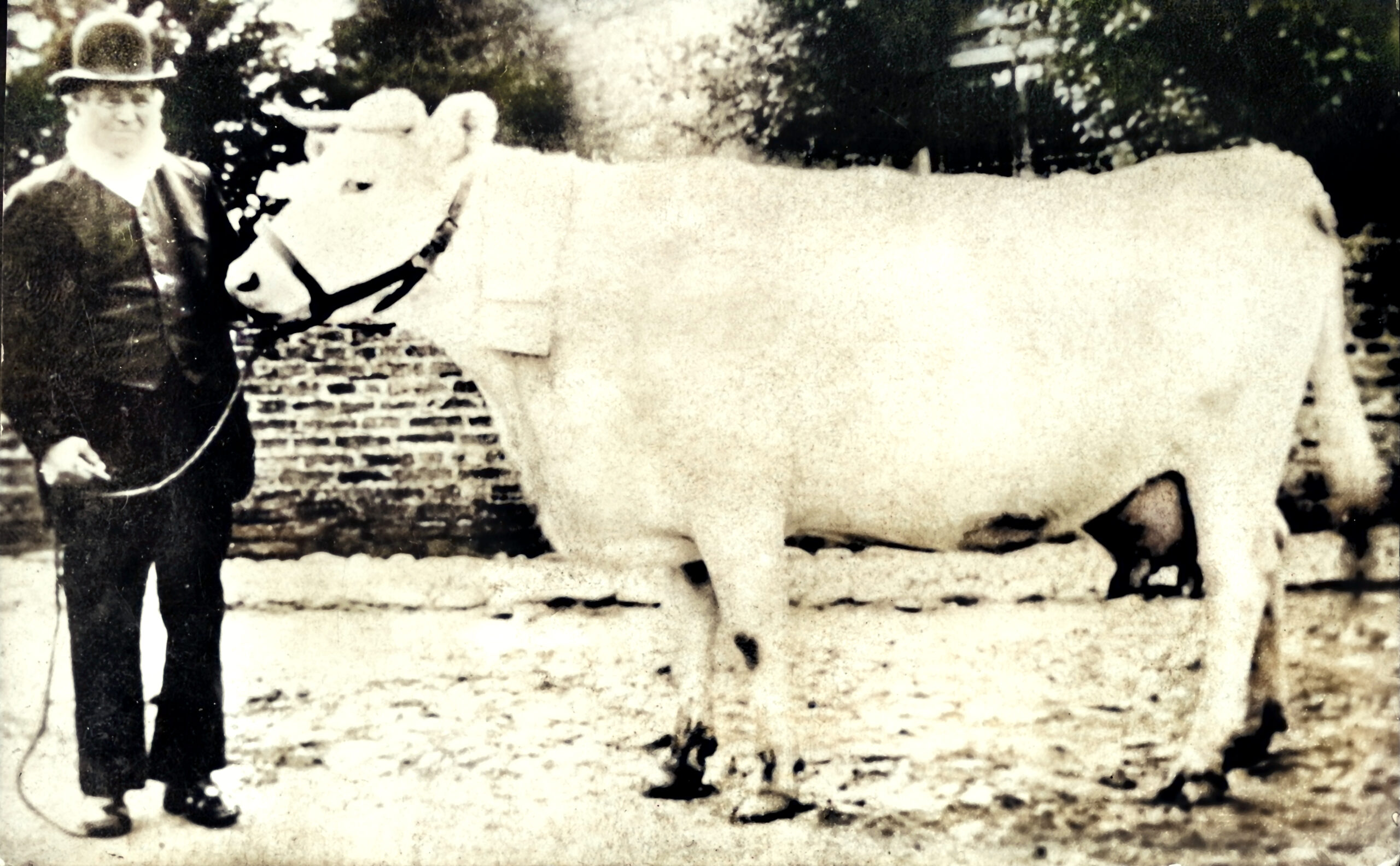
Above is William Jennings with a prize winning cow
It was last lived in by William “Tommy” Bulmer, a farm worker and his wife, the magnificently named Tryphena Mercy Ellen. Her maiden name was Scarrow and in 1939 her invalid sister Jane was living with them.
The East Farm was demolished in the 1950s?
In 1841 and 1851 between the farm and the inn was another house
The Plough Inn (now Plough Farm)
The earliest record of an inn at Saltmarshe is in 1823 when an inn called the Punchbowl was kept by Thomas Barker. He was still landlord in 1826. This is probably the same Thomas Barker, cordwainer who in 1826 sold a ‘Cottage with garth and croft containing half an acre in Saltmarshe and the cottages or tenements on part of the hereditaments before described’ to Philip Saltmarshe.
What makes it likely is that one of the names mentioned in the document is John Carter, brewer of Howden whose family owned and supplied beer to many local inns and pubs. There is no certainty that this was the same property which then became known as The Plough inn but it seems likely.
The Tuke family
The landlord in the 1830s was John Tuke, born in Howden in 1795. In December 1838 a tithe meeting was held at the house of Mr John Tuke ‘known by the Sign of The Plough’.
The ferry – attempted murder
The village inn was, for many years, closely linked with the ferry across to Reedness although there was at times considerable controversy as to who had the sole right to run the ferry. It was apparently leased to the Earl of Beverley who also had the right to run the Howdendyke and Booth ferries. But Philip Saltmarshe disputed this.
In July 1837 there was a court case after John Sinclair, the ferryman appointed by the Earl of Beverley, was accused of trying to murder three village boys George Tuke, John Colt and Charles Tomlinson by attacking their boat as they crossed to Reedness pick up passengers. It was Colt’s father’s boat and he had been given permission to operate the ferry by Philip Saltmarshe who said he and not the Earl of Beverley had the right to run it.
Sinclair had used his boathook to hole the boat. The case was dismissed after the judge ruled that Sinclair could have drowned the boys if he had wanted to but didn’t. Only a few weeks later in November 1837 Robert Thompson and John Colt were tried at Sheffield for attacking John Sinclair as he was ferrying two passengers across to Reedness. The defence said that Sinclair had used abusive language and attacked them with his boat hook.
Thompson and Colt were however found guilty and were fined 1s each and had to enter into recognisance of £20 to keep the peace. Since all the participants in these cases lived almost next door to each other life must have been difficult.
John Sinclair
John Sinclair had already led an exciting life. He was born in Eastrington around 1784, the son of John Sinclair and Frances Copley from Yokefleet. Aged 19 he joined the army and fought in the Napoleonic wars.
He was discharged as corporal on 20th July 1814 aged 29 from the Royal Horse Guards under the command of Duke of Wellington due to wearing succeeding to haematemesis [coughing blood?] on duty. He had married Elizabeth Pryer at Reading in 1809. She was from ? Woodurt in Oxfordshire.
They settled in Saltmarshe where their children were born. Their son William moved to Howden where he was a builder and built the Shire Hall in 1871. He went bankrupt in 1875. John Sinclair, soldier and ferryman died at Howden in 1846. His brother Robert also lived at Saltmarshe with his family while another brother, Jervis was the bailiff for the neighbouring Sandhall estate.
The arguments about who ran the ferry were solved when Philip Saltmarshe leased the rights from the bishop of Ripon. By 1851 John Tuke and his wife had moved to a small farm at Bransby in North Yorkshire leaving their son George as the publican.
In 1848 George had married Elizabeth Gawthorpe and in 1851 they already had a son William. Also living with them was Richard Harrison, 20, who was the ferryman.
Around 1860, Philip Saltmarshe built a jetty at which the river steamers used to call. He let this jetty to the innkeeper, who charged a toll for both passengers and goods landed at it and also for vessels lying against it or the adjacent bank for the purpose of taking in or discharging cargoes. However, once the railway was completed in 1869 the river traffic from Saltmarshe dwindled away rapidly and the jetty fell into decay, steamers ceasing to call there about 1880.
The traditional Saltmarshe fisheries were also let to the innkeeper for a nominal rent – however, by this period they were of little value.
In 1910 Colonel Saltmarshe wrote that “since the Aire & Calder Company commenced operations, they [the fisheries] have been completely discontinued”. George Tuke remained publican until 1868 when he was declared bankrupt. He moved to Laxton and worked as a farm labourer until his death in 1908.
In 1871 the Plough Inn was being run by John Penrose, described as ‘licensed victualler and ferryman’. He had previously been an agricultural labourer in Laxton. The ferry traffic was beginning to die away in this period, however, and by 1881 John Penrose had branched out into farming and now described himself as ‘farmer and publican’. He died in 1887
The new tenant was John [‘Jack’] Rogerson, the son of the Saltmarshe family’s former coachman. Colonel Saltmarshe wrote in 1910 that “the ferry is seldom used now”.
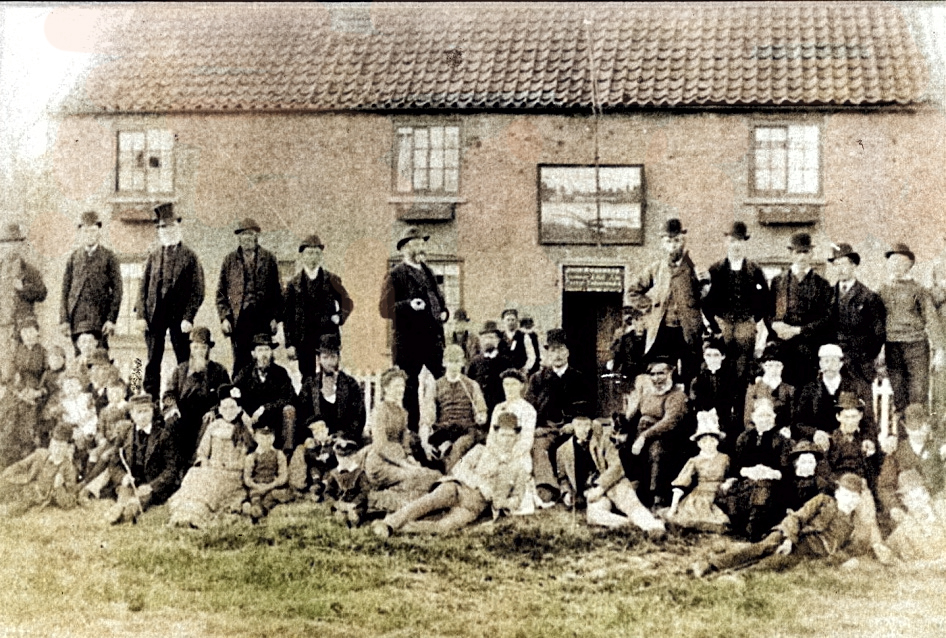
Above, villagers on the riverbank outside the Plough Inn when John Rogerson was landlord
John Rogerson died in 1914 and his wife took on the licence for a time but even in 1911 he crossed out innkeeper as his occupation and described himself just as farmer. John Shaw, known as ‘Poppy’ and his wife lived there and also ran a little shop where you could buy cigarettes etc . But by 1939 John Shaw he too was described just as farmer.
Between the Plough Inn and the mill
There were 18 houses between The Plough and the mill in the mid 19th century but, by 1851, five of them were uninhabited.
Most were probably quite small cottages, occupied by agricultural workers. There is evidence too that there was a ‘back lane’ with six cottages for poor people, often elderly widows.
In Aug 1872 the Trustees of the Saltmarshe Poors’ Land Charity, with the approval of the charity commissioners, sold the ‘Poors’ Croft containing two acres two roods 13 perches and a piece of garden ground adjoining with six cottages (four in ruins) and blacksmith’s shop thereon containing one rood 15 perches and the bank and foreshore of the River Ouse adjoining thereto to Philip Saltmarshe for £300
There are now two Victorian cottages in this area.
The Parrott family
Nearer the mill than the inn were at least three houses belonging to the Parrott family and occupied by their extended family. They were the last of the villagers in the 19th century to sell up to Philip Saltmarshe.
Many of the family were boat builders and mariners. The first of the family [the names varies between Parrott and Parratt] to live in Saltmarshe was probably Joseph. I believe he originated from across the river at Reedness and Whitgift.
In 1784 Joseph, who was then in his 30s, bought a cottage, stable and garth of one rood [quarter of an acre] at Saltmarshe from Aaron Armitage and his wife Dorothy. Joseph and his wife Elizabeth nee Taylor had at least three sons, Joseph born in 1786, Robert born in 1788 and Thomas born in 1793 and a daughter Harriet Elizabeth. Another daughter, Charlotte died aged 18 in 1801 and is commemorated on a gravestone at Laxton with her grandmother Mary Taylor who was 80 when she died in 1804.
Joseph and Mary Ann Parrott – the Rank connection
The eldest of Joseph’s sons, Joseph, married Mary Ann Borman. His children were born at Saltmarshe but by 1841 he had moved to Hull where he was a shipowner. One of his children was Mary Ann, born at Saltmarshe in 1825 and christened at Laxton.
In 1851 she married James Rank, a corn miller and their son Joseph was born on Holderness Road in Hull in 1854. Sadly, Mary Ann Rank died in 1858, having never recovered from the birth of her fourth child. Her son Joseph was only four when his mother died but apparently had very clear memories of her.
Above is a view of the Rank mill on Holderness Road in Hull
Joseph went on to found Rank Hovis McDougall, flour millers. He was educated at a small private school run by Rev Edward Cragg Haynes at Swinefleet, just along the river from Saltmarshe.
One source suggests that Mary Ann, Joseph’s mother, was a Primitive Methodist and that the whole Parrott family were among the earliest members of the Primitive Methodist Church in Hull. Her father Joseph may have been converted after hearing the unconventional preaching of William Clowes and the ‘Ranters’.
Mary Ann had a younger brother, the interestingly named Joseph Danne or Dagneau Parrott, born at Saltmarshe in 1828. He was a chemist and druggist who emigrated to Canada, briefly returned to Yorkshire before emigrating for a second time with his wife and family [eventually 12 children], this time to Iowa.
He fought in the American civil war and ran grocery and drug stores in Page, Iowa.
Robert and Ann Parrott
In 1809 Robert Parratt, Joseph’s second son, described as a waterman of Saltmarshe, married Ann Bell. Five years later his parents gave him a piece of their land on which to build a house. The relevant document explains that Joseph Parrott of Saltmarshe, a yeoman and his wife Elizabeth transferred a piece of land ‘on the west side of, and part, of the croft and premises of the said Joseph Parrott, with frontage to Town Street of eight yards two feet and depth therefrom of ten yards’ to their son Robert Parrott of Saltmarshe.
Robert built his house [exactly which one I am not sure] and his family was born in the village. In spring 1841 he and Ann were living at Saltmarshe with their younger children Hannah, Eliza and Harriet. Visiting was their daughter Charlotte, her husband Jonathan Brumby, a minister, and their children Aaron and William. Their only son Thomas, born in 1813 had emigrated to Canada.
Soon afterwards Robert sold his house and land to Philip Saltmarshe and moved to Hull where he worked for a time as a coal merchant. He emigrated in 1851 then returned. But by 1861 he and his family all emigrated to Reach, Ontario, to join son Thomas.
Jonathan and Charlotte remained in Yorkshire and Jonathan later worked as a missionary for the Port of Hull Society for the Religious Instruction of Seamen.
Thomas Parrott – ship owner
Thomas, the youngest of the three brothers was also a mariner. In 1823 he bought a cottage, outbuildings and yard from Mary Hardcastle of Saltmarshe, a widow, for £100. It may have been this Thomas Parrott who ran a market boat every fortnight from Whitgift to Hull in the 1820s.
Certainly he had a vessel which he used to bring coal and slack to Saltmarshe in 1824 for making the bricks which were used to build the hall.
1824 Maken bricks Thos Parratt, 10 waggon of coals £8 15s 17 waggons of slack £7 4s
Thomas’ father Joseph Parrott, described as a mariner on his death, died in July 1833 aged 84. Thomas Parrott inherited the cottage with stable, garth and foreshore containing one rood at Saltmarshe which his father had bought in 1784.
So he now owned two houses in the village. In 1840 Thomas, described as shipowner of Saltmarshe, aged 47 and a bachelor, married widow Harriet Ashton sister of the late William Pickard, solicitor of Wakefield and was living at Wakefield in 1841. Harriet sadly died in 1848.
In 1849, when he was 56, Thomas married a second time to Mary Jennings aged 21. Mary was from Crowle but her sister Elizabeth was married to Thomas Scruton and lived at Cotness whilst her brother William later farmed at Saltmarshe. Thomas and Mary went on to have a large family. However they did not stay in the village.
In 1859 Philip Saltmarshe bought the two houses with outbuildings garden and garth and appurtenances at Saltmarshe from Thomas Parrott gentleman and his wife Mary for £650. They moved to Hull where Thomas died in 1871.
Harriet Elizabeth Parrott married Joseph Borman in 1817. The last of the Parratt family to live in Saltmarshe was Harriet Borman. In 1851 she was living next to her brother Thomas. She died in 1866.
There was one house listed between the Parrott houses and the mill.
In 1841 and 1851 it was the home of the Allan family. Joseph Allan was an agricultural labourer and lived with his wife Elizabeth and family. They had seven children all baptised at Laxton. George Joseph b 1821 emigrated in 1845 to Illinois and son Thomas b 1833 emigrated and settled in Minnestota.
Other villagers between the Plough inn and the mill
Families came and went seemingly quickly from Saltmarshe
In 1851 James [Emanuel] Hutchcroft aged 40, a farm labourer born at Kilpin with his wife Sarah and son Samuel were living there. Sarah Hutchcroft died in 1863. James then emigrated to USA where his brother’s family lived and is buried in Yamhill cemetery Oregon USA. He died aged 80
Also there in 1851 was Richard Taylor and his wife Ann. He was a coal merchant. Their first child, Mary was born in the village but they later moved to Hull where Richard worked on a steamboat.
By 1861 there were 19 houses listed between the inn and the mill .
Saltmarshe now has a tailor. He was William Brown, from Blacktoft. But there was no living to be made and by 1871 William was working in Darfield.
Another interesting villager was Irishman John O’Brien, 66, M, a Chelsea Pensioner (who had served as a private in 6th dragoons), with wife Fanny and son Richard who was a gardener. Richard probably worked at the hall but by 1871 this family were living at Tadcaster.
In 1871 there were 13 houses between the Plough Inn and the Mill.
New this time is a blacksmith. William Fenwick was from Whitgift where his father was a blacksmith. He was still working in 1881 but by 1891 was retired but still living in Saltmarshe
In 1881 there were ten houses between Plough and the mill including William Buller a butcher. This is the first mention of a butcher. He was originally from Sandholme but previously had been a butcher in Manchester. By 1891 he was a farmer at Kilpin
1891 Matthew Wake appears as joiner and wheelwright from Carlton in Cleveland. He did not stay long and returned to Carlton in Cleveland within five years where he was a joiner and innkeeper.
1901 In 1901 the most unusual resident was Mrs Mary Penney who was 46 and had a servant. She was living in a house next to The Plough. She may have been having a ‘rest cure’ at Saltmarshe as her husband, Mulgrave Daniel o’Connell Penney, an analytical chemist and inventor was with their children in Hull. She died in Hull in1907
In 1901 there was a butcher again, Walter Ford, in Saltmarshe.
The number of houses shrank until in 1911 there were seven private houses between the Plough Inn and the Mill House.
In order from The Plough –
John Bonney a retired screw maker, from Birmingham aged 78.
Leonard and Jane Wainman, with boarders John Ambler Shaw [estate joiner and wheelwright] and Albert Langstaff [estate joiner]. Leonard was a gardener. House had four rooms.
Joseph Anson, labourer and wife Mary and seven of their nine children, House of seven rooms
John, labourer, and Rose Scruton
George , labourer and Jane Sweeting
Fred Armitage shipping clerk and wife and five children. All children born at Goole .House had seven rooms
Henry Fenwick, labourer, wife and son
Beyond the last house, on the edge of the field leading to the mill house was the
‘Postman’s Hut’
This was listed on the 1911 census. Wilf Campbell, son of Arthur Campbell the estate joiner, who was born in Saltmarshe said,
The postman came from Howden. The end of his round was the east end of Saltmarshe and he had a small hut in the edge of the field [now next to Mrs Precious’ house]. He had a small stove in there and did cobbling during the day, returning to Howden with letters in the evening.
The Mill
Saltmarshe Mill stood at the extreme east end of the village, and is now no longer in existence, although the mill mound is still visible.
There is mention of a mill at Saltmarshe is in a 1548 inquisition of the property of Edward Saltmarshe, which recorded “in Saltmarshe … one windmill, lately in the tenancy of William Jackson, miller”.
But by the eighteenth century the mill in the village was not owned by the Saltmarshe family. Various millers are listed. Jacob Maslin, who later moved to Eastrington and became a wealthy farmer was there in the 1760s.
It changed hands in 1773 when Robert Thompson became the miller.
In 1798 the Saltmarshe family bought the mill and thereafter the millers were Saltmarshe tenants.
Mrs Elizabeth Saltmarshe who was then helping her 20 year old son [Philip was born in 1780 but was only 11 when his father died] run the estate wrote in 1800
Memorandum “Agree with the milller about having the mill coloured – he to find labour and to pay his rent when it becomes due; we materials and for our tenants to employ the miller.”
The millers for much of the early nineteenth century were the Carlile family. William was there in 1800 and in 1810 paid £34 pa as rent for the mill , cottage and adjoining field. In 1828 he married Mary Bell from a local milling family. He died in 1841 but Mary remained in the village as a pauper labourer.
In 1841 the miller was Cornelius Thompson and in 1851 James Sharp. By 1861 the miller was Henry Walmsley. He remained as miller until 1882. He had previously been landlord at a pub in Kilpin Pike.
In 1866 he was listed as having a windmill and croft and cottage, shed and and four acres of arable in the Groves.
The Groves is mentioned in Philip Saltmarshe’s book which he wrote in 1910.
He wrote “My father [born 1825. inherited in 1846 on his father’s death] built Pratt’s present house.”
“The Groves [now Pratt’s field], in ancient days was common land. My grandfather strengthened the flood bank and ploughed it up. This caused dissatisfaction among the villagers who has pastured cattle on it from time immemorial. The mill and small farm adjoining was held by the Carliles until about the middle of the century.
Henry Walmsley moved to near Grimsby and the new miller by 1881 was Urias Pratt.who had previously been head keeper on the Saltmarshe estate and living in Keeper’s Cottage just across the field from the mill.
Mr Pratt gave up grinding corn in the 1890s and mill was blown down around 1900 but its remains still existed in the 1920s. Evidence points to its being a post mill.
Golden Wedding
There is a wonderful report of the golden wedding of Mr and Mrs Pratt which appeared in the Howdenshire Gazette of June 12th 1914:
Mr and Mrs Urias Pratt of Saltmarshe have just celebrated their golden wedding. Though not natives of this district they have resided in it for a very long period. Mr Pratt is a native of Norfolk while Mrs Pratt, whose maiden name was Fanny Nash, was born in Litchfield, Staffs. They are an aged couple. Mrs Pratt will be 81 next October and Mr Pratt will be 77 in September and both are in receipt of old age pensions which is a great boon to them and they are spending the eventide of their lives in a comfortable cottage on the side of the long ribbon of road which winds along the bank of the River Ouse. It stands alone at the eastern extremity of the village, picturesque with its front overgrown with roses, clematis and honeysuckle. To the rear are farm buildings, Mr Pratt farming about 12 acres of land, being a tenant of Colonel Saltmarshe.
It is just over 50 years since Mr Pratt secured the appointment of head gamekeeper to the late Colonel Saltmarshe and two months later Mr and Mrs Pratt were married at Stockport Old Church. The golden wedding was celebrated in a quiet manner at their little cottage, only a few immediate relatives being present.The aged couple are not enjoying the best of health – Mrs Pratt having been confined to bed with inflamation of the eyes and although going about the house she is not quite better. Her husband has suffered with rupture for some years. He was head gamekeeper to the late Col. Saltmarshe for nine years and when his health began to fail the late Colonel let him have the little house he now occupies which stands on the site where once existed the old Saltmarshe Mill.
Mr and Mrs Pratt are the oldest tenants on the estate. Formerly Mr Pratt was head gamekeeper to the marquis of Exeter and also to Sir John Thorold of Syston Park near Grantham. When he came to Saltmarshe she says there were only four or five children in the whole village whereas now there are about 40. The village has undergone many changes.
When he and his wife arrived there was no railway as now through the village, the nearest stations being Goole [L&Y], Staddlethorpe and Howden. Most of the produce required in the village was brought by boat on the Ouse and landed at a little jetty opposite the Plough Inn, not far from the house where the old couple now reside. The produce from the farms was mostly taken away in this manner too, though some was taken to and brought from Howden. Both recalled the days when coal was brought by boat and landed at Saltmarshe at 10s a ton while now Mrs Pratt regretfully said they had to pay 21 and 22s for a ton for coal.
Both have vivid recollections of the time when the line of the railway was extended from Staddlethorpe through Saltmarshe to Goole and Thorne. Col Saltmarshe generously gave the requisite land to the railway company. When the station was erected Mrs Pratt recalls that it was first named Laxton after the village but it was soon altered to its present name out of compliment to the donor of the land. The Colonel, she said, would have preferred the station named Laxton but the name has not been altered.
It was a great day in the history of the village when the station was opened to the public one August morning and Mr and Mrs Pratt were among the first of the passengers to travel on the new piece of line. This is over 40 years ago.The navvies employed in the construction of the railway were a source of worry to Mr Pratt. The navvy is often a born poacher and seeing the district in which they laboured abounded with game it was a little too much to ask to expect that they would refrain from taking hares rabbits etc. Although they increased the vigilance of Mr Pratt he never had open disagreement with them.
Indeed, through his long period as gamekeeper, he says he has never been in any trouble with poachers although he has been in places, especially Suffolk, and the South where there were rough customers. In his early days the taking of game was a great offence almost as much as one’s life was worth, he said, but since then the game laws have been altered and they are nothing like so severe now.
Mr Pratt is a well preserved man and excepting the complaint referred to is hale and hearty with colour in his face. He is in possesession of all his faculties and can yet see to read the newspapers without the aid of glasses. He is fond of his pipe but says he might as well be teetotal for the little alcoholic drink he takes.Mrs Pratt is also very active for her age. The mention of newspapers by her husband led her to talk of present day dresses and fashions for ladies. She has illustrated papers sent to her and therefore has opportunity of noting latest fashions. She got a paper and opened it showing photographs of ladies in lovely dresses. “I call those silly,” she said significantly, “they cannot nowadays walk properly owing to the tight skirts,” and she went on to talk of the advantages of the crinoline which of course she wore in the days of long ago. “What changes there have been since I was a young woman,” she went on. “They say the world moves slowly but my opinion is we are going too fast.”
This happy old couple are of another generation out of time with the present one and the things that are taking place now are strange to them. Both can well remember having to travel on the railway in compartments open to the sky with the dust from the road and the smoke and grime from the railway engine besmearing them as they went along. “And how cold it was too,” said Mrs Pratt and she related travelling from London to Southampton one hot June day when she was almost frozen by being rushed through the air in one of those open carriages. “They called them carriages,” chimed in Mr Pratt, “but they were not near so good or comfortable as the present railway trucks are.”
The couple spoke in terms of high praise of the goodness of the late Col Saltmarshe and also of the present Colonel both of whom had been great friends to them. The present owner of the estate was a little boy when they first came to reside on the estate and three other children of the late Col. Saltmarshe were born after they went to Saltmarshe.
Occupying the same home as the old couple is one of their two sons (who manages the farm), his wife and two children. The other son, also married, is employed on the Metropolitan Railway near Aylesbury but he and his family did not attend the quiet celebration of the golden wedding day.
Both Mr and Mrs Pratt are members of Laxton church though they seldom attend as the distance is too far for them to walk. It is to be hoped Mr and Mrs Pratt may continue for many years to enjoy the quiet of their pleasant rural home.”