Skelton houses and people
This page contains information using censuses and memories of Skelton, about the houses and their occupants. So we begin with the Jolly Sailor public house, now closed
Jolly Sailor
The Jolly Sailor at Skelton, now a private house was originally known as The Lamb and the landlady in 1822 was Mary Hall.
By 1825 Robert Butttle was landlord of The Lamb but by the following year he had changed the name to the Jolly Sailor.
1851 William Garlick victualler born Spaldington
1861 George Drury publican and coal merchant born Laxton
Then came the Hutton family who were there until the 1920s
The Hutton family
Abraham John Thomas Hutton married Tamar Fowler nee Buttle in 1871. Tamar’s husband Abraham, a shoemaker in Hemingbrough had died the previous year leaving her a widow with a young family. Abraham and Tamar moved to the Jolly Sailor soon after and their son John William, [Jack] was born 1873. He went on to attend Howden Grammar school
His father died in 1895.
It is said by his great grandson that he ‘died of exposure following a prolonged thunderstorm during which he fatefully took shelter inside the hollow of Elm Tree near Howdendyke’
Tamar took over as landlady. Later that same year John William married Mary Alice Coleman at Airmyn church. The couple celebrated their 60th wedding anniversary in 1955 and were then living in Sanders View in Skelton, almost next door to the Jolly Sailor. But they had not always lived there as this extract from the diamond wedding report explains
Mr Hutton was born at the Jolly Sailor, Skelton, and began work at the age of 15 with the Mr Joseph Glew, Goole furniture dealer as an upholsterer and polisher. He then became a journeyman, working at Scarborough and Nottingham before returning to Goole to continue his trade with Messrs Millard and Eastham.
During the First World War he saw active service in France with the Royal Engineers. On returning to England he set up his own upholstery and polishing business, a business which he kept up until the outbreak of the Second World War in 1939. He then went to work at Goole shipyard until an accident caused his retirement a few years later.
Mr Hutton is the oldest freemason in the district, having been a member of St Cuthbert’s lodge for 52 years. His fellow freemasons recently presented him with a gift to mark his diamond wedding anniversary.
Mrs Hutton who is 78 is a native of Manchester and worked as a dress maker for Miss Precious in Jefferson Street Goole.
Immediately after their marriage Mr and Mrs Hutton lived in Parliament Street Goole before moving to Skelton and then returning to Goole – a move which they carried out a number of times. For many years they lived in Jackson Street.
While living in Goole both Mr and Mrs Hutton were regular attenders at St Paul’s Church and the Parish Church, Mr Hutton recalls that for several weeks in 1891 he walked from Skelton to Hook across the frozen river Ouse. He also recalls helping the wounded in North Street after the bombing raid on Goole in the First World War.
Mr and Mrs Hutton who both enjoy good health have four sons, three daughters, 14 grandchildren, and fifteen great grandchildren.
When they were living in Goole the Huttons with their seven children visited Tamar regularly crossing the river on the Howdendyke ferry. She died in 1923 and left £2000. Probate was to her sons George Fowler publican and John William Hutton upholsterer.
Nb George Fowler’s daughter Muriel married Lawrence Fox, later blacksmith at Laxton
Later the landlord was Horace Prince window cleaner and sweep
Shipyard
Next to the Jolly Sailor was for many years a small shipyard. It probably built its last ship before the First World war but older people can still remember metal rails in what was the pub car park which are said to have gone across the road.
Industry
In the early 1800s the river frontage at Howdendyke was a flourishing semi industrial community with ferry, staithes, tannery, sail lofts, warehousing, a steam corn mill and in the early 1800s possibly three small shipbuilding yards. Between Howdendyke and Skelton was a tongue of land which had river frontage called Kilpin Pike.
There was a shipyard was just over the boundary at Skelton. It was owned by Richard Mann in the 1790s then by Richard Ward. Ward, a Victorian entrepreneur, eventually owned much of the Howdendyke and Kilpin Pike river frontage and at his Skelton shipyard built 18 ships between 1800 and 1852. He lived in a large house fronting onto the staithe at Kilpin Pike where he had a coal yard.
He died in 1852 aged 71. He left two sons Westoby and John. Westoby died in 1859 described as shipowner and merchant. His son, Richard Blanchard Ward became a locomotive engineer and spent time in India.
Meanwhile the Skelton shipyard was sold to John Banks. He lived in Howden Hall and not only had ships built at his yard but commissioned others from other yards to add to his fleet of 18 ships trading from Howdendyke.
Thomas Chester
One of his workers was local man John Chester, a ship’s carpenter. John’s son Thomas briefly had his own shipyard at Skelton although it is not possibly to say exactly where.
However it did not last long as in 1870 the following sale notice appeared
To be sold by auction, by Mr William Woad, at the Half-Moon Inn, Howden on Thursday, May 12th, 187O, all that Piece of Land, situate in the Townships of Kilpin and Skelton, and in the occupation of Mr Thomas Chester, and used him a Shipbuilder’s Yard, containing by estimation 2 roods. 30 perches. And all those Two Cottages being near to the North East Corner thereof and in the respective occupations of Ann Chester and Mary Proctor.
Also all that newly-built dwelling house recently erected thereupon and occupied by the said Thomas Chester. And all that Slip being upon the Foreshore of the River Ouse, and upon the said Plot of Land, recently constructed by the said Thomas Chester and used by him in his said trade for the purpose of repairing Vessels. The premises are of Freehold Tenure, in good repair. And especially adapted for the carrying on of the trade of Ship Builder.
The Chester family moved to Goole but soon returned to Skelton where Thomas and his son Reuben worked as ships’ carpenters.
Reuben Chester, golden wedding report
1905
Golden Wedding at Skelton. On Christmas Day, 1854, at Howden Church, Mr Reuben Chester, of Skelton, was married to Miss Mary Taylor, of Hessle, by the late Rev W. Hutchinson. The couple celebrated their golden wedding Sunday last at Skelton, where their 50 years of married life have been spent. Mr Chester was a ship’s carpenter, having been apprenticed to his father at the age 14. There are three sons, two daughters, and nine grandchildren living. One daughter is the wife Mr H. Fitch, of Howden, whilst the, other married Mr Tom Craven, now mate in charge of the Primrose, Customs’ launch at Hull. Mr Chester’s eldest son is also a Customs officer in Hull. The youngest son was one of the Howden volunteers who went to the front during the late South African War.
Mrs Chester died in 1909
Dec 1912 Hull Mail
That despite his 80 years, Mr Reuben Chester, Skelton, paid his annual visit the fat stock market. . . That he has held many positions during his 60 years’ membership of the P.M. Church, rnciuding the Superintendentehip of the Sunday School, treasurer to the trustees, and is still a steward of his church. That for many years he walked to Howden thrice each Sunday—morning (Sunday School), afternoon, and evening—and still docs the journey twice each Sunday. That he was a member of the old P.M. Chapel connection with which he relates many interesting stories, and took the keenest interest in the erection of the new church, of which he is still an ardent, worker.
William Caisley
John Banks died in 1879 and by 1881 the new owner of the shipyard was William Caisley originally from Newcastle. He had married Mary Hope at Howden in 1860 whose father Thomas was a waterman from Selby. The Hope family were living in Skelton in 1861 and Mary Caisley was living there with her mother Ann who ran a small grocer’s shop. Both William and Thomas were away from home.
From the memories of Mr Durham whose memories are elsewhere on the website
The Jolly Sailor Inn at Skelton, owned by Mr Hutton in the early days, had a jetty in front of it, old and battered, with a willow tree hanging over the stern of an old schooner by the name of May Flower. The forward bowsprit had a lovely painted figure of a lady. This boat was laid there years and in the end it was towed to Hull or Goole, but it belonged to a man called Hope Caisley. He lived in the end house of the row of cottages. This man had a long beard and always wore a captain’s cap. I was told his parents [William Caisley and Mary Hope] were the owners of the sailing ship repair yard that existed next to the Jolly Sailor Inn. I would love to know if the figure of a lady at the side of Plymouth Dockyard is the same one belonging to the May Flower.
Ships built at Caisley’s yard
1881 Polyhymnia, ketch 73 tons, October 1881 registered Hull
May 1883 Elite, schooner, 118 tons built at a cost of £3,000 for the Newfoundland trade in 1883. Elite was discovered November 18th 1897 mid Atlantic, on route Cadiz for St. John’s, Newfoundland with a cargo of salt. The crew were starving and after being rescued by the ‘Rossmore’ the Elite was abandoned and the crew landed at New York.
1884 Proserpine, ketch, 87 tons, October 1884 registered Hull
1884 Thalia, ketch 80 tons, February 1884 registered Hull
1885 Parthenon, ketch, 90 tons registered Hull
1886 Metis, ketch, 90 tons, July 1886 registered Hull
1887 Iris, ketch. 91 tons, February 1887 registered Hull, owned by John Holmes, Hull
1887 Egeria, ketch, 92 tons, September 1887 registered Hull
January 1889 Maud Mary, English oak 90 x 21 x 9 ft, 77 tons, February 1889 registered Goole. Was owned by George Herbert Anderton, Howden and christened by Miss Maud Mary Anderton, Mr Anderton’s daughter.
??June 1889 -Mary Isabel oak sloop rigged keel, 60 x 16 x 7 ft, to carry 120 tons, launched by Mr. Ezra Gooderidge for river and canal trade.
1891 George Kilner top sail schooner 124 tons for George Kilner, Thornhill Lees, Dewsbury.
1893 Golden Wedding. Largest vessel built at the yard and made of British oak and copper bottomed.
May 1893
On Saturday morning there was launched from the shipyard of Mr. William Caisley. Howden Dyke, a first-class sailing vessel, to the order of Mr. G. Kilner, of Thornhill Lees, near Dewsbury. She is the largest vessel that has been built at Howden Dyke by these contractors. She is built of British oak and is copper- bottomed. Miss Annie Kilner, daughter of a Mr. Caleb Kilner. and a granddaughter of the owner, christened the vessel Golden Wedding, a name rendered appropriate by the fact that Mr. and Mrs. Kilner had enjoyed married life for fifty years up to October last.
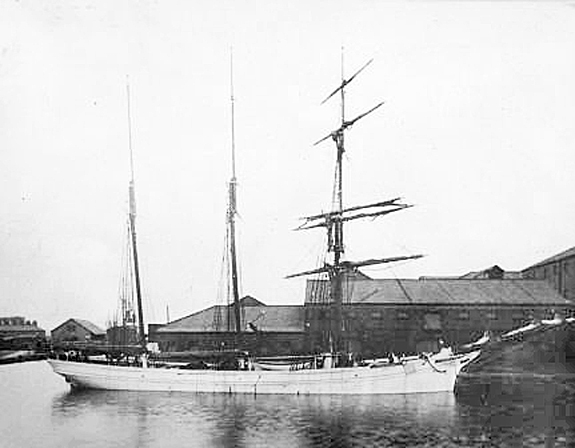
Above is the Golden Wedding in Goole docks.
She was wrecked off Chiltapee, Mexico in 1907
May 1896 Hydro, oak sloop 51 tons, will carry 120 tons, registered Goole, owned by George Herbert Anderton of the Ouse Chemical Works, Howden.
1901 – Beatrice, brigantine, 99 tons registered Goole.
Mr Caisley retired in 1902 and sold his tools etc to Mr Scarr who began his own shipyard at Howdendyke.
William Caisley died 1920 and wife Mary in 1930.
Sanders View
It is difficult to work out exactly where the houses were in this area. Officially the Kilpin Skelton boundary was the Belby Goit or drain which is still in use today and marked by the hump backed bridge over it. But it seems likely that there were some houses and warehouses on the back lane which linked with Jenny Hudscroft lane.
Next to the shipyard was a row of houses. In 1871 they were described as being ‘in the shipyard’ . They are now demolished and have been replaced. In living memory Dick Abbey lived in one of these old houses .
The Abbey family were in Skelton in 1871 next to the inn. David Abbey, born 1836, was a sloop owner in 1891.
The cottages are now called Sanders View as they were in 1939. The name perhaps comes from the fact that the vessels loaded sand from the sandbanks in the river.
There is now a gap of a field and then
Jenny Hudscroft Staith and Lane
I have not found a Jenny or a Jinny but I did notice that when looking at the will of Thomas Leighton in the early nineteenth century – see Riverside Farm – he left ‘the cottage where John Hutchcroft lives with the outhouse used for dressing line’ but subject to a right by foot for the use by occupiers of other houses nearby that Thomas owned. So could the lane be named for Johnny Hutchcroft?
Next to the lane are two cottages called Crow Trees.
Crow Trees
In front of the two semi detached houses is a staith.
First house
In 1861 James Jackson , farmer and coal merchant aged 43 from Amcotts was living there in the first house with his wife Mary aged 39 . He probably had coal delivered to the staith.
There was a scandal in August 1867 when Mary eloped with a young navvy who was lodging with them. The case made all the national newspapers.
It was reported as follows:
At the magistrates meeting held in the Town Hall, Howden, on Saturday, William Teare, a 24 year old navvy, lately residing at Skelton, near Howden, was charged before Mr. Thomas Clarke and Mr. E. W. Clarke, with felony. The prisoner, who was employed on the Hull and Doncaster Railway, had lodged with James Jackson, at Skelton for 18 months. On the 23rd August, Jackson stated he went into the harvest field at breakfast time, and when he came home again to dinner, found his house shut up and his wife and Teare missing, and on further examination found they had decamped, taking with them upwards of £160 money (which had been kept in a bag under the bed), a ham, a tapestry carpet, a bed, sheets and blankets, and other articles. He went to Hull to try to find them out, but was unsuccessful, and afterwards put the matter into the hands of the police.
Witnesses from Saltmarshe were examined and deposed to seeing Teare with Jackson’s wife on the day named at Saltmarshe Ferry, where they went on board the Hull steamer, and Police-constable Marshall, of the Hull force, observed them leaving the steamer together at Hull with two hampers and a bundle, which the prisoner carried on board one of the New Holland boats.
Superintendent Green stated that from information he had received he went to Liverpool in search of the fugitives, but getting no clue of them there, proceeded to Newark, where he ascertained they had stayed for three nights. He next went to Lincoln and apprehended them there a small cottage they had taken for a short time, and in which they were, living together as man and wife.
He read over his warrant to Teare, who said he had had not taken the things. On searching them he found only 6d. on Teare and £5 8s. 10d. on Mrs. Jackson. In the house he found the articles enumerated above, all of which were identified as his property by Jackson, and in a canvas bag inside leather bag £145 in gold, and £1 in silver. He brought the prisoner and the woman to Howden on Saturday last.
Mr. Clarke, the presiding magistrate, having asked the prisoner what he had to say in reply to the charge, he said he had not taken the things, and was not guilty, though he did not deny being with the woman. The prisoner was committed for trial to the next quarter sessions at Beverley. Jackson has been married to his wife for twenty-five years.
When the case came to court in October William Teare was sentenced to six weeks in prison. Apparently James Jackson had bailed his wife and taken her home but thereafter she disappears from records.
In 1870 James remarried to Jane Bow[e]s aged 21. Their daughter Emma was born there in 1870. They moved nearer the Jolly Sailor but in 1880 James died. Jane remarried to John White Johnson, a waterman. In 1891 they were living in a four roomed cottage with four Jackson children and three Johnson children. It must have been very crowded.
In 1891 the first Crow Trees house was occupied by Mary Haslewood
In 1911 it was occupied by T W Johnson aged 55, a sand dredger
In 1939 by Elizabeth Fowler
Second house
1861 John Horsley blacksmith
1891 Thomas Johnson wife Susannah born Hook with mother in law Mary Jackson born Hook
in 1911 Henry Jackson 76 pensioned engine man [ railway] 5 rooms. Sister Susan Johnson
In 1939 Leyssens family
Belgian refugees
Living at Crowtrees in 1939 was Romain de Leender [although he was then working away], his wife Annie and his brother and his wife, also Annie. Romain was a Belgian refugee who had come to England in the First World War with his family. There was a Howden and District Belgian refugees society and in May 1915 a shoemaker’s family from Louvain came to live on the Sandhall estate. They had arrived in England on 20th September 1914 and were Flemish speakers
They were Victor Roch Leyssens, aged 38 and his wife Victoria?Reimer Marie also aged 38. With them were 16 year old Leonie de Leender and 13 year old Romain de Leender, described as Victor’s stepchildren and his children 7 year old Francis Leyssens, 5 year old Angelina Leyssens and 3 year old Shan Leyssens.
Another son George Charles was born in 1915 in England.
The family settled into the local community.
Leonie married George Brown of Howdendyke in 1916
Romain married Annie Sweeting in 1931 at Howden Roman Catholic church.
Angelina married John Jackson also in 1931
Francis married Lucy Jackson in 1932 died 1938
Shan married George Lee in 1932
1944 Maria Victoria Leyssen died [
Chapel
On 4th October 1841 Robert Hairsine [ see next entry, Chapel house] made a deed of covenant with J Wetherell, representing the local Methodists, giving them a plot in the corner of his garden on which to build a chapel.
Skelton chapel was opened in January 1842.
1861 SKELTON CHAPEL Monday last, the above anniversary was celebrated in the Wesleyan Chap!, Skelton, when tea was provided for the school children at four o’clock, and for the friends at five. After tea, a variety of pieces were sung and recited by the children alternately with addresses by the Rev. J. H. Reay and Messrs J. H. Clews, James Smith, aid W. E. Miller. The following presided at the :-Mrs Hairsine, Mrs Chester, sen., Mrs Chester, jun., and Mrs Everitt. The various speakers, gave great satisfaction, the introductory address of Mr Clews being particularly admired.
1878
SKELTON. Anniversary.—On Sunday, June 9th, the Wesleyans held their annual anniversary in the infants’ school (kindly lent by the Misses Scholfield, Sandhall). The services were conducted by Mr. S. Smith, of Howden. On Whit-Monday a childrens’ tea was provided in the chapel, after which a public meeting was held. Addresses were delivered by Mr. Armitage (Hook), Mr. Day, and Mr. R. Hew (Howden) ; recitations were also given by the scholars. Mr. John Haw, Howden, presided at the harmonium.
Records cease 1934
Sold 1960
Chapel House
Chapel house is on the Skelton enclosure map of 1815 and is shown as being owned by Robert Taylor.
It was then occupied by an elderly couple John and Anne Hairsine who both died at Skelton in 1833. Their gravestone is in Howden churchyard.
John’s brother Edward was a farmer who lived at Bursea near Holme on Spalding Moor. He and his wife had a large family, including a son Robert who was born in 1806.
On 18th October 1831 Robert married Elizabeth Bramley at Market Weighton. Their daughter Maria was born in 1834 at Skelton. Robert was described as a labourer at her baptism. Probably Robert and Elizabeth had moved into the cottage after the death of Robert’s uncle and aunt.
At some point after moving in Robert apparently built or rebuilt the cottage, according to the deeds.
Property described as messuage [built by Robert Hairsine upon the site of an ancient cottage together with yard, stable, outbuildings, garden and orchard together with 2 several crofts of land adjoining each other behind and adjoining the said messuage and premises containing, together with the site of the said messuage garden and orchard but exclusive of the foreshore, 3 acres and 26 perches more or less.
In the 1841 census Robert and Elizabeth are living with their three daughters in the house. Robert is listed as a farmer.
In 1851 Robert was described as a ‘proprietor of land’. He was shown with his wife Elizabeth and children Hannah 13, Thomas 10, Eliza 7 and Edwin 5. Eldest daughter Mary Ann was a nursemaid near York and second daughter Maria was working as a kitchen maid at the refreshment rooms on York statio
Robert was charged with game trespass in a case reported in March 1855 in the magistrates’ court in Howden. Notice that the magistrates included Mr Scholfield who owned much of the land in Skelton
On Saturday last, before Thomas Clark and P. Scholfield, Esqrs.
Mr. Robert Hairsine of Skelton, near Howden, was charged by Thomas Tay, gamekeeper to Phillip Saltmarshe, Esq., with trespassing in pursuit of game on Saturday, the 17th of February last.
The case excited a great deal of interest to a crowded court, as the real point was whether a copyholder of the township of Skelton, having a game certificate, had the power to search for game in a place called Skelton Broad-lane, over which the defendant, along with all the copyholders of Skelton, had a right of common.
It was urged, on the part of the complainant, that although the defendant had a right of common, and the lane in question was a public way, yet he had no right to be there in search of game, and his being there constituted him a trespasser under the 10th section of the Game Act.
Mr Greaves, of Hull, who appeared for the defendant, argued that the defendant had a perfect right to be on the land in question, and that as he was summoned under the 30th section of the Game Act the complainant must firstly prove the trespass, and not only that but the trespass in search of game, and that the 10th section had merely reference to whether owners of cattle-gate and rights of common, if without a certificate, could pursue and kill game.
The summons was heard against Mr Hairsine for a trespass, at the same time, in a lane leading from Skelton Broad-lane. The principle involved was the same in each case. Magistrates, after consulting some time, decided that the defendant had been guilty of trespass in pursuit of game, and in each case fined him 40s. Mr Greaves, on behalf of defendant, gave notice of appeal.
By 1861 Robert was described as a shopkeeper as well as an occupier of land. This is the first mention of a shop and would probably be run from one of the rooms fronting the road.
The chapel was now in regular use – from various sources it is clear that the Hairsine family were devoted Methodists.
The Hairsine children
The Hairsines had eight children, although only six survived to adulthood.
Maria Hairsine married George Russell, a draper in Micklegate York in 1855. She had three children.
Mary Ann Hairsine married Henry Pears in June 1862 . Her father Robert Hairsine was described as a gardener on the marriage record.
Hannah Bramley Hairsine in 1863 married Richard Gibson Fisher, a draper and tailor of Market Place, Hornsea.
Also in 1863 Eliza Hairsine married John Lott in the Wesleyan chapel in Hull.
Interestingly when John and Eliza celebrated their diamond wedding in 1923 a newspaper report included the information that
Mr Lott was the only member of a family but his wife was the youngest of eight children belonging to the late and Mrs Robert Hairsine. Her only surviving brother is Mr Edwin Hairsine, who is living in retirement at Eastrington. Her father gave a corner of his garden for the erection of a Wesleyan Chapel at Skelton and the building is there to-day. Mrs Lott’s mother died shortly after breaking her thigh, at 83 years of age, while her grandfather who was a Methodist, lived to 95.
Son Thomas Hairsine married Ann Allan in Hull in 1864. He was a wheelwright.
And lastly in 1870 Edwin Hairsine married Hannah Scruton formerly of Clough Farm Skelton.
So by 1871 then all the children had left home. Robert Hairsine was then in his mid sixties and described as grocer and farmer of 3 acres.
Robert died on 6th February 1880 at Eastrington where his son Edwin, a butcher, lived and his memorial stone, which also commemorates his wife Elizabeth, is there.
By spring 1881 his widow Elizabeth is living in Laxton with her other son Thomas, a wheelwright. She was described as an annuitant.
Chapel House was then occupied by Robert and Elizabeth Scruton, a retired farmer and wife and Agnes Hall aged 13 and described as a servant. They are son Edwin’s parents in law.
Thereafter Chapel House was still owned by the Hairsine family but rented out. Thomas Hairsine died in 1883 shortly after the birth of his youngest child. His mother, as mentioned above, died in 1885 and the Laxton branch of the family then emigrated to USA where Thomas’ widow died in Kansas in 1900.
In 1891 James Ward Jackson a wheelwright originally from Goole is living in Chapel House. He had been there since the mid 1880s.
James moved to another house in Skelton and by 1901 John Scarrow, a machine minder at a stone mill, born Chippenham, was renting Chapel House.
Reuben Parker
By 1911 Reuben Parker and his family had moved in. The house was described as having seven rooms. Reuben was a 65 year old basket maker and his descendants [the Claydon family] still live in the village. He had moved all around the country as a basket maker but most recently he had been living at Yokefleet Mill.
He rented an osier bed from the Scholfield family at Sandhall.
I found an advert in the Yorkshire Post in 1930 for his baskets
HAMPERS. 2 bushels 5s. each; Potato Baskets and Hampers, six also eight stone; wholesale or retail. Parker, Basket Manufacturer. Skelton. Howden. Yorks. Tel. Howden 40.
He had seven children including his son Herbert, also a basket maker. Reuben Parker died in December 1931.
His daughter Louisa had married James Claydon in 1907. Later one of their sons, Henry who had lost a leg, lived further along the village and also made baskets. They also kept a shop. Mrs Claydon snr died in 1966.
In January 1931 Edwin Hairsine, owner of Chapel House died. He had made his will in 1923 and the reference there to the property is as follows.
Messuage [built by Robert Hairsine upon the site of an ancient cottage together with yard, stable, outbuildings, garden and orchard together with two crofts of land adjoining each other behind and adjoining the said messuage and premises containing, together with the site of the said messuage, garden and orchard, but exclusive of the foreshore 3 acres and 26 perches more or less which said messuage, tenement, crofts, hereditaments and premises are occupied by Herbert Parker and as a whole are bounded by land belonging to the devisees of Mary Robinson, deceased on the east; by the River Ouse on the west; by hereditaments formerly the property of Thomas Copley but now of [ blank] on the south; and in part by a piece of land belonging to the Trustees of the Wesleyan Chapel; and in other part by property of Edward Paget Scholfield on or towards the north.
The whole property was left in trust to Robert Edwin Hairsine, Edwin’s son and Charles Henry Cherry, his son in law.
The Parkers moved out and by 1939 “Chapel house” [ as it was described for the first time] was occupied by Norman Sanderson and his wife Dora. He was listed as a market gardener on own account.
In 1953 Robert Edwin Hairsine of Market Weighton died . His son Charles Edwin and son in law Edwin Featherby Sawyer were executors and trustees. In 1956 Charles Edwin Hairsine died
In 1958 Edwin Featherby Sawyer sold the property to John Thomas Jackson of 13 Pinfold Street Howden, labourer and wife Angelina Jackson for £860. He is remembered as Johnny Jackson and was, I think, a painter and decorator. His wife was formerly Leyssens.
The Jacksons ? had bought the old chapel from the Methodist trustees ? sold the the old chapel with some land in 1975 to the Priestleys and sold the Chapel house to Gerald and Janet Guest.
Field house
1891 Jane Coulthard, widow of John and her son Isaac. Also her grandson John. She died in 1899.
1901 Isaac Coulthard ag lab. aged 60. Only occupant
1906 Isaac married Hannah Habblett, widow of George and became stepfather of Arthur William and Harold.
1911 census Isaac Coulthard 70 stoker at chemical works [ form filled in by son Arthur Habblett]. Isaac died in 1914.
1939 Lawrence Fox blacksmith
Broad Lane
Next is the lane leading towards Laxton and the important drain which has recently [ 2021] been repaired.
A newspaper report from July 1906 refers to a court case
Petty Sessions. —Before R S. Scholfield (in the chair), Colonel Saltmarshe, Mr Mr W. Hutchinson.
Four boys, Thomas Abbey, Walter Sweeting, Havelock Caisley, and Ernest Nutbrown, were summoned for damaging the Skelton Clough, the property of the Trustees of Bishopsoil Bridge.—P.C. Charlton (Skelton) and Mr Hanson, who was working down the drain, stated the boys’ object, which was to stop the doors by throwing bricks and stones, had succeeded, with the result that the back land had been flooded.—The Chairman, in admonishing the boys, said they had been guilty of doing great injury to the crops behind. They would have to pay the costs, and come up to receive judgment in six months if called upon.
Two cottages on the Clough side
There appear to be have been several small cottages on the corner of the lane, sometimes known as Clough Corner.
Two new cottages were built 1873 according to a Scholfield notebook
In 1891 there were four houses listed in that area with between 2 and 4 rooms each
But by 1901
George and Hannah Hablett lived in one cottage. George was a platelayer
George died in 1904 and, as above, Hannah married Isaac Coulthard.
A police constable, George Chambers, lived in the other cottage
In 1911 Isaac and Hannah and Arthur were the only occupants in Broad Lane cottage.
In 1939 Broad Lane cottages Ernest Leighton, wife Elsie and family were in one and. William Anson Hablett and wife Ethel in the other.
Ernest Leighton was born and grew up in Barmby. He served in the army and married Elsie Allot in 1921.
Clough Farm
Owned by Sotheron family. Rented 1808 to John Scruton. He was already there in 1799
Parties: 1) Frank Sotheron, Hook, esquire 2) John Scruton, Skelton, farmer Property: farmhouse, barn, stables and outbuildings and lands containing 52 acres at Skelton Consideration: £235 per year Witness: Henry Peirson
John was from a long established Sandholme family. His son Robert was born at Skelton in 1814. He married Ann Overend in 1837. They had 2 daughters Margaret and Hannah but Ann died in 1841. Hannah later married Edwin Hairsine who was born at Chapel house.
Robert Scruton re married in 1843 to Elizabeth Fenton. His father John died in 1849. In 1851 Robert and family were in Skelton farming 150 acres
Thomas Townsley
1891 Thomas Townsley was at Clough Farm
In 1911 Thomas Townsley was aged 74 and was a farmer living with his wife, son, daughter and 3 servants . He died in 1914
Newspaper report.
We regret to announce the death of Mr Thomas Townsley, farmer, Skelton, near Howden, which took place somewhat suddenly at his residence on Monday. Deceased, who had reached the advanced age of 77 years, was well known in Western Howdenshire, and for nearly 30 years was a regular attender at Howden Market, which he attended up to Saturday week, and where his familiar figure and genial manner will be much missed. Mr Townsley was a farmer of the “old school,” in politics staunch Conservative, and had tenanted his present farm for some 27 or 28 years, prior to which he farmed at Skipwith. He was only confined to his bed a few days. He leaves a widow, one son (Mr Harry Townsley), and five daughters, all of whom, excepting one, are married.
Harry Townsley continued to farm at Clough Farm until his death in 1946.
Later occupants of the farm were the Clayton family. Ernest ‘Vic’ Clayton had farmed at Asselby. Son Bill Clayton and his wife Ruby farmed Clough Farm.
Ruby had been in the Land Army.
Bill and Ruby had 3 daughters. Around 1965 they built a new house at Clough farm
Bill’s brother Dick and wife Nora farmed Pasture Farm.
Siddicks
Next to Clough farm is Siddicks [in earlier records Side Dikes or Siddex]. Some of the buildings here date from the eighteenth century – there is the date 1745 carved into one of the beams.
In 1851 John Everatt was farming 45 acres here. He was born at Eastoft, his wife Grace was born Laxton and his eldest child Elizabeth aged 10 was born Skelton
In 1891 Thomas and Matilda Precious were at Siddicks but by 1911 they were farming at Beevers Bridge near Snaith and their son Fred Precious was the farmer .
The farm was advertised for sale in March 1942 as follows
SKELTON. SIDDIKES FARM. Two miles Howden. Sale Instructed by Mr. F. Precious. On Tuesday. 10th March.
2 H B heifers. 20 months, served Feb. 5 pigs.—Bacon Pig and four small Store Pigs. IMPLEMENTS AND MACHINERY. —2 PA. Heavy Carts with s. and s ; strong Spring Shaft Rully to carry three tons: Martin 9-tined Cultivator; Spring-tined Cultivator; Bamford Horse Rake; Self-Binder. 5ft. 6in., good order; Edlington Grass Reaper; Pole Cambridge Roller; various Ploughs, Harrows. Scrufflers and other implements and small tools for 70-acre farm; Fordson Tractor spuds, in running order: Mogul Tractor, 16 hp. with pulley: Bamford 2 half hp. Petrol Engine; 2-knife Straw Cutter for power: Turnip Pulper fur power. Pair of Grey Stones wood frame. Sundry surplus furniture
Sale to commence ONE o’clock. Auctioneers: R. M. ENGLISH and SON. Pocklington.
Frank Jarred farmed Siddicks Farm. Later David Goulden and family lived there. They bred and showed Shire horses. The family built three houses on the farm.
Manor Farm
It was owned by the Dunn family and rented in the nineteenth century by John Swailes
In 1830s on John Swailes [born Haxby] and wife Mary [nee Ward, born Skelton] were at Manor Farm. In 1851 John Swailes was farming 100 acres and employing 5 labourers.
Mary Swailes died aged 77 in 1857.
John died aged 91.
In 1891 Robert Moore born Ellerton, his wife Annie and young daughters were at Manor Farm. Annie and Robert had married 1887. She was Annie Townsley formerly of Clough Farm. They were living at Wressle by 1893.
The next occupiers were the Blyth family. An 1894 lease survives.
Description Parties: 1) Hannah Dunn, Howden, widow 2) Charles Blyth, Skelton, farmer, John Blyth, Conisborough, contractor, Arthur Blyth, Goole, draper
Property: house, barn, stables and land therewith at Skelton and Kilpin containing 93 acres two roods two perches late occupied by Robert Moore.
Consideration: £154 12s 6d per year Witnesses: George England, Goole, solicitor; Benjamin Blyth; W Wigley
In 1896 Manor Farm was bought by the Scholfield family. The Blyths continued however as tenants
1911 Charles and Annie Blyth and children Muriel and Wilfred
1939 Charles and Annie Blyth. Son Wilfred Dandison Blyth assisting on the farm.
Wilfred married Esme Steel in 1945 who had worked in Howden post office. They had two sons.
Charles died 1952 and Annie died 1954
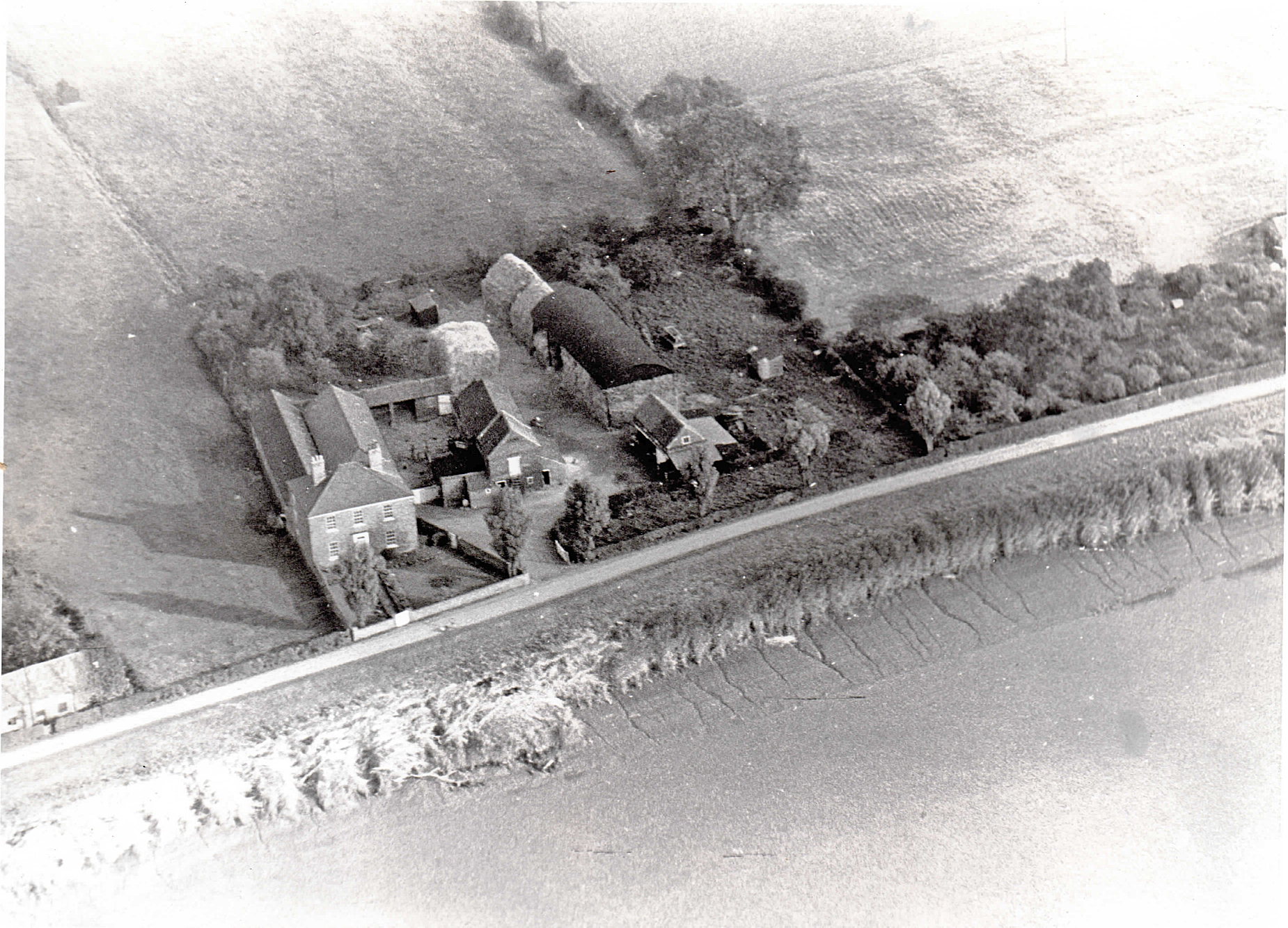
Aerial view of Manor Farm Skelton, 1950s
School houses
The 1851 census shows ‘Four houses building’. These houses and the school were built at the same time and in the same style by William Scholfield
The one nearest the school was often occupied by the teacher.
1891 Emma Woodhead aged 25 National schoolmistress b Meltham lived there
1911 Julia Collinson b 1862 d 1952 York lived there
1939 cottages occupied as follows
John and Gladys Bryan
Robert and Eva Keeble
Louisa Claydon. Widow of James and mother of Henry. Died 1966 at 3 School Houses. Born Louisa Parker and married James Claydon. Louisa was the daughter of Reuben Parker, basket maker of Chapel House
William and Mabel Dickinson 2 blacked out and Florence Walduck
School
September 4th 1852 Yorkshire Gazette
Chapel of Ease at Skelton, near Howden. The elegant little chapel erected by William Scholfield, Esq., in the village of Skelton, was, by the licence of his Grace the Lord Archbishop of York, opened for Divine worship, on Thursday morning last, at eleven o’clock. Prayers were read by the Rev. Philip Scholfield, M.A., and a very impressive sermon preached by the Rev. J. D. Jefferson, incumbent of Thorganby, and canon of York Minster. The singing of the Howden church choir was most excellent: they chanted the ” Venite exultemus Domino,” Heathcoat ; “Te Deum,” Robinson ; and ” Benedictus,” Dr. Boyce, in admirable style; and also sung some appropriate hymns, accompanied on the seraphine by Mr. Bradley, organist of the parish church, Howden. The service was attended by a very large congregation, amongst whom several clergymen were present; and the weather being beautifully fine, added to the gratification of all present.
School Memories
Harry Durham b 1911
I remember around the age of seven years old, I attended Skelton school. The teachers were Miss Milne for the senior class and Mrs Brixome for the infants. Mrs Scholfield, the squire’s wife [from Sandhall], used to call twice a week at the school on horseback. I remember that when she entered the school we all had to stand up and say “Good morning Ma’am”.
Jean Tomlinson, (nee Train), was evacuated from Hull and stayed at Sandhall from 1940 to 1942. Extract from her memories
Once in the countryside, you had to start a new school which wasn’t easy, and Skelton school became crowded with all the extra children. I was taught by Mrs. Green, who was very nice, but it must have been difficult teaching children of different ages all in the same room. I wasn’t used to that and think my education was disrupted through having to change schools. Arthur started school and was in Miss Wilmott’s class. She had an artificial leg, but still soldiered on, doing her job.
Val Chaffe nee Akney b 1936
I started there in 1940 when I was four. Cried on first day!! Jack (my brother) used to take me on his cross-bar and had to pick me up for lunch and take me back. All in HIS lunch hour. Bet he loved it. He was much older than me and when he was at school the teacher (Mrs Fisher) was a bit of a tyrant. One of the older lads threw an inkwell at her and they told tales of her white blouse being covered in ink and ruined. He was expelled.
I can remember two classrooms. Back room was for babies and I think up to age of six. Front room was for older ones up to 14. The little ones’ teacher was Mrs Willmott. After her I think was Miss Parker who lived at a house at the bridge which has since been demolished. There was a coke boiler in classroom. I remember the smell of coke being overpowering. Outside lavatories which were not very choice but I didn’t take any notice because we had same at Sandhall.
I seem to remember that the babies’ teacher was, a lady who was disabled in some way and had a taxi to and from the school. Wish I could think of her name. I liked her a lot.
Another teacher was a Mrs Green who cycled to school and lived in Howden. She was quite strict but okay really. She told my Mum I should transfer to Howden school to try for my 11 plus which helped me get to Goole Grammar. Would not have managed it without her help.
We had free milk provided at that time and it was always warm and tasted ‘off’. Hated it but dare not leave it. There was also a piano in the ‘big’ room and we had singing.
During the war we had some evacuees from Hull at the school. Hull was badly bombed because of the docks. The evacuees lived with people in and around Skelton village. Up at Sandhall they had a family plus 2 or 3 other children. I don’t remember them being with us for very long.
For a time we had school dinners provided. They were cooked by a lady at one of the houses by the school (Mrs Keeble) Goodness knows how she did it but they were very good. Don’t know if we paid for them or not.
Rowland Jones
I started Skelton school September 1939. The back room was for the young children. The front room for the older children. There was a coke stove with large fire guard. Mrs Green from Howden was the teacher for the older children, and Mrs Wilmot for the younger children. When Mrs Green retired Miss Parker took over.
We had a Christmas party every year Mr and Mrs Scholfield supplied the tree.
The school closed 1946.
Mr & Mrs Scholfield had eleven evacuees in early 1940 who went to the school.
The School building had a bell on the right hand side of the roof, which was taken down for safety about 1940 by Mr Fox the village blacksmith at Laxton.
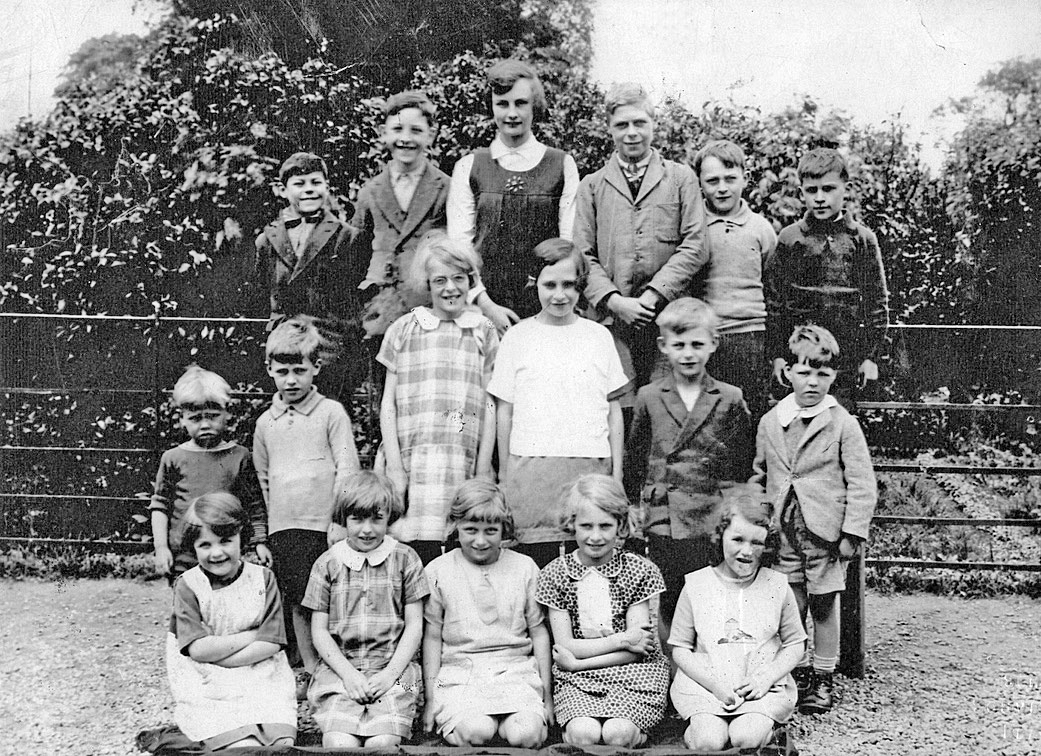
Skelton schoolchildren 1929/30
Back row: Ted Lawrence, Jack Backhouse, Doreen Wilson, Jack Wallis, Les Backhouse, Gerald Mell
Middle row: Dumpy Maw, Ward Maw, Dorothy Allott, Betty Backhouse, Edward Maw, Edward Leighton
Front row: Margaret Habblett, Mary Leighton, Muriel Wallis, unknown, Beryl Mell
Smithy cottage
1939 Arthur Smith farm tractor driver and wife Bessie . Also Joan [ who later married Mr King] plus 3 others
Rowland Jones lived there for a time.
Dairy Farm
1851 William Andrew born Balkholme farming 150 acres?
1871 still there
1939 William, Arthur and Annie Thompson. William was a dairy farmer b 1894
Oat Lane cottage
Dated EPS 1928 [ Edward Paget Scholfield]
1939 George and Mary Tomlinson lived there. George was a farm labourer
Ron Oakley?
West View
In 1939 occupants were
1 Eric Cutts, foreman bricklayer. Also Thomas Cutts b 1910 horseman on farm and Ada Fletcher
2 Henry Claydon b 1915 gardener and Annie
3 Harry Newman, Ethel, George, John and one other
Claydon family
1891 Walter Claydon general labourer was living near Jolly Sailor, next to Abbey family. Five children children including James who in 1911 was a bricklayer. he married Louisa Parker in 1907. They had several children including son Henry born 1914. James died in 1936. She died 1966.
Hull Daily May 1938 Goole The wedding took place in the Parish Church on Saturday of Henry Claydon, youngest son of Mr and Mrs Claydon, of School House, Skelton, and Miss Annie M Kay daughter of Mr and Mrs H Kay of Chestnut-avenue, Goole. The bride wore a gown with net veil, and was given away by her cousin Oliver Goodall. She was attended by Miss Olive Kay (sister) and Miss Claydon (bridegroom’s sister) .Walter Claydon (brother of groom) was best man.
Henry Claydon lost a leg in the war. A Howden story is that he was well known as a bookie’s runner and hid the betting slips in his artificial leg .
He worked as a basket maker, making baskets out of willow. The family also ran a small shop.
In 1939 Irish row came next, lived in by Robert Tipping
Milners’ Row
These houses were named for their owner, Joseph Milner whose family are still in the flower and nursery business in Boothferry Road, Goole.
Joseph was born in 1835 and his father Thomas was a professional gardener. The family settled in Airmyn where Thomas was the gardener at Boothferry House. Joseph meanwhile worked as a gardener near Redcar and in 1859 he married Mary Murray originally from Scotland whose father too was a gardener.
Joseph was a seedsman and after his business in Airmyn failed he moved with Mary and their two sons Thomas Murray and Joseph Arthur Braim to Skelton where he set up a market garden and nursery. An advert in the Goole Times for May 1877 reads
Plants Plants Thousands now ready, consisting of Geraniums Dahlias etc etc .FLOWER SEEDS, with instructions for culture, I/-. J. Milner, Nurseryman., Skelton, Howden. Attends Goole Market, opposite the Sydney Hotel, every week.
The two sons, both of whom worked in the family business had a double wedding at Howden on October 12, 1887. Thomas married Ellen Hunt and Arthur married Margaret Holliday.
Thomas and Ellen moved into Milners’ Row. In 1891 Joseph and Mary were living in the first one, Thomas Tyldsley, a gardener, and his wife were in the middle and at the furthest end next to Riverside Farm were Thomas and Ellen. The three cottages were then called ‘The Echo’
Arthur Murray and his wife lived across the river at Hook where they had another large market garden.
One day in 1893 Joseph and Thomas were crossing the river to Goole when they sadly saw and retrieved the body of a 12 year old Goole boy called John Sutcliife who had drowned while swimming near Hook Bridge.
A more amusing report appeared in the Goole Times in September 1896. This was a report of a case heard by Howden magistrates – although Messrs Scholfield and Saltmarshe did not hear the case they were members of the bench.
Henry Worth, a gardener of Skelton, was charged with trespassing on land belonging to Mr R. S. Scholfleld. He said was in the field but that he was not trapping.
Joseph Parker, under-keeper to Colonel Saltmarshe said that on Sunday morning he was walking towards Skelton when he heard something flapping in a trap and on watching for the defendant saw him come out of a field with a pheasant. It was a trap ordinarily set for rabbits. Defendant said I don’t deny that I took the pheasant out of the trap.
Mr Milner (defendant’s employer] said he was really the defendant as that he was the owner and occupier of some nearby land. The field alluded to and where the trespass was said to have been committed swarmed with rabbits and he had suffered loss of produce in consequence.
He had permission from Mr Hart, who occupied the field, to destroy the rabbits. He had spoken to Mr Scholfield who also gave full permission. If there had breach committed in trapping the pheasant he pleaded ignorance and hoped that the bench would deal leniently with him. The chairman said there had been a violation of the law but they were convinced that it was purely of a technical character. Fined 5s and costs.
Joseph and Mary later years.
Mary Milner nee Murray died in February 1901 at Skelton. She was 74.
In 1901 Joseph was at Skelton. He was on his own but there were three other men nearby described as gardeners. Soon afterwards Joseph became blind and moved to Goole. He died in 1918.
When Thomas Milner died in 1933 he left the three houses at Skelton to his son Joseph Ernest.
1939 occupants of Milners row
Ernest Alexander fertiliser mixer
Alfred Freeman, horseman
Henry Reedman next to Riverside farm, wife Mary and daughter Dorothy. Henry was a market gardener. Henry Reedman’s father had been head keeper on the Sandhall estate.
The Jewitt family
Long time residents of Skelton in the nineteenth century were members of the Jewitt family. Branches of the family originated at Ousethorpe near Eastrington and Saltmarshe. But the Skelton Jewitts were mariners. They lived near Riverside farm and Peter Jewitt married Susannah Leighton in 1806. They had a large family including son Thomas.
In November 1860 the coasting vessel Charity was lost off the Norfolk coast. The Hull newspaper describes how
She was bound for Rouen with a cargo of’coal. The captain and owner, Mr Jewitt of’ Skelton near Howden was on board with his wife and niece about 16 years of age. The crew consisted of five men, four of whom were saved.
Two of them; WilIiam Till and George ?Cottarus, of Howden Dyke, reached home on Thursday. They described the situation of the vessel, after she struck on the sand as terrifying with the sea breaking over them so furiously.
Mrs Jewitt was the first washed overboard; her loss appeared to unnerve the captain, who was clinging to the mast, and he speedily followed. The niece, who was being held by two of the young men in the rigging died in their arm. Boats from the shore three times aproached but were unable to get near enough to render assistance. For eight hours the four survivors clung to the rigging and were nearly exhausted, when Captain Thomas Tye, of the smack Tyrrell, who had already had one attempt to reach the wreck, encouraged his men to try again, saying “God Almighty would be with them.” His words proved true, and their faith enabled them to save from their impending fate four human beings.
There is a family gravestone in Howden churchyard which reads as follows:
To the memory of Mary Ann the wife of Thomas Jewitt of Skelton who departed this life on the 14th day of October 1840 aged 22 years.
In memory of Thomas Leighton Jewitt aged 53 years Ann Jewitt aged 40 years and their niece Alice Hunt aged 13 years who were all drowned at sea on the Longsands November 17 1860.
Another son Peter jnr moved to Hull where he was a Humber pilot.
Riverside farm
The Leighton family
This was the home for many generations of the Leighton family, passing from father to son [ latterly as tenants], usually called Thomas, from the early 1700s and possibly earlier.
Thomas Leighton, a well off yeoman, who died in 1817 left a lot of property in Skelton, itemised in his will [made in 1806] which is online via Find my Past.
In summary he left his house and messuage where ‘David Briggs now lives’ to his wife Dorothy and then to his son Thomas.
He left money [ £100 each other than to Mary who got £50] to his daughters Mary , Sarah, Susannah, Margaret Hannah and Elizabeth. He lists four other properties he owns and says who should inherit if young Thomas died before him.
They were
the cottage where William Smart lives and the croft adjoining
the cottage where Charles England now lives along with the close called Little Siddix
the cottage where Widow Flint lives and the close called Great Siddix
the cottage where John Hutchcroft lives with the outhouse used for dressing line but subject to a right by foot for use by occupiers of other houses. [Is this the origin of Jenny Hudscroft lane?]
A later document lists the family as they were in 1817
Thomas Leighton, Skelton, farmer
Dorothy Leighton, Skelton, widow of the said Thomas Leighton,
Mary, wife of William Turner, Gilberdyke, farmer
Sarah, wife of Thomas Richardson, Howden, gardener
Susannah wife of Peter Jewitt, Skelton,
Margaret wife of Martin Overend, Balkholme, farmer
Hannah wife of William Booth, Selby, printer and stationer,
Elizabeth wife of William Goulden, Howden, cordwainer
I think however that the actual farm was by then owned by the Saltmarshe family who had bought the property from Thomas Leighton snr in the 1780s.
Thomas Leighton jnr was born in 1791. He married Hannah Scruton in 1820 and their son William was born the following year.
In 1851 Thomas and Hannah were living near Manor Farm while son William was farming 90 acres at Riverside. He had married Mary Andrew in 1849 and they had a daughter Hannah in 1850.
Sadly Mary Leighton died in 1855 and in 1856 Thomas Leighton, was leasing the farmhouse and land at Skelton containing 76 acres two roods 17 perches for £142 15s 8d per year. from the Saltmarshes.
William died in 1862 and his father in 1865. Hannah snr and her granddaughter Hannah were living together in 1871 next to Riverside farm.
Hannah snr died in 1874 and in 1875 Howden manor court found Hannah Leighton the younger entitled to the property of her grandfather, Thomas Leighton, deceased This was Oat Lane Croft containing two acres and Siddex Close containing four acres at Skelton.
But Hannah died in 1880 aged 30. In 1881 we read that Thomas Andrew and William Andrew, of Skelton are found entitled to Siddex Close containing four acres at Skelton as devisees of their niece, Hannah Leighton the younger.
In 1901 William Andrew, formerly of Skelton then of Gilberdyke, farmer sold Oat Lane Croft containing two acres and Siddikes or Siddocks Close containing four acres at Skelton to Robert Stanley Scholfield, of Sand Hall for £300.
The farmer at Riverside in 1871 was John Martinson born Reedness who had been there a year
In 1901 it was Robert Hairsine aged 29
In 1939 it was Blythe Backhouse. He was born in 1888 at Wressle and worked as a farm labourer. In 1911 he was farm foreman for Amaziah Hairsine at Warwick’s House. He married Alice Newham in 1914. Their children included John, Leslie, Betty and Blythe jnr.
Betty married Fred Jarred. Their son Rob Jarred farmed at Riverside from 1968.
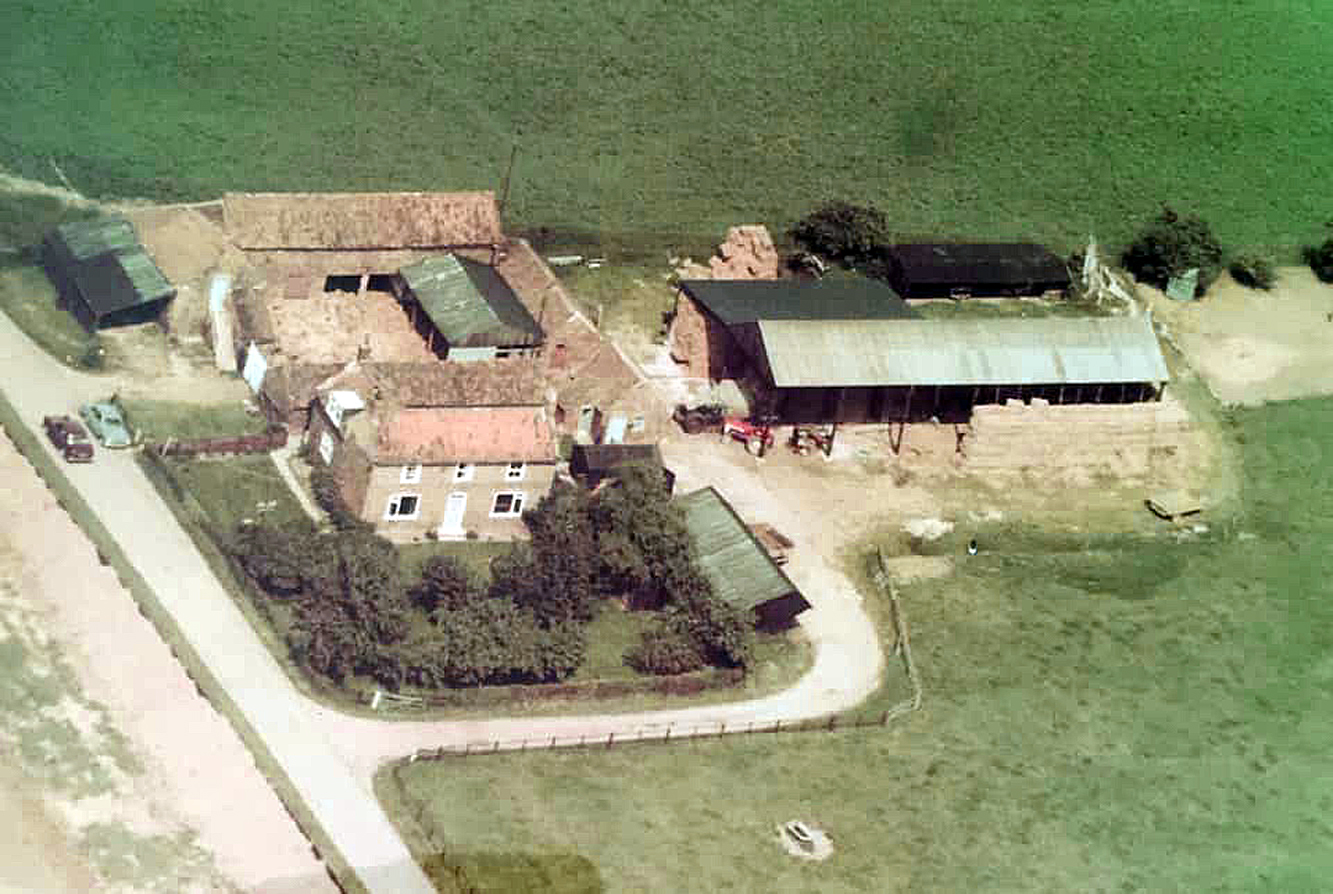
An aerial view of Riverside farm [ with thanks to the Jarred family]