A description of Goole on June 15th, 1810
This was written by Mrs Susannah Best [nee Storr] and is an account of the first visit she paid to Goole when she was about 12. She later lived with her husband Robert on a farm in Old Goole. As far as I can find, it is one of the first descriptions of Goole. She wrote this account when she was in her nineties:
…
‘We set out for a journey from Selby to Blacktoft. It was no slight undertaking, for our only means of transit was either by horseback – and at midsummer the roads were scarcely passable – or by water. We chose the latter and started on Friday morning, full of delight at the unusual excitement of a journey. Our vessel was a small schooner named The Adventure, built expressively for the Leeds trade and therefore made to fit the lock on the way to that town. She was one of the first boats that ever made the journey from Leeds to London.
Wind and tide must have been against us, for it was Sunday morning before we cast anchor at the mouth of the Dutch River [formerly known as Willow Tree roads]. From this point you can have a view of Goole as it was then.’
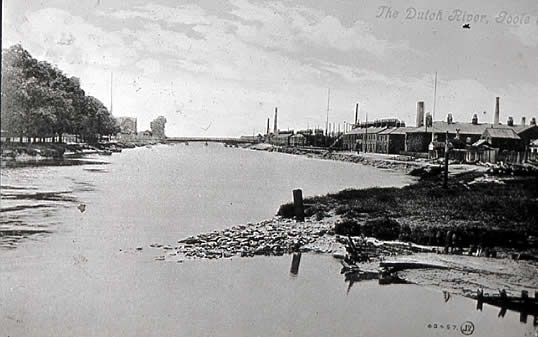
Dutch River, looking towards the Dutch River Bridge
‘On the New Goole side your eye would have wandered hopelessly in search of anything to denote civilization; there was one old thatched house and ploughed fields. This house stood rather nearer the docks than the present Lowther hotel does and was eventually pulled down by Admiral Sotheron, who built the house now occupied by Mr George Duckels in its stead in 1822.
Those ploughed fields have strangely altered since then; a line drawn diagonally from the wooden bridge [now pulled down] to [?] will give a fairly correct outline of the boundaries of the farm known as Moorfields. It all belonged at that time to Mr Thistleton of Scarborough, who had to maintain in good order the whole of the banks surrounding this tongue of land. He was therefore exempted from the payment of highway; this land was afterwards sold for the purpose of cutting the docks at the rate of £95 an acre. The level of the land was much lower than at present. The part of Goole now used for a recreation ground [now the Stanhope dock] is almost the only portion remaining at the original level.
At the present day it is neither an easy nor a cleanly undertaking to land at the mouth of the Dutch river, but then our means were primitive, simply the backs of the boatmen. A narrow flagged footpath on this muddy bank was all the pavement possessed. My recollections suggest that every flag was broken and that every step produced a squirt-like motion from the mud beneath, which was not pleasant, but we had no Local Board in those days and the pavement was almost as bad as it is now in Old Goole.
Two small public houses adorned the bank of the river, the Boat Inn and the Anchor; the latter has long since disappeared. Crossing the bridge another public house met our view named the Half Moon [now pulled down], an old thatched cottage occupied by the Robinsons and their three cottages under one roof afterwards known as Ivy House, now replaced by Heber Terrace.
Here I would draw your attention to the old clough, neither altered nor improved since those days. William Storr, steward for the commissioners for the drainage of Hatfield Chase, was ordered to bring the Dempster drain down so far as to make an outlet for it into the Dutch river; this he did apparently to the satisfaction of all posterity for no one has presumed to improve it since.
The corner house [also pulled down], though much dilapidated, was the nearest approach to a ‘good’ house that we had yet come to, and what would our children think of it now? Low and thatched, with deep eaves and open chimneys, its internal arrangements were more barn like than home like. I think a tenant would be difficult to find for it nowadays.
Grove House was built about 1730, but it had no neighbours until a few cottages on the left and Manor Cottage on the right were reared. This house was slightly above the level of the road and a tongue of the moors came within two fields of the back of it. Goole Hall of that day was a picturesque old place with long lancet windows, possibly more ornamental than useful. As late as the year 1818, only twelve houses stood in the village or town and eight of these were on Old Goole side of the river.’
Further information on Mrs Best is available on the website The Storrs family online. This a brief extract
Mrs Best’s family
Mrs. Best is described as very tall (five feet eleven inches in height), and of fair complexion. She is now (1884) in her eightv-eighth year, “with sight and memory unimpaired and can read the smallest print and do the finest needlework without spectacles, and is a quite regular attendant at church.” Her home is now with her daughter, Mrs. Bryan, where the vicarage and the church are separated by only a four-minutes walk. She has two other daughters Mrs. Helliwell, who at one time resided in Toronto, and Mrs.
Hodgson of Rochdale, Lancashire.
Mrs. Best wrote
” My father, Samuel Storr of Wistow Lordship, left three sons : Robert who died unmarried; Samuel, whose sons are all dead, leaving no issue and William, who left two
sons, both married, but without children.
On the death of my brother Robert the small farm at Wistow Lordship, was purchased by my husband, and is the only property left in the [Storr] family either in Holderness or Wistow.
My elder son, John Storr Best, who was six feet four inches in height, died at the age of twenty-one, while in St. John’s College, Cambridge. My only remaining son, Robert Storr Best, is a large farmer at Moorfields, Goole. He has twelve children, all of
whom have been named Storr Best at their christenino-. We endeavour in this way to keep up the name.”
” My father had a large book which took our pedigree down to 1814 ; but he lent it and never recovered it, so I have only his memory to depend on. He well knew our family came in with the Conqueror, but in what capacity he had not known. They had large possessions of property in Holderness and the parts adjoining, and certainly were associated with the county families. My great-grandfather being expelled from his family so completely, [apparently they were Quakers] I have only the traditions of my father to go by.
There is a hall yet standing in Wistow that was built for one of his sons, and the farm in this lordship was purchased for the younger son, my grandfather, who was a cripple, but yet married into a very good Yorkshire family, the Spofforths of How-
den.”
Manor Cottage
Susannah Storr married Robert Best in 1825. He died in 1862 aged 70. She lived in Manor Cottage, Old Goole for many years with an unmarried daughter Auretta. [Auretta later married Rev Percival Bryan]
There is a newspaper reoprt of a fire there in 1877
DESTRUCTIVE FIRE.—On Saturday morning fire broke oot the Manor Cottage, Old Goole, the residence Mrs. Best, widow of late Mr. Best, of Moorfields. Mrs. and Miss Best bad been from Goole for a few weeks, and were expected home on Saturday, and the servant girl, according to instructions given her, had fires in the bedrooms on Friday night.
In the front of one of them she placed a feather bed to air and left the house in perfect safety, as thought, with the bed still in front of the fire, about eight o’clock same evening. The following morning, about five o’clock, it was observed that the house was on fire. Mr. Wilson, the Goole agent of the Lancashire and Yorkshire Railway Company, lost no time in callicg the fire brigade, who, with that gentleman as their superintendant, were quickly the scene of the disaster.
It was soon apparent that the fire have been raging for several hours and the roof of the eastern part of the house fell in. The fire, before the engines conld be got fairly work, had made sad havoc in the two best rooms, and the flames were traversing quickly along to other parts of the house.
At first the work of those who willingly rendered every assistance they could, seemed to have but little effect, and it was not before eight o’clock that it was got under control. By this time two bed-rooms and the drawing room were entirely destroyed, and other parts of the house were very much burnt. Very little of tho furniture was saved, and the loss includes many family relics and valuable property, the total amount of damage done being estimated at between £l,OOO and £1,500. We understand the properly was partially insured
Mrs Best died in Liverpool in 1888.