Introduction
This is all about Laxton in East Yorkshire which is often confused with Laxton in Nottinghamshire/
Some of the following information is taken from an article about Laxton written by Philip Saltmarshe of Saltmarshe Hall. At the time of writing in the early twentieth century he owned most of Laxton and Saltmarshe and had in his possession many of the documents and deeds relating to the two villages.
Laxton was first mentioned 1086 in the Domesday book. The name probably means Lax’s farm but it is often believed to be connected with the word ‘lax’ which means salmon. There were salmon in the nearby River Ouse.
In 1086 Laxton consisted of only one carucate of land (about 120-150 acres) while neighbouring Saltmarshe was six carucates. Sometime in the 12th century a large drainage ditch was dug by John le Clerk of Metham (Metham is about a mile from Laxton) and Laxton probably benefited from the better drainage it brought.
Manors of Laxton
By 1316 there were three separate manors within the settlement of Laxton. They belonged to:
1. Nicholas de Metham
2. Geoffrey Hotham
3. Henry Sothill
In the poll tax of 1379 Laxton had 16 married couples and 28 single adults (over the age of 15). The richest taxpayer was John Dayvill, a franklin (quite a well-off farmer) who paid 6s 8d. There were very few tradespeople – most were servants or farmworkers.
1. The manor of Nicholas de Metham
This manor covered most of Laxton as well as the area known as Trandike (“tranedic” in 1199; “trandyke” in 1282 – we still have Trandy Lane today). The Methams owned it until 1649 when it was sold to David Belt of Howden.
David Belt sold his manor to the Corporation of York, then in 1837 they sold it to Philip Saltmarshe. It appears to have been centred round the area near the former blacksmith’s shop (possibly this was known in the 19th century as Popples’ farmhouse).
2. The manor of Geoffrey de Hotham
Geoffrey was granted land in Laxton in 1281. He owned a mill in the village, possibly water-powered. He was also granted free warren (the right to hunt certain game) in 1310.
In 1445 William Hotham sold some of his Laxton land to John Portington of Laxton.
In 1531 Thomas Braunch owned this manor.
In 1533 the same land was owned by Robert Brandling, a former sheriff of Newcastle who died in 1568. The land passed down the family to Robert Brandling who inherited in 1576 when he was just one year old. It then consisted of eight houses, 30 acres of arable land, 100 acres of pasture, 60 acres of meadow and 10 acres of wood. The Brandlings probably never came to Laxton.
In 1608 the Brandling family sold their Laxton manor to John Higdon. He was already living there as he was listed in the muster roll with his own armour in 1584. His son, also John, married Elizabeth Monkton of Caville.
From the 1672 hearth tax records we know that Ralph Higdon was living in Laxton in a house with an impressive seven hearths. This could have been on site of today’s Manor Farm.
The Bayles family of Laxton
In 1682 the Bayles (or Baylis) family bought the manor from Ralph Higdon. They were originally Selby merchants.
Christopher Bayles of Laxton was born on the 10th March 1685. On the 30th December 1712 he married Elizabeth, the daughter of John Wastell of Bolton near Richmond, Yorkshire, afterwards of Ainderby Steeple. She had been born on September 12th 1690.
Christopher and Elizabeth Bayles had nine children:
Christopher, born March 19th 1714
Elizabeth, born August 25th 1715, died April 1744
John, 1716 – 1720
Nathaniel, 1717-1718
Deborah, born December 1721, married 1746, died 30 March 1782 aged 62
John, 1722 -1724
Frances, born May 1724
Barbara, born March 1726, married 15th Sep 1760
Catherine, 1727 -1728
An old family record states that:
“Elizabeth Bayles, the Mother of the above nine Children, Dyed in Child bed the 10th of October 1727; and was buried the 12th, In the North Isle, at the West end of St Mary’s Church in Kingston upon Hull.
Christopher Bayles, the Husband to Elizabeth, Dyed the … [blank] … And was buried the … [blank] … In the Chapel at Laxton near Howden.”
Christopher Bayles was a merchant in Kingston upon Hull. He was Chamberlain there in 1714 and Sheriff in 1717.
In the old chapel at Laxton are memorial stones to Christopher Bayles of Laxton who died 1744, his daughter Elizabeth Bayles who also died 1744, his son Christopher who died 1782, and his daughter Barbara Bayles who married her first cousin John Wastell of Doncaster and died in 1794. These stones are in poor condition.
The following summaries of abstracts from wills are from the Borthwick Institute at York University:
Christopher Bayles [1] of Laxton, dated 24 May 1744
His executor was his son Christopher Bayles. The will mentions lands in Laxton, Skelton, Riccall, Selby and Skipwith. He left bequests of £800 each to his daughters Deborah, Frances and Barbara.
The will was proved by Christopher Bayles, son and executor, Kingston upon Hull, merchant, 4 January 1744/5.
Christopher Bayles [2] of Laxton, Esq., dated 18 Aug 1782
Left bequests to Elizabeth the daughter of Mary Leek, otherwise Mary Aldham, “my servant who now resideth with me”; to Mary Leek, otherwise Mary Aldham; to “my sister Frances Bayles” (executor); to “my sister Barbara, wife of John Wastell, Esq.”; to John Wastell of Aynderby Steeple near Northallerton, County of York, son of Rev. Mr Wastell, late of Simondburn, Northumberland, clerk; and to “my late servant Sarah Crowston”. Proved 11 June 1783.
Frances Bayles of Laxton, spinster, dated 17 December 1794
She left:
“To my nephews Christopher Inman and Charles Inman [they were the sons of her sister Deborah, who had married Michael Inman of Hull], £50 apiece.
To my servant maid, Ann Waud, £20, my cloaths, wearing apparel, my trunk with a hair cover and a mourning ring.
The residue to my niece Elizabeth, the wife of Charles Escricke Broadley of Kingston upon Hull, Esq.
Scarfs and rings to be given to each of my said nephews and to friends and acquaintances.”
The will declared Elizabeth Broadley to be sole executrix.
It was proved on the 24th June 1799. Executrix Elizabeth Broadley was duly sworn before Thomas Rudd, Surrogate.
There was a declaration instead of an inventory – the executrix declared that the said deceased’s personal effects at the time of death would not amount to the sum of six hundred pounds.
The Bayles family built Manor Farm.
As the above wills show, the last Christopher Bayles who died in 1782 had left all his property to Elizabeth, daughter of his illegitimate daughter Mary Leek. She had married Charles Broadley.
Their son, Charles Bayles Broadley of London, sold the whole estate to Philip Simpson, the owner of Metham and vicar of Laxton, in 1845.
As an aside Charles Bayles Broadley who died in London in 1866 was a clergyman and academic. In 1840 he commissioned composer Felix Mendelssohn Bartholdy to write a setting of his own metrical paraphrase of the 13th psalm. Acting as intermediary between the two parties was Ignaz Moscheles, Broadley’s composition teacher in London and one of Mendelssohn’s dearest friends. Charles is described as ‘an eccentric musical and literary amateur’. The anthem is still widely performed today.
In 1854 Philip Saltmarshe swapped Manor Farm and lands for the manor of Cotness. He then modernised the farm. The tenant then was a Mr Shaw. Later the land agent Mr John Biggs lived there.
3. The manor belonging to the Sothill family
Some members of the Sothill family – Robert and John – may have lived at Laxton Hall. This was about half a mile west of the village near the present double bend (Hall Garth).
The land passed in the 16th century to William Lowson, a local man living in Laxton. He too was in Laxton in 1584 when the muster roll lists him as having his own ‘coat plate’ and a ‘bill’. At that time Laxton and Skelton together had ten pikemen, 15 billmen, 23 calivers and six archers.
William Lowson died in 1613. At the time of his death he owned Laxton Hall, five cottages and around 100 acres. His heiress, Elizabeth, was then aged four.
By the mid-17th century Thomas Girlington of Sandhall was the lord of this manor and the lands were split up. The new owner of much of it was Christopher Fulthorpe who, the hearth tax shows, lived in a house with six hearths – probably on the site of Hall Farm today.
In 1698 the Fulthorpes sold the manor to Richard Mawson, the second son of Robert Mawson of Cotness. In 1714 he built himself a new house; his initials are still on the north end wall of Hall Farm.
It is not easy to work out the locations of some of the farms as in 1855 when Philip Saltmarshe had obtained possession of most of the village farms, with the exception of Church Farm, he remodelled them. This must have been quite traumatic for the tenants as what it meant was that some farm houses lost all their land while other land was moved between farms to tidy up their holdings and group fields together.
A history of Laxton church
Laxton was part of the bishop of Durham’s Howden lands and there is no documentary evidence of it having its own place of worship until the 15th century. However, Laxton (with Skelton) was one of the prebends of the collegiate church at Howden and the village tithes of hay, wool and lambs used to provide for the prebendary. From 1330 Laxton had its own vicar appointed but, although there is a full list of holders of the office from 1330-1540, most of these were non-resident and so there is no certainty that regular services were held or even a date for when the chapel was built.
In 1409 John de Skipwith and others endowed a chantry in the chapel of St John the Evangelist in Laxton with a “messuage (formerly held of Alexander de Metham, chivaler), a toft and 35 acres of land (formerly held of William de Rascelin)”. This seems to have been one of several such endowments – in 1481, for example, Edward Saltmarshe left 3s 4d to Laxton chapel and 3s 4d to the Chaplain to hold a service there.
It is therefore difficult to say when Laxton chapel was built but it seems likely that it was some time in the 14th century.
In the 16th century King Henry VIII seized the land belonging to Laxton chapel; in all, about 100 acres. He sold it to Nicholas Arlush of Knedlington who, in his inquisition post mortem in 1553, owned 100 acres of land “arable, meadow and pasture, late parcel of the chapel of St John in Laxton”.
The chapel itself (which stands in the graveyard) fell into disuse and decay since its endowment no longer existed.
Then in 1625 three sisters – Anne, Elizabeth and Grace Dorey – paid for the building of a new place of worship at Laxton, incorporating part of the old chapel. An engraving of it still hangs in the present Laxton church. For some reason the new ‘chapel’ was known as St Peter’s rather than St. John’s.
The sisters also endowed the new building with land to pay for its upkeep: “shoulder of mutton” in Cherry tree row field; one acre in West field, Saltmarshe; two acres in Farnite fields, Laxton; four acres in Cotness; a small cottage and a garden in Laxton; one and a half acres in Bishopsoil and a small close in Wallingfen.
But by 1769 the Laxton chapel was again decayed and worn and the village was unable to maintain it. Permission was granted to collect for its upkeep, a sum of £1200 being necessary. In 1797 £400 was granted out of Queen Anne’s bounty to help pay for the chapel and this was invested in a close at Kilpin. In 1800 another £400 was granted and in 1809 another £200.

Laxton old church. The small stone chapel to the right is still there in the churchyard, across the road from the present church.
At this time, of course, Laxton was still a chapel-of-ease to Howden and until the 19th century the curates do not seem to have lived in the village. The first curate, licensed on March 14th 1673, was Rev. John Mallison who was also curate of Eastrington, Barmby on the Marsh and Barlby and vicar of Hemingbrough. He was followed by Rev. Robert Poole (1793-1813), Rev. Thomas Allanson (1813-1814) and Rev. R Thomas (1814-1821).
In 1821 Rev. Edward Ward was appointed and he seems to have lived in Laxton. Four curates followed until in 1847 Rev. Philip Simpson, owner of nearby Metham, became the incumbent. He resigned in 1850 and was followed by Rev William Hutchinson who became vicar of Howden in 1855. He was followed by Revh Richard Ellis and it was he who became Laxton’s first vicar when in 1858 Laxton became a separate parish. The stipend then was £50 p.a. but in 1859 Mr Saltmarshe gave an extra £30.
In 1860 he sold what was formerly Eland’s/Nottingham’s farm house (now “Vicarage Farm”) as a vicarage. Rev. Ellis resigned in 1868 and was succeeded as vicar of Laxton by Rev. Edward Simpson (son of earlier vicar Philip Simpson).
In 1875-6 the present Laxton church was built at a cost of £3,400, the sum of which was raised by public subscription.
This report appeared in the Hull Packet newspaper of Friday 11th August 1876.
LAXTON CHURCH-A new church was consecrated and opened, on Monday at Laxton, near Howden. It has been built in place of the old church, which was erected more than 200 years ago by three lady residents of the village-the Misses Dore and which had gradually grown out of repair, and was altogether meagre in extent and uncomfortable In accommodation. The new church is on the opposite side of the road, the site having been given by Mr. P. Saltmarshe. of Saltmarshe Hall, who has also contributed nearly £800 to the building fund.’ The other principal donors have-been the Rev. P. Simpson, of Metham Hall, £375 ; the Rev. E. W. Simpson, vicar, £275 ; Mr. J. W. Empson, of Yokefleet Hall, £200; Colonel Saltmarshe, £100 ; and Mrs. Gamble, of Gorrock Lodge, N. B., £50, and a new organ. The estimated cost is £3,300.
The design for the building- was furnished by Messrs. Hadfield and Sons, Sheffield, and the contractors were Messrs. Chambers and Sons, also of Sheffield. The stone of which it has been built has has been given by Mr. C. Sykes, M.P., for the Riding The general effect of the building is such as to add greatly to the picturesqueness of the village, and the interior is both commodious and comfortable, sittings being provided for close upon 300 people .
Several stained glass windows have been presented by Mr. and Mrs. Alfrey, Hemingford House, Warwickshire; Mr. J. W. Empson, Yokefleet Hall; Mr. Geo. Denison, York; and Mr. Alfred Small, Laxton. The opening service was attended by a crowded audience, and the consecration ceremony was performed by the Archbishop of York, who entered by the south door, and was received by the Rev. E. W. Simpson, vicar, and Mr. Saltmarshe and Mr. Hill, the churchwardens. The usual petition having been presented, was read by the Deputy., Registrar, Mr. Hudson, of York. A procession was then formed, which included the following clergy Rev. Canon Paget, Welton, Rural Dean; Rev. Canon Jarratt, North Cave, Chaplain; Rev. P. Simpson, Metham; Rev. W. Hutchinson, M.A., Vicar, and Rev. W. Booth, Curate, of Howden; Rev. R. J. Crosthwaite, Brayton; Rev. H. Greeves, Wistow; Rev. ?? H. Wright, Hemingbrough; Rev. G. W. Robinson, Barmby; Rev. J. Westmoreland, Brantingham; Rev.T. W. W. Watson, Skidby; Rev. J. Collins, Ellerton Priory ; Rev. T. Bennett, M.A., Eastrington; Rev. H. Bennett, Ellougbton ; Rev. E. Ward, Finningley; Rev. 0. L. Chambers, Hook ; Rev. E. C. Haynes, Swinefleet; Rev. R. Kennedy, Wressle; Rev. A. B. Day, Cawood; Rev. W. Cole, Hotham. After the usual prayers, the sentence of consecration was read by the deputy-registrar, and signed by the Archbishop. The prayers were read by Rev. W. Booth and Rev. E. W. Simpson, and the lessons by the Archbishop’s chaplains. A cold luncheon was provided in the schoolroom, over which Mr. Saltmarshe presided, and the usual loyal toasts and the healths of the Archbishop, and the vicar, Rural Dean, and clergy were duly honoured. There was evening service on Monday night, the preacher being the Rev. R. J. Crosthwaite, and services every evening during the week.
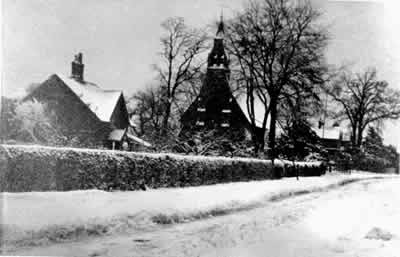
Rose Cottage and Laxton Church pictured in the snow
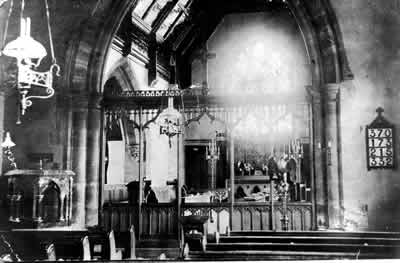
The interior of Laxton church showing the oak carved screen erected in memory of Rev Edward Whitmore Simpson of Metham Hall, who was vicar of Laxton for 42 years until his death in 1910
The Hatfield family of Laxton
The Hatfields were a well-established local family, farming 12 acres in Laxton. Thomas Hatfield, born in 1832, was the son of Benjamin Hatfield and Catherine (nee Wright) who were married at Howden on December 6th 1821. Thomas and his wife Eliza had several children including another Thomas, born 1874.
Many members of the Hatfield family played an active part in Laxton village life. Benjamin was the parish clerk and both Thomas Hatfields in their time acted as sexton and village carrier, driving to Howden market every Saturday.
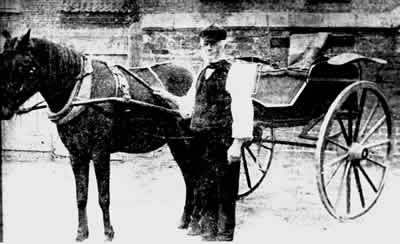
In the winter of 1899 Thomas Hatfield made a somewhat more daring trip than his usual run when he drove his pony and trap, in which his wife and daughter were passengers, over the frozen River Ouse from Saltmarshe to Reedness. His feat was commemorated in the photograph below which shows Thomas standing proudly at the head of his pony.
The Bricklayers Arms
The Bricklayers Arms in Laxton seems to have changed its name several times, depending on the occupation of the owner.
The earliest definite reference to the inn in Laxton is from August 1789 when Thomas Croyser, gent of Saltmarshe sold
“ the dwellinghouse now used as an inn under the sign of Blacksmiths Arms with shop, stable, outbuildings etc and garth or orchard containing one rood in Laxton’ to George Featon, of Laxton, blacksmith for £153.
George and his wife Margaret were still there in 1792 but by 1797 had moved to Hatfield.
In 1808 George Featon, Hatfield, blacksmith and his wife Margaret sold the “house used as an Inn known as The Cross Keys with blacksmith’s shop, garth, garden etc at Laxton containing one rood”
to Thomas Freeman, Laxton, yeoman and Robert Steele, Laxton, labourer for £315
Taylor Freeman who inherited the inn from his father Thomas was listed in 1823 as bricklayer and victualler of the Mason’s arms. He was working as both upto the 1840s when he is just listed as bricklayer.
In September 1856 he sold the ‘house used as an Inn formerly known as The Cross Keys but now known as The Bricklayers Arms Inn with blacksmith’s shop, garth, gardens, stables, cowhouse, brewhouse and outbuildings at Laxton containing one rood’ for £450 to Philip Saltmarshe
He died at Laxton in 1869 described as a gentleman
1861 William Johnson publican Bricklayers Arms
1892 Johnson Geo., farmer & victualler., Bricklayer’s Arms
In 1901 and 1911 Featherstone Bruines was the landlord. In 1891 he was a farm foreman. He was living with his wife Emma in 1901 but was a widower by 1911. He had a son Arthur and daughter Georgina.
In 1927 the pub was to let and the following advert appeared:
TO LET, Bricklayer’s Arms Inn, Laxton, Fully licensed Free House, with 19 acres of Grass and Arable Land; immediate entry.—Appy John Biggs, Estate Office, Laxton, near Howden.
1939 publican was Needham Whitehead who came to Laxton from Goole.
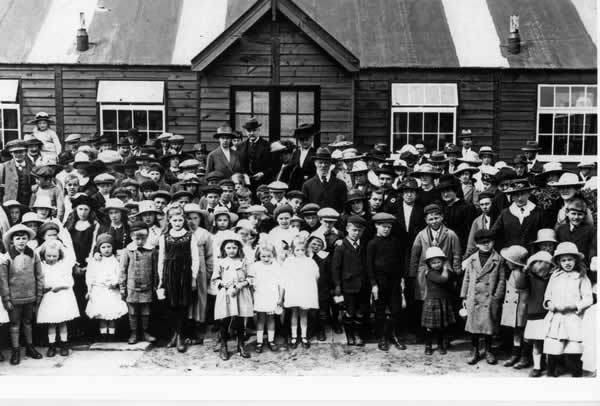
Here is the original opening ceremony of the Laxton Victory Hall. The hall was originally an army hut and was opened in 1919 . It was refurbished in 2009.
War time memories by Trevor Johnson
Trevor contacted me a few years ago and sent me these memories
Memories of an evacuee 1939 to 1942.
I arrived on a sunny afternoon in September, six or seven weeks before my ninth birthday, soon after the outbreak of war, my mother had brought me to Laxton a small village a few miles from both Goole and Howden. I was to stay with a Mr and Mrs Barker in their small cottage opposite the blacksmith’s forge. As we walked down the main street from the station, we were confronted by a herd of cows. The only cows I had seen before was from the window of a train, but in real life these looked huge. I got behind my mother’s skirts until they had passed.
I think the cottage must have been quite a culture shock. Although we only lived in a Council house in Hull it was quite spacious and had a bathroom, running hot and cold Water, and an indoor flush toilet, and of course electricity. The cottage had a very small living room, just a cold tap in the kitchen and an earth closet down the garden behind a privet hedge. An earth closet was enclosed in a small brick outhouse and had a pine board with a hole cut in and bucket underneath, not a pleasant experience on a wet or snowy night.
Oil lamps and candles were the only form of lighting. The living room had a paraffin lamp hanging centrally over the table, as there was no room at all for a child to play with toys, reading was the only option on dark nights, I sat on a stool in the corner until bed time, then a I had a candle to go up the stairs that were behind a door in the comer of the room. lf you were lucky enough to have a torch they were used sparingly as batteries were hard to come by.
The Barkers had two daughters, Nora who was twenty two and Vera who was seventeen, they both worked in a small crowded front room of the cottage at dress making and repairs. Not long after my arrival Vera had all her teeth taken out in the cottage by a dentist from Howden. l cannot imagine it happening to-day. this seemed to be the practice at the time, to save trouble later in her life.
Just before Christmas, Vera was taken ill with diabetes. All the village school children were at a party in the Victory hall. The church bell started to toll as we left, still allowed in the early few months of the war, indicating that there had been a death in the village; it was poor Vera who had passed away. That night I was taken by Mr Barker’s brother to his cottage down by the wood side just beyond the railway station, I cannot remember his name or that of his wife and two boys who were about my age, but they were very kind to me, I slept in the same bed as the boys, to my everlasting shame I was sick in the bed after eating too much cake and chocolate at the party. The next day I went to Hull to stay until the school reopened after the Christmas holidays.
The headmistress my of infants’ school in Hull Francis Askew, came one evening in her car to check that I was where the school had been informed I was going to be, because I had not gone with one of the organised schemes. I was in the front street with other Children playing egg if you budge near the school at the time, a car being a rare event, I directed her to Mr Freeman’s house, Laxton’s headmaster.
The first Sunday there I was taken to the mid morning church service which usually I only went to Sunday school occasionally at home. All the villagers gathered outside waiting for Lord & Lady Saltmarshe to arrive, which they did in grand style in a large old fashioned chauffeur driven car. As they went into church the men all touched their caps before following to their own pews. I do not remember when the lord and lady passed away or I would imagine a big funeral, but it did not seem long before Capt Philip Saltmarshe took over as heir to the estate.
Occasionally Capt Philip would come to the cottage to discuss estate work. Both the brothers worked for him, hedging and ditching in the winter and general maintenance in the summer. Any memories after this are at random, as I cannot put them in a time frame. I called Mr Barker Uncle Dave, but Mrs Barker was always Mrs Barker. They were given permission to visit the halls and gardens of the Saltmarshe estate, so one fine Saturday evening we walked to the park and entered the hall’s private gardens via a small gate in the wall and spent a pleasant time looking round.
A year or two ago there was an open garden day by the present owners, and my wife and I spent a pleasant afternoon exploring and trying to see what I could remember. The only thing that seemed familiar was the goldfish pond. It would have been nice to have met someone from my school days, but after seventy years it was a bit unlikely to happen.
I have been trying to remember the names of children in the village or school and I cannot remember the names of any from Saltmarshe, but at Laxton , there was Geoff and Olive Walker from the farm near the church, the Sweeting family were two doors up from the Barkers cottage, I think they were Sarah and Norman, across the road lived Joyce and Keith Baron. The headmaster lived in a biggish house opposite the village shop; he had two children David and Pat, Sid Lazenby lived in the back street, but I know he died some years ago as I had met his brother. A girl called Rhoda Dent lived in the small village of Cotness. John, the son of Mr Hardwick who was the station master, lived in the station house, they later moved back to HuII.
There was a brickpond just off Dead End road (I think the name has since been changed) well hidden behind trees and bushes where the bigger boys went swimming on fine summer nights -it was frowned on and I would imagine quite dangerous. l fished for perch there too, but Uncle Dave said we would be in trouble if the estate game keepers caught us. John Hardwick and I once fished in a pond near the estate park, again we had to keep well out of sight. That pond can be seen from the railway. Saturday meant a trip to Goole on the train, to the cinema for the children and shopping for the ladies, getting back in time for tea.
lf it was not possible to go outside in the evening the only thing to do was to read. A library came to the school every two weeks. There was a wireless in the cottage but they run off lead acid batteries that had to go Howden to be recharged every other week. It was only switched on for the six o’clock news. Uncle Dave had two or three bee hives as well as a few chickens at the bottom of the garden, so there was always plenty of eggs and fresh vegetables, and often a wild rabbit to supplement a meagre meat ration. Sometimes a pig was killed on the farm. They pole axed them in those days not efficiently and certainly cruel by modern methods but some of the children would watch and after butchering Mrs Walker the farmer’s wife would collect the blood in an enamel bowl to make black pudding, and the children inflated the bladder to play football with. If lucky, the children got a pig fry to take home.
The war visited Laxton a couple of times, early one morning as a train full of workers for Brough was at the station when a German fighter plane tried to machine gun the train but only succeeded in making a mess of the engine shed doors along side the track. Another time a bomber dropped three bombs on the fields between Laxton and Cotness probably shedding its load of bombs after being chased away from Hull.
Geoff Walker and I went to look at one of the holes the army lads had dug with the defused bomb lying at the bottom. We did throw a brick at it to check that it was not still live but we lived to tell the tale. The army bomb disposal unit took it away the next day.
I had not heard of oak apple day until l went to Laxton. The children assembled at school and then all walked to church for a short service, after which we chanted ‘the 29th of May is oak apple day. If you don ‘t give us a holiday we will all run away’. We were then given the rest of the day off.
Summer cricket matches were played in a field belonging to Thompsons’ farm opposite the Bricklayers Arms, a game I disliked and still do most likely because I was no good at it, or any other game come to think of it.
One very warm spell all the children were given thick gloves and taken to the fields to cut tall nettles we then tied them in bundles and took them back to the schoolyard to and hang them on the wall to dry. The worst bit came when the dry the leaves had to be stripped off the stalks, leaves and stalks were then put into separate sacks to be taken away to be processed, stalks I think to make a coarse material, maybe for sacking.
Later in the year we collected wild rosehips to make a syrup, at least most of the school children were given a dose. As a town boy I had never come across spud picking, gathering peas or gleaning after the crop was in. But it sure was hard backbreaking work. l also had a go at stooking grain sheaves but as the stooks were nearly as tall as us boys it was not an easy job. One very frosty Saturday morning Geoff Walker and I drove a horse and cart down the road to a field of kale. It had to be cut and loaded on to the cart to take back for the cattle to feed on. I wonder what the health and the health and safety people would say of such behaviour to-day.
I wonder if anyone remembers the small army detachment that arrived to set up a small camp on the Saltmarshe road not far from the station. A barrage balloon was flown from a large truck, and was a cause of great excitement to the children gathering after school to watch the balloon filled with gas from large cylinder and raised on steel cable attached to a winch.
Since starting to think more about my time spent living in Laxton, things and thoughts come to mind that have not been there for years. On the whole my two years plus in the village were happy, The Barkers looked after me very well, which I doubt l appreciated at the time and never thanked them for and Mr Freeman the school’s head master was very kind to me. It was a close knit school, unlike the large one I was not that keen to return to.
Before I finish a last thought – l must mention the blacksmith’s work shop which was just across the road, and one of the first places I visited and spent a lot of time watching horses being fitted with shoes that the blacksmith I think called Mr Young had fashioned on his anvil after heating in his hand operated blast furnace. When the red hot metal was being hammered sparks flew everywhere and I was usually in trouble for having small burn holes in my socks, as all young boys wore short trousers until leaving school at fourteen. Horses were essential to the way of life for farming, as not all farms had a tractor
I followed up some of the names Trevor mentioned.
Feb 1930. LAXTON. SILVER WEDDING. On Sunday and Mrs David Barker, of Laxton, celebrated their silver wedding, and were the recipients of many congratulations. Both and Mrs Barker are natives of Holderness, and their wedding took place at St. Mary’s Church, Brandesburton. The day after their marriage they came to Laxton and took up residence at North Side. Mr Barker was then employed by the late Col. Saltmarshe, and has had continuous employment with that family to the present day. After residing at North Side for eight years. Mr and Mrs Barker removed to their present home in Laxton. Both are actively connected with the Victory Hall, and Mr Barker takes a keen interest in local Women’s Institute. The happy event was celebrated by gathering of relatives and friends.
Dec 1939 BARKER. —Vera Annie, aged 17 years, suddenly, Dec. 21st. beloved daughter of David and Margaret. Interment Laxton, 1.30 p.m., Sunday.—Till we meet at the end of the King’s Highway.
Dec 1947 DEATHS BARKER. —Nora May. passed away Dec. 23rd, aged 34. Funeral Saturday, 2.30 p.m., Laxton Reunited. loving memories.—Dad, Mother, Charles, Rene.
[Charles Barker was the son of David and Margaret, born in 1908. He was married to Rene and was a joiner in Hull]