The small hamlet of Knedlington has a surprisingly interesting history. For example, on 20th August 1602 the Howden parish registers record that ‘Elizabeth, a wi[t]ch, died at Knedlington’.
Knedlington is an early Anglo-Saxon settlement and is first mentioned in the year 959 as ‘Cnyllingatun’. The site was probably chosen by settlers for its good quality land.
In Stuart times Knedlington was the home of the Arlush family.
The Arlush family were prominent in the Howdenshire area in the 16th century. They first appear in local records when Nicholas Arlush is listed as the representative for Skelton on the Eight and Forty meeting [for more on this see the Wallingfen page].
1546 death of Em wife of Nicholas Arlush of Skelton
Nicholas died in 1553, possessed among other property of 100 acres of land “arable, meadow and pasture, late parcel of the chapel of St John in Laxton”. This was after the chapel lands had been confiscated after the Reformation by Henry VIII and subsequently sold to Nicholas. At the time of his death he was leasing the manor of Sandhall.
His nephew Nicholas, son of his brother Thomas is known to have lived at Knedlington. He died in 1623 [at Belby] leaving two sons, Thomas and Nicholas.
Nicholas was a local lawyer, married to Margaret.
It is believed Nicholas Arlush built what is now Knedlington Old Hall beginning work in 1649. The house is described in Nikolaus Pevsner’s famous architectural guide as the finest small manor house in the East Riding.
He died in 1673 and was succeeded at Knedlington by his son Stephen Arlush, born in 1625, who was educated at Cambridge. He was a nonconformist minister and during the Commonwealth period when Cromwell was in charge, he was appointed the minister of Howden church. He was removed from the living in 1662 for his Puritan beliefs but continued to preach for a time in a house in Pinfold Street.
Stephen Arlush was a widower when he married Mrs Rebeka Taylor in 1656 . He married for a third time to Ann Ridley of Beverley. He died in 1681.
Stephen’s young son Nathaniel, then aged 10 inherited the estate. He married Ann Gibson in 1892 but died childless in 1697. Nathaniel’s young widow Ann married Rev. Samuel Terrick, rector of Wheldrake in 1699. Their eldest son, Richard, rose high in royal favour, becoming chaplain to King George II and later the Bishop of London.
Ann Terrick was possibly living at Knedlington in 1761. She died in 1764. Stephen Arlush’s sister Sarah had married into the Elcock family. They changed their name to Weddell and inherited the Newby estate in North Yorkshire.They also later inherited Knedlington and tenants occupied the hall for most of the 18th century.
In 1851 Thomas Clarke in 1851 says there are 2 stone slabs in the transept bearing the date 1673. One to Nathaniel and one to Stephen Arlush of Knedlingtpn.
Thomas Gent in 1733 recorded them as
Nathaniel in hac ecclesia concionator optimus
Stephen legis procurator integerrimus, justus et aequi tenacissimus
Quakers
Knedlington was a village which bred families with fiercely-held and sometimes dissenting religious beliefs. For centuries there was a Quaker burial ground in the village, although it was ploughed up during the Second World War.
In the late 17th century two Knedlington Quaker families emigrated to America so that they could worship freely. Samuel Wright, a Knedlington yeoman, was imprisoned for refusing to pay towards the wages of the Howden parish clerk as it was against his Quaker faith. He emigrated with his two brothers and their families in the 1670s.
On the same ship was William Goforth of Knedlington and his wife Anne, also Quakers, whose mother later died in York Castle having also been imprisoned for her religious beliefs.
The Clarke family.
The Clark[e ]family owned the Knedlington estate in the nineteenth century.
The Clarke family home seems to have been at Prickett hill, not far from Wressle. It was a large farm, part of the Wressle estate and John Clarke, probably William Clarke’s uncle lived there all his life, dying there aged 80 in 1822.
William, described as ‘of Spaldington’ and his wife Ann [ Elmer] had one son Thomas who was baptised at Bubwith in 1796.
In 1811 Knedlington hall was put up for sale by the owner Robert Leighton of Market Weighton. It was descibed as
A Capital MESSUAGE or MANSION-HOUSE, called Knedlington Hall, with the barn, stables, brew house dovecote, and otherout offices. Also a well planted orchard, and garden, walled round, and stocked with choice Fruit Trees. The Premises are now in.the occupation of Samuel Backhouse, who will show the same. For further particulars apply to Mr. Robert Leighton the Owner
The sale included some pieces land but only around 20 acres. It seems likely that this is when the Clarkes bought Knedlington Hall.
In 1822 William Clark esq of Knedlington was buried at Bubwith aged 56. In October 1823 , Rev. Ralph Spofforth, vicar of Howden married Mrs. Clark, widow of William Clark. described as being of ‘Knedlington House’.
Thomas Clarke studied at St. John’s College, Cambridge, ‘where he was Fourteenth Wrangler’ in 1820, and afterwards was called to the Bar. In 1825, he married Sarah, the eldest daughter of the Rev. Eric Rudd, of Thorne.
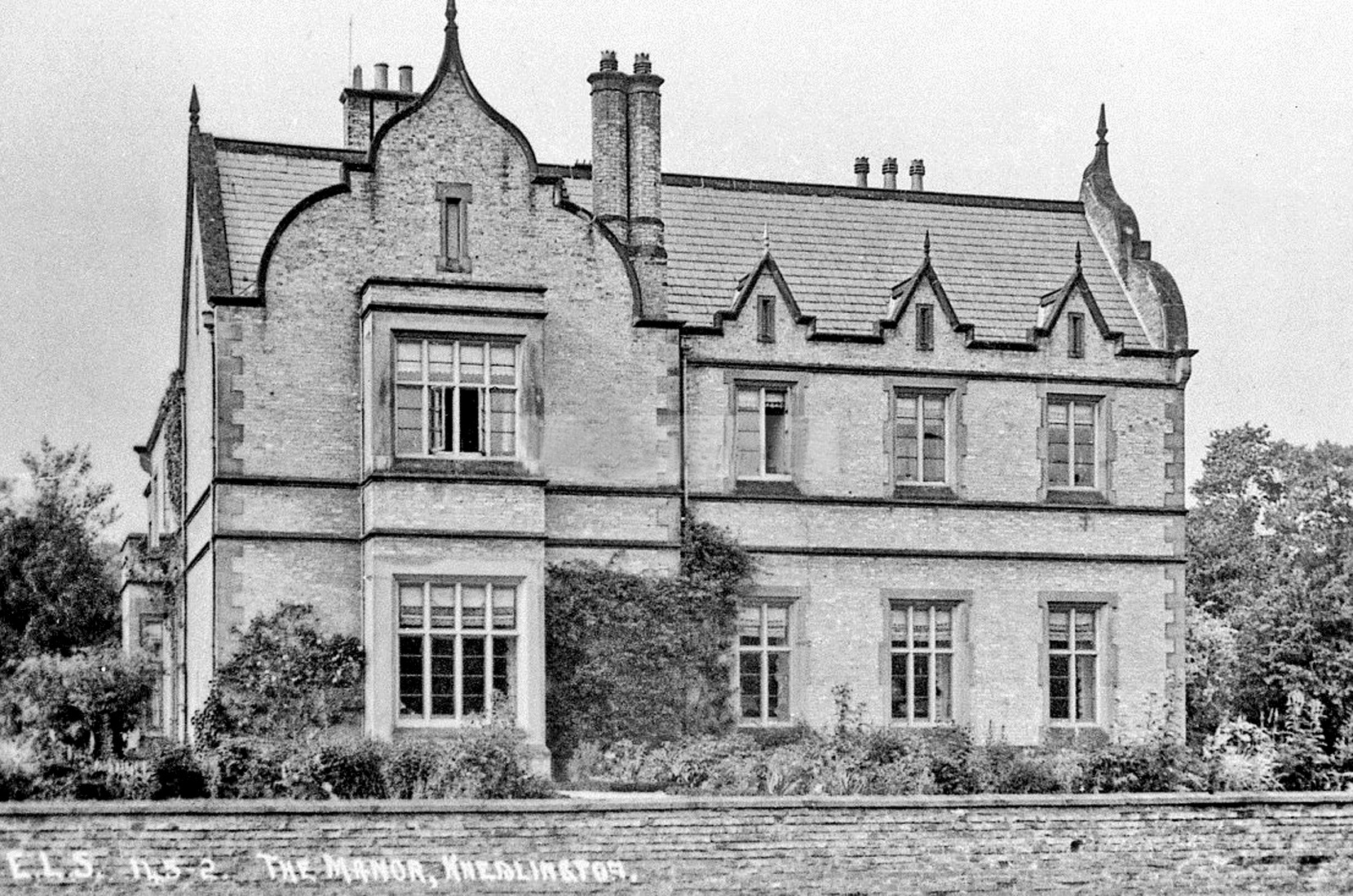
Thomas gradually bought much of Knedlington, Asselby and Barmby [over 2,500 acres] and in 1841-2 he built a new hall which he called Knedlington Manor. It consisted of 33 rooms and was designed by Weightman and Hadfield of Sheffield in the Tudor style. There were formal grounds containing several American trees grown from seeds imported by William Cobbett, the famous 19th century pamphleteer and horticulturist.
He and his family were prominent in local affairs. He was involved with the restoration work of Howden church, the building of the Howden workhouse and the Shire Hall.
He had strong opinions, being a keen Royalist and anti Catholic [writing strongly against the opening of the Howden Roman Catholic church]. He wrote two books – one in 1835 a romantic tale set in April 1644 and another about the history of Howden in 1851.
Thomas and Sarah had four sons, three of whom predeceased him – Elmer died 1846 aged 19, John Sutherland died 1864 aged 35, and Eric William who died in 1868 aged 42.
Thomas died in August 1882. His surviving son Thomas Sinclair Clarke inherited the estate.
The death was reported in the Howdenshire Gazette and included the following
His tenantry marked their esteem of the justness of his character as a landlord, and his fair treatment of them under difficulties, by presenting him with his portrait, painted by Mr. Onlep, R.A., then a very young painter, the pupil of Millais, but now almost rivalling his master in the excellence of some of his best works. The proceedings at the dinner at which the portrait was presented were marked by enthusiasm, which augured well for the cordial relations existing between landlord and tenant. Of late years in the trials his tenantry have had to labour under, he has met them in the same liberal spirit that has characterised the English landlord throughout Yorkshire as well as other counties. At the Hall [ presumably actually the manor] we may note he cut two avenues, affording views from his library windows—on the one of the fine old collegiate church at Howden and on the other of the more modern spire at Goole.
Thomas Sinclair Clarke
He died in 1895. After his death a drinking fountain was installed in 1901 at the corner of Boothferry Road and Howden Road in Knedlington, nearly opposite the front gate of the manor. It carried the family coat of arms and the exhortation ‘Drink, weary traveller and give also to your cattle’.
His widow Jane paid in 1909 for a new market cross in Howden. She remained at Knedlington until her death in 1912.
In 1914 the manor was offered for rent
TO LET, furnished, Knedlington Manor, Howden, East Yorkshire, with 2,000 acres of shooting; this beautiful mansion stands within a park, and contains principal reception-rooms, offices, gun room, etc., bedrooms, 2 dressing-rooms, ample stabling, lovely gardens and grounds, orchards, 50 acres park land, etc. hunting with York and and Holderness packs; golf; two railways. Apply Green and Son, Solicitors. Howden.
The Knedlington estate had passed to Eric de Siobalde Sutherland Rudd-Clarke who died in 1925. He was born Eric Rudd but took the name Rudd Clarke in 1912 after inheriting the estate,
His obituary tells us that
He served on the Howden Board of Guardians and Rural District Council and was president of the Barmby Asselby. Knedlington and Booth ferry sports committees, in addition to which he was trustee of Harlthorpe’s Charity Barmby, and patron many other societies and institutions in the district. Possessed of most charitable disposition the deceased was held in high esteem and affection amongst his tenants and tho villagers at, Barmby, Knedlintrton, and Asselby. He all times revealed a heartfelt concern for the sick, whom he visited regularly, and the sympathy of the neighbourhood goes out to. his widow and three sons. At Barmbv Parish Church he was lay lector, and also officiated in tho same capacity at the Asselby Mission, where he was a regular worshipper.
In 1918 twenty German POWs came to Knedlington to erect tents in the manor grounds. These tents were used by fifty cadets from Ampleforth who came to help pull flax, which was grown locally and was a key component of aircraft wings
1933 Mrs Jessie Forrester Rudd Clarke, widow, married Rev Arthur Waring vicar of Howden. They eventually retired to Thixendale where she died in 1950.
The Knedlington estate was sold to James ‘Jimmy’ Mortimer in 1929. Mr Mortimer had bought the Howden airship station where the R100 was built and in 1931 he played host at Knedlington Manor to Dr Hugo Eckener, commander of the Graf Zeppelin. It was planned at the time that airships for the Transatlantic routes could be built at the disused airship station, but nothing ever came of this.
When Mr Mortimer moved to Howden Hall, he sold the Knedlington estate to the Earl of Yarborough and it then passed to his daughter, Lady Diana Miller. Knedlington Manor was finally demolished in 1954.
Other houses
Of the other houses in the village, Knedlington House in the mid-19th century was the home of Rev. George Richards, an Independent minister. He used the house as a boarding school for ‘young gentlemen’. It later became the home of the Jubb family who were market gardeners.
Knedlington also had an inn called the Anchor on the south of the village street, run for many years in the 19th century by the Waterhouse family. In the 20th century the village was the home of composer and organist Friedrich Muller and descendants of the Cass family. William Cass had been Goole’s first doctor and, as a student, went whaling out of Hull.
Knedlington Old Hall in its present form is believed to have been built around 1649 for Nicholas Arlush
In 1851 Knedlington Old Hall was occupied by Edward Thompson, farmer of 230 acres, his wife Ann, their six children, three female house servants and two male farm servants. The Thompsons were still there in 1861, but by 1871 the tenancy had been taken by Thomas Fentiman. He and his wife Elizabeth lived at Old Hall with their son John, a young nephew, John Keniwell, a governess, three farm servants and one domestic servant.
By 1891 the Old Hall was lived in by Richard Barker, farmer, his wife Elizabeth, a domestic servant and three farm servants. The Barkers were still living in Knedlington, presumably at the Old Hall, in 1901. A survey of 1910 names Cyrus Howden as tenant of the farm.
Cyril Blea of Asselby worked at the Old Hall Farm from 1940 to 1963, the year before the Old Hall was “modernised” internally in 1964. Cyril Blea recalls that the Old Hall had a bathroom and internal plumbing fitted in 1941. Cyril lived in the Old Hall for some time. The farm manager was William Waudby.
From 1964-2001 the Old Hall was occupied by Ken Everatt. He said there was a secret passage somewhere in the house opening to the alleged tunnel from Howden Church to Wressle Castle. This tunnel was a regular talking point amongst the local children, but no one knows if access within Old Hall really existed at all.