The present Saltmarshe Hall
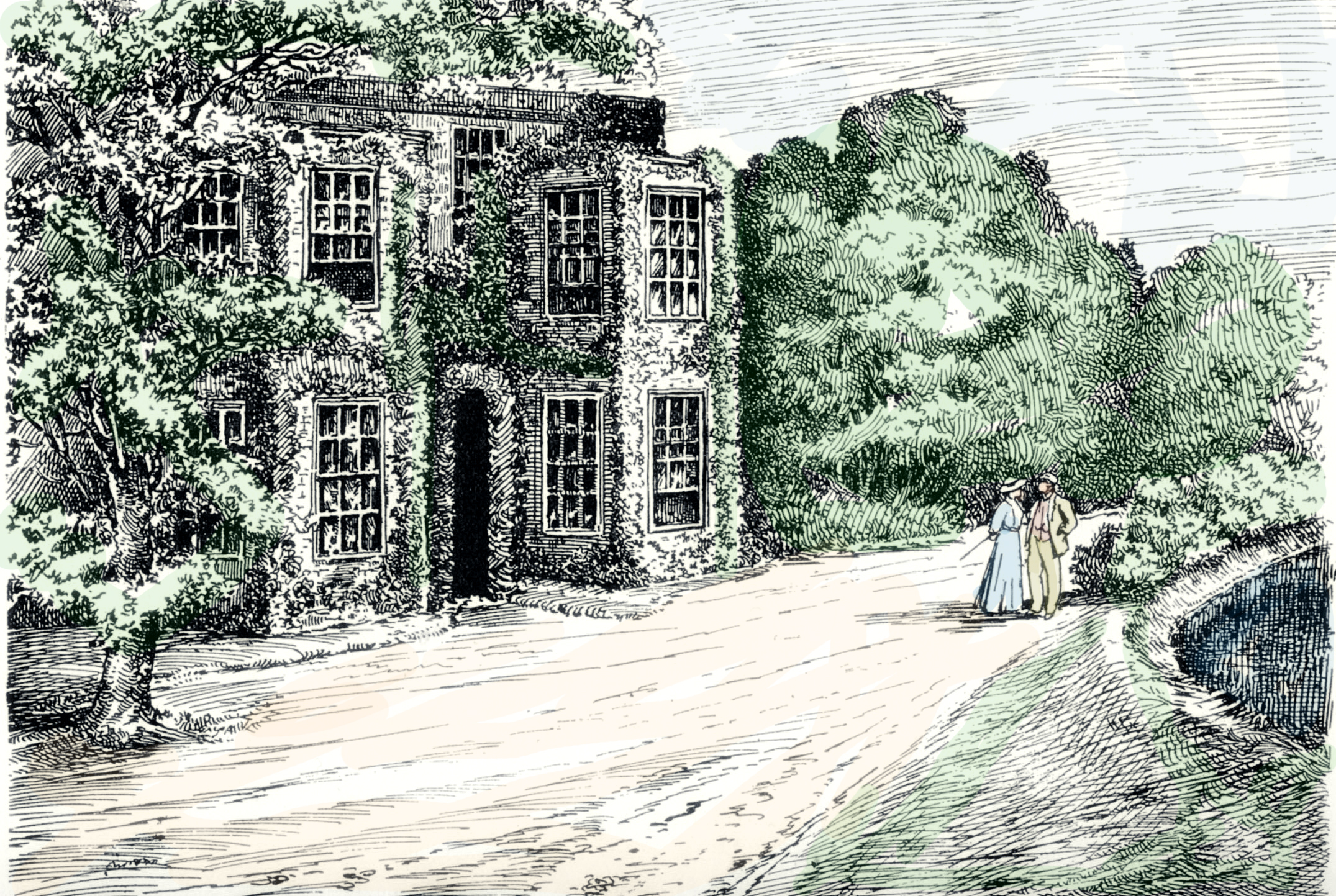
The present hall on the banks of the river Ouse dates from the time of William IV. It was designed by 1825 by architects James Pigott Pritchett and Charles Watson for Philip Saltmarshe whose family had lived at Saltmarshe since at least the thirteenth century. The family There are several earlier generations of the Saltmarshe family but we will begin here with the Philip Saltmarshe who built this impressive hall.
Philip Saltmarshe 1780-1846
He became head of the family in 1796 when he was only 16, on the death of his great uncle, another Philip [1707 -1796]. This great uncle never married but his brother Arthur [1710 – 1776] married Ann Mawson of neighbouring Cotness. Their eldest son was also Philip [1753 – 1791]. However he died before his uncle. So our Philip was only 11 when his father died and 16 when he became head of the family. But he had not had a lonely childhood. He was one of a family of eight children and his mother, Elizabeth Rawson was from a from a large mill-owning family in Halifax. The Rawsons and Saltmarshes were very close.
At this time the Saltmarshe family were living in the “old Hall”, a converted farm house near the river.
Philip was educated at a school near York and at Clare College Cambridge. In 1807 his youngest sister, Catherine aged 19, died of consumption { tubercolosis]. Two years later in 1809 his eldest sister Elizabeth died, aged 27. When his last sister, Henrietta Maria, who was engaged to William Empson from neighbouring Yokefleet, showed symptoms of the disease in 1810 Philip took her to Madeira but to no avail. She died there in Feb 1811 aged 24. He brought her body home for burial.
He was always very proud of his family and keen to restore the family fortunes. As a young man in the militia he even fought a duel over his family honour. In fact by the end of the 18th century the Saltmarshe family fortunes had dwindled and the family were little more than yeomen farmers. They owned 9 houses and 290 acres in the village. Sidney Smith said Philip was keen on sport and hunted regularly as a young man with the York hunt – he and his mother always spent the winter in York as the roads round Saltmarshe were so bad. It is said that he may have had an ill fated love affair.
In 1816 he toured abroad and visited Waterloo where he saw the new graves. He may have been thinking of building a new house for some time but actually began warping the site in 1819 [allowing the tide on to deposit silt]. The road along the river bank was diverted to run through the newly-made park – it is landscaped so that it is not visible from the hall] and he kept accounts [now in the East Riding archives] which dealt with building the hall, emparking the land, making a new road and making bricks. The present hall is constructed of brick, faced with ashlar although the partly concealed west servants wing is not faced and the whole stands on brick arches, now used as cellars. The bricks were made on site. The money came partly from his aunt but Philip was also a successful farmer and made good profits particularly on potatoes which were transported by river.
Marriage and family
On 10th May 1824, aged 44, he married Harriet Denison from Kilnwick Percy near Pocklington. Their first son, Philip, was born in 1825. As a baby he ‘laid’ the first brick for the new hall.
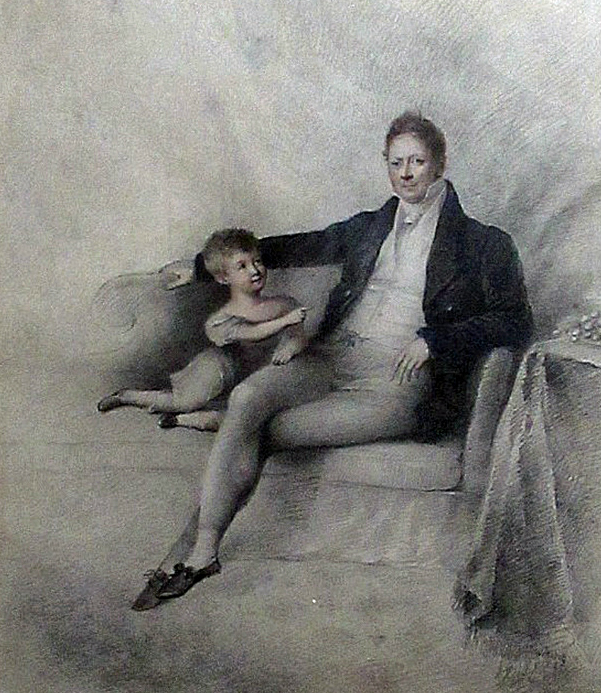
In 1829 artist William Moore (1790 – 1851) painted this charming scene captioned
“Father and Son, Saltmarsh Hall 1829”
Philip’s mother moved out of the old hall and went to live in York. She returned 1828/9 when the new house was finished. Philip and Harriet meanwhile added to their family. Henrietta Maria was born in 1827, Catherine Elizabeth in 1830, Arthur in 1831 and Robert in 1833. In 1834 Philip’s mother, Elizabeth Saltmarshe died. She had been left a young widow in 1791 but from the notebooks and diaries she left behind we can see that she took the responsibilities of looking after her son’s inheritance seriously. And also of course it helped that her family, the Rawsons were large and well connected.
In 1841 on census night three of the children, Henrietta, Catherine and Robert were at home with their governess, Juliana Allen There was also a staff of twelve servants then living in the hall. We do not know their exact roles as they were listed simply as either female servant or male servant. However we know that one, John Horsley was personal servant to Philip Saltmarshe – his notes and accounts are in the archives. Another, James Beck was by 1851 the butler. Arthur, aged 10 was at prep school at Cheam and Philip aged 16 was at Eton. The childrens’ parents, Philip and Harriet, were away from home staying at Grove Park house Budbrooke in Warwickshire with their Philip’s brother Christopher Saltmarshe and family.
Philip continued to improve Saltmarshe hall and in 1842 the stables and ice house were built. He was very keen on his game shooting and protecting the game at Saltmarshe. He bought up land and houses and by the 1840s owned 24 houses and cottages and 531 acres in and around Saltmarshe as well as land elsewhere. He played a prominent role in East Yorkshire society. In appearance, his grandson wrote, ‘he was a fine big man over 6 ft 2 in height and broad in proportion’. But then tragedy struck. Philip Saltmarshe aged 66 died suddenly on 28th November 1846 ‘of a quinsy sore throat’. His grandson wrote ‘he was apparently very badly treated by Dr Gaggs, the family physician at Howden’ .
His eldest son, Philip was then aged 21/2 The funeral was at Howden a few days later. We have a graphic description of it: Notice that none of the ladies attended.
‘The remains of this much-lamented gentleman were removed from his late seat at Saltmarshe, near Howden, on Friday week, and deposited in the family vault in the church at Howden. At half-past ten o’clock, the great bell of the parish church beginning to toll, announced the approach of the hour when his remains were to be consigned to the silent tomb. At twelve o’clock the funeral procession arrived at Howden, and moved in the following order: The Undertakers. The Mutes. The Body, in a magnificent hearse drawn by four horses. The first mourning coach [carrying] : Philip Saltmarshe, Esq., Arthur Saltmarshe, Esq., and Robert Saltmarshe, Esq., the sons of the deceased. The second mourning couch [carrying] : Arthur Saltmarshe. esq., Christopher Saltmarshe, Esq., brothers of the deceased and J. Walker, Esq., the High Sheriff. The private carriages of many of the relatives, including the High Sheriff’s carriage, and also a very great number of private carriages belonging to the gentry of the town and neighbourhood of Howden; The tenants on horseback The members of the respective benefit societies The tradesmen and other respectable individuals of the town of Howden. In this manner the procession arrived at the great western entrance of the church. After they had advanced a few paces up the aisle, the organ played a solemn dirge, and the Rev. T. Guy read the burial service in a very impressive manner. The sacred edifice was crowded by a numerous assemblage ot the most respectable classes, who were anxious to evince their respect for the departed, and their sympathy in the general grief for his death, by attending at the funeral. At the conclusion, the procession moved up the aisle to the place of sepulchre in the transept. During the whole of the impressive ceremony we never saw more unfeigned sorrow than that which was exhibited in the countenances of the relatives m this mournful scene. That regret was also exhibited in the conduct of the assembled multitude, more strongly and intensely than, we believe, was witnessed at the death of any subject within the memory of the oldest person now living. As a tribute of respect all the shops in the town of Howden were closed on the forenoon at half-past ten o’clock, and remained so until after the interment. The deceased was a munificent benefactor to the poor, a liberal contributor to the public institutions of the town, an upright magistrate, a high minded English gentleman.
Philip Saltmarshe [1825 -1912]
Family
Philip had been educated at Eton and Trinity College, Cambridge and was commissioned as cornet in 8th Hussars in 1846. He retired as a lieutenant in 1850. So in 1851 on census night Saltmarshe Hall was occupied by Philip Saltmarshe, described as a landed proprietor and farmer of 200 acres employing 7 labourers, his mother Mrs Harriet Saltmarshe, described as a gentlewoman, and his sister Catherine. His sister Henrietta Maria had married Rev Hon Frank Sugden the previous year. He was the vicar of Hale Magna in Lincs. However his father was Sir Edward Sugden, later Lord St Leonards who had risen from being the son of a barber to become Tory Lord Chancellor. The family home was a mansion known as Boyle Farm on the Thames near Thames Ditton and opposite Hampton court. Frank later inherited it.
Catherine later married Henry Wells Allfrey of Hemingford House near Stratford on Avon, a widower of independent means with 6 children. She later had four children of her own. she died in 1920
Staff
Looking after the three members of the family at Saltmarshe in 1851 was an indoor staff living in of eight servants. In charge was James Beck, the butler. He had married Hannah Newbold a servant in 1848 and by 1861 Hannah, was the housekeeper. Mrs Saltmarshe had a ladies maid, Elizabeth ‘Lizzie’ Sinclair aged 37 born at Saltmarshe. However she found romance as she married the gardener Thomas Webster in 1851 and she moved to other posts with him. There was also a cook, a kitchen maid, two housemaids, a coachman and a groom.
A large family
Philip married his first cousin Blanche Denison in May 1852 at Allerthorpe church. They went on to have 10 children.

Their first child, Philip [shown above aged 6] , was born in 1853. Their second, Arthur Harry, was born in March 1855 at Waplington Manor near Pocklington, then the Denison family home. Later that year, also at Waplington, Philip’s youngest brother Robert died aged 22. Another son Cecil was born in 1856 but died aged 3 in 1859. Robert Edwin was born in 1857 and Ernest in 1859. So it is not surprising that in 1860 Philip made additions to the nursery wing and also at same time built the billiard room and a brew house.
The 1861 census shows a living in staff of 12 and there were others who lived in the village. Mr and Mrs Beck were butler and housekeeper and there were also a ladies maid, two housemaids, a laundry maid, a nurse , a kitchen maid, a scullery maid, a footman and a groom. There was also a governess Martha Notley aged 20 from Suffolk. John Rogerson who was both coachman and personal servant lived with his family in the village.
Mrs Harriet Saltmarshe in 1861 was living in London. She died in 1864 at 27 Queens Gardens, Hyde Park. The family at Saltmarshe continued to grow with Hugh, born 1861, Lionel in 1862, Blanche Violet in 1864, Harold in 1866 and Humphrey Arthur in 1868.
In 1871 Mrs Blanche Saltmarshe and the younger children were at home and the older boys away at various schools. Philip was not at home and may have been away fishing or shooting. There are several mentions of him in newspaper reports of the period where for example on one day in August 1871 on a Scottish moor Mr Saltmarshe and partner killed 80 brace of grouse. This must have been the heyday of Saltmarshe Hall. With 9 children, their parents and a staff of 12 and no doubt visitors and shooting parties it must have been a very busy place.
Celebrations
In June 1874 there were great celebrations at Saltmarshe at the coming of age of the eldest son Philip. He was by then serving in the Royal Horse Artillery. After being educated at Eton he had joined the Royal Military Academy, Woolwich and entered the Army in 1872. He became a Lieutenant in the Royal Artillery on January 9th, 1873.
From the York Herald newspaper
Great rejoicings have taken place at Saltmarshe Hall, near Howden, in honour of the coming of age of Mr. Philip, the eldest son of Mr. Saltmarshe. On Tuesday a large party of tenants, tradespeople, and others connected with the family dined and spent the day at Saltmarshe Hall. Dinner was provided in a spacious marquee on the lawn in front of the house, and the guests as they arrived were most cordially welcomed by Mr. and Mrs. Saltmarshe and their sons and other members of the family. After the loyal toasts had been duly honoured, Mr. Sowby, who has been a tenant at Saltmarshe for 32 years proposed the health of Mr Philip Saltmarshe jun. Mr George England of Howden then said he had been requested on behalf of the tenantry and many of the neighbours and friends at Howden, to ask Mr. Philip’s acceptance of a richly engraved silver salver (which was then uncovered, amidst loud applause.) After a few brief but well-chosen remarks, Mr. England read an address which was illuminated on vellum. Mr. Philip SaItmarshe, in replying, said his profession rendered it necessary, for him not to be so frequently amongst them as he could have liked, but he should endeavour to take the greatest interest in everything| connected with his home, and he hoped that like his ancestors, to whom allusion had been made, he might ever prove worthy of their regard. Mr. E. Storry then proposed the health of Mr and Mrs. Saltmarshe and the family. Mr. Saltmarshe, in replying, thanked all present for meeting him that day to do honour to his son. and for the kindly feeling they had also exhibited to Mrs Saltmarshe and himself. The presents made would ever be remembered with most cordial and kindly feeling to all who had taken part in their presentation. Mrs Saltmarehe also added a few words of thanks
The hall, gardens, greenhouses, and park were then thrown open to the visitors, who enjoyed themselves as they pleased until dusk, when numerous arrivals of visitors (principally young ladies and gentlemen) took place and a ball was held in the marquee. On Tuesday morning Mr. F. Haldenby, on behalf of the servants hall, presented Mr. Philip Saltmarshe with a rich oxidised silver and gilt vase as a mark of their respect for him. On Wednesday a banquet was given to the smaller tenants, the cottagers, and the employees on the estate, and a treat to the children of the school. The houses in Laxton and Saltmarshe were all gaily decorated with flags and the demonstrations have throughout been characterised by the heartiest enthusiasm.
A bad time
However this happy atmosphere did not last long. In April 1878 the second son of the family, [Arthur] Harry, aged 23, was killed in the Zulu war
Then two years later on 26th March 1880 Blanche Violet, the only daughter of the family died at Torquay of typhoid. She was only 16. Then less than a month later, on 21st April her mother Blanche aged 45 died at Saltmarshe hall. The family must have been devastated.
A year later, rather than face the melancholy anniversaries at home Philip Saltmarshe, accompanied by his brother Arthur, went on a trip to America. He kept a diary [ now in ER archives]. They sailed from Liverpool on Mar 22, on ‘City of Chester’ and arrived at New York on 1 April. They travelled on to Philadelphia, Washington, Las Vegas, Santa Fe, San Bernardino, Yosemite Valley, San Francisco. They visited Philip’s sons , Robert ‘Bob’ [then aged 24] and Ernest [then 22] near Grants Landing, via Portland, Seattle, New Westminster, Fraser Fiver, Fort Hope and Esquimault Harbour. They left San Francisco on Jun 15th and journeyed to Webber Lake, Carson City, Virginia City, Reno, Salt Lake City, Denver, Chicago, Detroit, Niagara, Kingston, Montreal, Saratoga and eventually back to New York. They arrived back in Liverpool Jul 24th.
Meanwhile the only occupants of the hall in April 1881 were a house maid, a lady’s maid and a kitchen maid .
A second marriage
In 1889 Philip married as his second wife Harriet Hotham. In April 1891 only Philip and his wife were at home. The rest of the family were scattered aound the world.
The staff .
Most were from all over the country. There was Joseph Hartley, the butler, who lived with his wife in what is now Jamaica Cottage. Annie Lancaster the cook, Emily Joy who was Mrs Saltmarshe’s ladies maid, Agnes Austin, a housemaid. The other housemaid was Mary Bruce, Alicia Cooke was the laundry maid, Mary Smith the kitchenmaid and Sarah A Eggleston the scullery maid There was also Charles Bellerby, the 16 year old footman whose father was the coachman and who lived with the rest of his family in what is now Joiner’s cottage.
Sudden death
Sadly in February 1894 Philip’s son Hugh Saltmarshe [born 1861], a London solicitor at Lincoln’s Inn, was killed when he mysteriously fell from a train and was found at Clayton Tunnel on the track side near Brighton. The funeral was at Laxton and ‘the remains deposited in a new vault, lined with moss and snowdrops’
Then in July 1897 Philip’s second wife, Harriet died.
By now Philip Saltmarshe was 72 but from reports he continued to play a large part in local administration as well of course as overseeing the running his own estate with the aid of his land agent.
John Biggs
The agent was John Biggs who lived at the estate house and office in Laxton. He was originally from Limerick and had come to the Saltmarshe estate in the 1880s. In 1881 he was assistant farm bailiff at Rowland Hall near Wressle. In 1885 he married Sarah Jane Kennedy – ‘Jennie’. They had 3 daughters Edith Julia, Winifred and Dorothy Harriet Jennie died in 1903. John Biggs died in 1932.
Diamond Jubilee 1897
Leonard Elmhirst who founded the Dartington Hall project was brought up at Laxton where his father was the curate.
He was apparently greatly influenced by his early days at Laxton and spoke and wrote extensively about his memories of rural life and characters in the village. The following is extracted from an early chapter of a book written on his life by Michael [Lord] Young.
William [ Leonard’s older brother] and Leonard were put to bed early and then woken when the grown ups had eaten supper. They drove in the family dog cart, with the groom Charles Dilcock, behind, to Saltmarshe. Through the darkness at the head of the procession of torch bearers came old Colonel Saltmarshe. Two by two they had marched from the hall to the banks of the river. The last bucket full of tar had already been poured on to the giant bonfire from the top of a long ladder. On their arrival the match was struck. With a crackle which terrified the two boys the flames leapt up, sending sparks far out into the sky. The light picked out the faces in the crowd, the branches of the trees and was reflected for miles over the Ouse.
In 1901 Philip was aged 76. The hall was staffed with a housekeeper, a laundry maid, 2 housemaids, a kitchenmaid, a scullery maid and a 16 year old page.
What happened to his sons
Robert 1857-1903 died in The Dalles Oregon at the end of the Oregon Trail. It was an Indian trading centre. He was a merchant dealing with hides and pelts.
Ernest 1859-1941 He was a civil engineer. We know he was in USA in 1881 when his father and uncle Arthur visited. He died in May 1941 at Torquay. He left £49 000 to his brother Humphrey Arthur. Interestingly he left £500 to a Venetian gondolier Attilio Geolin ‘for his long service with me”
Lionel 1863-1920 Lionel was a civil and mining engineer and spent time in South Africa and was there at the time of the Jameson raid He died in 1920 at ‘Brendon’ Palm Bay, Margate Kent and left £26000.
Harold 1866-1931 He emigrated to Australia where he died in July 1931. An Australian obituary tells us a little more of his life.
‘He was educated at Charterhouse, where he distinguished himself as an all-round athlete. He came to Queensland as a young man, and, after working as a jackaroo on Jondaryan on Darling Downs, he became interested with Mr. A. J. McConnel in a North Queensland station, called Conway. He visited Western Australia during the gold rush of the early ‘nineties, but as the result of a severe illness had to relinquish mining, and take a health voyage to England. On his return to Queensland he joined his brother ?Humphrey Arthur, and Mr. Fred. Brown, a well known mining expert, in a gold sluicing venture on the Russell River. Subsequently he took up farming in the Esk district, but in a few years bad to relinquish this pursuit and return to England on account of his father’s ill health.
Mr. Saltmarshe returned lo Queensland in 1912, and soon afterwards built his home Salamaris, at Southport and has since resided there. During the Great War the deceased gentleman look a very prominent part in the recruiting campaign in the Southport district, and afterwards was deeply interested in, and worked hard for, the repatriation of soldiers. The late Mr. Saltmarshe was a genial and active figure who never lost his keen interest in sport. Of late years became an enthusiastic golfer, rising to me position of president of the Southport Golf Club, He is survived by his wife formerly Miss Lilian Drury and two daughters Mrs. Clavile Bere.of Mapleton, and Miss Yvonne Saltmarshe, of Southport and also several brothers,
Humphrey Arthur 1868-1946 was educated at Charterhouse then, aged 18 went to Jesus College Cambridge in October 1886. He was a prospector and miner and spent much time in Brazil. He died in 1946, in London and is buried at Laxton.
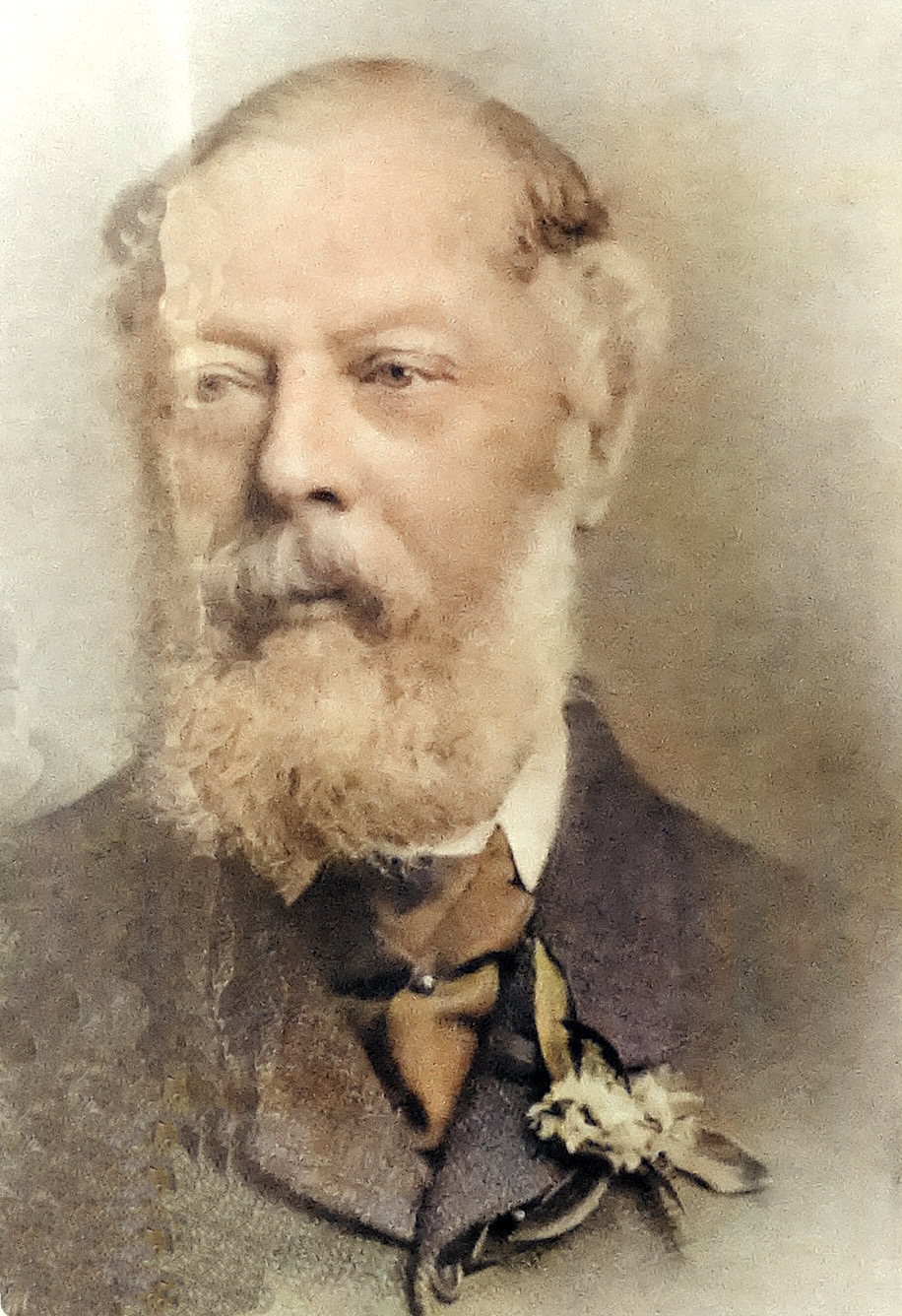
1911 Philip Saltmarshe was 86 and ill. His sons Lionel and Humphrey were at home. He died in March 1912.
Hull and East Yorkshire Times‘
We regret to announce that the death occurred {on Sunday morning of Lieut.-Col. Philip Saltmarshe of Saltmarshe Hall, near Howden. On Saturday he reached the age of 87 years. Mr Saltmarshe had been in failing health for some time, and ‘had not been able for several months to occupy his positions of chairman at the Howden Petty Sessions and Board of Guardians. He was in Howden in his motor-car on Wednesday, and on the following morning he was taken ill, and the services of Dr Brown and two extra nurses were at once obtained; but all was of no avail and Mr Saltmarshe passed away. He will be greatly missed. He was an English gentleman of the old school, a good landlord, and a true friend of the poor.’
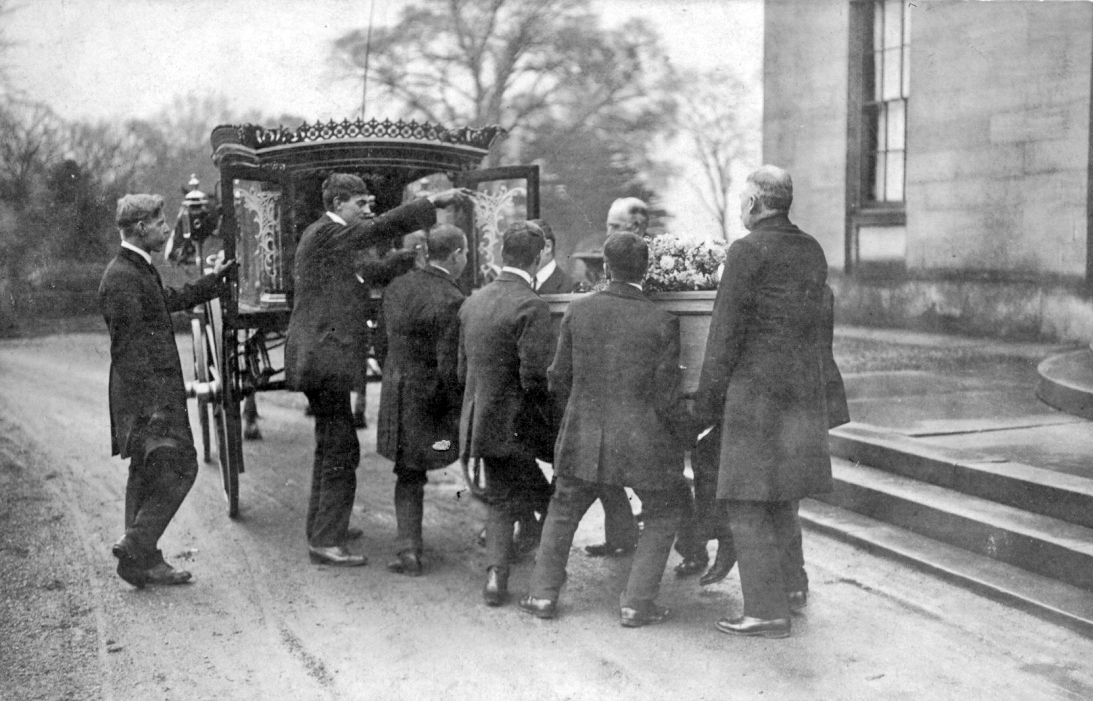
The new head of the family was his eldest son Philp, a career soldier until his retirement in 1903. He lived in York and wrote a comprehensive history of Saltmarshe in 1910, dedicated to his father
Philip Saltmarshe 1853 – 1941
He was educated at Eton and was admitted to the Royal Military College, Woolwich, at the age of 17. He received his commission in the Royal Artillery three years later and served in the second Afghanistan war of 1878-79 .
In 1883 married Ethel, the daughter of Charles Murray Adamson of North Jesmond, Newcastle-on-Tyne. They had four children whose birthplaces reflect where he was stationed Blanche Violet was born at Charlston House Dublin in 1884. Ivy Oswald was born at Aldershot in 1885. Myrtle Elnard was born at Southsea in 1891. The youngest child and only son of the family, Philip was also born at Southsea in 1894.
Col Philip Saltmarshe served in the Boer War, 1899-1900. He had a batman [personal servant], John Frederick Samways who was with him during the Boer War. In the national army museum are two items which belonged to him: a leather canteen with leather strap and buckle dating to around 1900 containing a fork, spoon, corkscrew and salt and pepper pots and a leather medical kit from the same period. He was with the Saltmarshe family as batman to Col Saltmarshe in Sheerness in 1901 and in 1911 was with the family in York as their butler. But by 1921 he was in a small cottage in Laxton working as a bricklayer’s labourer and later was working as a waiter in Scarborough.
First World War and the Saltmarshe family
Col Saltmarshe aged 61 rejoined the Army on the outbreak of the war and commanded a reserve brigade of Royal Artillery until June, 1916.
Eldest daughter Lady Violet In 1907 had married Lord Robert Deramore of Heslington Hall and became Lady Violet Deramore. She was a member of the VAD and transformed Heslington Hall into a home for convalescing soldiers.
In 1914 Ivy Oswald married Reginald Herbert Woods, an officer in Kings Royal Rifle Corps . They had a son Humphrey born 1915. Reginald Woods was a colonel and won the MC.
Philip was 20 when the war broke out. He served with Kings Royal Rifle Corps 1st battalion as a 2nd lieutenant. His records show he was hospitalised several times but with illness rather than wounds.
But the family did not escape unscathed from the war. Youngest daughter Myrtle died in December 1918 aged 28 of pneumonia following flu. She was only ill for 10 days. She had been a VAD at Bournemouth and had resigned to take up a position at the Hospital for Limbless Soldiers at Roehampton. She is buried at Laxton.
Between the wars
Col Philip Saltmarshe led a life of public service. He was president of the East Riding Antiquarian Society, sat regularly at the Howden court, and on the death of Mr R. S. Scholfield became chairman. He attended the last petty sessions held at Howden before his death, and thus completed 65 years as a magistrate, 23 years of which were as chairman. In 1910 he was elected to the East Riding County Council to represent Howden, and was created an alderman in 1922. He was chairman of the East Riding Education Committee and chairman of the Howden Rural District Council and Guardians Committee.
In 1922 he dedicated the war memorial clock in Newport

and in 1929 as an East Riding councillor he cut the ribbon to open the new Howden by- pass when the Boothferry bridge was opened on July 18th .
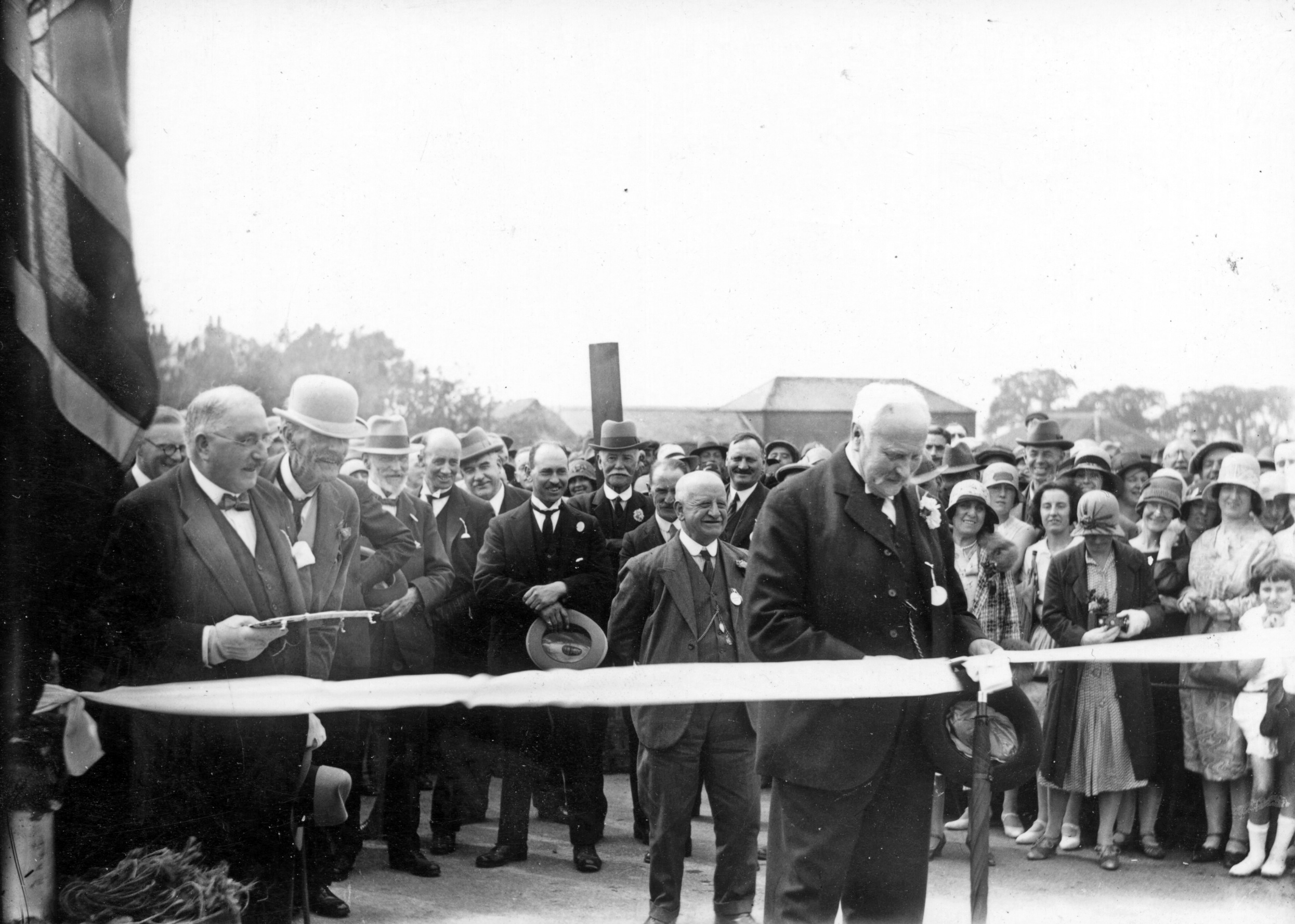
Colonel Saltmarshe died in March 1941 aged 87. His widow died in 1955 aged 93.
Lady Deramore
In 1913 she opened the Derwent Valley Light Railway of which her husband was chairman. Magazine articles of the 1920s also show her to be a renowned hostess. In 1925, Lord Deramore became Lord Lieutenant of the East Riding, a role which increased the couple’s public responsibilities. Lady Deramore participated in a number of royal visits to the area, including that of the Duke and Duchess of York to Hull and York in 1928 and a visit of Queen Mary in the 1930s. Lord Deramore died on 1 April 1936. Violet Deramore relocated to London the following month as Robert’s brother, George, became the 4th Lord Deramore and took over Heslington Hall. During the Second World War, Violet Deramore spent her time both in London and the family home, Saltmarshe Hall. In her later years she moved out of London to live with her god-daughter, Miss Lisa Gray, in Newbury, Berkshire. Lady Deramore died on 30 December 1972 in Newbury, aged 88.
Lt Col Humphrey Woods, son of Ivy Oswald and Reginald was killed in action on 14th June 1944 in Normandy. He had gained gained the DSO and MC in North Africa.
He was educated at Winchester and Sandhurst and joined the 2nd Battalion of the Kings Royal Rifle Corps at Aldershot in January 1936.
After a distinguished war Humphrey was given command of the 9th Battalion, Durham Light Infantry on the 26th July 1943. He joined them in Sicily . He returned home with his battalion in December 1943 to prepare his men for the invasion of France.
On 6 June 1944 Humphrey was leading his battalion on the assault of the Normandy beaches. All the objectives they were given were captured and then the Battalion was engaged in seven days of bitter and continuous fighting. Finally, on 14 June 1944, near Tilly-Sur- Seulles, Humphrey went into action for the last time. Two companies were given several objectives to capture. As ” A” company moved up in two waves it was met by heavy machine gun fire that killed or wounded most of the officers and sent the men diving for cover. ” B” company, who were following closely behind, found themselves in the same position.
Humphrey leapt out of his carrier and was seen dashing about urging his men forward. They managed to move forward and penetrate the first objective, owed mainly to Humphrey’s fine example. He repeated his efforts with “B” Company and also moved them to their first objective. He then returned to his carrier and sat down to speak to HQ on his radio set. As he did so the German defence opened up with mortar fire. As the first salvo landed a young officer, who was in the carrier, looked round to see Humphrey looking at him and smiling, he suddenly slumped over to his left, lasting only a few seconds longer.
He was originally buried where he fell but was later re-interred in the Bayeux War Cemetery,
His mother died in 1964 and his father in 1968
Philip Saltmarshe 1894 – 1970
Philip never married and when he died in November 1970 aged 76 he left £30 000 of his personal fortune to York RSPCA cats home. He spent his last years in The Retreat nursing home in York. For several years before that he lived a bachelor lifestyle with villager Bertie Brignall being left money in his will to care for his cats.
He was always known as Captain Saltmarshe. He was a magistrate at Howden and vicar’s warden at Laxton church
He travelled extensively abroad in the 1930s. During the Second World War he led the local Home Guard.
in 1968 there was an armed robery at the hall when Capt Saltmarshe and a gardener were tied up and threatened with a gun. Antiques and guns were stolen
The contents of the hall were sold at a three day sale in 1971. It raised £81,000. The estate was sold later in the month.
Life at the hall- memories
Vera Stewart, [later Arnold], went to work at the hall in the late 1930s and who remembered that even then the hall was fully staffed with a butler, a footman, a hall boy, a cook, a kitchen maid, a scullery maid, a ladies maid, about 4 gardeners and at least three housemaids.
Staff names Vera remembered were: Mr Beedom ‘met me at the station – I was very surprised when I came out and saw a pony and trap’. The housekeeper was Mrs Eaton. She was a very big stout lady, very big and she had started in service at Clifton hall, near Nottingham. The butler was Mr Bradford who lived in the village. He came in about half seven in the morning and left for home about half past ten at night. The third housemaid was Elsie Snidle from Sandhall. Alice Arnold was the kitchen maid. The footman was Ernest Ounsley. He came from Asselby and wore a maroon coat, a tailcoat with brass buttons down the front. In the morning he wore a short black jacket like a blazer with a yellow and black striped waistcoat very narrow and the butler wore the same but without the waistcoat and in the evening he wore tails, when dinner was served. The hall boy was Cliff Elwood. He was quite a character and also came from Asselby. There was also a chauffeur, Mr Starkey who sometimes took Mr and Mrs Saltmarshe out in the car but not far as both were elderly then
Joyce Lawson, nee Whitehead
Last Sunday, 28th June 2009, I visited Saltmarshe Hall. It was an open day for the garden and so I took the opportunity to revisit one of my childhood memories. It must have been in 1928/9, when I was about 4 years old, that I first went to Saltmarshe Hall with my Mother. We went with her mother, Grandma Ramsey, my mother’s brother, Uncle Ted, and his wife Aunty Bertha.
We went to visit my Grandmother’s sister who was Housekeeper for the owner, Colonel Saltmarshe. I remember I was quite alarmed on that first visit as there were about six or more peacocks in the courtyard and their greeting calls were so loud and raucous I found it frightening. I remember the courtyard surrounded by farm buildings and housing for the staff and a rear entrance to the main house. All the kitchen staff were wearing white aprons with blouses and skirts while my Grandmother’s sister, the housekeeper, was all in black. A long scrubbed table was set for the five o’clock meal.
The owner [ in 2009 Philip Bean] had heard me mention the long table that had been in the kitchen and he told me it was still there, though no longer in the kitchen, and he asked me how big I thought it was. I found it difficult to remember really but I thought about 30 feet long. He took me to an outhouse where the table was. I recognised it immediately but it was only about 15 feet long, it seemed much bigger when I was a child, but then I was only quite small. Grandma and Grandpa Ramsey had moved to Skelton, near to the Hall, when Grandpa worked on the Hook Railway Swing Bridge. The river here is quite wide with a strong current but I was told their furniture and household goods were moved on an upturned table, on the river which was frozen over
[/vc_column_text][/vc_column][/vc_row]