The Market Place in Howden has evolved over the years it is sometimes hard to work out which buildings had which occupants! And memories, which I have collected from local people over the years, may not always be reliable or correctly interpreted. If you can add anything please get in touch.
—
1. Market Place, Howden [now a bakers’ shop]
1851 – Robert Kettlewell, provision merchant, born Cliffe
1861 – Robert Kettlewell
1901 – Alfred Charles Thompson, grocer, born Barmby on the Marsh. By 1911 Alfred was a greengrocer in Norwich.
1911 – Arthur Rackstraw Smith, hosier and draper, born Sheffield
For a time this was a fish and chip shop run by Mr and Mrs Arthur Shipp.
Memories of the fish shop: It was very popular. Customers used to start queuing at 6 o’clock and it didn’t open till 7 o’clock; they were as good as that. Mr Shipp would talk to the customers whilst frying – “That were a good match” – but he’d never look round. Dave Sparrow used to come and collect all the fish and chips for Skelton and Howdendyke. He may have been was an evacuee. He worked for ?Vic Claydon. They said he had a cap with a light on and went chopping sugar beet in the dark!]
2. Market Place, Howden [now Touchwood]
1851 – Henry Sanderson, tailor, b Norton(?)
1861 – George Simmons, grocer, b Brighton, Sussex
1871 – Henry Winter, saddler, b Howden
1901 – Henry Kilham, saddler, b Howden
Memories: Before the First World War William Gladstone Bailey a fruiterer, kept this shop . He served as a guardsman in the war and later married Mary Remmer of Knedlington. In 1939 he and Mary were living at Manor Farm Knedlington.
For a time the premises were used as the War Ag. office and ?Dan Freeman and Ted Dexter worked there, then Wards took it over as a ladies’ department.
3. Market Place, Howden [now Tailor’s Chalk]
1851 – Robert Meggitt, painter, b London
1861 – Robert Meggitt
1881 – John Burnd, painter, b Howden
Many people remember these premises as Wards’ tailors. It is now [2026] a micro bar.
Moses Ward, originally from Eastrington, was apprenticed to Mr Haigh in Bridgegate. Mr Haigh lived in what much later was known as ‘Charlie Fitch’s house’, which is opposite what is now PA. Mr Ward started business on his own in 1875 in Highbridge. He moved to number 3 Market Place, Howden in between 1881 and 1891.
The shop is Victorian and was probably built for Moses Ward.
His son William Ward was educated at Howden Wesleyan school and began work with his father at the age of 11. After the death of his father in 1912, William continued the business until he was joined by his own son Arthur.
There were two resident apprentices – Arthur Sherburn and Robert Thirkettle. They worked in the back room, sitting crosslegged on a low table, making men’s suits.
Pat Newstone, nee Eccles, remembers that during the war, although it was really a man’s shop, it did have some ladies’ clothes but nowhere to try them on. So Pat’s mother used to send her down to ask for four ladies’ dresses to try on at home. She picked what she wanted and sent back the rest. Mr Ward used to go out to customers to measure and give fittings.
Arthur Ward’s son Gordon married Betty Heald and they opened a ladies’ dept in the adjoining shop (number 2).
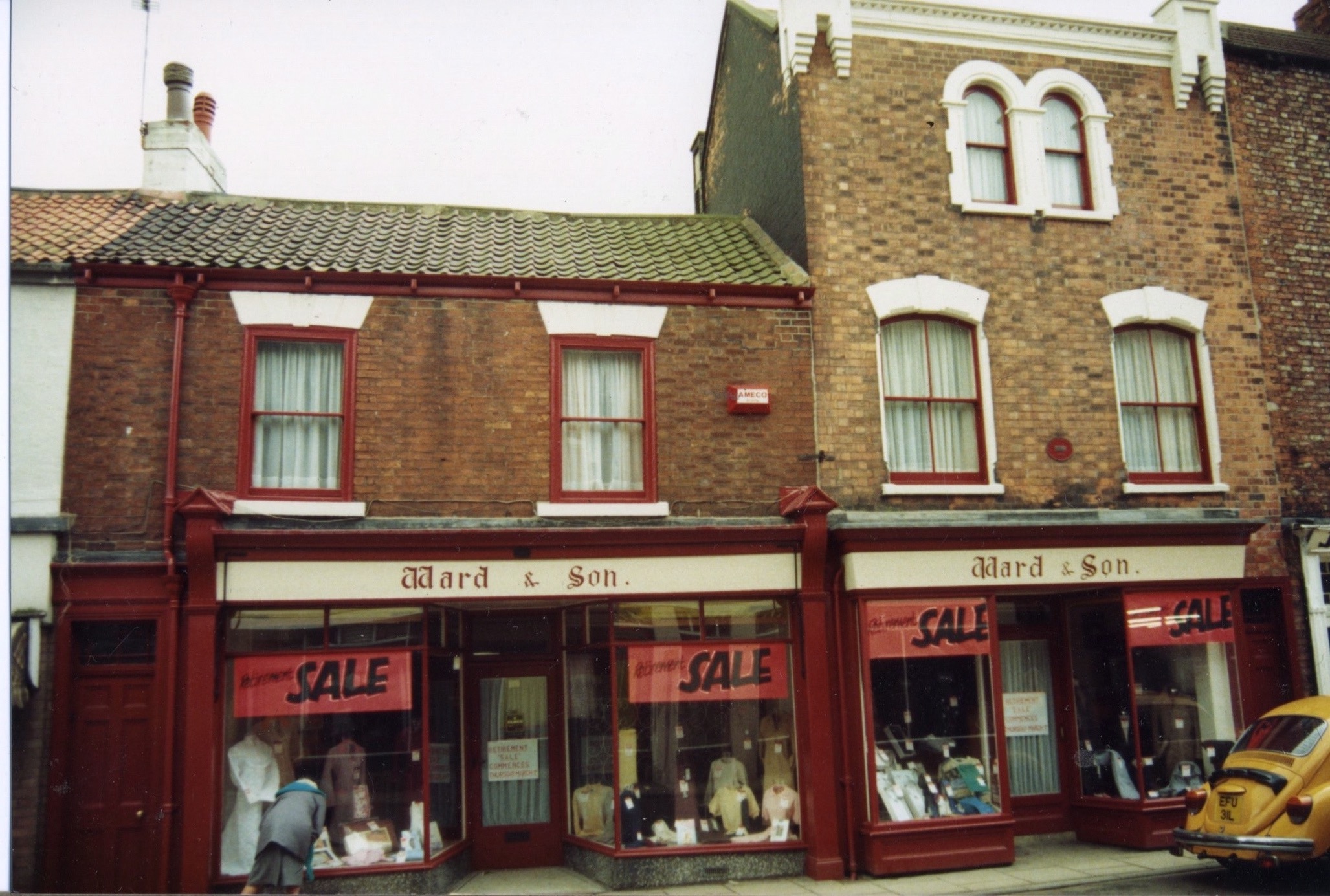
Wards’ shops at numbers 2 and 3 Market Place
4. Market Place, Howden
1861 – William Rowntree, shoemaker, born Easingwold
1881 – Mary Rowntree, widow, boot and shoe dealer, born Preston [Hull]
1891 – Robert Thompson, hatter and tobacconist, born Barmby
1901 – Jonathan Sowersby, draper, born Garthorpe
Mr Aitken, chemist, lived here and later Ted Willmott lived here and ran his carrier and road haulage business from these premises.
Willmotts Motors
Edward [Ted] Willmott was born in 1907 and came from a Goole family of sea captains. He began his haulage business in 1930 when hs father
Possibly it was a betting shop(?) run by Frank Lead. Then it was Mrs Joan Lead’s flower shop.
5. Market Place, Howden [now Parkins’ butchers]
1861 – William Stephenson, tallow chandler, born Hull
In 1867 Thomas Hill, butcher, born Howden, bought the premises and moved from number 21 Market Place, Howden.
In 1898 Thomas Hill sold the premises to Greenwood Rhodes, a butcher born in Baildon. He eventually moved to farm at Spaldington and in 1918 Mrs Wilde was the occupier when the property was sold to Frank Moore. Her husband, William Loftus Wilde, was a cattle dealer from Hemingbrough before the family came to Howden but he died after being kicked by a horse in 1916. The Wilde family had a long association with the butchers’ shop and William’s son Reg followed in his father’s footsteps as a butcher. Reg died in 1941.
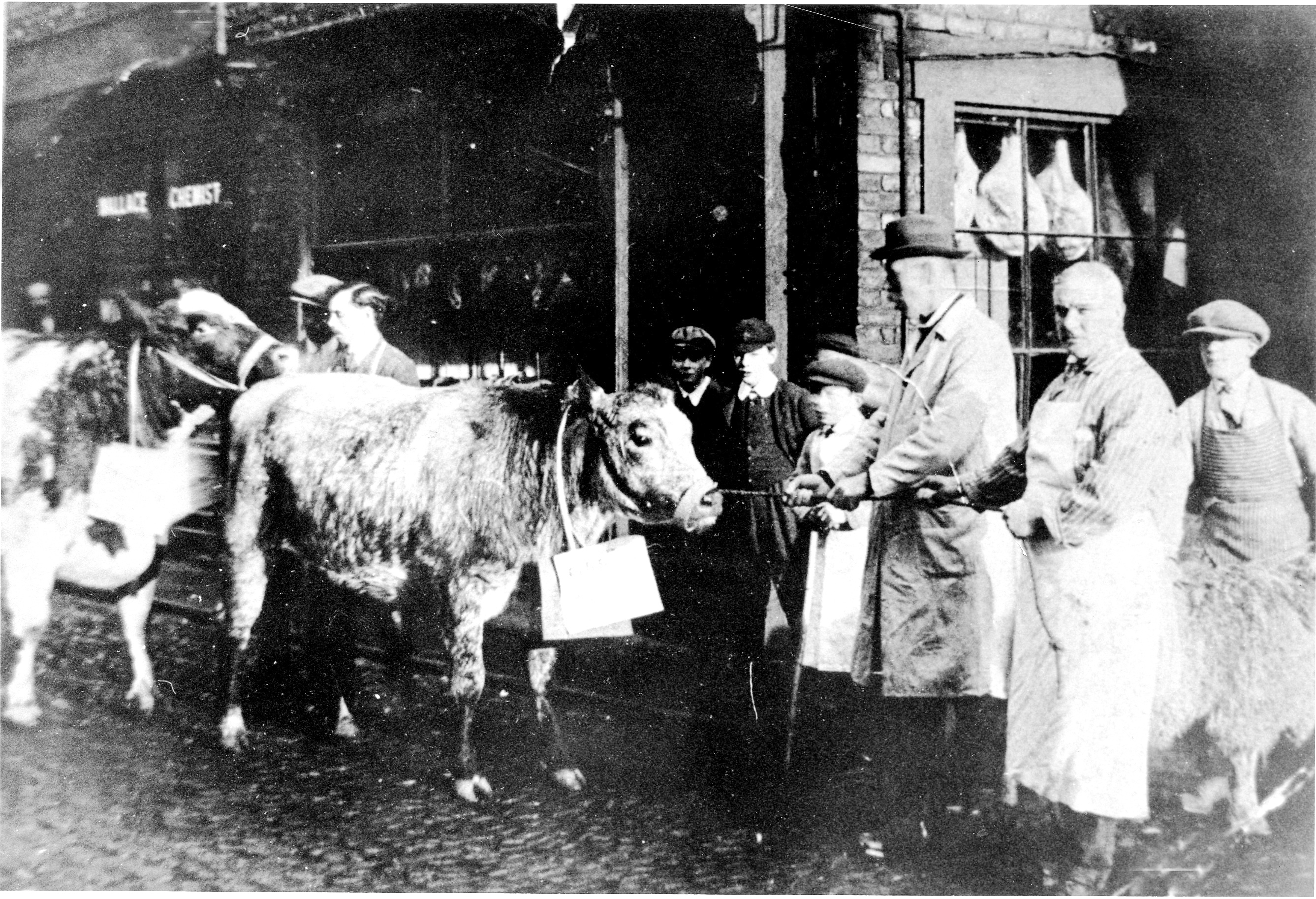
The man holding the beast is William Loftus Wilde. The boy next to him in a flat cap is his son Reg Wilde. The man to right of William Wilde is Jack Braham, butcher who later had a shop in Hailgate. To his right, with a sheep, is Frank Spivey, later the brother in law of Reg Wilde.
The butcher’s shop later passed to Frank Moore’s son Jack, then to Roy Parkin.
6. Market Place, Howden
In the early years of the 19th century the house was the home of Robert Dunn, agent of the Bishop of Durham. He died in 1847.
In 1851 Mrs Mary Dunn (nee Bell), described as ‘landed proprietor, born Portington’, was living there. She moved out to Derwent House which she had built in 1853-4.
1861 – John Hartley, surgeon, born Marton cum Grafton.
1863 – George Sutton was living there when he founded the Goole and Marshland Weekly Times and Howdenshire Gazette. He moved to Goole soon afterwards.
1871 – William Miller, draper, born Forfar, Scotland
1881 – William Miller
1891 – Fanny Sugden, born Howden, ran a confectioner’s shop there. She was a widow and lived with three children and her aunt.
1901 – William Stockill, printer, born Brompton. William Stockill ran a jobbing printing business in the premises for many years.
He was followed by Frederick Holroyd who also ran a printing business there in partnership with his son in law Leonard Asquith as Holroyd and Asquith. They printed posters, local postcards (many of which survive), dance cards etc.
After printing ceased, the shop continued as a newsagents. Geoff Winn, who ran it, married Dorothy Asquith, Leonard’s daughter.
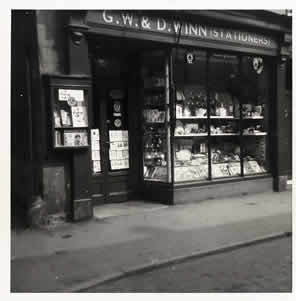
The newsagents’ shop of Geoff and Dorothy Winn in the 1950s, Market Place, Howden
Then came Geoff Andrews and his wife, and then for many years it was a newsagent’s run by Messrs Chappelow.
The numbering after this has changed over the years as smaller premises have been incorporated into larger ones.
6a. Market Place, Howden
This was originally part of Robert Dunn’s house.
Memories: This property was used by the dentist Mr Gorham as a temporary surgery.
It is now a beauty clinic
7. Market Place, Howden [until recently Board Inn]
This was a spirit vault and did not become a pub until 1941.
1861 – William Carter Gaggs, born Howden
1891 – John Hillkirk, wine and spirit store manager, born Tideswell, Derbyshire
1901 – Tabitha Simpson, widow, wine and spirit merchant, born Leeds
William ‘Billy’ Coupland, who was agent for John Smith’s brewery, stored beer behind the Board in premises facing Hailgate.
The premises were converted into a pub in 1941 when Mr Eccles came from Hull with his family to escape the bombing. Mr Eccles was a keen cricketer and put the scores outside on a blackboard.
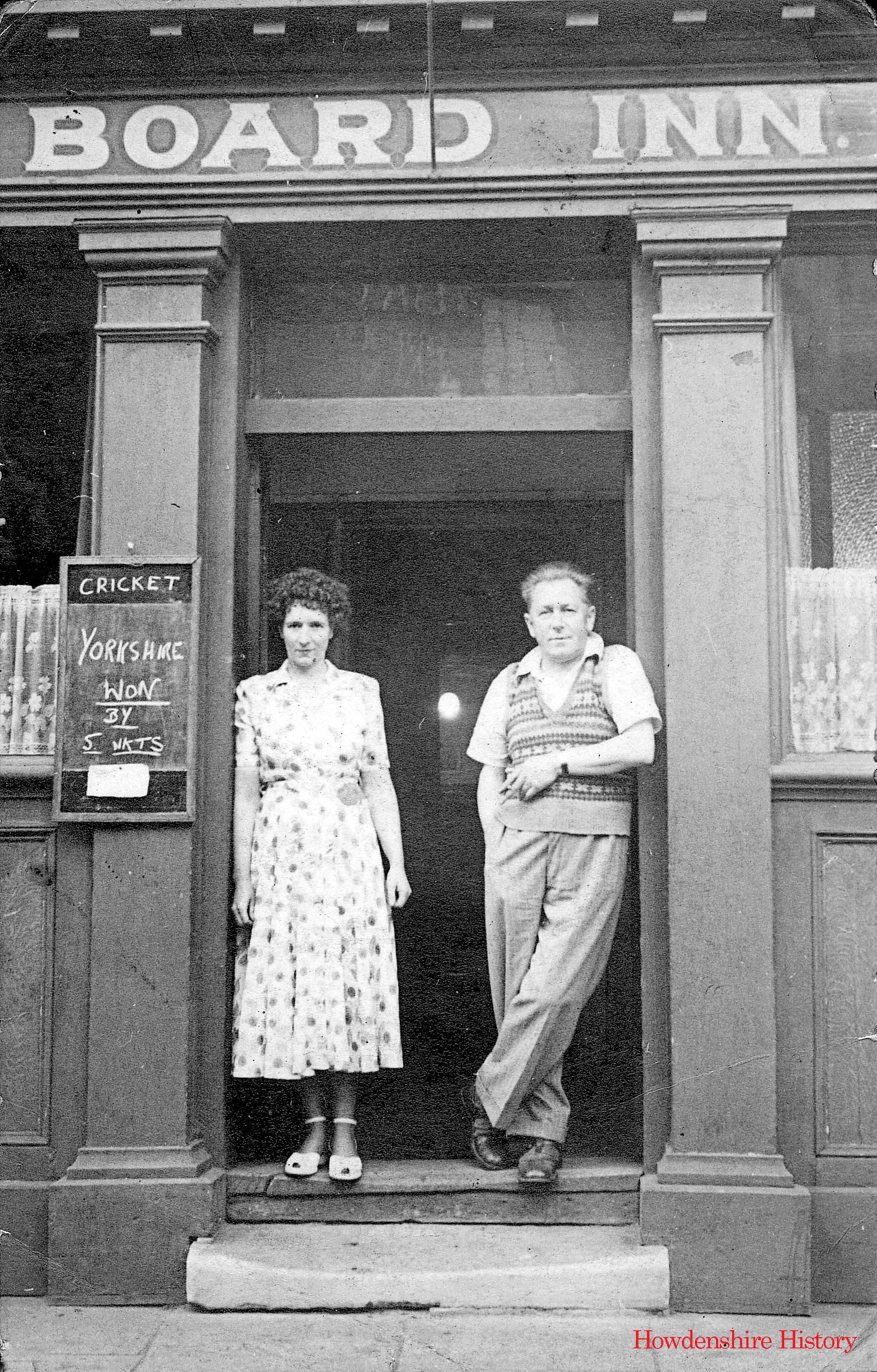
Mr and Mrs Eccles outside the Board Inn
The Board was one of the first places in Howden to have a radiogram – a collection was made for popular records and then they were bought from Sheppards’ in Goole.
Mr Eccles’ daughter Pat remembers that the best you could do during the war for goodwill was to serve dishes of hot peas that weren’t rationed. ‘Mum used to have a big cauldron in a big coal oven, and served them on little dishes. There were also Sunday night suppers and pie and peas. Howden Athletic Football team was based there – they changed there’.
Mr Eccles left in 1953.
Mr Oldfield and family were there in the 1960s.
G S Beecham, known as ‘Tinny’, was a tinsmith whose shop was near the Board Inn yard.
8. Market Place, Howden
1851 – Charles Hutchinson, ironmonger, b Howden
1861 – James Lightfoot, grocer, b Bubwith
1891 – James Lightfoot
1901 – Thomas Andrew, plumber, b Barmby on the Marsh
Later the plumbing business was run by Thomas’ sons, Jack and Billy Andrew. Billy lived on the premises and was cared for by his sister ‘Lizzie’, who was lame and had a speech impediment. Their brother Jack lived in the old hospital where the fire station is – he was a fireman. When Lizzie was living on her own a widowed sister came to live with her. They sold cotton, thread etc but never had much stock.
Mr. Cook, headmaster of the junior school, used to come to the shop on Monday evenings to run the York County Savings Bank. You had a book and you could put a penny in, and when you reached a pound you got another book with a pound in.
Later John Walker, painter & decorator, had the shop; then the Farmers’ Union; then Elliott’s antiques.
More recently Candy Andys
9a, next to No. 9, Market Place, Howden [now part of former White Horse]
1861 – Garland Sanderson, tailor, b Skirlaugh
1891 – Thomas Tomlinson, retired cooper, b Thorne
1901 – Thomas Tomlinson
Later Megson’s grocers.
10. Market Place, Howden [former White Horse Inn]
The inn was recorded as early as 1702.
In 1773 it was bought by Mr Thomas Carter (1730-91). He was licensed to sell ale in Howden in 1764. Thomas Carter innkeeper howden died 1797. He left his property to his son John.
Soon after Thomas’ death, John, although retaining ownership of the White Horse, rented it out.
Hull Advertiser August 1797
TO BE LET, (And may entered to at Michaelmas next ) All that old established and well accustomed inn situated the centre of the Market-place, Howden, known by the sign of the WHITE HORSE, with good stable and a capital yard, with a road from the street adjoining the same being fitted up with every convenient requisite for carrying on an extensive business. The Furniture and stock of wines, liquors etc. may bought at a fair valuation, and other particulars may known, by applying Mr John Carter, upon the premises. The owner is going into another line of business, which is the cause of his declining the above.
John and brothers Thomas and Mark extended their business into brewing.The family played a large part in the hisory of Howden in the nineteenth century.
They owned a brewery which was in the yard of the present Board Inn [ Howden Arms]. Around 1834 they built a maltkiln, now houses, which runs along side of Bishopgate . The family also owned several other Howden inns, a farm, brickworks and corn mill in and around Howden and had breweries in Market Weighton and Knottingley
1822 – an alehouse licence was granted to John Buttle. George Wadsworth of Laxton stood surety.
1829 landlord John Buttle
1834 Joseph Dean
1851 – Richard Lindley, born Epworth, was landlord. Mrs Sarah Lindley was landlady after her husband’s death.
1871 – William Wheldrake, born Howdendyke
1891 – William Clarkson was landlord, born Newsholme
1901 – Hannah Clarkson, landlady, born Asselby
Tommy Watkins ran the White Horse in the war. One of his daughters married Keith Spink. A lot of betting slips were exchanged in the pubs. A famous bookie’s runner was Henry Claydon from Skelton who had an artificial leg in which he hid the slips.
The Shire Hall, Market Place, Howden
Three/four premises were demolished to make way for the Shire Hall when it was built in 1871-2. The site was bought from Mrs Mary Dunn. In 1851 the shops were occupied by William Leaf, tailor; Ann Rowntree, china dealer; John Pease, shoemaker, who also ran the premises as a Temperance Hotel, and John Wood, gunsmith and bellhanger.
In 1871, just before they were demolished, one shop was still occupied by Mrs Fanny Woodall, widow of auctioneer Charles Woodall.
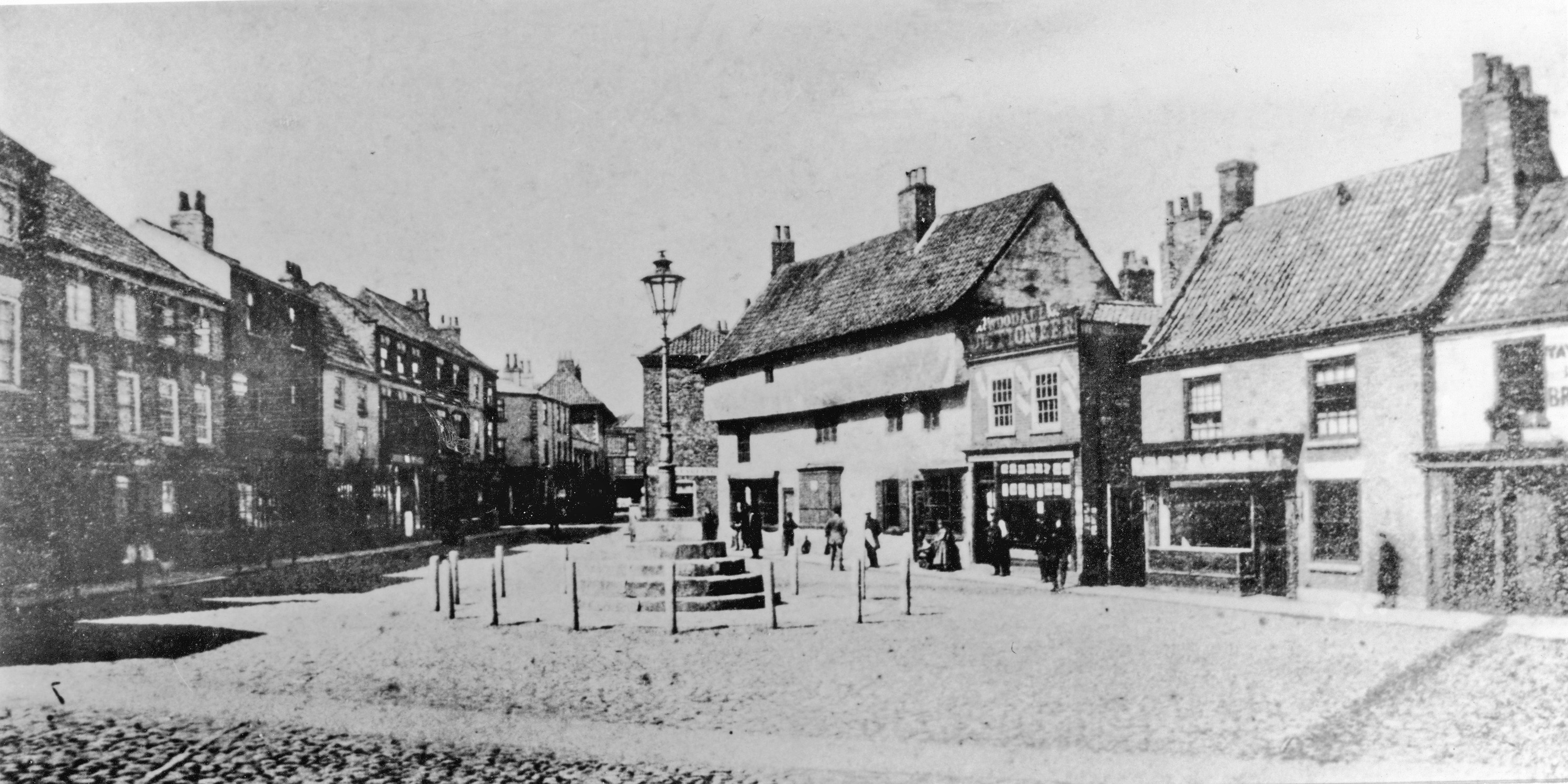
A pre 1871 view of Howden Market Place. Notice the gas lamp
The new Shire Hall included a new shop:
1891 – Charles O Bastow, watchmaker, born Armley
1901 – Charles O Bastow
Mr Bastow and his family lived in the flat in the Shire Hall, above what is now the Shire Hall shop. His son, Harold, who was a starter at local sports events, had the shop at No. 28 Market Place, Howden. He sold trophies there.
In the war what is now the Shire Hall shop was private and Peggy Rispin lived there, evacuated from Hull. Rispins occupied this until 1948 when they got an Airey house on Buttfield Road.
Later the first ladies’ hairdresser in Howden, Noreen Milnes, used these premises. There was a ladies’ hairdresser there for many years – Mrs Una Porter, also Val’s.
The Shire Hall was used extensively for dances, concerts and bazaars etc. On Wednesday, Friday and Saturday evenings it was used as a cinema. Silent films were shown by Chris Kettlewell. Seats were 2d, 4d, 6d and 1s. Regular stars were Tom Mix, the cowboy and Chon Chan, the Chinese detective.
Miss Draycott, who was blind, was the pianist. Mr Tom Savage (former manager of Gallons) said he used to buy 1d worth of unshelled monkey nuts and 1d worth of broken toffee from Robinson’s to eat before he went in.
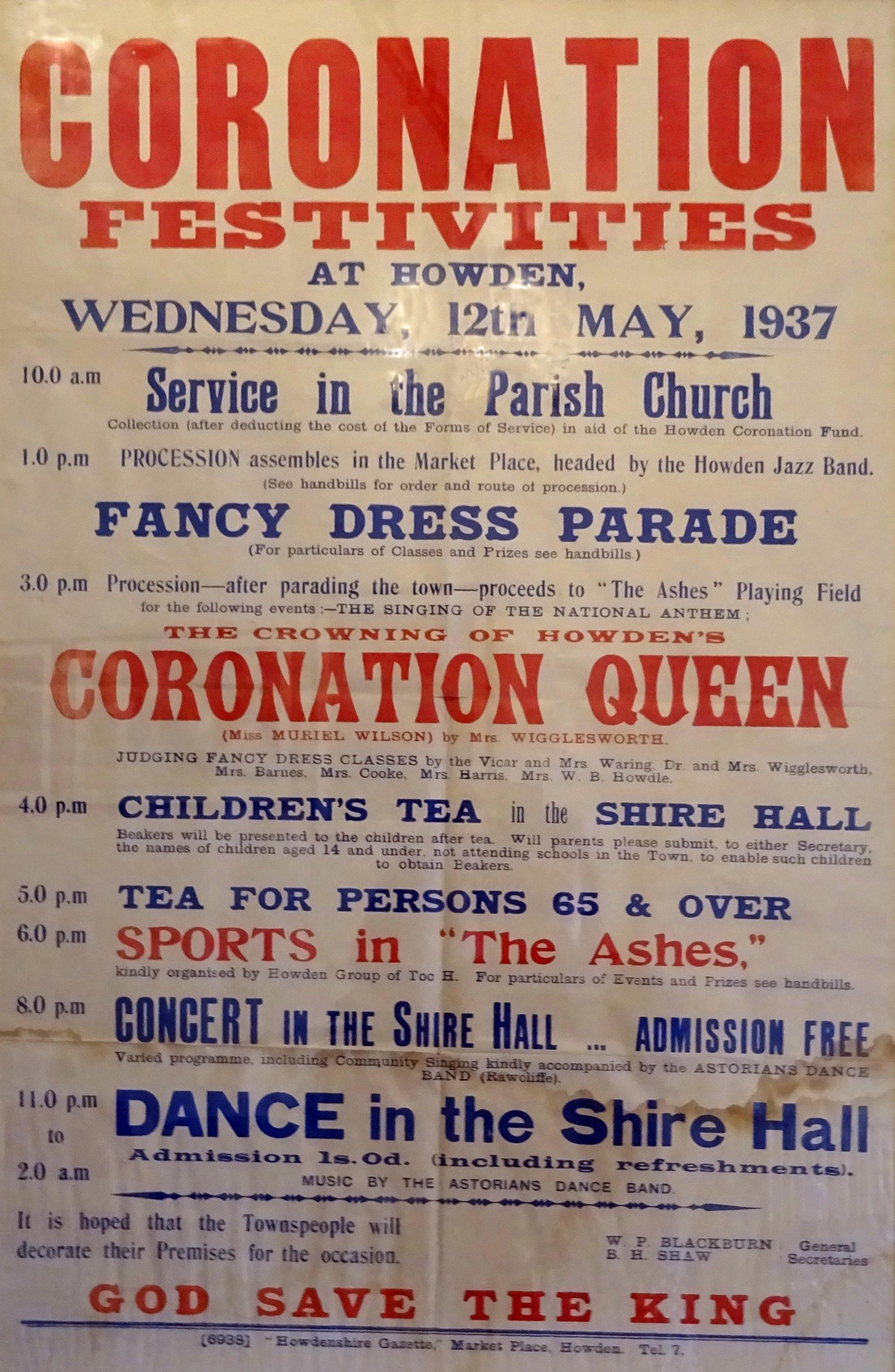
Events for the 1937 Coronation
The Shire Hall in the war
There was a dance every Saturday night in the hall, usually for a charity. 2s 6d to go in, till midnight, emerging 11.30 at Double Summer Time it was still light. The dances were packed with airmen and Arthur Henrickson remembers that ‘we lads used to wait till 10 to 10.30 when they let us in for a shilling. Mrs. Bancroft served cups of tea for 2d, the only refreshment available in the hall. Generally the main fellow on the door was Woppy Saltmarshe. If it was a British Legion do their lads were on it, he tended to be the main one; he was also caretaker for a time.’
The music was provided by The Gaiety Boys from Goole, Revellers from Howden (Percy Jeeves, Laurie Bancroft, Les Backhouse, Tommy Wright on drums) and sometimes Harry Rowntree’s band with Geoff Whitehead on drums.
Most servicemen cycled in and many cycles were left behind the Board Inn. Arthur remembers that Mrs Thirkettle used to sit there staring, a moral representative!
Pat Newstone remembers the black American band which really turned the place over jitterbugging. Howden had seen nothing like this.
The market place was sometimes used for fund-raising weeks. Mrs. Scholfield was chairman of the local National Savings Committee. She used to come onto the Shire Hall balcony and announce every night how much had been raised. After Dunkirk the Royal Sussex Regiment were based in the Shire Hall until they were reformed.
The next block of shops was demolished in the 1960s and then rebuilt up to Highbridge corner. They originally were:
14. Market Place, Howden [next to the Shire Hall]
This was Robert Sunderland’s butchers’ shop, with slaughterhouse in rear. Robert Sunderland was born at Heck and was related to the Sunderland butchers’ family in Goole. He died in 1914; however, one brother, Harold, and two sisters, Lilian and Nell, remained.
Harold Sunderland was a local historian and wrote books and articles in the Hull Times.
Lilian was a piano teacher and after Edie(?) Armstrong died, Lil took over playing the piano at the Shire Hall. She had to look at the screen and play appropriate music. Sometimes she didn’t quite keep up and played romantic music when a cowboy was being shot! She didn’t have a chance to see the film first as there were two changes a week, on Wednesday and Friday.
Nell looked after them all and smoked like a chimney. She went to all the whist drives and always had a Woodbine in her mouth. She ran the library, where Mrs Harris and Mrs Whitehead used to stamp books.
15. Market Place, Howden [now about where off licence shop is]
1861 – William Selly, chemist, born Grafton
1891 – Albert Croudson, ironmonger, born Goole
1901 – Mary Chantry, tobacconist, born Rawcliffe
Later this was a shop selling ribbons and fancy goods.
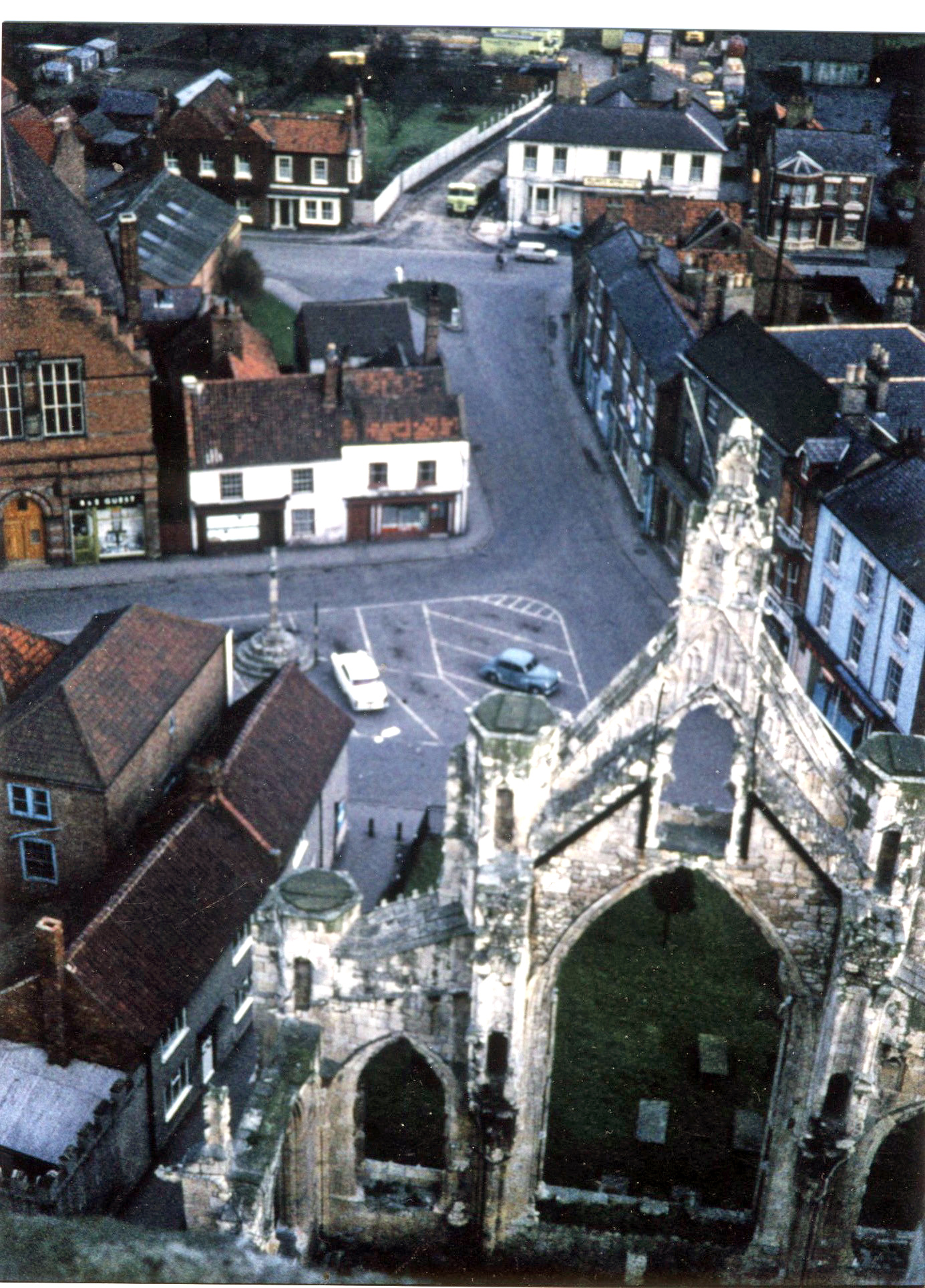
The original shops on the corner of Market Place and Highbridge
Market Place, Howden
1861 George Briggs, ironmonger, b Fishlake
The property here was demolished to allow for corner widening. The Golden Cottage is now on the site. It is not easy therefore to say exactly who lived where.
16. Market Place, Howden [formerly HSBC bank]
Howden banking history
Until the eighteenth century most people in England transacted all their business using coins and did not trust bank notes. In fact, until the 1750s there were only five private banks outside London. However, Howden had its own private bank by 1792 – the only others then in East Yorkshire were in Beverley and Hull, which shows how prosperous and important the town was at the time.
The Howden bank was originally run by John Barker, father and son. Both died in the early 1800s and soon afterwards Thomas Coates came to Howden from York to run the bank. Thomas lived at the bank office on Highbridge; this original office is now a pet shop and stands next door to the more recent bank premises.
Thomas Coates went into partnership with John Scholfield (a member of the Scholfield family of Sandhall), Barnard Clarkson snr of Holme on Spalding Moor, his son (Barnard jnr) and John Clough of Selby. The partnership also ran a bank in Selby.
But in January 1822 for reasons unknown Thomas Coates ceased to be a partner and in May that year it was reported that sadly ‘Mr. Coates, lately of the Howden Bank, cut his throat in a dreadful manner and that he survived only a few minutes’. The running of the Howden bank then passed into the hands of John Clough’s son Thomas.
Barnard Clarkson snr died in 1826 but his son and grandson continued their involvement in the two banks. The Clarkson story featured in the Howden Town play when Barnard jnr was the nemesis of local rogue Snowden Dunhill.
But in the 1830s disaster struck. Barnard jnr overstretched himself by buying the Kirkham Abbey estate. His son, who was responsible for the running of the Selby bank, died suddenly of a fever at the same time. In 1831 both the Howden and Selby banks crashed and John Scholfield, John Clough and Barnard Clarkson were declared literally bankrupt. This was disastrous for the many local farmers and tradespeople who had money in the Howden bank. They lost everything.
The Howden bank was immediately taken over by the York City and County bank who bought the existing bank premises. Thomas Clough was appointed manager, suggesting that he was not held responsible for the bank’s problems.
Thomas Clough continued to run the bank. Next door, in the premises which later became the bank, lived a family called Wetherell.
The Wetherell family
James Wetherell and his brother John were at various times woollen drapers, chicory growers, millers and tanners. In the 1830s they built, in partnership with their neighbour Thomas Clough, a new tanyard in Howden near Mill Yard. Tanning was a large industry in the town with over 40 men employed as tanners, curriers and shoemakers.
John and James married sisters Jane and Ann Wikeley, whose father Thomas was a surgeon and apothecary in Howden. The family were well connected – another sister was the wife of Thomas Guy, vicar of Howden. But life in Victorian days could be like snakes and ladders and the Wetherells were about to go down the snake. Thomas Clough withdrew from the tannery business and in mid December 1851 the Wetherell brothers had to call in the administrators. They must have had a miserable Christmas.
Within the month the contents of the Wetherells’ house, where both families lived, was for sale. It was described as having two drawing rooms, two sitting rooms, ten lodging rooms, a hall and two kitchens. The furniture was opulent and included ‘a Finger Organ’, ‘a Piano-forte’, ‘400 Vols of Books’ and a ‘Four-Wheel Carriage and Harness’. James and John, then in their 50s, left Howden for Australia to try to recoup their fortunes. James died in 1852 at Bendigo, a gold rush town, and John died in 1854 in Melbourne.
The Wetherells were an interesting family. James’ eldest son, also James, was a merchant in Brazil. He was acting as British vice consul at Paraiba in 1858 when he died in a fall. When his possessions were returned to his family it was found they included notes he had made about the natural history and people of Brazil. They were published posthumously as Stray Thoughts from Bahia and the book now is popular with those studying the history of Brazil.
The bank moves premises
Back in Market Place the York City and County bank moved their premises – and the Clough family their home – to the now empty building next door. This remained as a bank until HSBC closed their Howden branch in 2016. Thomas Clough died in 1871, having played a full part in the life of the town: in particular, it was largely due to his work that Howden vicarage was built.
The new bank manager was Edwin Storry. He also took an active part in local life and, amongst other roles, was a prominent member of the East Yorkshire Volunteers, rising to command the Second Battalion in 1891. His military service is commemorated by a brass plaque on the wall of the Minster.
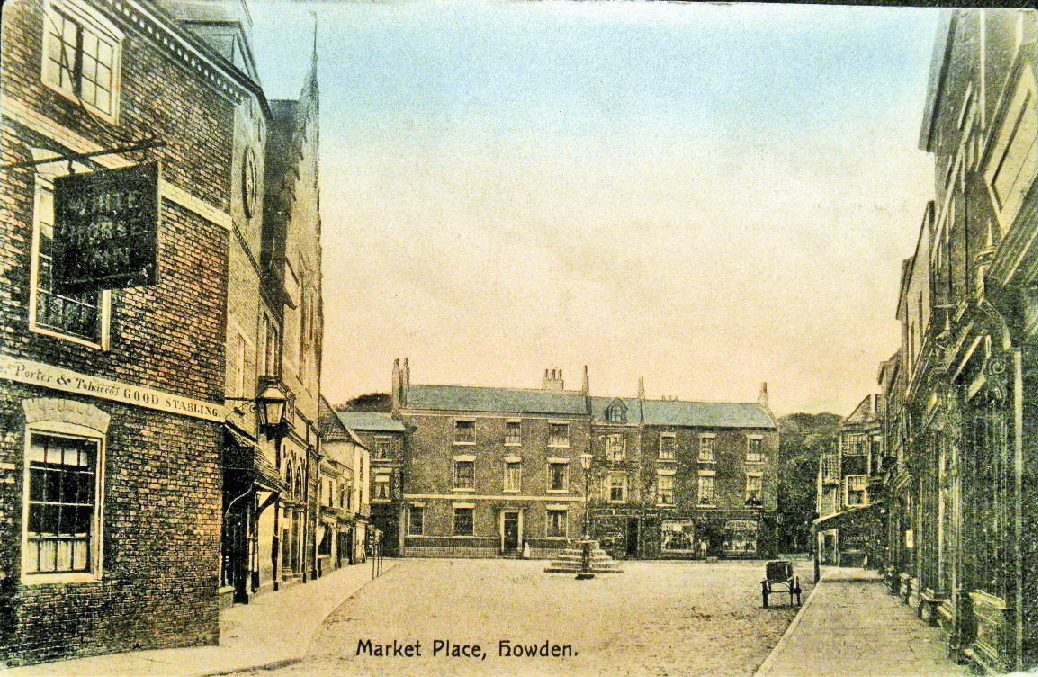
The view above shows the bank premises before 1902
Banking in Howden seems to have been something of a family business as Edwin Storry was succeeded as manager of the bank by Charles Wilkinson, whose wife Agnes was the granddaughter of previous manager Thomas Clough. It was while Mr Wilkinson was manager that the whole bank building was remodelled in 1902 and the frontage that is there now was installed.
The Howden bank managers remained as part of the community where they lived in the twentieth century.
17. Market Place, Howden [now Townend Cleggs’ auctioneers etc]
For many years in the 19th century this was Richardsons’ watchmakers.
Later this was Matthews’ fruit and vegetable shop. Mr Matthews also had a stall in the Shire Hall. This was possibly the same Mr and Mrs Matthews who celebrated their golden wedding in 1947 when the Hull and East Riding Times reported that:
“Mr John Wm Matthews of Bridgegate was now 82 and was a horsebreaker. He was the eldest son of Thomas William Matthews who was also a horsebreaker and dealer. He had his business in stables rented on the Angel Inn premises in Batty Lane. Mrs Matthews was the housekeeper at the Angel and so met her husband. She was the sixth daughter of Mr and Mrs F Brabbs of Mt Pleasant Farm, Newport. Mrs Matthews moved premises to Bridgegate and retired two years since.”
Then the shop was run by Mrs Morris, greengrocer, who lived at North Howden.
Later in the 1960s the shop was Willis Redfearn’s chemists’.
18. Market Place, Howden [now a hair salon]
For many years this was Fitch’s, a double fronted milliners’ and drapers’ shop.
In 1825 John Fitch, draper of Howden stood surety for Thomas Barker of the Punch Bowl Inn at Saltmarshe
John and William Fitch were listed as drapers in Market Place in 1829.
John had three sons, Thomas, John Stow and Edward. He died in 1841, the same year as his son Edward was born. His wife Elizabeth ran the business until her 2 eldest sons took over as T and JS Fitch.
Thomas on his death left £6, 741.00 in 1902
John Stow Fitch left £6.965.18s.3d on his death in 1903
The death of Mr.J.S.Fitch 1903
It is with regret we have to announce the death of Mr.John Stow Fitch of Howden,which took place somewhat suddendly at his residence in Hailgate on Monday night about 11 o’clock.
Mr Fitch was a member of a very old and much esteemed Howden family, whose name for a long period been associated with every movement having for its object the well being of the town and district.
He was the second son of the late John Fitch draper of Howden, and it is barely a year since, on the death of his much beloved brother the late Mr Thomas Fitch, that we had occasion to refer to their suceeding in 1859 jointly to the business so successfully carried on during a long interval by their mother. The partnership existing between Messrs T & JS Fitch continued up to four years ago when the senior partner retired by mutual consent to devote himself more to the Bank Agency, which they had jointly held as the representatives of the Yorkshire Banking Company Limited. With the amalgamation of the latter with the London City and Midlands Bank, Mr J.S. Fitch retired from the agency , and his brother became the Bank Manager, but survived his appointment only a few months.
The deceased continued the drapery business up to the time of his death, for although he had been in delicate health for a long time he was able to supervise the business carried on in the Market Place up to nearly closing time on the Saturday night.
Mr Fitch had spent the previous evening with his son in law and daughter- Mr and Mrs T.P.Brearley at Portington Grange, remaining all night and driving into Howden on Saturday morning. He appears to have thus caught a chill, symptoms of influenza presented themselves on Sunday which necessitated Dr Chestnutt being subsequently called in. Unhappily pleurisy developed rather rapidly and on Monday afternoon the family were made aware of the fact that the illness of the deceased had taken a very serious turn. Meantime the services of a trained nurse had been obtained, but although everything was done that medical skill could devise, death peacefully ensued as above recorded.
Of late years failing health had prevented the deceased taking a very active part in the public affairs of the town, though formerly he was not only a strong politician, but he took a very active part in the many contests which ensued in the East Riding, his support always being on the side of the Liberals.
Though nominated for the Board of Guardians he was not successful, but this arose more from the objection he had to a personal canvas of the voters than from any other cause and on to the coming in of the operation of the Parish Councils Act he was elected a Parich Councillor. and was subsequently appointed by this body one of the charity trustees. He resigned two years ago, but retained thetreasureship to the Parish Council up to his death.. He was a director of the Howden Gas Company and for many years was associated with the committee of the Howden Horticultural Association and the Howdenshire Choral Society, of which latter he was for a long time a member of the chorus.
The deceased was from his youth a member of the Howden Congregational Church, of which he was formerly a deacon as well as a trustee and had for some years had conducted a bible class for young men. The various branches of church work had in him an ardent and generous supporter.
The late Mr.J.S.Fitch was a shrewd man of business and one whose advice was much valued by young tradesmen entering upon their business career. In many instances his services we called into reqisition as a trade valuer.
The deceased was married at Canning Street Chapel, Liverpool on 9th September 1861 to Miss Elizabeth Copley, only daughter of the late Mr Copley of Asselby near Howden, by whom, and a family of four sons and four daughters, he is survived.
With Mrs Fitch and the members of the family much sympathy is felt in their bereavement, for the loss of one so highly esteemed will be keenly felt throughout the town and neighbourhood.
Alfred Fitch, a son of J S Fitch died of wounds on 26th Feb 1919 in hospital. He had been serving as a Private with the 28th Battalion Canadian Infantry (Saskatchewan Regiment). He is buried in Howden churchyard.
His brother Charlie Fitch was the last of the family to run the draper’s business. He died in 1951.
The shop was for a time the premises of Dutchman Willem F Lange who sold bulbs and grew tulips in the early 1950s. It was later a mini-supermarket and briefly an art gallery.
The Manor House
Many people remember that Mr and Mrs Alf Kellington lived there in the 1930s/40s. They had previously run a cafe at what is now the Cheese Shop. Mrs Kellington catered for weddings etc; Mr Alf Kellington was a freemason and was in the choir. He didn’t seem to take a part in the cafe or baking business. Mrs Kellington did the baking and used to test to see if cakes were ready with one of her hairpins.
She was helped by Mrs Wright; the Wrights had come to Howden and were taken in by Mrs Kellington, who gave them accommodation. Mr Sam Wright was a chemist and was said to have played cricket for Derbyshire. Mrs Wright worked very hard.
House, now gone, near The Ashes gateway
1861 – Mary Cook, dressmaker, born Goole
The house was divided into two and was at different times the Labour Exchange (Mr Sherbourne was the manager) and the Salvation Army HQ.
Mrs Barnes had one part as a dressmaker’s workshop and it was also Thirkettles’ boot and shoe shop; Miss Thirkettle was also a dressmaker.
The Dog and Duck [churchyard]
This stood in front of the church ruins.
It was formerly known as ‘The Seven Stars’.
1822 – alehouse licence granted to Thomas Iveson. Standing surety was George Maskell of Howden, shoemaker.
1851 – landlord of the Dog and Duck was Goodworth Fox, b Howden
1861 – William Coggrave, landlord, b Howden
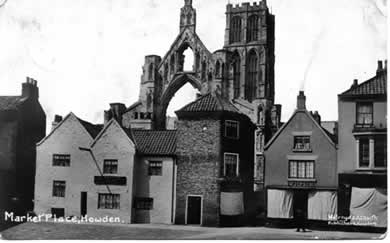
Market Place, Howden. Above is the Dog and Duck [left, white] and William Jipson’s shop with blinds down, gable end on. Postcard by Holroyd and Asquith.
Next to the Dog and Duck was a tall building, matched by a similar one at the other end of Church side. In 1851/1861 it was occupied by John Richardson, watchmaker, born Bubwith. The Richardson family were long-established Bubwith clockmakers and family members later worked in Goole and Selby. Another of the family was at No. 17 Market Place, Howden.
The buildings were demolished in 1913 and the site given to the church by Mr Scholfield of Sandhall.
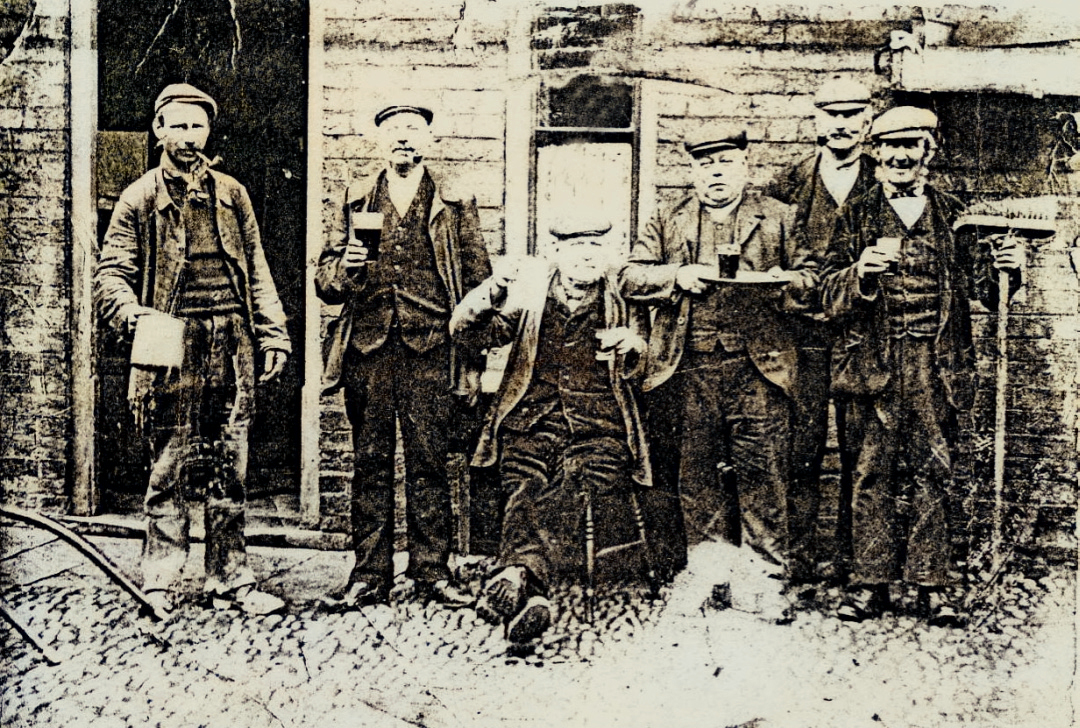
Below is last landlord William Cole and friends, supposedly on the final day of the pub.
20. Market Place, Howden [now Badger and Bean ]
1851 – John Steel, grocer, born Scalby
1861 – Charles Woodall, grocer and auctioneer, born Hambleton
1881 – William Jipson, born Howden
1901 – William Jipson
The shop was later run by William Jipson’s son, Herbert. It was later run by Mrs Kellington and then by Mr James Kitwood and his son Peter Kitwood. Everyone around Howden remembers their baking and particularly the lovely smell and taste of theit breadcakes and teacakes.
The shop was Mike Lawson’s butchers’ in the 1990s.
21. Market Place, Howden
1851 – George Allen, butcher, b Haxey
1861 – Thomas Hill, butcher, b Howden
1881 – Robert Sutherby, shoemaker, b Selby
Robert Sutherby was followed by J C Jenkinson, draper and milliner.
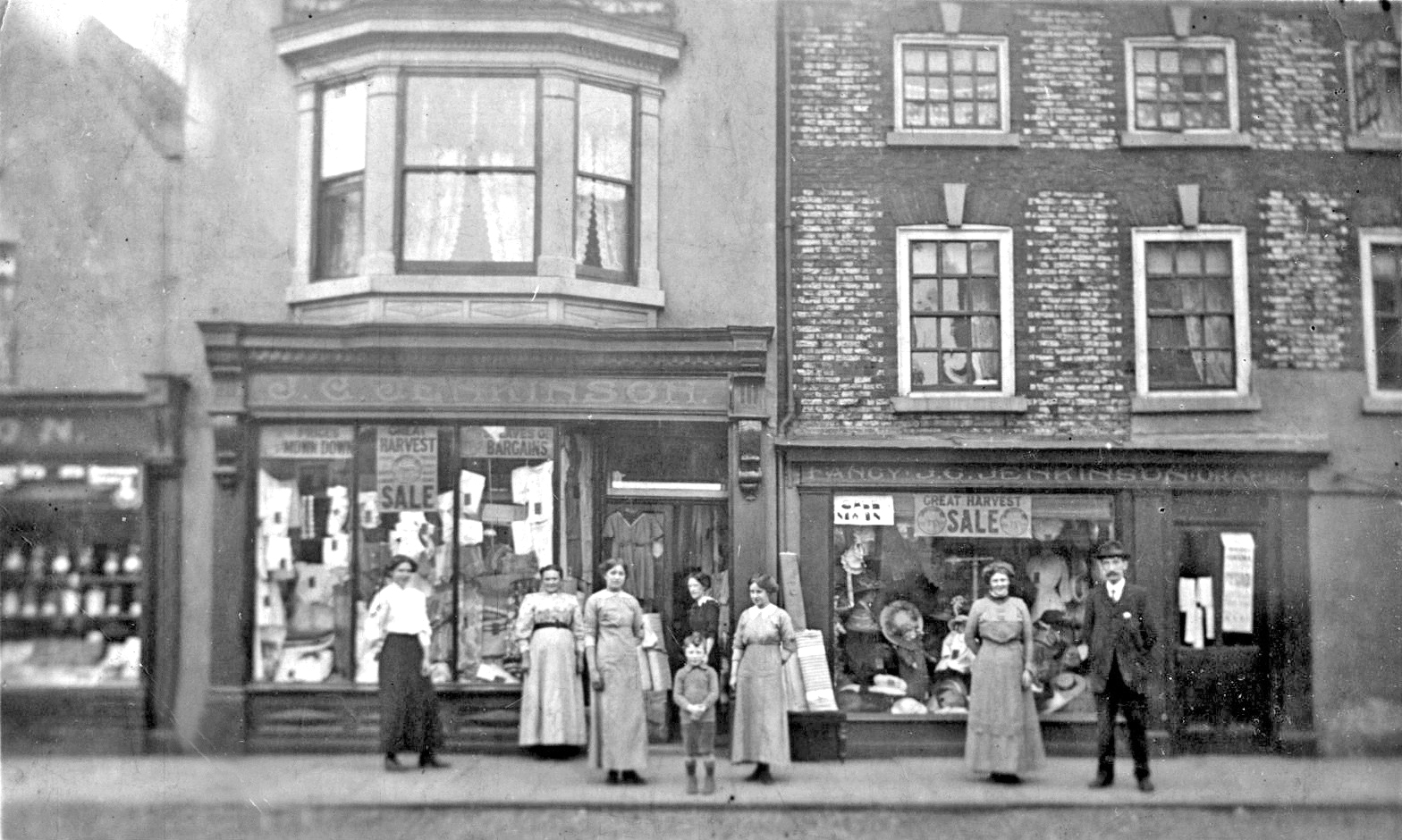
The Jenkinson family outside their shops – nos 21 and 22. Badger and Bean is extreme left.. The building to the right was demolished and for many years was a ‘gap’ before it was re-developed.
Number 21 was for some years the Nat West bank and was then Symes Baines Boomer solicitors
22. Market Place, Howden [redeveloped 2007]
No.s 22 and 23 were one building, the Lincoln Tavern, in the early 19th century.
1822 – alehouse licence for Lincoln Tavern granted to John Townend. Surety was George Day of Howden, hardwareman.
The premises were split into two in the early 1820s.
1826 – alehouse licence for John Townend of the Whittington and Cat at Howden.
1851 – Ann Chadwick, innkeeper, born Saddleworth
1881 – John Tabrah, fancy goods, born Howden
Mr Jenkinson bought No. 22 to extend his next door shop. It was lower; you turned right into it and it sold all sorts – material, cotton, embroidery, silks, stockings. It was pulled down and was left as a ‘gap’ for several years with seating and a mural. It has now been redeveloped.
23. Market Place, Howden [redeveloped 2007]
These premises were a butchers’ for many years.
1851 – Richard Fleming, butcher, b Howden
1881 – Antony Taylor, butcher, b Kilpin.
1901 – John Draycott, butcher, b Howden
Memories: ‘This was Gerry Hodgson’s pork butchers. It had a slaughterhouse at the back, into Vicar Lane. It was a building two storeys high, like an old farm house with a low roof. It was pulled down by Butlers when the local council declared it unsafe.’
24. Market Place, Howden [now redeveloped]
For many years Butlers’ general shop and newsagents stood here, but it has recently been redeveloped.
In the early 1800s, numbers 24 and 25 were F. Ullathorne’s grocers but later the premises were made into two shops.
In 1851 the shop nearest the church was the premises of William Small, bookseller and printer. William was one of the two sons and two daughters of William Small of London, a grocer, and his wife Dorothy. Dorothy was born Dorothy Justice and her brother, William Andrew Justice, until his death in 1830, had run a thriving bookselling and printing business in Howden in the premises at the end of the Market Place, Howden (now occupied by a flower shop).
William Small’s brother Alfred lived in Aire Street, Goole and in 1854 founded the Goole and Marshland Gazette. Alfred married 17-year-old Mary Ann Mitchell of Yokefleet and had one daughter, Mary Ann, born in 1851.
After ten years of running the paper Alfred sold out to James Jillott in September 1864. His brother William still ran the printing business in Howden and lived with their youngest sister, Justice, who later built herself a fine house at 2, Churchside, Howden which still bears her initials [JS]. William died in 1868 and his sister Justice in 1901.
Alfred retired to Laxton, where his wife died in August 1867. There is a memorial to her in the church there. Their daughter, Mary Ann, married Henry [Harry] Smith, an affluent farmer with connections to the Leeds woollen industry. They lived variously at Thorpe Hall, near Howden, which was owned by Alfred Small, and at Grove Farm, Portington. In 1906 Henry bought Portington Grange estate, where their descendants lived until around 1940.
1881 – William Kirkland, born Melton Mowbray, bookseller and printer was occupying the former Small premises in the Market Place, Howden.
25. Market Place, Howden [ now redeveloped – Chappelow’s]
1851 – James Hill, shoemaker, born Howden
1881 – Henry Harrison, master cordwainer, born Gilberdyke
Memories: ‘The original Butlers’ shop was only a small shop where they sold papers and sweets and did a bit of baking. Next door was Mrs Sowersby’s drapers’ shop. Later Miss Polly(?) Whitehead, a retired teacher, ran it as a wool shop. Before that Alf Armstrong had it as a wallpaper shop.’
26. Market Place, Howden [ bridal shop]
This was a grocer’s and provision shop for many years although at some time it was Albert Thorley’s gents’ tailor and outfitter
1851 and 1861 – Edward Banks, grocer, born Howden
1881 – William Kay, grocer, born Catterick
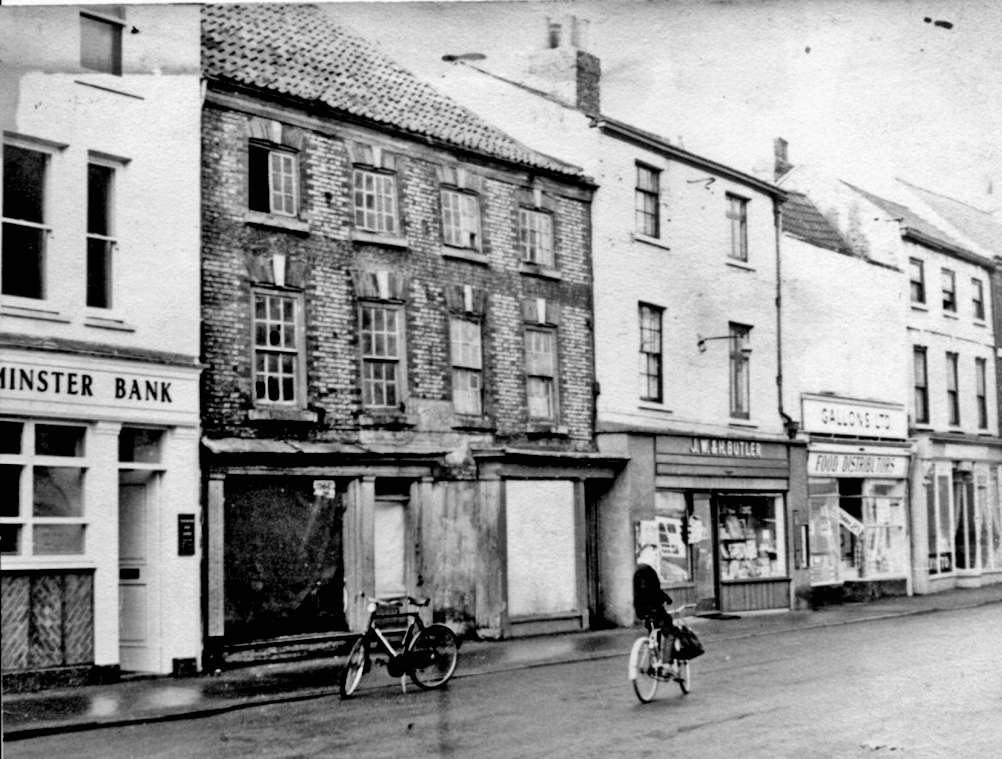
William Kay’s was taken over by Cussons. In 1923 Cussons built a new shop on Bridgegate (now the site of the bathroom shop). Melia’s grocery chain – managed by Eric Kellington – took over the Market Place shop.
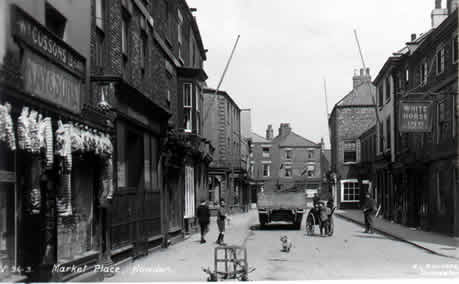
A view of Market Place, Howden. Here you can see the name board of Kay and Sons with Cussons’ board above. The White Horse inn is on the right.
Later the shop was Gallons; then a wet fish shop.
27. Market Place, Howden [now bakery]
1861 – William Dawson, grocer and draper, born Caltman Lindrick?, Notts
1881 – Martin Farrer, linen and woollen draper, born Birstall
1901 – George Everingham, tailor and draper, born Market Weighton
Later this was the premises of Mrs Dora Davis and was her photography studio. Her husband was the school attendance officer. She later lived in a bungalow on Thorpe Road.
Memories: ‘Her mother sold bric-a-brac and was a tall lady with skirts down to the ground. She was killed in a fire in the cellar.’ (??)
The shop become Wrights’ second hand shop and later SP(?) Woods. More recently it was Goods Travel.
28. Market Place, Howden
28 and 29 were originally one and owned by George Dunn, a cooper (there in 1851, born Howden).
1861 – George Sutton briefly lived here (see No. 6, Market Place, Howden for more details); his occupation was ‘printing and fancy goods’.
Harold Bastow had a trophy shop here (?1920s/30s). He was the son of Charles O Bastow and often acted as official starter at local cycling and sports events.
It was a seed shop – Eric(?) Johnson, then NFU.
In the 1990s this was a gift shop, ‘Adornaments’.
29. Market Place, Howden [now takeaway]
1851 – William Harrison, grocer, born Hull
1861 – George Sutton, born Lincoln
1881 – John Platts, butcher, born Melbourne
1901 – Margaret Tabrah, confectioner, born Howden
In January 1931 the Hull Times reported that,
“Mrs Woodall is giving up her sweetshop in Market Place, Howden. She has occupied it for 40 years and her sister Miss Tabrah before her. Business to be sold.”
It is also remembered that ‘Mrs Harrison later ran the shop. Her daughter Phyllis, a postlady, married Sid Sherburn, who was the driver for local buses between Howden and Goole’.
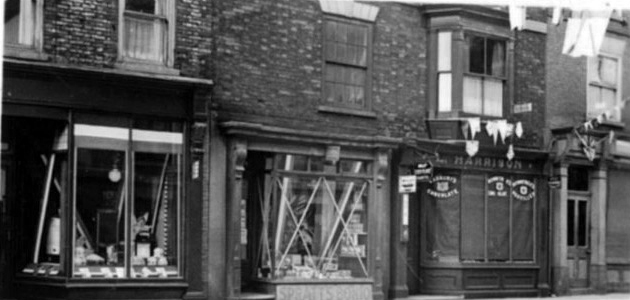
Number 29 when Mrs Harrison was running it
30. Market Place, Howden [now fruit shop]
This was split into two premises for many years:
1851 – Thomas Goodall, druggist, born Howden
1851 – William Rowntree, shoemaker
1881 – J Haw, provisions
1881 – Tom Favel, beef and pork butcher
1901 – Joseph Palframan, butcher, born Goole
Memories: ‘Favel’s butcher’s assistant was John Braham, who later set up on his own in Hailgate. It was later an Argentine beef shop selling frozen beef. Mr Harold Naylor was the manager. He later moved to run his own shop in Bridgegate. The shop shut down in the war and was used as a salvage depot where waste paper etc. was stored.’
Later it was run by Leads as a fruit shop and is now Annie’s Fruit Bowl.
31. Market Place, Howden
1851 – James Wainwright, chemist, born Malton
1861 – John Saville, chemist, born Sheffield. His father and then he and his sister, Elizabeth Wadsworth, owned Albert Terrace.
1881 – Robert Latham
1901 – Robert Latham, chemist, born Yokefleet
Memories: ‘Latham’s chemists went round the corner into Vicar Lane. Mr Latham was also registrar of births, marriages and deaths. Later this was Mrs Bramley’s confectioners and cooked meats shop and cafe. Her daughter Annie carried on the business; brother Charlie Bramley was a clerk at Andertons.’
32. Market Place, Howden
1851 – William Deighton, draper, born Spofforth
1861 – Mary Smith, wife of hatter and furrier, born Colne, Lancs
1881 – uninhabited
1901 – John Thomas Hill, watchmaker, born Howden
William Stockill had a newsagents and jobbing printing busines here. He sold to W Beal, who in March 1928 sold the printing, stationery and fancy goods business to the Goole Times Company. Jobbing printing continued for some years. The last printers to use the printing equipment at the back of the shop were Percy Jeeves and Ted Philpott.
The Goole Times appointed a resident manageress to run the shop premises – first Mrs Dudley, then Mrs E Walker then Mrs Ken Powls.
Mr W Norman Hains from Eastrington worked as reporter for the Goole Times and had an office here in the back of the shop.


Above the Howdenshire Gazette shop
33. Market Place, Howden [now Dove House hospice shop]
This was demolished and rebuilt.
1851 – Henry Marsden, tanner
1861 – Thomas Tomlinson, cooper
1881 – Annie Bell, glass and china dealer, born Howden
1901 – John Howdle, born Howden
The Howdles are a long-established Howden family and for many years provided the town with boots and shoes and legal advice.
Harold Howdle had a shoe shop in Boothferry Road, Goole; Lawrence Howdle lived in Jessamine(?) House, Hailgate. Wilf Howdle was a solicitor and clerk to various organisations; his office was where Taylor Broomers were at 55 Hailgate. He and his wife lived at The Chestnuts.
In the 1990s the shop was Rob Winlow, optician.
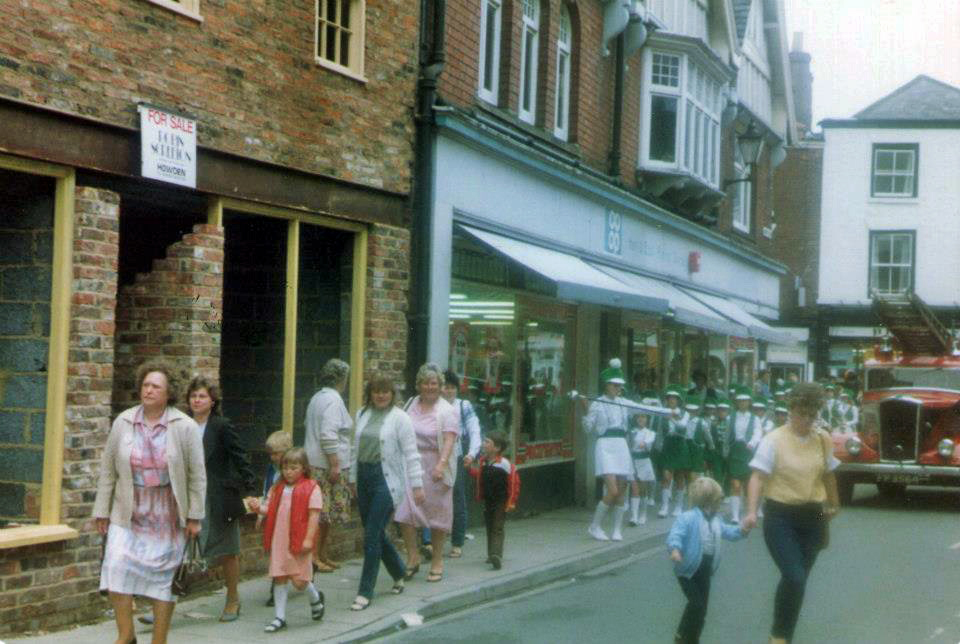
In the process of being rebuilt
34. Market Place, Howden [Dove house hospice shop]
Also demolished and rebuilt.
1851 – Sarah Mathewman, widow, ironmonger, born Thorne
1881 – William Mann, grocer and gardener, born Howden
1901 – Alfred Howdle, grocer, born Howden
Memories: ‘Later this was the shop of the Burwell family who lived on Pinfold Street. It was a very dark shop. The last member of the family was Harry Burwell, who married Zillah Wright.’
35. Market Place, Howden [now small supermarket]
1901 – Henry Fitch, boot and shoemaker
Memories: ‘This was Harry Gibson’s crockery shop then later it was Ted Fletcher’s jewellery shop before he set up in business in Carlisle Street, Goole.’
The Half Moon until recently the Co-op.]
This was one of the largest and most impressive inns in Howden. A letter survives from 1661 addresed to the Half Moon at Howden. The inn was owned for many years in the 18th century by the Bullen family. It passed into the Dunn family in 1785.
1822 – alehouse licence granted to Robert Foster. Surety was William Mathewman of Howden, tinplate worker
1881 – Charles Burrows, born Leeds
The Half Moon was rebuilt in 1890. Howden Co-op. (a branch of the Hull Co-op.) moved there from their Churchside premises c.1931.
Mr Hiles was the landlord from 1921-31. Extracts below come from the memories written by his son Bill Hiles:
“My father became landlord of the Half Moon in 1921 and left in 1931 when the brewers, Bentleys Yorkshire Breweries, closed it down.
Part of the original inn was a lock-up shop, Fletchers the jeweller and clockmaker. Next to that was Gibsons who had a china shop and also sold and repaired boots and shoes. Gibsons lived behind and above their shop and had a rear entrance into Half Moon yard.”
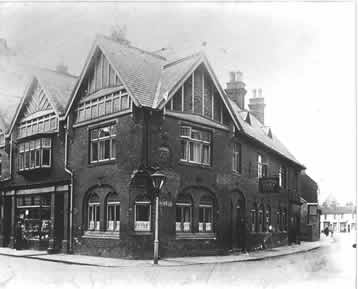
The Half Moon Inn, Howden, as it looked in the 1920s
“On the corner of the yard entrance was a corn and seed merchant in a lock-up shop which was only open on Saturdays.
On the first floor was a large sitting room on the corner, above the lounge smoking room. There were five large bedrooms, four of which overlooked Bridgegate and one at the rear overlooking the outbuildings and the yard. On the landing was a water closet and, as there was no sewerage system, I can only assume that this discharged into the Old River Derwent. Water was provided by rainwater from the roof, which was collected in a large underground cistern under the corn and seed shop; from here, it was pumped by a hand-operated pump into a tank in the roof, from which it gravitated to the WC cistern.
This water, and the water from the pumped well at the Half Moon, was unsuitable for drinking and therefore all drinking water was carried from the Bowman’s in cans and buckets from their drinking water well, halfway up the yard. Some rainwater was boiled and filtered in a stoneware charcoal filter in the bar because this treated water had a special appeal for whisky drinkers.
To the right of the yard entrance was the wash house, in which there was a coal-fired copper for heating water. Apart from the usual wringer, dolly tub, wash tub and bench, the wash house had a six foot cast iron bath for the use of family and guests. On wash days and bath nights water had to be carried to fill the copper, where it was heated and then ladled out.
Immediately in front of the yard entrance was an arched throughway which led to Burwell’s, the grocers’, yard. On the right of the archway there was a coach house in which Gibsons garaged their Model T Ford. In the yard and on the Bridgegate side there was an open-fronted coach shed in five bays.
To the right was a coach house, used by Draycott the butcher to garage his car, and then came a stable with five stalls. Most of the time of our occupation my father used this stable as a workshop. He was a skilled carpenter and joiner and, in between pulling pints, he made gates and sheds for the farmers and at times when trade was bad in the hotel he went out to work. One of the stables housed the stakes and hurdles to make up the pens for the fatstock show, which was held each year towards Christmas time. The pigs were shown in the Half Moon yard and the cattle in the Bowman’s yard.
On Saturday, which was market day, the Half Moon, Bowman’s and Wellington were open all day from 10.30am until 10pm. On these days the farmers and merchants and sometimes farmworkers would stand on the pavement in front of the Wellington and Half Moon. Many of the farmers came into town in a pony and trap or dog cart and these were stabled in the hotel yards; some even came on their bicycles. Only the very few rich farmers had cars, and they would park them in Bridgegate for all to witness their prosperity.
Half Moon corner was the Market Place/Bridgegate junction and was known as a popular meeting place at all times. During the day the unemployed would stand there waiting for a job; some would stand there waiting for opening time and others would be waiting for a friend.”
The Half Moon was bought by Hull Co-op. around 1931. Cyril Bottomley, Arthur Clayton and Sid Bunting were well-known assistants. Mr Tommy Buckle was manager of the Co-op. and moved with it from Churchside to the present site. Mr F. Parker was a later manager in the 1930s and was very involved in local community affairs [1935].
The Co-op. bakery was where the restaurant/wine bar is now on Vicar Lane. The new shop development was where the stables were. The cart was still kept there by the Co-op. after the war and used to be driven by Mr Drury and Mr Jack Neville and later by his son; they delivered groceries. The cart was later replaced by a lorry.