The Knottingley to Goole canal was opened on a wet day in 1826. The description below gives a vivid picture of the day’s events
Hull Advertiser Friday July 21st 1826
Opening of the port of Goole
The new canal and other works at this port were formally opened yesterday.
The following particulars, collected on the spot, may be acceptable to our readers.
The canal is about 19 miles in length, 60 feet wide on the water surface and above seven feet deep extending from Goole to Ferrybridge and opening a direct and speedy communication with the centre of Yorkshire and the manufacturing and commercial district.
Vessels of 100 tons burthen can be admitted as far as Ferrybridge. The works are on a most extensive and commodious scale. Two water locks communicate with the Ouse one intended for barges and the other for ships
The former is 22 feet 6 inches wide, and 72 feet long in the chamber; and the latter is 33 feet 9 inches wide, and 120 feet long in the chamber being capable of admitting vessels of between 3 and 400 tons.
The Barge Lock has been sufficiently deepened to allow the passage of vessels at low water.
The gates, of which there are ten pairs, each outer lock containing three, are of the most approved construction, and admirably calculated for the security and accommodation of foot passengers.
These locks lead to the outer basin or harbour which averages about 276 feet in length and 220 in breadth, containing 17 feet of water, and capable of being rendered still deeper. From the western extremities of this harbour branch two other locks, called the Inner Barge and the Inner Ship Locks, of rather less dimensions, in width and length respectively, than those already mentioned. The former, which is the more southerly, leads to the Barge Dock in measurement about 900 feet by 150, and communicating, at its western end, with the Canal over which at this point is a handsome stone bridge with a span of 26 feet and the rise of the arch 7 feet, leaving 13 feet from the surface of the water to the centre of the arch. The lnner Ship Lock, at the northern corner of the harbour, leads to the Ship Dock which is about 600 feet in length from north to south and 200 in width the depth of the water being 17 feet, and the walls 5 feet higher than the surface of the water.
Between the two docks is a communication about 22 feet 6 inches wide and about seven or eight yards in length.
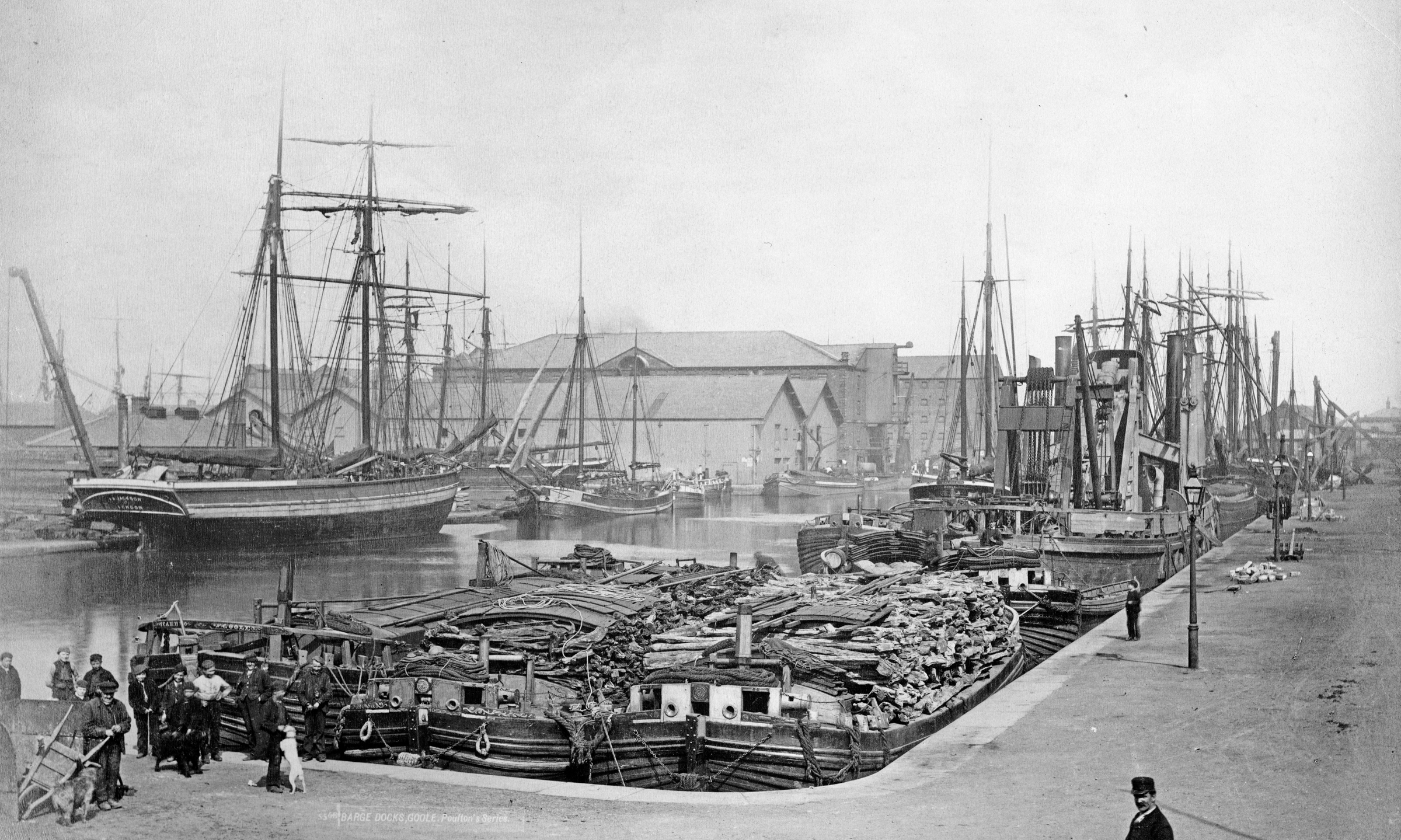
Above is an early picture of Barge Dock
On the north side of the Barge Dock is a small Basin, over which a capacious Warehouse four stories high has been created, for the purpose of loading and unloading fly boats, under cover. A little to the south of the shipping dock an immense fire-proof Bonding Warehouse is nearly ready for roofing. Convenient offices for the transaction of business, and a number of handsome houses for the agents and officers of the establishment, have been erected adjacent to the works.
The town (for the miserable huts previously in existence, do not deserve that name), is built on the north of the harbour. A large and commodious inn, called the Banks Arms hotel, is already opened and fitted up in capital style.
On the north of it is to be a spacious market-place, 220 yards square. Several streets are staked out, in parallel lines, branching west from the Ouse; some of these are 60 feet wide, with flagged causeways, already laid, five or six feet wide. The houses in three or four of these streets are already built, and many of them occupied – when the whole now contracted for are completed, they will amount to about 120.
Those of the lowest class are finished in a style of neatness very unusual. The whole of this stupendous undertaking, with most of the buildings, bas been completed in a comparatively short period and at expense,, report says of £400,000 for the Aire and Calder Navigation Company, by Messrs. Jollife and Banks, the contractors, under the able superintendence of G. Leather, Esq. chief engineer.
The architects of the buildings, we understand, are Messrs. Woodhead and Hurst, of Doncaster.
Several roads, communicating with the port, have been improved, and others are in contemplation.
Upwards of 4OO persons are at present in employment, to carry the various designs into execution. The Proprietors of the Canal have laid down a plan and elevation, which we have seen, according to which all the buildings are to be erected of fine brick or stone, and covered with blue slates; and if this plan be carried into effect, the town when completed will in point of elegance and uniformity, be the handsomest in the north of England
We come now to the proceedings of the day. An event of such importance to the future prosperity of the town and neighbourhood, naturally excited a strong degree of interest, and as early as nine o’clock in the morning, numbers of people, from the adjoining district began to flock into the place. The Graham Steam Packet, from Hull, which took a special trip on the occasion, arrived about half an hour afterwards, with upwards of 100 passengers and the Thorne and other Packets furnished a considerable increase, some of them remaining at Goole well after the ceremony.
Several coaches from Leeds and other parts of the West Riding contributed to swell the numbers. In the meantime, the weather, which had never been promising, became decidedly unfavourable. Showers continued to fall, at brief intervals, and the wind was bitterly cold for the season.
The spectators were unable, from the deficiency of accommodation, to obtain much comfort within doors and the state of the morning offered them little enjoyment without. The arrival of the company and vessels from Ferrybridge was anxiously desired but hour after hour elapsed without any tidings of their approach
We understand the Canal was opened at the other extremity, about ten o’clock in the forenoon and after about 50 sail had been admitted, the principal officers of the establishment, with their friends, set forward on a flyboat splendidly fitted up followed by three others with goods and passengers. They proceeded along the whole line, making several stoppages, and came within sight of Goole about half-past three,
At that time the bridge of which we have already spoken and other places with a view of the canal were thronged with people .Flags were displayed from the buildings and the shipping in the river.
The vessels, on nearing the town, advanced at a brisk pace. The foremost of them was decorated with & large union jack and a profusion of colours, among which were four blue banners bearing the inscriptions—’Agriculture and Commerce’, ‘Prosperity and Plenty,’ ‘Jolly Tars and Cheerful Swains and ‘Success to the Port of Goole.’
Among the Gentlemen on board, we observed W. M. Maude and J. Priestley Esqrs., who have the direction of the Company’s affairs, Sir E Banks, one of the contractors, Arthur Heywood, Esq. Jas. Maude, Esq. of Leeds, Messrs, Leather and Hirst, etc.
In the second vessel was an excellent band of music, which was met by another from the town. ‘The first boat passed under the bridge, at four o clock, amidst three hearty cheers, and a discharge of cannon, the bands playing ‘God save the King’. The whole party then proceeded through the Barge Dock into the Harbour, the music performing Rule Britannia, the multitude cheering, and the firing being kept up by the vessels, and great guns.
About five o’clock, a number of gentlemen sat down to an excellent dinner. W. M. Maude, Esq. was in the Chair, and Joseph Priestley, Esq. Vice President. A number of loyal and appropriate toasts were given, including Sir John Lowther and the Undertakers of the Aire and Calder Navigation—Success to the Port of Goole and the New Canal, etc.—
The Company then adjourned to witness the entrance of the Lowther Steam Packet by the proper lock into the Ship Dock, which, after some delay, was effected; and when we left the place (9 o’clock) the passengers and spectators were exulting at this event.
An accident occurred on the passage, at New Bridge, a few miles from Goole. One of the vessels in the train, rather top-heavy, was capsized, in consequence of the passengers suddenly crowding to one side. Many persons were precipitated into the water, and there were some apprehensions that a boy was lost. In another instance, an elderly gentleman, immediately after the first boat had passed under the canal bridge was swept by the hauling rope, into the Barge Dock, and carried nearly to its centre. He clung however most tenaciously to the rope, and was rescued from his perilous situation with no injury other than a sound ducking.