Barmby was first mentioned in the Domesday book in 1086 when it is listed as consisting of 90 acres belonging to bishop of Durham.
The village was probably a Scandinavian settlement, from the personal name Barne/Barni and the ending ‘by’ meaning farm.
Today it is a ‘dead end’ by road but in former years there were two ferries – one over the River Derwent and one [Langrick Ferry] over the River Ouse. There was also a railway station and bridge on the Hull and Barnsley line.
It should not be confused with Barmby Moor [near Pocklington] but is sometimes described as Barmby on Derwent.
There is a long standing tradition which says William the Conqueror gave Barmby to 40 of his soldiers who each received an oxgang of land. Another source says that around 1200 the bishop of Durham gave all his waste in Barmby to his men of Barmby forever. I have not found the evidence to back this up but certainly the land around the village was not enclosed until 1853.
The village has a long and interesting history. Below are some brief notes but I am sure there is a lot more to find out about Barmby.
Religious history
In 1267 Barmby became a prebend of the church of Howden
In 1322 Barmby was given its own vicar. His endowment of 10 marks a year was to be paid by the prebendary.
The first vicar was William de Skypwith. A full list of vicars survives from 1322
The earliest record of a chapel on this site dates to 1388, when the archdeacon issued a licence for a new chapel at Barmby
In 1459 four Barmby men were granted a licence by the king to ‘found a fraternity or guild of 4 wardens and other persons of both sexes of the same vill of Barneby juxta Howden….in the chapel of St Ellen in Barneby’. The guild was for ‘the praise glory and honour of the Holy Trinity and Blessed Virgin Mary and St Ellen‘
In 1489 the people of Barmby petitioned Pope Innocent VIII complaining that they had to travel to Howden church for baptisms and burials and often found this difficult because it was a long way and frequently impassable because of floods.
They asked if ‘a chapel or church, dedicated to St. Helen, could be built in Barmby with a baptismal font and cemetery’ and if the rector could depute a chaplain for the village
In 1564 there is mention of ‘Barnaby chapel in Barnaby in Holden, co York and lands in Holden given for a priest celebrating in the same chapel’
In 1570 when the Barmby tithes were leased they included ’the tithe barn in Barmby once belonging to the prebend of Barmby and Asselby in the late collegiate church of Howden’.
This is long after many sources say the barn had been converted to the church. So whether both barn and chapel occupied the same site I am not sure.
From Allen’s history of the Co of York ‘about 1700 there was such an excessive flood that it became necessary to have boats to bring the dead from Barmby [to Howden] for interment, a distance of nearly 4 miles’.
Church in the eighteenth and nineteenth centuries
1738 Permission was sought to ‘build a loft at the west end of the said chapell, also to put in windows 4 feet wide and 5 feet high on the north and south sides and a window 4 feet wide and 3 feet high under the new loft’.
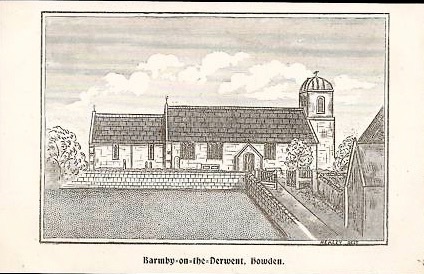
1773 the spire [possibly wooden] was removed as unsafe and a new steeple built, capped by a dome at a cost of £120
1785 the north side of the chancel was rebuilt in brick.
Rev George Walter Robinson 1821- 1889
Rev Robinson, originally from London, came to Barmby in 1864. In 1861 he was curate of Little Billing in Northamptonshire. His wife was Rosa Ellen and they had two daughters Rosa aged 5 and Lavinia 11 months. His wife Rosa died in 1863. He married his second wife Maria in 1865.
Visitation in 1864
He was not impressed by what he found in his new parish. Just after his arrival In 1864 the Archbishop of York carried out a visitation of his diocese and asked the clergy to answer questions about their parish.
George Walter Robinson who described himself as Blanshard’s lecturer answered the questions for Barmby on February 16th 1864.
His answers did not paint a very good picture. He said there was a village population of 431. He took the services and also ran a Sunday school. There were 24 communicants. He wrote
‘the past neglect on the part of the Church has left the generality of the people ungodly or worldly minded or sectarian
There is one Wesleyan meeting house and one Primitive Methodist meeting house . They are but poorly attended. These meeting houses afford several a pretext for their neglect of the Church. Many plead that they go to these places occasionally because they are open of an evening on a Sunday. There are also five public houses. I visit the people weekly from house to house urging them to attend their religious duties.
The roof of the nave was slated a few years since. The chancel is in a bad state being built of brick. There hath been only one chapel warden who has not levied a chuch rate in two years.
But he did not suffer this for long. In 1870 the whole chancel was rebuilt. The new cornerstone was laid on 23rd August 1870. The old gallery was removed, and the nave re-seated with open benches of pitch pine. The choir stalls and communion rails were made in oak. The pulpit was the gift of Mrs Clarke of Knedlington manor.
The ancient piscina was retained.
Architects for this were Messrs Hadfield of Sheffield. Woodwork was by Messrs Shaw of Howden and Asselby
And two years later 1872 a new vicarage was built at a cost of £1700. The Robinson family were its first occupants.
But Mrs Robinson died in August 1880. A small window in her memory is in the south east nave, possibly by Burlison and Grylls.

In the same year ‘A painted east window’ was put in the church ‘the munificent gift of the late Miss Jane Pycock, in loving memory of her mother, the late Mrs. Elizabeth Pycock’. It depicts the Ascension of Christ and was the work of Messrs Burlison and Gryles, of London.

Rev Robinson died in April 1889 and was buried at Barmby having been vicar there for 25 years.
The York newspaper reported that
We regret to announce the death of the Rev. G. W. Robinson, vicar of Barmby-on-the-Marsh, near Howden. The Rev gentleman, who had been in failing health for some time past, was on Tuesday night seized with apoplexy and died in the course of the following day. Mr. Robinson graduated at St. John’s College, Cambridge, being ordained priest in 1846 by the Bishop of Ripon. He held the curacy of Elland, near Halifax, from 1815 to 1857, and three other curacies, including Billing Parva, North Hants. In 1864 he was presented by the Lord Chancellor to the vicarage of Barmby, the value of which is £280 per annum. Mr. Robinson, in 1860, published a volume of “Village Sermons,” and, at a later date, a pamphlet entitled ” Eirenicon for the Wesleyans.”
He left £721 and in 1891 both his daughters were unmarried and running a boarding house in Scarborough. Lavinia died there in 1894 aged 34. There is memorial stone in the churchyard to Rev Robinson, both his wives and his daughter.
Rev John William Talbot
Rev Talbot was appointed the vicar of Barmby later in 1889 and remained there until his death in 1941 at the age of 84. He had been vicar of the parish for 51 years. In 1939 he celebrated the 60th anniversary of his ordination and his golden jubilee as vicar of the parish. In the same year he and Mrs Talbot celebrated their diamond wedding. He had the unique experience of having baptised children whose grandparents he also baptised.
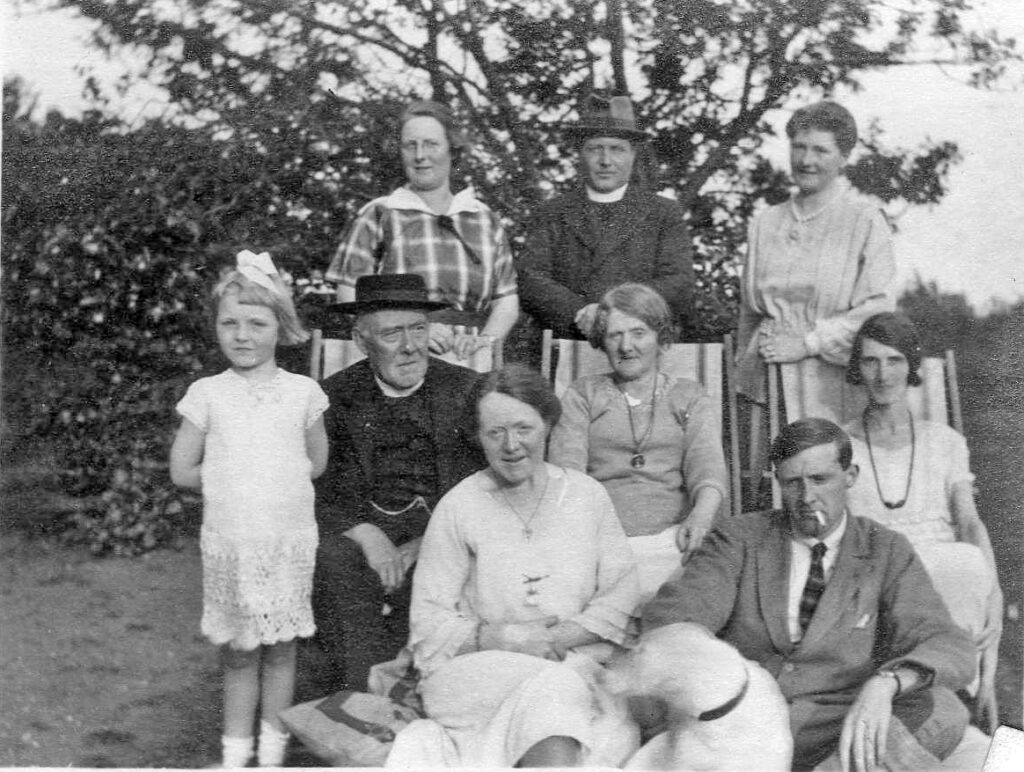
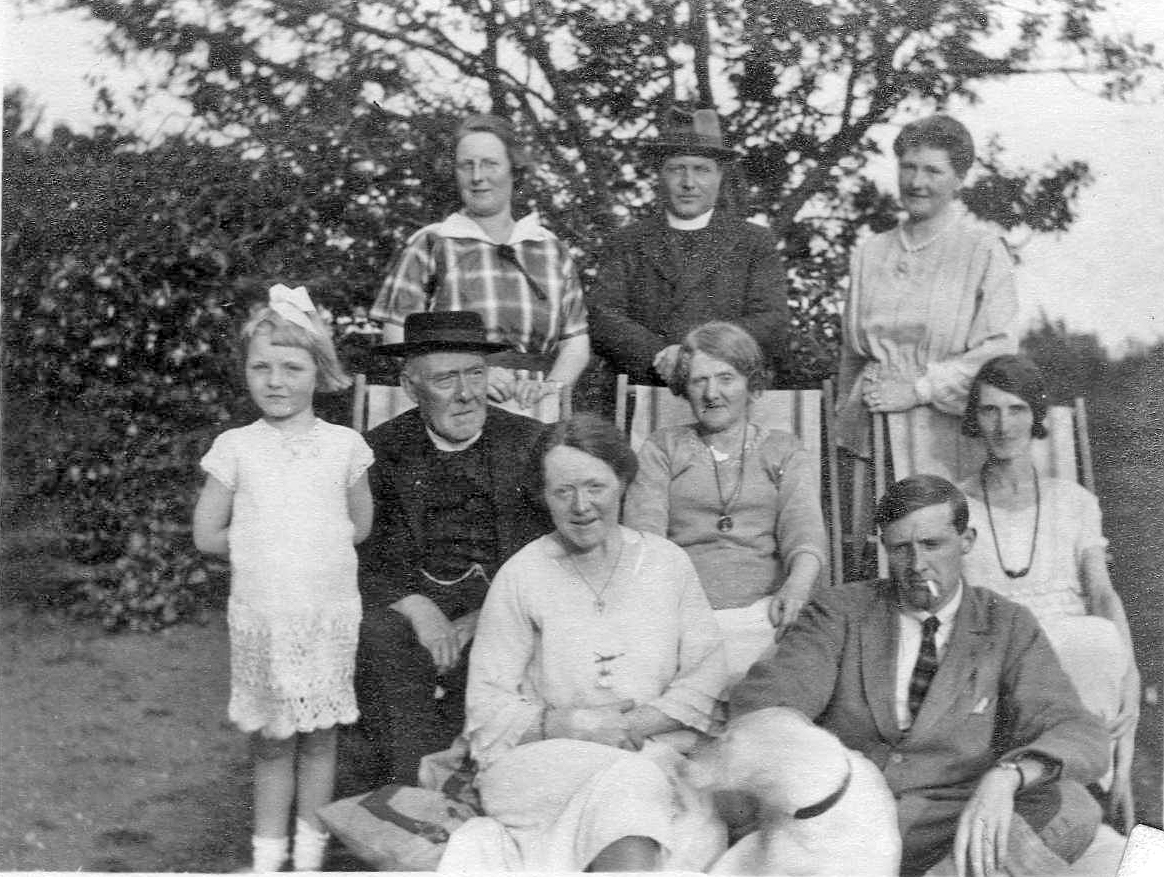
Above : Rev John W Talbot, vicar of Barmby on the Marsh, one of his sons, three of whom became priests, his wife and her nieces, pictured August 1923 at the vicarage at Barmby.
Church restoration
The church was restored again in 1910. The following report appeared in the Hull Daily Mail
In the presence of a large congregation, Barmby-on-the-Marsh (Parish Church, near Howden, which has been beautifully renovated and repaired, was reopened on Friday night by the Bishop of Hull (Dr Kempthorne). The old brick floor of the chancel has been removed and relaid with suitable tiles, and the wooden altar step has given place to one of stone. The interior of the edifice now presents much improved appearance. The vicar of Barmby (the Rev J. W. Talbot) was assisted in the service by his two sons, the Rev T. W. L. Talbot, curate of Sharrow, and the Rev A. D. Talbot, curate of Kimberworth, and Miss Elsie Talbot presided at the organ.

Barmby church was closed in 2007 and it was feared that it would be demolished. But now, in 2024, it has been restored under the auspices of a group called Friendless Churches. It is hoped it can be put to community use.
John Martin, long serving parish clerk
In October 1908 it was reported that John Martin of Barmby was the oldest parish clerk and sexton in East Yorkshire.
Born in Bristol in June, 1822, he served his apprenticeship as a hand loom weaver in the city, but after several moves he settled down at Barmby, where he married in 1844, and became parish clerk in 1864.
He was a hemp and flax weaver on the 1871 census and his wife was a spinner. They had 8 children, not all of whom survived to adulthood
His first wife, Mary Ann [Watts] died in 1889, and about a year later he married again, his second wife, Harriet Lazenby being 69 years of age. She had worked in the mill as a spinner and had known her future husband nearly 50 years before she married him. She died in 1906. John died in 1915 in Hull.
Barmby charities
Like many villages Barmby had various charities whereby former residents left money and property for the benefit of later villagers. Barmby still has its charity – Garlthorpe’s which incorporates others. Sometimes the charities have had to be remodelled to fit with changing times.
Garlthorpe’s charity
In 1480 Richard Garlthorpe, about whom we know nothing, left a messuage [a house and its surroundings] and 60 acres for the benefit of the people of Barmby. The proceeds from the rents were to be divided three ways between the poor, repairs to the church, the staithes and the river banks and to the payment of a reading minister.
In 1621 it was found that the lands were administered by elected Orderers and that it was specified that no lessees should be able to receive more than 7 rood lands [a rood land was a quarter of an acre].
But over the years there were problems. It appears that leases were granted for several years, that lessees were able to receive many more roods than seven and that some land was kept in the hands of the Orderers.
In 1830 charity commissioners surveyed the charity ‘with a view to reforming the abuses which prevail in the letting and management of the trust property and to secure the due administration of the charity in future’.
A new scheme was set up in 1831 and the trustees included upstanding local gentlemen Rev. Thomas Guy, vicar of Howden, Thomas Clarke of Knedlington, Philip Saltmarshe of Saltmarshe, Robert Spofforth of Howden and William and Robert Scholfield both of Sandhall.
In 1839 a newspaper report explained that
The trustees of Garlthorpe’s charity, were recently appointed to the management of the trust estates by the Court of Chancery, on the first day of the year, distributed a liberal supply of blankets to the poor of Barmby-on-the- Marsh. This charity has been the source of reiterated commissions and disputes from the time of Edward IV, the date of the death of the donor. It is now hoped that the trustees, who are chosen from the most respectable persons in Howden and the neighbourhood, and not from the inhabitants of Barmby, continue to administer the important trust with fairness and punctuality. The poor of the place have heretofore been cruelly deprived of their just rights..
Another report from December 1853 reads as follows:
On Monday and Tuesday last 60 tons of coals were distributed to the most deserving and industrious of the labourers, not being in receipt of parochial relief, in the township of Barmby on the Marsh, by the command of the trustees under the will of Richard Garlthorpe. The remainder of the yearly rental (the whole of which about £120), is divided thus :— £20 to a reading minister, £18 towards the support of a schoolmaster; the remainder for the repairs of the chapel of ease, and the staithes and waterworks.
Blanshard’s charity
In 1712 John Blanshard left 25 acres of land and two houses, in trust, to pay £2 yearly to the poor, and the rest of the income to pay a lecturer and schoolmaster, who should be elected by the resident householders. The school was to be a grammar school, held in the church. The resident lecturer was also to preach sermons twice on a Sunday at Barmby.
But by 1743 the Barmby curate reported that the only school in the village was run by Quakers. In 1763 there was a school teaching 30 children reading and writing and the catechism, but this was not properly a grammar school teaching Latin grammar.
It was probably held in the west end of the church. The lectureship seems to have linked to the incumbent of the living who then often paid towards a schoolmaster’s salary. Funds also came from the village. For more on schools see a later paragraph.
In 1892 it was said that both these charities had been remodelled by the Charity Commissioners in 1877. The income from the Garlthorpe lands, then about £150 a year – was divided into three equal portions – one third for the poor, one third for the repair of the church, river banks, etc., and of the remaining third, £20 yearly was paid to the minister of Barmby, and the remainder applied to the purchase of rewards and prizes for children attending an elementary school in the parish.
The office of lecturer and schoolmaster was abolished on the death of the Rev. G W.Robinson and the income of the Blanchard Charity (£62 per year) was applied as follows: the sum of £2 was given to the poor, one half of the remainder was applied to the augmentation of the vicar’s income, and the other half was distributed amongst the children of the parish in rewards and prizes, for attendance and in prizes for proficiency in religious knowledge and the church catechism.
David Tacker, a seventeenth century innkeeper, left 40s. a year towards the relief of the poor. This was later given to the village overseers to distribute.
Thomas Holdsworth
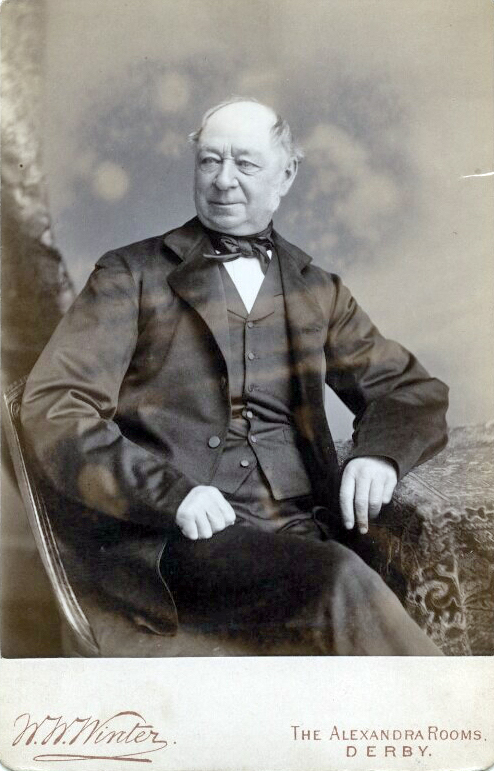
Thomas Ho/uldsworth, pictured above in 1886 [image courtesy of NPG] was born in 1811. He was apprenticed at 16 to a Mr Bairsto of Selby and he married Hannah Saxton there in 1835.
He was a self made man, trained as an engineer and became a prominent and rich colliery owner in Clay Cross in Derbyshire. But he never forgot his native Yorkshire and contributed over £1200 to the restoration of Selby Abbey around 1890 paying for the work on the sacrarium including a new marble pavement and steps; the cleaning and repairing of the communion rails; the restoring and waxing of the oak screen at the north side; the stone screen restored and fixed original position; a new reredos and side panelling above the stone screen and the restoration of the sidelia including the new canopies. This was all of course before the terrible and destructive fire at the Abbey in 1906.
At Barmby he founded around the same time the Holdsworth charity by buying some nine acres of land in memory of his wife. He stupulated that fifteen aged people of the village should received gifts of money from the land rent every half-year,
He died in 1893.
Barmby chapels
The Wesleyans erected a chapel at Barmby around 1811/12. In the 1851 religious census Joseph Good, the steward said it was 30 feet long and 20 feet broad and would seat 140 people.
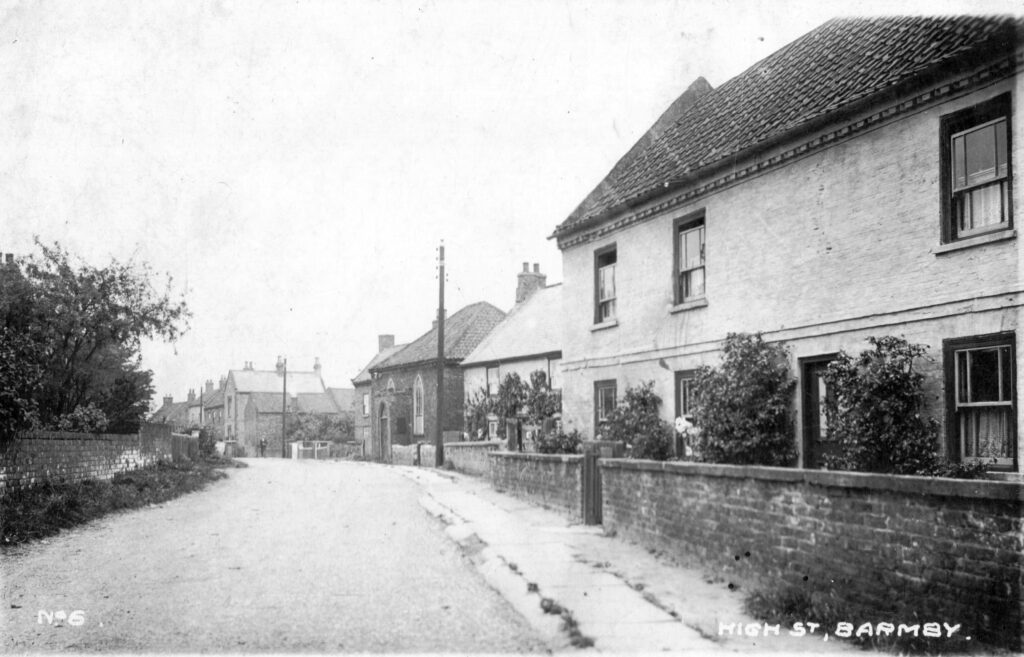
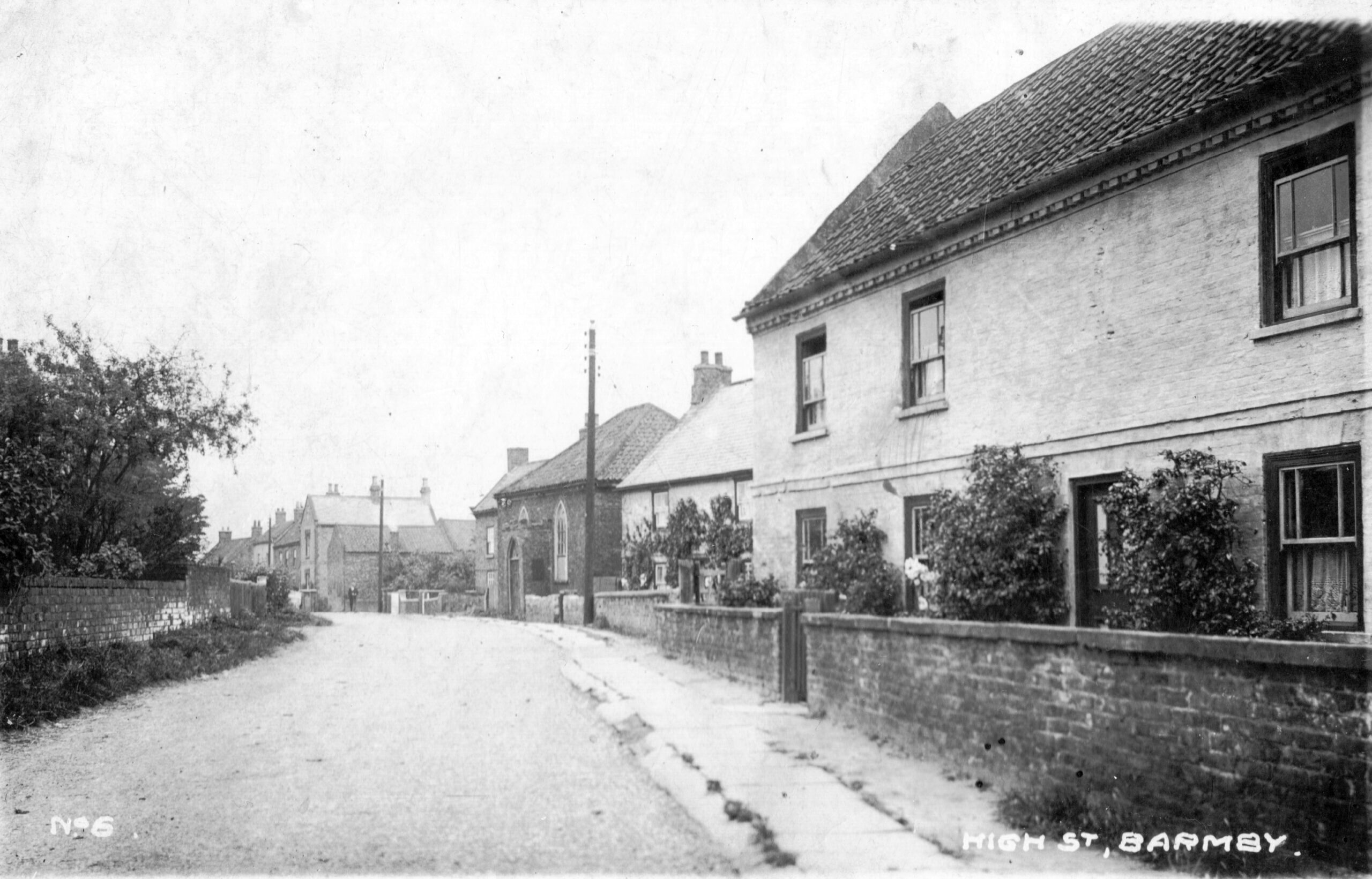
Shown here on the right it was demolished in the 1970s
Primitive Methodist chapel
Thomas Bickerton, class leader in 1851, reported that the Primitive Methodist chapel was erected in 1838 [ other sources say 1833] and has a house joining the place of worship. He said it was 28 feet long and 18 broad and would seat 140.
On 30 May 1902 the stone laying took place for a new PM chapel.
Thursday, in the presence of a large company memorial stones of a new Primitive Methodist Church erected at Barmby were laid by numerous friends associated with the cause. The new structure is estimated to cost £500, and is be of a commodious character. At the end of the proceedings an adjournment was made to the Board School, where tea was served.
The architect was William G Smithson of Leeds. He was himself a Primitive Methodist, a native of Whitby and designed several other PM chapels.
This chapel, now described simply as a Methodist church is active today.
Village Wells
St Helen’s well was south of present church. It was a chalybeate [ iron rich] spring and was filled in in the 1820s.
The dedication of both church and well is interesting. There is a recognised link between holy wells and dedications to St Helen, particularly in eastern England centred around the Humber / Ouse area..
St Peter’s well. There was also was a well in Barmby dedicated to St Peter. This was a spring of sulphuric water and possessed the ‘rare virtue of curing scorbutic eruptions by external application’. By 1892 it was said that although the water still flowed and was said to cure scurvy and sore eyes, it was nothing but a duckpond.
Enclosure
The village open fields were not enclosed until 1853. Before enclosure there were 1152 pieces of open land as well as 352 separate enclosed pieces of land [average size 2 acres].
Field names included: Middle Marsh, Solo Marsh, Seave Carr, Marsh Lane, Bank field, Hill Field, Low Field, Hither Great field, Oxen Stang field, Holy croft [?holly], Barmby Pasture [which was on other side of the Derwent].
Enclosure ended the annual horse races which began on the last Thursday in June and lasted 3 days
Weaving Industry
There has been a weaving industry at Barmby for hundreds of years – mainly sacking and sailcloth.
In 1379 13 websters or weavers were listed
The weaving was of flax or line which was grown around the village and which was woven and used for sailcloth which was sold to the vessels on the Ouse and Derwent.
The Noble family
The family were living in Barmby in the early 18th century and were weavers. In 1727 John Noble married Eliabeth Lawrence at Howden. He died in 1741 and included in the inventory of his possessions were the tools of his trade”
In the shop or loom house one loom and furniture
He also supplemented his income by brewing and selling ale. Listed too were
In the kitching old barrels and tubs belonging, brewing vessels
After John died his widow took over his ale house licence and later their son, another John [Noble]. He was listed as an alehouse keeper upto 1775; when this John married in 1759 he too was described as a weaver.
John jnr and his wife Hannah had ten children, not all of whom survived beyond childhood.
John died in 1786 and left a will. By then he was a very well off yeoman. His eldest son, Robert [Noble] inherited the bulk of his property but he also left
two messuages [properties which included land, farm buildings and houses] occupied by Thomas Williamson, Richard Drinkall ‘and myself’ to his widow Hannah for her life and then after her death ‘to my sons John and Michael’. He also left them the rest of his cottages, lands grazing rights on the marsh [known as marsh gates] . To his daughters Ann and Hannah he left two hundred pounds ‘a piece’ [each].
Robert married Elizabeth Delanoy, a member of another well-known Barmby family on 29th May 1787 at Howden. They had at least 12 children.
Robert died in 1833 owning a house, a cottage and a hundred acres.
Cock fighting
His son Michael Noble was an innkeeper. I think Michael had a cockpit at his inn. There was a reference in 1809 to ‘Mr Noble’s pit’. As yet I have not traced which inn is the correct one.
This advertisement appeared in the York Herald June 1809
COCKING. BARMBY UPON THE MARSH. To be fought, on Thursday and Friday the Twenty EIghth and twenty ninth of June 1809, at Mr Noble’s Pit, a Long Main between Gentlemen of the East-Riding and Gentlemen of tbe West- Riding, for Five Guineas a Battle and Fifty the Main. And on Saturday a Welch main for a Mare, value Twenty- five Guineas. Collinson and Burnill feeders
[A Welch Main was a contest to leave the last cock standing. It was an elimination contest starting with around 16 pairs, the next round were the eight winners, and so on until one was the winner. The birds themselves were fitted with silver spurs designed to inflict damage to the opponent. The contests usually coincided with local horse races or fairs when there was an influx of gentlemen inclined to bet heavily on the outcome of the battles.
Robert’s daughter Mary Noble was born 1799.
She married William Thompson, a sacking manufacturer of Barmby.
It was the Thompson family who continued Barmby’s weaving tradition in the nineteenth century. They ran a sacking mill on North Street .
William died in 1832 of cholera. Mary and William had six children, including one called Noble Thompson. Their son John Solomon Thompson had an interesting life. He joined the army as a master tailor and served in India. One of his children was born at Peshwar and another aboard a ship in the Bay of Biscay. He returned to Barmby in 1866.
In August 1832 the property was described as ‘A Dwelling House, Garden, Orchard, and and Mill or Sacking Factorv, with Sheds and other requisite Buildings belonging thereto, situate at Barmby on the Marsh, in the County York in the Occupation of Messrs. Thompson’.
In 1851 Thomas Clarke of Knedlington, in his history of the parish of Howden, described Barmby as ‘a well built village housing two manufactories of coarse linens’
In the 1870s there was only one sacking manufacturer, John Solomon Thompson and by 1892 none was listed.
A very sad part of the story of Barmby’s sacking mill took place in December 1915. It was reported as follows
An accident which happened at Barmby-on-the- Marsh on Thursday afternoon, through a. falling building, unfortunately resulted in the death of a school girl.
The building is an old one of two storeys, and was formerly the hand loom weaving shed of the late Messrs Wm. and J. S. Thompson, but of late years has been used more or less for storing agricultural implements and the upper storey as a store for cattle cake. For some time the bidding had been in decay but was thought to safe.
The accident happened about four o’clock, when a strong east wind was blowing and it is thought that this may have been the immediate cause of the accident. Unfortunately, it just happened after the close of school. Had it been a short time earlier it would not have been attended with loss of life. The premises are now in the occupation of Mr Arthur Mitchell, farmer. His daughter Ivy, a girl about nine years of age was playing in the bottom storey with Doris Falkingham, aged 11, the daughter Mr Alfred Falkingham, farmer, and Edith Tasker, aged 11, daughter of Mr Alfred Tasker, hay cutter. They were running in and out of the building.
Unfortunately for Doris Falkingham she was more in the interior of the building than her playmates. Without any warning whatever the side of the building fell outwards, and Doris was buried in the debris having been caught bv a massive beam. Mrs Mitchell, hearing the crash, ran to the rescue, and willing hands were soon at work to rescue the girl, but from very first little hopes were expressed for her life.
A messenger was despatched for Dr Brown, of Howden. but that gentleman being away, Dr Crowther hurried to the scene and found that life was extinct. Ivy Mitchell was the nearest the door and she was hit on the head by a falling brick and knocked down. Edith Tasker was most miraculously saved. She was knocked down, but was able to crawl from under the debris. Special Constable ?Head of Barmby, soon arrived take charge till the inquest. The sympathy is felt with Mr and Mrs Alfred Falkingham where they are so highly respected in the village. Their daughter Doris was a bright, lively girl, and a great favourite with her companions.
The Delanoy family
The Delanoy family of Barmby are very interesting. The first mention of them in England was when Isaac Delanoy – sometimes written as De la Noy- married in 1649 at Sandtoft. This was where there was a church for Protestants working on the Isle of Axholme drainage.
The Delanoy family seem to have migrated towards the Carlton/Drax area and then across the river to Barmby by the mid eighteenth century. They were farmers and there are several family graves in the Barmby churchyard.
John Delanoy died in 1827. He left his property in trust and it was sold in 1839. It then consisted of a farm houses with barns, stables and foldyard and adjoining premises occupied by Thomas Birkitt and Robert Thompson and another house with yard occupied by Thomas Sales as well as 55 acres and four marsh or cattle gates on Barmby Marsh.
John’s son William was born in 1816. In 1850 he married Mary Marshall and their son William was born the following year. The family had settled in Doncaster where William became landlord of the Wood Street Hotel. He gave this up and became a currier and harness maker in Baxtergate. His son William followed him in business initially and also became a prominent freemason in Doncaster. In 1880 he wrote the story of St George’s Lodge of which he was a member.
But by 1891 he had moved to Egypt where he worked for the government and took a leading role in Egyptian freemasonry. In 1901 we read that
The King has granted unto Mr. William Delanoy authority to wear the Insignia the Fourth Class of the Imperial Order of the Medjidieh, conferred upon him by the Khedive of Egypt in recognition of valuable services rendered to his Highness by Mr Delanoy in his capacity of Director of Stores and Industries in the Prisons Department of the Egyptian Ministry of the Interior.
He died in Egypt in 1931. A long way from Barmby.
Windmills
Barmby had a windmill in 1295.
This post mill was on the outskirts of the village on the corner where Gateland Field Lane joins the Asselby to Barmby Road. It was a post mill and in medieval times belonged to the Bishops of Durham who maintained it. In 1530 for example a new main oak post was installed, cut down and carted from Howden Park.
After the Reformation the mill became freehold and was eventually acquired by the Dunnington Jefferson estate.
The last miller was probably Joseph Wood. When he died in 1893 It was said that ‘Mr Wood, though a native of Hensall, resided Barmby for over 40 years. For a number of years he followed the trade of a miller, trading at the “Old Mill,” Barmby.’ He was also a farmer of 68 acres.
In the nineteenth century there was also a mill In the centre of Barmby. It had a house and premises attached and was in the centre of the village and was occupied by John Cook, father and son. John Cook snr was from Seaton Ross and it was his brother Robert who owned the Barmby and Seaton Ross mills. John jnr was born at Barmby in 1813.
The mill was advertised for sale in both 1831 and 1834 but presumably there were no takers as the Cooks remained in Barmby.
In 1838 there is a report mentioning the bravery of John Cook.
CLEVER FEAT. On Tuesday week, John Cook, of Barmby-on-the-Marsh, near Howden, miller, was out with his mare and cart. Having left them for a short time, he was surprised to observe on his return that the mare had plunged into the river with the cart; he immediately pulled off his coat and waistcoat, and put his knife in his mouth and swam to the opposite side of the river, and when he reached the mare, he attempted to cut the neck strap, but not being able to accomplish it, he put the reins in his mouth and drew the mare back out of the river, amidst the shouts of the assembled spectators. Great fears were entertained that he would perish in the attempt.
In January 1839 there was a terrible storm and many mills, including the two at Barmby were blown down. There was a graphic description in the newspaper of the damage caused to the mill.
Barmby —This village and its neighbourhood were visited with a tremendous gale. The damage done cannot yet possibly be calculated. The beautiful corn mill which is upwards of seven storeys high, belonging Mr R.Cook, of Seaton Ross, had the top completely carried off together with part of the wall, which before it fell, presented a grand but awful appearance. From the top to about the fifth storey, the wall on each side opened and shut twelve or fourteen inches, the sails were going round through the gearing. The stones were laid on their faces prevent its progress, but which in reality aggravated Its previous effects. The neighbours and tenant were in the act of carrying water to the top to prevent the mill firing, when down it came altogether into the adjoining garden, the top, etc. being completely smashed to pieces. The damage done will not be less than from £350 -£400. Another (post) mill in the same place was overturned.
The smock mill was re-built and the post mill righted. John Cook snr died in 1845. John jnr remained at Barmby until his death in 1866. The mill was put up for sale in 1867
It was then described as
All that Superior and Substantially Built Wind Corn Mill, with the Dwelling-House, Stables, Outbuildings, Garden, Piggeries, etc, attached situate at Barmby-on-the-Marsh aforesaid, and lately in tbe occupation of Mr. John Cook (deceased). The Mill is Seven Stories High, Brick Built, Runs Three Pairs of Excellent Stones, and is worthy of the attention of Millers and others, the Property having Two good Frontages to the Town Streets of Barmby. Possession can be had on the 6th day of April next.
There was also an inn called the ‘Windmill’ next door to John Cook. In 1861 Thomas Fussey was the innkeeper.
We learn a little more about the Dixons and the smock mill sadly in 1933. A newspaper report describes how ‘ Mr Peter Dixon, aged 78, of Barmby Marsh, near Howden, was yesterday found dead with his throat cut. He was not seen during the morning by his neighbours, and Mrs Wilson, who lives nearby, entered the house and found him lying in a pool of blood by his bedside. A razor was on the floor near by. Mr Dixon was a native of Burton Pidsea, and came to Barmby in his boyhood. His parents lived at and worked the Wind Flour mill, which was demolished 1902.
1854 Cholera in Barmby
We know that there was a cholera epidemic in the Howden area in 1854. In Barmby the following tribute was paid to local man William Fox in January 1855. It would have been interesting to know exactly what he did.
The inhabitants of Barmby assembled in the school-room, along with their friends, to present Mr. W. Fox, jun., of that place with an elegant time-piece, silver tea-pot, and sugar-basin, in commemoration of the valuable services rendered to the poorer classes of the village by Mr. Fox during the time the cholera visited the village.
The articles above enumerated are of the highest class, and were manufactured by Mr. Rhodes, jeweller and silversmith, of Bradford, and reflect great credit on the manufacturer. The time-piece is a superb piece of mechanism, and the tea-pot and sugar-basin are equally beautiful.
The following inscription is engraved on the different articles: — “Presented to Mr. William Fox, jun., by his friends and fellow-townsmen in grateful acknowledgment of his unwearied exertions in alleviating the sufferings of the poor attacked with cholera, and for the adoption of those prompt and energetic measures which tended to stop the progress of that fatal malady in the township of Barmby- on-the-Marsh, 1854.”
An excellent address was delivered by Mr. Robert Wilson, who presented the testimonial, and some very able remarks were made by Mr. Samuel Storr, of Thornton Land, near Howden, and Mr. England, solicitor, Howden, after which Mr. Fox responded in a very able manner, and the company shortly afterwards separated, highly gratified with the meeting, yet feeling that they had but done little to one who had risked in the hour of danger and suffering that which is dear to all men, namely, ” life.” The sum subscribed for the above testimonial amounted to £39.
The ferries.
Derwent ferry
There was possibly a bridge across the Derwent in medieval times. ‘Barmbie fery‘ is often mentioned in Howden parish registers. This was the Derwent ferry. There was a paved path to Hemingbrough. This ferry was operated by the occupier of the ‘Sloop’, now Ferry hill farm.
In 1793 the Fenton family of Malton leased the Derwent navigation. Their agent lived at Barmby and they had a warehouse there. There was a lock keeper or chainkeeper at Derwent mouth.
Ouse ferry
This was Langrick ferry which went across to Long Drax and was operated from Drax.
Barmby was a regular packet boat stop for Selby. There was also a market boat every Monday
The following appeared in the “Yorkshire Evening Post”, March 1928) describing Drax/ Barmby/ Langrick ferry
A few cottages together with the Ship Inn face the river, and the place is lonely and dreary, particularly on a cold grey day, with the wind whipping the water; though one can imagine that it is pleasant in summer sunshine to where the roofs of Barmby can be glimpsed through the trees. The river lies deep between the banks, rising high as the tide runs and then dropping back to leave three or four feet of slimy mud on view, but the high banks are not always high enough to cope with floods, and the inn, the cottages, and the farm buildings have a rampart of earth against their walls, with stout boards ready to slip into their doorways to keep back the flood water.
It is a ferry of indefinite age, needing no more than a passenger boat now, though it is not a great many years since it had also a much bigger boat in which cattle, sheep and horses used to cross. The stallion horses that travelled this part of the country crossed by it and sometimes there was a bit of a “to do” getting them aboard.
Some of its liveliest times were the Drax and Barmby feasts, one of which followed the other, for in addition to the people going from one village to the other, it was used to transport the donkeys from Drax to Barmby, and very often this ferrying of the donkeys was the best part of both feasts.
Mrs Spetch of the Ship Inn has owned the ferry since her husband died some years ago, and he was the ferry man for some thirty years. Mrs Spetch, now over seventy years old, is a Barmby woman [ she was born Rebecca Sails], and can remember that when she was ten or twelve years old the Ouse froze so solidly that she skated across. She has seen much ice on it since, though not in later years, nor does she remember any other occasion when it froze so solidly all the way across. In her husband’s time there was quite a lot of traffic, and there used to be a dozen or more farm labourers coming across from Barmby to work on the Drax Abbey estate, in times when their wages were from a shilling to eighteenpence a day.
There are few passengers now, one or two workmen use the ferry regularly and a few boys from Drax Grammar School cross each Wednesday and Saturday, but the sixpence for a cycle and threepence for a foot passenger brings in very little compared with the twenty and thirty shillings a week the ferry brought in the old days when fares were much cheaper. The railways and better road transport have completely altered the life of the river, and the problem of crossing it. Before Mr and Mrs Spetch had the farm, the inn and the ferry, and while they were still living on the Barmby side, her husband used to carry by boat all the fruit from the orchards round about the farm up to Selby market, and many a time she helped him to row a boatful of fruit to Selby market. He also brought back in his boat, most of the stores for the village, and laboured heavily under many a ten stone bag of flour up the steep banking of the river.
Mrs Spetch’s son and son-in-law mostly manage the ferry, but there are times when farm work is busy, then her daughter rows the boat across.
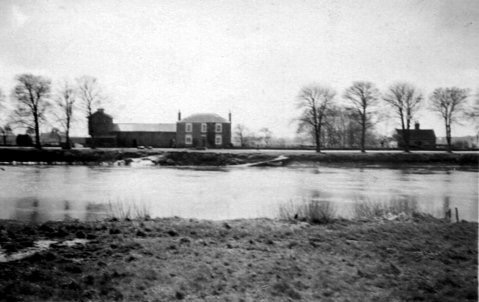
Above is the ferry from the Barmby bank looking across to the Ship Inn Long Drax
Carriers
James Maw was carrier in the 1850s. He was obviously a man of many parts as the following newspaper report shows
1855
Jas. Maw, of Barmby- on-the-Marsh, common carrier, pinder, bellman, parish clerk, and sexton, was charged with being found in his cart on the road between Barmby and Howden, on Saturday afternoon, the 28th ult, in an insensible state of intoxication. From the evidence adduced it appeared that he had been six or seven hours in travelling a distance of four miles to Howden market He was fined 2s. 6d. and 10s. costs.
Frederick R Pridmore
A later carrier was Frederick Readyhoff Pridmore [ Readyhoff was a family name]. A newspaper report of December 1929 reported that
After 40 years’ faithful service as carrier with his horse-drawn vehicle, Mr. F. Pridmore, of Barmby Marsh, has made his last journey to Howden Market. The extensive ‘bus services have practically taken all the business from him. He succeeded his late uncle in the business.
The Pridmore family lived at the west end of the village. Frederick’s father Joseph operated the swing bridge on the Hull and Barnsley line. One of Frederick’s brothers, Albert Meredith was interviewed about his life as a farm worker for a book called Amongst Farm Horses by Stephen Caunce. But Albert did not stay long as a farm worker and went to work on the railway as an engine cleaner as soon as he was 18.
The railway
The Hull and Barnsley railway crossed the Ouse on a swing bridge designed by Messrs. Bohn & Shelford, and opened for passenger traffic on the 6th July, 1885. It was an iron structure, and swung from the centre to allow vessels to pass up or down the river. The swing portion was 244ft in length, weighed 690 tons, and was moved by hydraulic power. In 1892 it was said that seven or eight boats passed through the bridge in a day, and 167 trains crossed every 24 hours
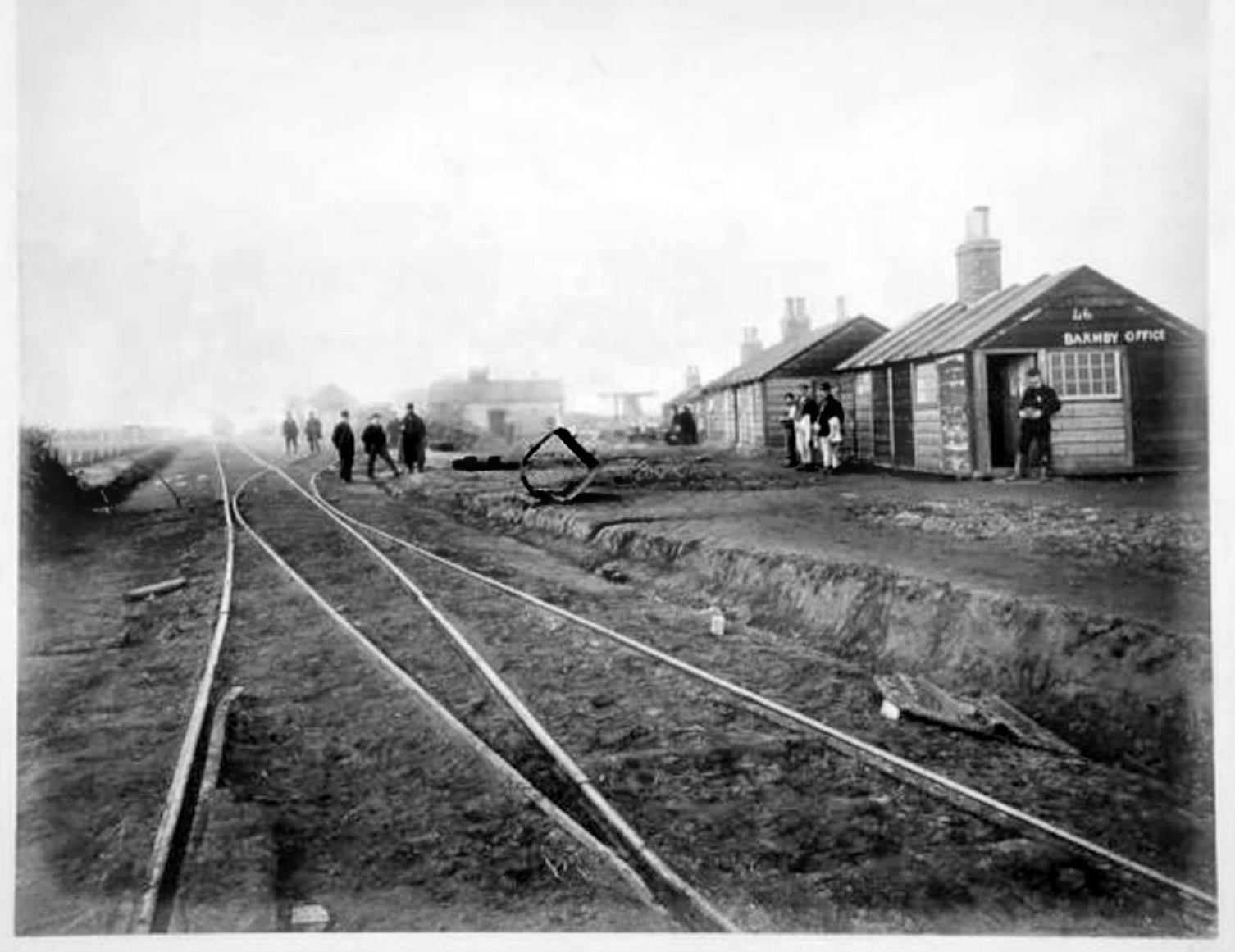
Originally there was not a station at Barmby, only some temporary buildings, as shown below but in 1897 a proper station was opened.
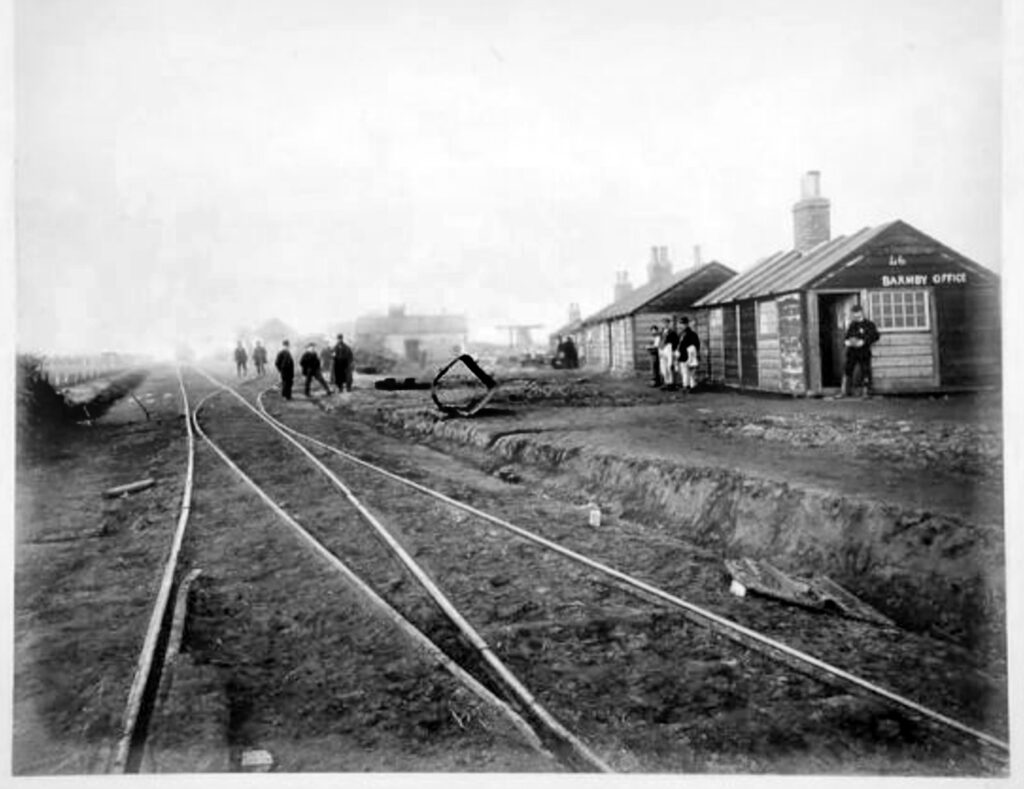
A newspaper report of 3rd February 1897 describes the opening of the new station
NEW STATION BARMBY. The new station at Barmby on-the-Marsh, on the Hull and Barnsley Railway, was opened for traffic on Monday, and will be an incalculable boon to the inhabitants of Barmby, and also to those of Asselby. The station is a neat and commodious building. Mr Creed has been appointed the first station-master. In honour of the event a dinner was held in the evening, at Boyce’s Hotel. The health of Mr Brindle, the Howden stationmaster, was proposed by Mr Spetch, and the “Farmers and Trade of Barmby” bv Mr G. H. Shaw, and acknowledged by Mr Sugden
The Hull and Barnsley Railway line closed in 1955. The bridge was maintained until 1968 in case of future re-use, but was dismantled by Kelsall (Demolitions) Limited in 1976/7
Schools
There was a school in Barmby held in the church with a schoolmaster funded by the village charity in the eighteeenth century.
In 1823 Thomas Watson was listed as schoolmaster. However some Barmby boys – for example John Gilderdale who became headmaster of the Forest School in Walthamstow – attended the grammar school at Howden.
The master there was Rev Thomas Guy who later became vicar of Howden and was also the Blanshard lecturer at Barmby.
He agreed with the trustees of the Garlthorpe charity to demolish two poor houses that they owned and build a National school on the site. This was opened in 1834 and still has its datestone
1n 1855 John Smith was master at Barmby National school.
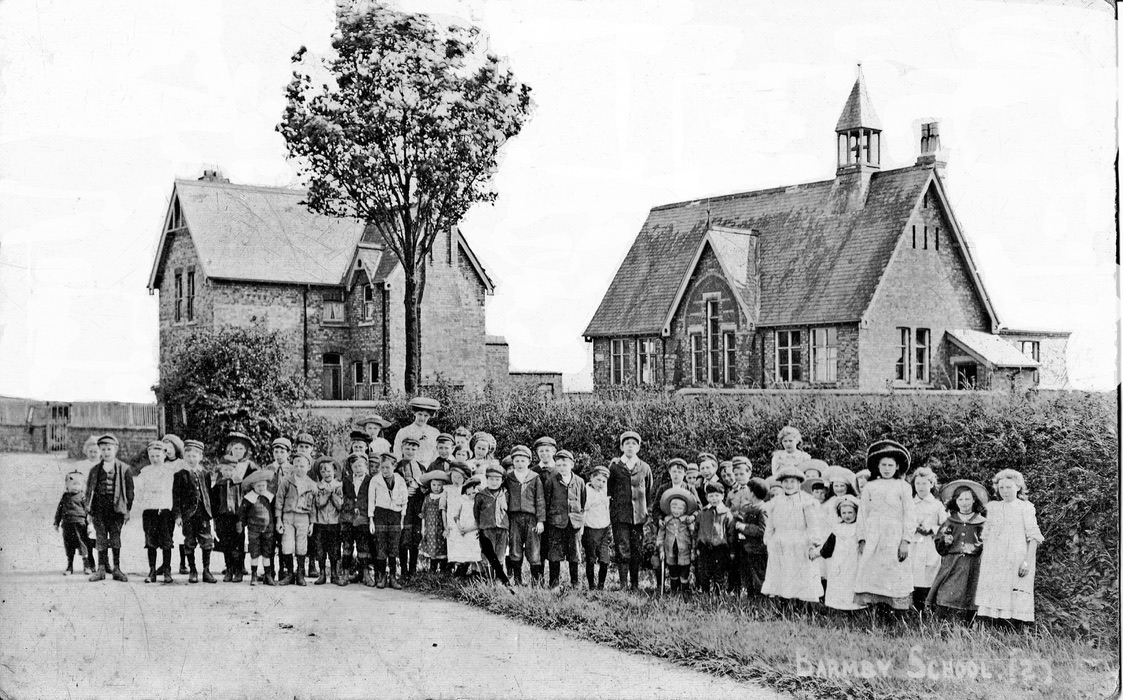
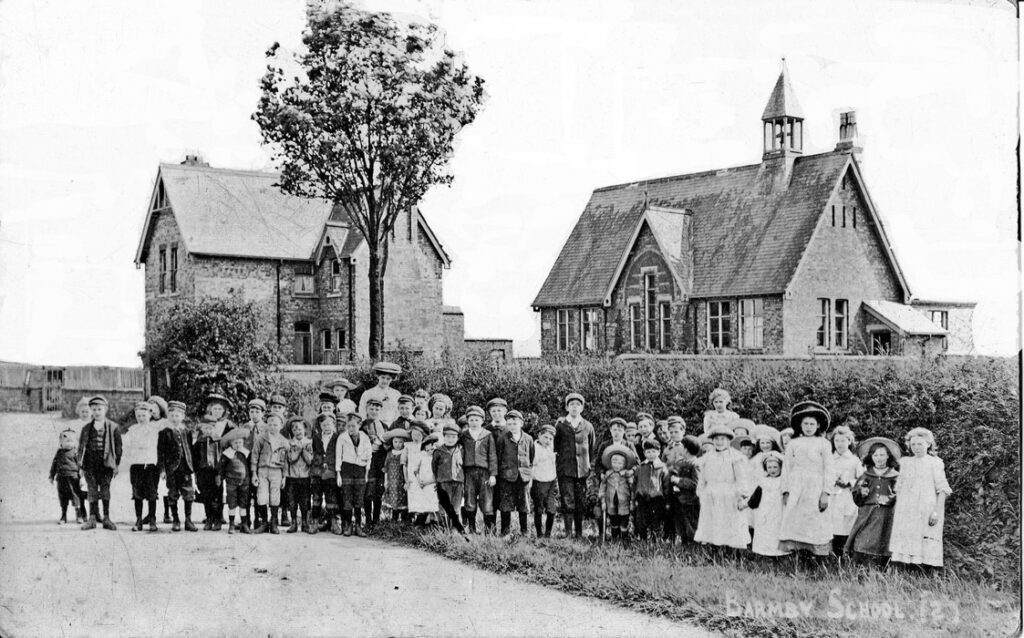
The building was replaced by a new ‘board school’ in Barmby [which is still in existence] and an infants school at Asselby.
That the new school was necessary is evidenced by extracts from two inspectors’ reports from 1876 and 1877. They were included in an 1878 article in the Goole Times written by Samuel Tuck of Barmby.
1876 ‘There seems to have been unnecessary delay in the provision of suitable school accommodation here, and there is still no infant school at Asselby. The present building is in a deplorable state inwardly. There was no preparation for the examination in the shape of paper for books. During my whole experience I have never met with such an unsatisfactory state of things as I found here.
No one connected with the school officially seemed to have thought it his duty to prepare for the examination of the children. The results obtained in elementary subjects are very poor indeed, the sewing is very moderate, the infants are not properly prepared. The singing is pretty good.
My Lords have ordered payment of a grant on this occasaion with great hesitation. and they are compelled to make a deduction of four tenths in consequence of Her Majesty’s Inspector’s most unfavourable report on the general efficiency of the school. No further grant can be made unless suitable premises are provided.
December 31st, 1877
l am glad to see the new buildings on the way to completion. Mr. Miller has already very greatly improved the elementary attainments of the children, and the order is better then it was. Under more favourable circumstances of accommodation and regular attendance there is no doubt the school will do well under his careful supervision. The singing and sewing are very satisfactorily attended to. A complete set of maps is needed.
My Lords have consented to allow the payment of the grant this year although the school is still conducted in the old premises. It must, however, be distinctly understood that this is the last occasion on which the present premises will be recognised.
Samuel Tuck wrote
I may add a few words respecting the new buildings ; they are nearly finished but my opinion is that the Government Inspector will not pass the internal fittings, which are of the most trumpery description, affording no means for the teachers to move amongst the children with ease. The sum of £2,120 bas been advanced, yet we have no artistic embellishmenta externally, and many necessary appendages will have to be supplied by the board.
The new school opened on 15th April 1878
In 1891 Samuel Parsons was the schoolmaster living in the school house
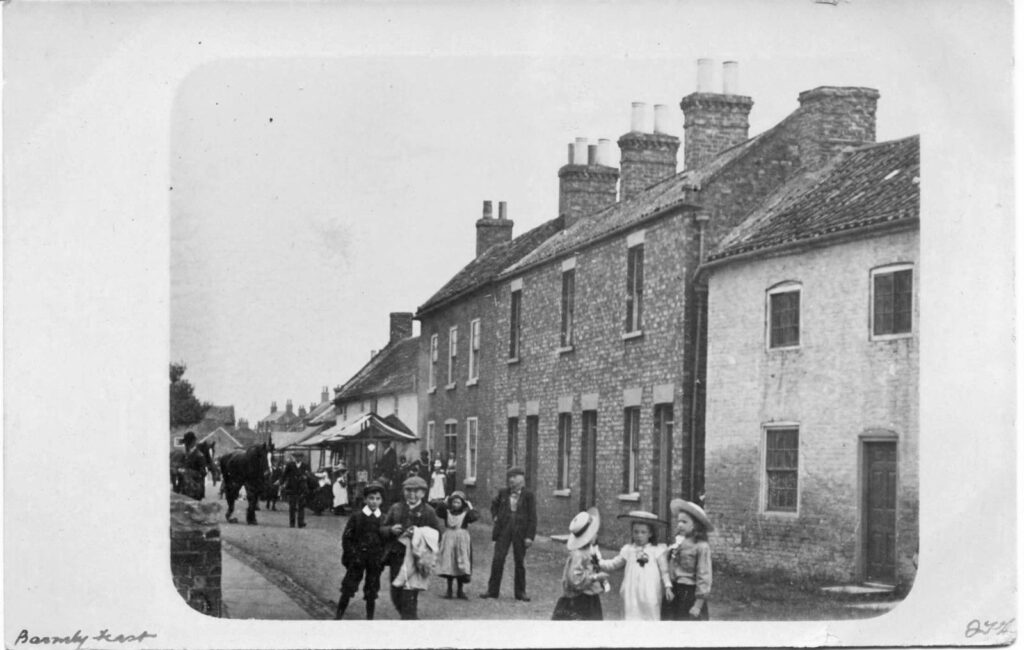
Corporal punishment
Sometime in the 1890s a new headmaster, Jesse Joy was appointed. In 1897 he was charged with assaulting a child by caning her. The case was heard at Howden.
James Cowling, labourer of Barmby-on-the Marsh, said on the 20th October, when he arrived home from his work, about a quarter to six in the evening, he saw his daughter Beatrice crying in the house. She said that Mr Joy had been severely caning her. She showed him her hands, which were marked right across them, and were swollen. He had had to complain before of the master’s conduct —partly through his having struck the child with his open hand over the head,
Beatrice Cowling, aged nine, who cried nearly the whole time she was giving her evidence, said week last Wednesday she went to school in the afternoon and behaved herself. The master called her out of the class before all the school and caned her on both hands twice with a thick cane. She had been caned before, but this time he caned her harder than he had ever done before.
She said he had done it because she had struck Jane Wilson at the pond. She hit the girl because she had called her names. Her hands were swollen with being caned, and she felt the effects two days after. She went to the school on the following day, and. because she could not do her writing, he struok her over the head with his hand. Other witnesses were called, and substantiated this statement. Dr Fisher, of Howden, said he examined the child’s hands the same evening, and, though there were marks upon them, could not say that they were caused by excessive punishment. Of course, it required a certain amount of force put the marks on. Mr Green argued that the punishment was justifiable, and not excessive. The Chairman said the magistrates were unanimous in dismissing the summons, and although personally had a certain amount of sympathy for the defendant, he must caution him against striking with his hands any more. The defendant applied for costs, but the Bench ordered each side to pay their own.
Mr Joy died suddenly in 1905 aged 58. His son took over as headmaster and later that year there was another case heard at Howden.
Mr Wilfred Joy, head master of the Barmby Council School, was summoned for an alleged assault on two of his scholars, named Leighton. The boys had been fighting after school hours, having been previously warned twice the same day. They were taken into school by the vicar of the parish, and, it was alleged. Mr Joy administered five strokes with a cane to each boy. It was contended that the punishment was excessive, one of the boys being severely marked. For the defence defendant said bad language and fighting was prevalent among the boys, and he was determined to put a stop to it. He did not think the punishment was excessive. The boys had been to school every opening since, except the half-day they were taken to the doctor. Evidence was given Mr Joy, the Rev J. W. Talbot, and Mr J. H. Holland. After consultation, the Chairman said if discipline was to be maintained, it might be necessary to inflict corporal punishment with due care and the case would be dismissed on payment of costs.
Wilfred Joy’s sister Olive was still teaching there in the 1930s.
Barmby Sports and Feast
1909 Newspaper report — Barmby feast is held annually on the last Thursday in June. It takes its name from one of the Biblical Saints, to whom also one the ancient wells in the village is dedicated. For many years there had been quite a nice and foal show with athletic sports in the evening. Unfortunately, however, wet weather on two occasions spolt the energetic endeavours of the committee, and the feast last year marked the absence of either show.
This year another enthusiastic band of men in connection with the cricket club resuscitated the athletic sports. and being favoured with fine weather, they were successful. The boys attending the school, whilst the elder girls gave an excellent display in the Maypole. In the alternoon, a cricket match was played between Eastrington and Barmby, the latter winning. Captain Liversedge, of Portington Hall and Mr Clark of Howden kindly acted as judges for the sports. Mr Liversedge gave a greasy pig to be run for between the races. Strains of music were played by the Gilberdyke Brass Band.
Another account described how Barmby Feast was a day when every house was cleaned and spruced up, tables laden with food and doors wide open to relatives and friends. Travelling funfairs set up swings and roundabouts, everyone dressed in their Sunday best and all thoroughly enjoyed themselves to the music of steam organs.
The First World War
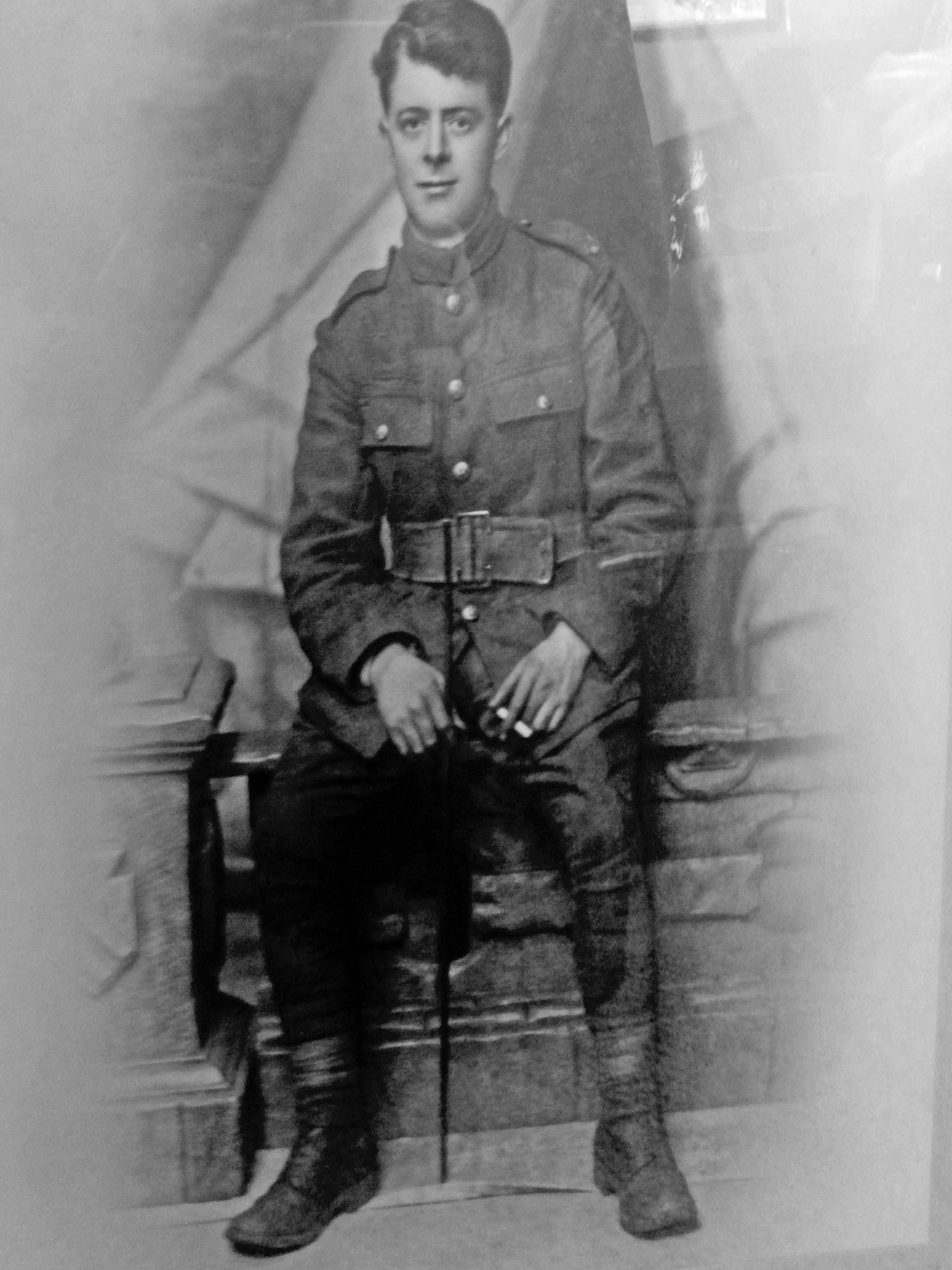
There is a brass plaque listing those 48 men who served [including those six who were killed] which was originally in the church but is now in the chapel. Also in the chapel and formerly in the church is a frame of photographs of the men who were killed.
A house to house collection was made for a memorial window and the plaque. These are the names, with additional detail about those men who were killed.
THE GREAT EUROPEAN WAR 1914-1919
This tablet is erected in memory of the undermentioned men who served
John Lancelot Arminson
George Boyce
William Bramley
Jesse Bramley
Tom Bramley
Richard Collins (Killed)
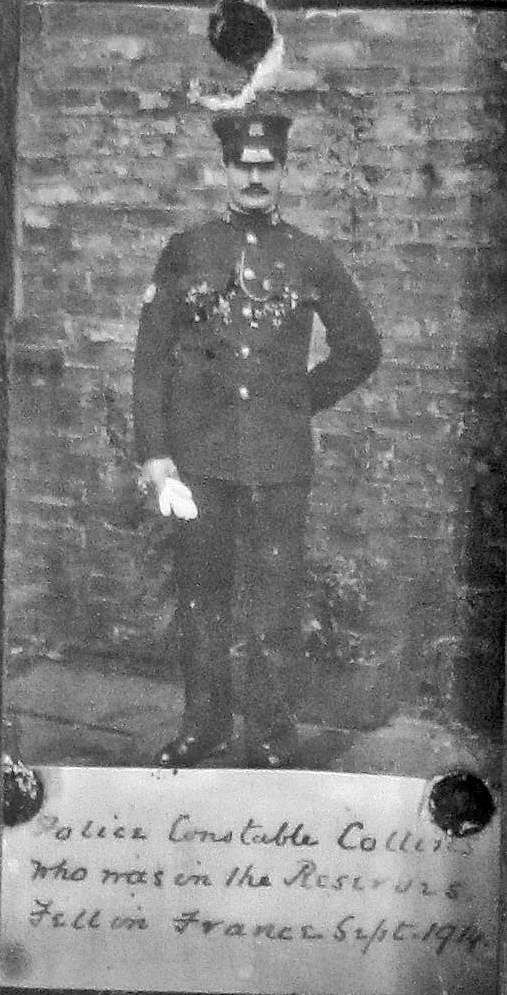
Richard Collins was the Barmby village policeman. Police-constable Richard Collins, of the East Riding Force, was recalled to serve with the 1st Northumberland Fusiliers at the outbreak of the war. He was killed in action on the 6th November 1914 at Ypres. He was born at Brentford in Middlesex. Corporal Collins lived at 7, Tower Street, Harrogate, and was one of the best shots in the regiment. He was born 1885 and had served in the army since 1904 and had joined the police in 1912.
Fred Cook
Harold Cook
Harry Cook
Stanley Coop (Killed )
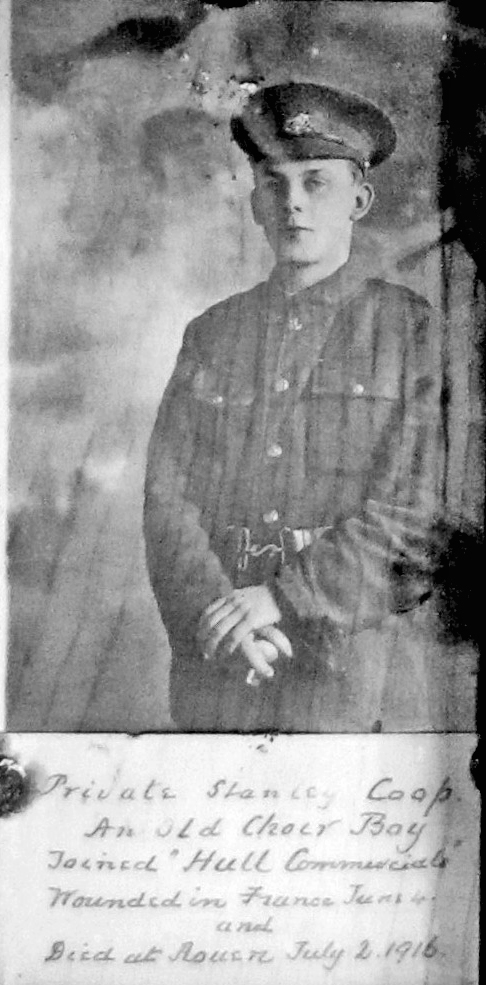
Private 10/501, 10th (Service) Battalion (Hull Commercials), East Yorkshire Regiment, died of wounds 2nd July 1916, aged 21
His name also appears on the Crowle war memorial
Born in 1895 at Clapham Common, London, Stanley was the youngest son and one of four children of Isaac and Edith Coop (nee Sanderson). His mother was the daughter of William Sanderson, a tailor, draper and newsagent in Crowle Market Place. His father was an accountant from Dewsbury.
Isaac Coop was an accountant in Yorkshire and North Lincolnshire in the 1880s and 1890s with clients in the farming community including some in Crowle. Sometime in the early 1890s he opened up a London office and the family were living there when Stanley was born.
In 1902 the parents separated with Edith and the children returning to Yorkshire to live with her aunt at Barmby-on-the-Marsh, near Howden. Isaac was ordered to pay £1 a week maintenance but rarely did so but ‘had plenty of money for drinking’. He was summoned before the Magistrates Court in Howden twice for non-payment, the second time in 1909 gaining him two months in prison.
When Stanley enlisted in the East Yorkshire Regiment at Hull, on the 4th September 1914, the family had moved from Howden and were living in Chaucer Street, Hull and Stanley worked as a clerk.
Stanley was seriously wounded on 4th June 1916, suffering gunshot and shrapnel wounds to his back, left leg and left knee joint. Taken initially to the 93rd Field Ambulance, he was evacuated the same day to No 23 Casualty Clearing Station and from here to No 10 General Hospital, Rouen. His family were notified by telegram that he was in a serious condition and that they were encouraged to visit. Unable to afford the fare to France, the Army issued them with a travelling permit.
Stanley Coop died of his wounds in 10 General Hospital, Rouen on 2nd July 1916. He is buried in St Sever Cemetery, Rouen.
Albert Conway
Willie Corney
James Douglas
Alfred Eastwood
Willie Fox
Robert Lloyd Falkingham
Willie Hutton
James Herbert Holland
Thomas Edward Holland
William Johnson
Thomas George Jackson
Wilfred Joy
Frank Joy
David Graham Joy (Killed )
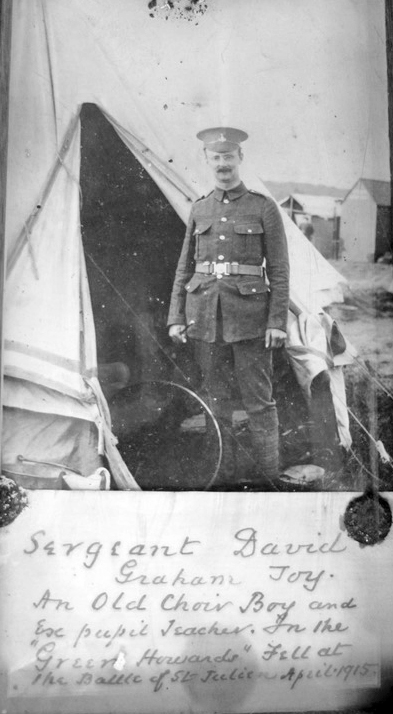
David Joy was the son of Jesse Joy who was headmaster of Barmby school and brother of Wilfred who was also head. David married Minnie Everatt in 1915 and they had two daughters Enid and Jessie. Before the war David lived at Sand Hutton where he was headmaster of the village school. He served with the 5th Battalion Yorkshire Hussars (Alexandra, Princes of Wales’ Own) and was aged 35 when killed on 25th April 1915.
George Johnson
Alfred Leighton
Charles Leighton
Ernest Leighton
Arthur Leighton
Harold Leighton
Arthur Lowery
Christopher Lowery
Arthur Lofthouse
William Lofthouse
Sidney Clifford Plaster (Killed )

Sidney Clifford Plaster appears also on the Asselby section of the Howden war memorial. His father, also Sidney, was a joiner and before the war Clifford was a gardener.
He enlisted at Grantham on August 26th 1914 and served in the 9th Battalion of the Prince of Wales Own West Yorkshire Regiment. He was killed in the Gallipoli Landings on 7th August 1915 aged 18
Leonard Pridmore
Malvrin Pridmore
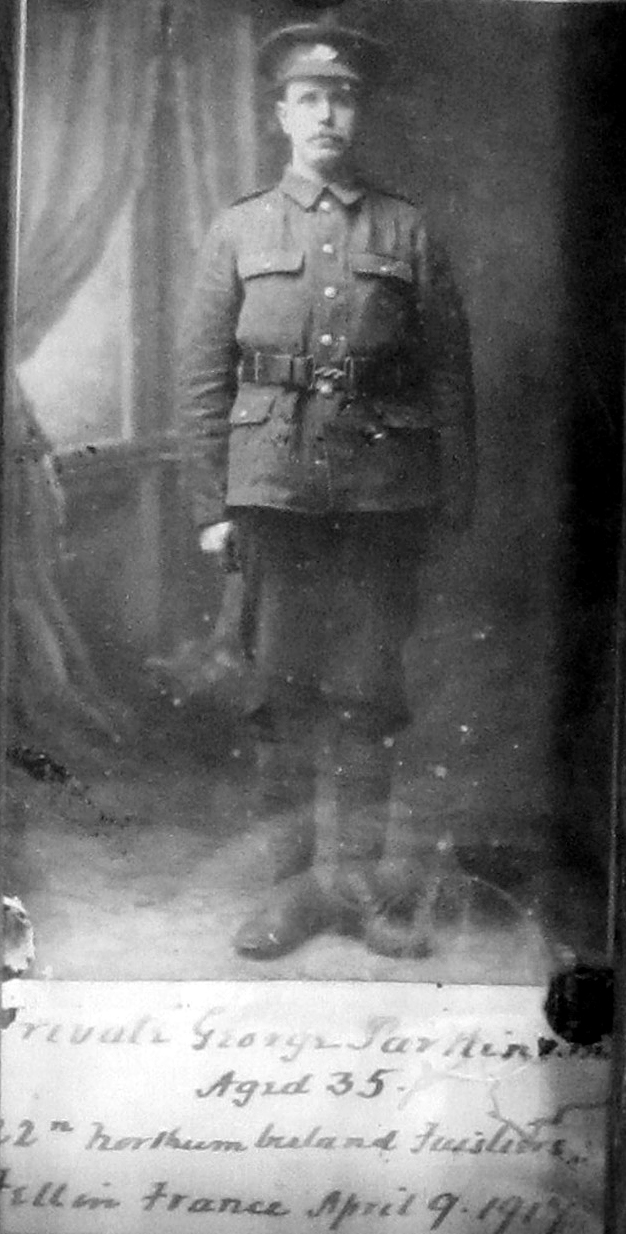
George William Parkinson (Killed )
George William Parkinson was born in South Duffield in 1884. In 1911 he was a farmer at Barmby. he was unmarried and living on High street with his mother sarah and siblings Thomas Craven, Mary Evelyn and Joseph. previosly lived long drax
He enlisted at Howden, originally in the East Yorkshires and later served in the Northumberland Fusiliers 22nd battalion [ Tyneside Scottish]. He was killed on 9 April 1917

Craven Parkinson
Cecil Pygas
George Clifford Sugden
James Edward Spetch (Killed )

James, was born in 1892. His parents were Joseph and Rebecca who lived at Langrick and ran the ferry. He was aged 22 when he enlisted and served in the 11th Bn. East Yorkshire Regiment. He died 12th April 1918.
John Shaw
William Tomlinson
Lazenby Tomlinson
Eric Vincent Talbot
Charles William Widdowson
John Henry Wilson
George Wilson
Barmby pubs
For most of the nineteenth century there seem to have been four inns in Barmby. It is difficult to work out exactly where they were as sometimes a new landlord renamed the premises.
In 1822 there was the Bull and Butcher kept by John and Hannah Sayles [Sails], The Sloop at Barmby ferry kept by William Potter, The Anchor kept by Robert Robinson and the Half Moon kept by James Norton.
By 1833 there was a reference to the King’s Head. It was possibly the renamed Anchor as by 1840 the other three inns were still listed. There was also briefly an inn called The Windmill in the mid nineteenth century.
Half Moon
In 1840 the innkeeper at the Half Moon was Michael White
In 1861 George Farr was innkeeper at the Half Moon. By 1871 he was living in Darlington with his family and working as a brickyard labourer.
Windmill Inn
In 1861 there was a Windmill Inn kept by Thomas Fussey but in 1871 it was listed as unoccupied.
The King’s Head
In 1840 landlord of the King’s Head was Joshua Andrew
In 1851 and 1861 Samuel Walsh was landlord of the Kings Head. He died in 1862.
1871 Samuel Pantry was landlord. He had married Jane, widow of Samuel Walsh. In 1881 the couplewere still in Barmby but had retired.
In 1881 Paul Eastwood was living in High St and was described as a waterman, born Hemingbrough
By 1891 he was landlord of the King’s Head. He and his wife Elizabeth went on to have 9 children. He was also a coal dealer.
He died in 1924 at Barmby
The next landlord was Edmund Russell Goundrill , known as Teddy. He was a bootmaker in Howden in 1911 and in 1914 married Emily Howdle. In 1939 he was living at the King’s Head but described as a riverside worker and bank repairer.
Bull and Butcher
In the 1840s and 50s the innkeepers of the Bull and Butcher were William and Ann Shipman. The Shipmans remained in Barmby until the 1880s but William worked as a farm labourer.
By 1861 John Backhouse was innkeeper but he did not stay long and in 1881 was a farm foreman at Breighton
Landlord in 1883 was Thomas Kirby
The inn was advertised for sale in the Goole Times in 1889. Described as
all that Fully Licensed PUBLIC HOUSE, Known by the sign of the Bull and Butcher, together with the Butcher’s Shop, Garden, Stables, large Barn, and other Outbuildings belonging thereto, situate at Barmby-on-the-Marsh, in the County of York’,
William Boyce was the landlord then and remained until his death in 1913 at the age of almost 80..
In November 1922 landlord Matthew Cockshaw and wife were fined for selling adulterated whisky. It was reported as follows
On Saturday, at Howden Police Court, Matthew Cockshaw, landlord the Bull and Butcher Inn, Barmby-on-the-Marsh, and his wife. Sarah Cockshaw acting as his agent, were summonsed for selling whisky below the legal limit under proof. Inspector Laytham, who prosecuted, said the Howdenshire Division was the worst the whole county for the adulteration of spirits. He purchased a glass of whisky at the Bull and Butcher Inn, on October 20th, and was served by the defendant Sarah Cockshaw. He afterwards said he would take what remained in the bottle, which was about one-eighth of pint. Upon analysis, this whisky was found to 47.86 degrees under proof, or 12.86 degrees below the legal limit. Mrs Cockshaw informed the Bench she had emptied a watered whisky back into the bottle without thinking, but Mr Laytham said this could not explain the condition of the whisky analysed. A fine of £2 10s was imposed upon each defendant.
In the 1930s William Cooper and his sons William and Thomas were at the Bull and Butcher. William was listed as a labourer and his sons as pig breeders and fruit growers.
The Sloop
The Sloop Inn was at the end of the village near the ferry and the chain house where the dues were collected for those using the Derwent navigation. The landlords were often also the ferrymen.
In 1840 William Brown was landlord and ferryman
Then for much of the middle of the nineteenth century the landlord was Robert Rockett. His family suffered a sad tragedy in 1854 when their son, John Blow Rockett aged 10 was drowned in the nearby River Derwent.
Nest landlord was George Terry and his wife, the former Elizabeth Spetch and her children Sadly only 5 years after this in 1871 George died leaving his widow in charge.
In 1878 the ferry boat went missing as this advertisement shows
Small ferry boat painted green covered each end and 14 feet long lost from Barmby ferry on the Derwent. Reward paid by owner Mrs Terry of the Sloop Inn
by 1891 Matt Mitchell was publican and ferryman . He was followed by Aaron Douglas who was living there in 1901 with his wife Emily and sons James, Joseph and William.
Meanwhile the Sloop had changed ownership. In 1897 a Mr Simpson had sold it to a Wakefield solicitor, Arthur Lake. In 1904 there was a report of a land dispute between Mr Lake and the NE Railway Co.
Mr Lake said he was the owner the Sloop Inn and premises, situated between the Ouse and Derwent and the foreshore. Between the Sloop Inn and the towpath there was a green, containing 24 perches, and this was the land in dispute. In October, 1903, the N.E.R. Company enclosed seven and a half perches of the green and claimed it as theirs
Mr Lake asked for a removal of the fence and an injunction. For the defence, it was submitted that in 1855 the NER purchased from Earl Fitzwilliam and his trustees rights of navigation in the river Derwent, and also the portion mentioned which had been enclosed.
Evidence was heard that since 1855 the land fenced had been used and held as part of the chainkeeper’s house and premises. Mr. Atkinson Robinson, the dues collector at the chain houses said he ‘had known it since 1865. There were no swings on the green at Barmby Feast until 1872. He said he had seen people playing quoits on the green, but not on that portion which was now fenced off. They walked across the piece, but they never played quoits on it. William Edward Fisher, swingboat proprietor of Goole, said he always erected his shows by permission of Mr. Robinson. He never paid any rent for the green to the Sloop people.
The Commissioner hearing the case said the first question was what was granted to the defendants by the deed of 1855. Unfortunately there was no plan attached to that deed, but there was a perfectly clear description the dwelling-house called the chain-keeper’s house, with the warehouse and outbuildings, and the gardens ‘attached thereto’. He was of the opinion that no part of the green in front of Sloop Inn could properly be described the ‘garden thereto.”
If the defendants were right, why they have limited themselves to the piece which they had fenced in. He was of the opinion that all the evidence pointed clearly to the fact that the land belonged to the Mr Lake.
But the Sloop Inn only remained open a few further years, losing its licence in 1911 due to lack of business.
Interestingly in 1913 Arthur Lake was struck off as a solicitor and declared bankrupt as it was found there were irregularities in his business accounts. He was later sentenced to five years in prison for mis-using his clients’ funds.