The present Eastrington school was built in 1964/5 to replace the old ‘board school’ on Queen Street. This school had opened on January 20th 1879 and was designed to accommodate 110 children in two classrooms. The board school had in turn replaced a National School, built in 1846 on the same site and that had replaced a thatched building given to the village as a school by Joseph Hewley in 1726.
The early history of the school
There has been a school at Eastrington for over four hundred years. In 1568 John Dodding was described as the curate and schoolmaster of Eastrington. It is not known whether there was a permanent schoolmaster in the late sixteenth and early seventeenth centuries but the parish registers of 1700 record the death in May of ‘John, son of Robert Holland of Eastrington, schoolmaster’, suggesting that there was a school in the latter half of the seventeenth century.
Hewley’s free school Then in 1726 Joseph Hewley of Eastrington left provision in his will for the foundation of a free school in the village where poor children could be taught to read and write.
Joseph Hewley was a prominent village landowner, originally from Drax, who married Margaret Story in 1701 at Eastrington. They possibly built and lived in the Manor House on the village green. The initials on the stone could be theirs as it was usual then for the initial of the surname to be above [H] and the two initials of the couple J and M to be below. After Margaret Hewley’s death
Joseph married for a second time to Jane Nelson on 17th Nov 1726. He died, childless, a few weeks later and left most of his property to his wife but also made provision for the establishment of a village school. He left a house, with buildings and an orchard as well as four acres of land in The Ings, one and a half acres known as Car Wire close, a land of one and a half roods in East Tow crofts, a rood in West Tow crofts, four lands in a close called Five Lands and another close called Thorwell croft.
Four well-respected local men, Anthony Wells of Cotness, John Bullen of Howden, John Dunn, also of Howden and steward of the Bishop of Durham and Noah Ellythorpe of Sandholme, a farmer and Quaker were named as trustees to administer the land and use the rents to employ a master. The house, which was described then as ‘late occupied by George Hastings’ with its buildings and orchard was on the site of the ‘old board school’ of today.
John Thorp, ‘
The first master was John Thorp and it seems that he was appointed by the trustees almost immediately, in 1727, as a note in the Eastrington parish registers in 1790, made by the vicar, records that John Thorp who was buried on October 31st had been the schoolmaster at Eastrington ‘above 63 years’. He must have been in his eighties and still master when he died.
However by the 1760s the school barely existed with only two pupils being taught. This was apparently because Mr Thorp had by-passed the trustees, claimed the land directly and was unwilling to teach many pupils. The villagers were angry at what they called the ‘mismanagement of the free school’ and the only surviving trustee, Mr Dunn of Howden wrote to the archbishop of York for advice.
His letter is a damning indictment of John Thorp as the following extract shows:
‘Howden July 3rd 1764 My Lord, The mismanagement of ye school my Lord is owing to ye will of ye donor not being fulfilled, for the will directs that ye trustees shall have ye estate given by Mr Hewley in their possession to receive ye rents and pay them to ye master who has not only committed waste upon it [as felling of wood] but taken upon himself to judge who are to be taught by this charity and, as I am told by several of ye parishioners, he has made it his rule to teach none but such child whose parent received weekly pay from ye parish and by this method he has for the most part not more than two to teach upon ye charity. Now that this enquiry is on foot he has called into his schoole to ye number of five. Beside my Lord he’s not diligent, he is a shooter, a gamekeeper and may I venture to say a common poacher of game, both in fishing and fowling. The truth of this and of what sort of master he is is signified by ye complaint of ye parishioners who are obliged to send their children to other schools when this charity well apply’d might be a foundation for a good school in so large a parish.’
Joseph Hewley’s will had specified that new trustees should be appointed while two survived but Mr Dunn explained that he was now the only one left as Mr Noah Ellythorp of Sandholme had recently died and ‘he being a Quaker was indifferent about it and tho’ we met to have done ye business our resolutions centred in first getting possession of ye estate in order to compel the master to diligence and attention but ye master’s obstinacy put a stop to our proceedings in ye choice of trustees.’ Mr Dunn also described how he had called a vestry meeting the previous Sunday to tell the villagers whom he proposed to appoint as new trustees but that he had asked the master to give up possession of the lands first. Unfortunately Mr Thorp had ‘positively refused, nothing was done and the meeting seemed to serve no other end than to raise an opposition and make confusion’.
The archbishop replied that Mr Dunn should go ahead and appoint new trustees and that if the trustees had the authority to appoint the master then presumably they had similar authority to remove him. No more correspondence survives but Mr Thorp, a village character to say the least, obviously kept his post.
However matters may have changed a little when the elderly Rev Lowther died in 1768 and a new vicar Rev Rudd came to the village.
A new master, Thomas Savile, was appointed in 1791 and was still there in 1823. He died in 1827 and was replaced by Isaac Nurse. Surprisingly when, after his death, the wages he was owed were received by his widow she signed for them with a cross. He may have taught the pupils to write their names but not his wife.
When the Eastrington open fields were enclosed the original lands in Joseph Hewley’s will were redistributed apart from the four acres in Ings Wood, which is still owned by the charity and the trustees received in exchange, a seven acre field or close in ‘Mill field’.This is to the south of Sandholme Road and is still called ‘’School field’. They also received two smaller pieces of land [ 3a 2r and 3a 3r 39 perches ] on Bishopsoil and Wallingfen respectively in compensation for the loss of common rights. This land is still administered by trustees and the rents used as an educational charity.
In the1830s the master still lived in the house that Joseph Hewley had bequeathed and taught about 38 children in winter and about 20 in summer. All children who applied were admitted and received free tuition although their parents had to provide books and stationery. The school itself was probably held in one of the buildings mentioned in Joseph Hewley’s will which was thatched. Evidence for this comes from a newspaper report of 1911, recording the death of John Brooks of Spaldington. He was then aged 86 and it was said that not only had he attended Howden market for over sixty years, selling his ‘famous Brooks Rubbing Oils’ but that he had been born in 1825 at Portington and had attended the Old Thatched School at Eastrington, master Isaac Nurse until he entered farm service at 13 years of age.
The new National school. Isaac Nurse died in 1842. Whether he had lived in the master’s house we do not know but by 1844 the old school and the master’s house were in a state of dilapidation and, encouraged by the new vicar Rev Chisnall Hamerton, the trustees transferred the 130 square yards of copyhold land on which they stood to the Church Authorities. This was done so that the village could benefit from the grants made to the National Society ‘for promoting the education of the poor in the principles of the established church’. The old buildings were demolished and new premises were completed by 1846 at a cost of £317 4s 7d.
The masters after Isaac Nurse seem not to have stayed long in the village: Richard Watson was the master in 1846, Robert Moore in 1847 and George Cook in 1848, Mr Johnson in 1851 and Mr Keir in 1852.
Shrove Tuesday celebrations The next master who came in 1852 was Joseph Cox. He stayed rather longer than his predecessors, perhaps because he fell in love with a local girl Sarah Anelay whom he married in August 1857. He was described as ‘master of the Grammer [sic] school, Eastrington’ in the wedding report. In Mr Cox’s time there were celebrations in the village every Shrove Tuesday and in 1858 for example there was the usual holiday from school and sports in the vicar’s field, organised by Mr Cox. after which all the children were given an orange. The Coxes’ children Charles and Annie were born in 1858 and 1859 but soon afterwards the family left to be replaced by George Drewry and his wife. In 1881 the Cox family, with ten children living at home, were living in Ossett. Joseph
Joseph was 25 when he arrived in Ossett. The school was newly erected,having been opened in April 1857, beside the equally new church for south Ossett, Christ Church. It was described in a local trade directory as a “handsome new school in the Gothic style, with master’s residence”.
He was the master at Ossett for 40 years and served as the mayor of Ossett during the time of Queen Victoria’s diamond jubilee when he attended a reception held by the Queen in London in 1897.
George Drewry, master
George Drewry, the new master, was from Aughton and lived with his wife Mercy, in the schoolhouse. Soon after their arrival in 1860 their son, Thomas, was born but sadly he died aged only three months.
The new school buildings were then often cold with little in the way of heating and a stone floor and in February 1861 a report in the Goole and Marshland Gazette told how ‘Eastrington school has recently been much improved, at the recommendation of the Government Inspector, by the removal of flags with which it was previously paved and the substitution of a new boarded floor. The cost of the new floor was £19. To this has been added a new stove, which cost £4 2s 6d making a total of £23 2s 6d.
The trustees, being without funds to meet this expenditure, appealed to the public, when the sum of £12 12s was raised by subscriptions, which, added to £9 10s the Government grant makes a total of £22 2s, showing a deficit of £1 0s 6d. Further subscriptions will be gladly received by the Vicar of Eastrington.’ The next year bought further tragedy to the master when the death was reported at Thornton le Moors in Cheshire of ‘Mercy, aged 27, wife of Mr George Drewry, master of Eastrington National school’. George Drewry was still the master in 1871 and acted as the census enumerator. He was then aged 45 and living with his daughter, Alice Ann. He described himself as a ‘National schoolmaster’ and the school as a church school for boys and girls. By 1872 he had left the village and by 1881 he had remarried and was an innkeeper at Dringhouses while Alice was working as a servant to a solicitor in York
Problems finding a master The new master of the ‘National school’ who was there by June 1872 there was Mr James D. Newby, originally from Wisbech who was then in his early twenties. Eastrington in the 1870s seems to have been rather a rough village and there was only an average attendance of 20 children at the National school. Mr Newby did not stay long and did not seem to enjoy his work. He frequently punished the pupils; on July 16th he ‘punished several boys for blotting their copy books’. The school was then overseen by the vicar – at that time a strong character, Rev Theophilus Bennett. It was he who was put to great inconvenience when on August 20th, only three months after his arrival Mr Newby suddenly resigned. In fact he and his family moved to Bubwith where he took the job of headmaster at the board school and his descendants still live in the Howden area.
Meanwhile however Rev Bennett had to find a new master. He solved the problem by temporarily employing Fred Parkin a former pupil, who had only left school three weeks earlier on August 1st. The attendance fell to around 13 and young Fred [aged only 12 and whose father worked at the station] had his own problems.
He wrote on September 27th; ‘the scholars are given to fighting. They are certainly not far advanced in anything.’ Rev Bennett then managed to find another new master to serve until Christmas. Mr P. N. Jackson took charge of the school on October 2nd, with a total of 15 scholars present. He was helped by Miss Jane Elizabeth Barrow who was paid out of the ‘school pence’. However he too had trouble with the Eastrington youth, describing them variously as ‘rather unruly’ and ‘troublesome’. He did however write that after he had punished two of the boys for disobedience this had a marked effect on the whole school.
The school supplies were obtained from the local shop, kept nearby by Mr Barrow, Jane’s father, who was paid 6d on November 18th for ink and pens. Mr Jackson left in December and was replaced by Mr H. Evans in January 1873.
He only stayed until August when he was replaced by Mr George Cook. Mrs Cook was also employed, teaching the girls ‘plain sewing and knitting’. Visits by the vicar Rev. Bennett called regularly at the school, inspecting the progress of the children – and the master- and finding time check whether the pupils’ hands were clean as well as complaining about their behaviour if necessary. He came on November 5th to tell some of the boys off for ‘calling ill names to people on the road’. On another visit he explained to the scholars that there would be no bells on Sundays for a few weeks as they were being repaired.
Mr Cook recorded the comings and goings of pupils: Fred Wilson took his copy book and slate home one day in November as he was ‘going into service’. In April the Brumby children who lived at Eastrington mill left as they were moving out of the village and a few days later William Pashley fetched his things ‘as he had gone to work in the brickyard’. The master at this time was paid his salary from the school’s endowment. He wrote in November that the vicar had called round with the balance of his Michaelmas salary. The delay in payment had been caused because the school field rent had only just been paid by the tenant farmer. The weather was severe in December 1874: one afternoon the master could not persuade half his pupils to come in to school as they were all playing on the ice.
An accident to the headmaster
In February 1875 Eastrington school was visited by a government inspector. The report was bad. There was an average attendance of 35 children but only six passed the arithmetic examination. The inspector wrote that ‘there seems to be very little discipline exercised over the children’. He went on to say that he could not grant a teaching certificate to Mr Cook. The following year was no happier at the school. Reverend Bennett visited one day to inform the pupils that ‘the master had no right to strap them on the back or shoulders’. On June 2nd, a Friday, Mr Cook suffered a severe shock when the school bell fell on him from the bell turret and ‘cut his head very much’. He recorded however that he opened the school as usual on the Monday morning ‘although the accident happened’. Mr Cook was the last master at the old National school, finishing in November 1877.
Free scholars
A few records, written on torn pages from a pocket notebook survive from this time which list the names of the children who had their school fees paid by the vicar acting as trustee of Burton’s Gift in the 1870s. In 1870 Rev Bennett paid 2s and 6d each for the education of Henry and George Proctor, Frank Leek, Fred Parkin, Arthur Pittock, George and John Broader, Henry and Mary Ann Bulliment, Mary Jane Hill, Fred Wilson, Jane Brooks, William Pashley, Margaret Ward, William Brooks, Matthew Tipping and George Fenton. By 1876 the fees had risen to 3s and 4d and the following children were listed as having had them paid: Henry Brooks, Fred Brooks, Thomas Cox, Jesse Holt, George Proctor, Richard Popplewell, George Pool, Albert Tipping, George John Ward, Thomas Wilson and Eliza Gibson. Also included are odd sundries paid for such as ‘ink and paraphin’, class register and Mr Sugden’s bill for altering a spout.
Other schools
In the nineteenth century there were other schools pupils could attend in the village – in the early years of the century the curate, Mr Thomas, took pupils and there was always the grammar school at Howden. There were also at least three other schools in Eastrington, probably best described as ‘dame schools’. These schools were so called because they were often run by women whose only qualifications were that they could read, although this was not a necessity, that they needed the money and had a room in their house where they could hold a school.
Mrs Turner’s school The charity known as ‘Burton’s gift’ paid for poor girls to go to the school kept by Mrs Turner from 1831 and ‘to be taught reading and plain sewing at 4s a quarter’. In 1851 Mrs Ann Turner, 55, was described as schoolmistress. She was born in North Cave and lived with her husband, John, a 65 year old farm labourer and their 16 year old daughter Ann.
Sarah Burn’s school By 1835 some poor children were attending another school which was kept by Miss Sarah Burn where the fees were only 3s a quarter. Miss Burn was herself then only in her teens and continued keeping her school until the 1860s. She did not marry and lived with her widowed mother, Mrs Ann Burn. She had two children, Joseph Peck, born in 1846 [living/ at Hive in 1851 with Robert Thompson and wife at the Gate Inn Hive. described as their nephew] and Sarah Ann born in 1857. Sarah’s sister, Martha also lived with them. She had married a stonemason George Goldie of Edinburgh and their daughter Ann was born in 1845. Mr Goldie died and Martha reverted to her maiden name and had two further children, Henry Neely Burn [born1852] and Elizabeth Burn [born 1857]. By 1881 Martha was a greengrocer in Leeds, living with her niece Sarah and with her married son Henry living next door.
Miss Wylly’s school Probably the last ‘dame school’ in Eastrington was that run by Miss Wylly for many years almost ‘in competition’ with the new board school. Her school may have been near or in Primitive Row and was attended by my grandfather Robert Nurse. He remembered particularly Miss Wylly’s parrot which he said was eventually killed by ‘Kezzy’ Laverack who hit it with a ruler.
Miss Wylly was a spinster born in Nassau in the Bahamas and it is a mystery as to who she was and why she came to Eastrington. The Wylly family were originally from Ireland and were soldiers and diplomats with Scottish and American branches. A William Wylly was attorney general of the Bahamas for 30 years and was a plantation and slave owner and other branches of the family lived in Savannah.
She appears in the 1871 census as Miss Frances Wylly, aged 48, ‘schoolmistress’ and was a boarder with Elizabeth Stogdale, shopkeeper, at Amethyst house. Her school attracted several pupils, often at the expense of the Board school according to the entries in the board school log. One reason may have been that her school was operating while the new board school [1877 to 1879] was being built and parents were later unwilling to move their children. She was mentioned in 1879 and was well thought of in the village. In fact in 1884 she was elected as a member of the school board which ran the ‘board school’.
However she obviously did not get on with the then headmaster in 1890, Mr Dudley who wrote ,’Feb 24: new admission, a girl over 13 from the dame school, ‘she comes like all others who have been received from Miss Wylly, a veritable duffer’. In 1894 the subject of the dame school was discussed at a board meeting after which Mr Dudley wrote, ‘This dame school has long been a source of great annoyance. Parents on the slightest provocation move their children alternately between the two schools’.
By 1895, however, although still running her school, Miss Wylly was aged 72 and considering retirement. Mr Dudley wrote on October 18th: ‘several new admissions from the dame school. Miss Wylly has now only five left. She informs me that it is her intention to give up altogether shortly’. In 1901 she was living in York at what seems to have been a gentlewomen’s retirement home in Bootham.
A poem written in the early years of the twentieth century by Mrs Healy includes the heartfelt lines
‘The school is empty and we can see The tenants of Chapel Row are free From taunts and jeers’. implying that the school had been in the ? Chapel Row area of the village and that the pupils had indeed been somewhat rowdy.
The ‘old school’
The ‘old’ school had an extra classroom built in 1898 – the ‘infants room’ – and the canteen was opened in September 1945. Teachers have come and gone – headmasters such as Mr Freer, Mr Etherington, Mr Bramley, Mr Garbutt, Mr Thomas and Mr Coates, who oversaw the move from old to new school – and classroom teachers such as Miss Botterill, Mrs White, Mrs Leadill and Mrs Watson.
At one time in the 1930s the school had its own magazine and even a school song to give pupils a pride in their school and village:
The school song
Life lies before us, all the earth
Before our feet is spread.
Ours is the future, our true worth
Will form the years ahead.
All time, all space our minds may roam
But present tasks are nearer home.
Eastrington, our village, our home, our school,
Our daily task, our work, our play
fill every hour yet while we may.
Let all strive paltry self to rule
And seek to serve our Eastrington.
For by our work and by our play
And by the tasks we do
Our characters are formed today,
Our aims and habits too.
Our hopes and purposes will grow
To noble ends if fashioned so
Eastrington, our village, our home, our school.
I have included below my own memories of Eastrington school :
Eastrington school in the 1950s
I went to school in what is now known as the old school beginning when I was four or five in the mid-1950s. The infants teacher was Mrs White and she seemed quite strict to me. The infants’ room (later used for playgroup) always smelled of chalk and plasticine. At one end was the Wendy house and our tables and chairs were at the other, nearest the canteen. The room was heated by a coke stove with a big guard around it. Lessons I remember were playing with plasticine while Mrs White did the registers, writing in a diary using wax crayons (I seem to remember the pages were black or grey paper) and doing sums in a small brown book printed in squares.
Playtime was a time to visit the lavatories which were across the yard. They had blue wooden doors and inside were wooden seats with a galvanised bucket underneath. At the end of playtime we had to line up outside our classroom when the teacher blew the whistle. I remember earning a sharp smack for pulling the plaits of the girl in front who was called Jill Daniels.
After the infants I moved into the main schoolroom into Mrs Leadill’s class. This was the end nearest the road and was divided from the top class by a folding wooden partition. I remember many spelling tests and doing sums from cards which were stored in a maroon box. You worked your way through one card, had the sums marked and then were allowed to put that card back and get another one. It took a long time to do a card as there were about a hundred sums on each one. I sat with Keith Holmes and I remember how we wondered if anybody ever finished those cards.
Another memory of Mrs Leadill’s class is the taste of warm milk. The crates of milk were often put near the stove to warm up in winter and at the end of the afternoon there were often a few bottles left from the morning distribution. These were offered around just before ‘hometime’ and I can still conjure up the warm, sickly taste. This ‘taste’ is always linked in my mind with the hometime prayer which we always chanted, often at speed before being dismissed at half past three. ‘Lord keep us safe this night, secure from all our fears; may angels guard us while we sleep, till morning light appears. Amen.’
When I was seven or eight I moved into the headmaster’s class on the other side of the partition. He was called Mr Thomas, invariably wore thick patterned woollen sweaters and had a very fierce temper. He lived with his wife in the schoolhouse. We never saw much of her but she was a potter and once made a beautiful pottery model of our Basset hound, Juno. I remained in this class for three years, spending a lot of the time making beautifully illustrated projects. I dreaded making the covers for these which had to be designed and each letter laboriously measured, often taking several afternoons to complete. We also had to draw borders half an inch wide round each piece of paper we wrote on and pencil lines half an inch apart. Then Mr Thomas dictated the contents of the booklet very slowly to the whole class. These booklets were displayed on the walls of the partition and no doubt impressed inspectors but I can recall even now the mind-numbing boredom of producing them. However, we did do some pottery and we were all very proud of our mugs which we made with our own names on and which were fired in Mrs Thomas’ kiln. I still have mine.
We also did a lot of playground games with Mr Thomas and I can still remember the excitement of games of ‘tunnel ball’ last thing on a summer afternoon. Sometimes on a Wednesday afternoon we all trooped through the village to the playing field and played rounders or cricket. In the playground we played whatever games were in season. Whips and tops were popular until some children, including my cousin Richard, obtained what were called ‘windowbreakers’ and then they were all banned. We played conkers and marbles and then came ‘hula hoops’. These were for girls and came in bright colours although I could never make mine do all the wonderful things that you were supposed to.
Also for girls were ball games such as ‘sixes’ against the little classroom wall and of course skipping. We borrowed one of the long ropes from the gym shed; turning it was hard as it stretched half way across the playground. The rhymes were largely traditional: ‘Salt, mustard, vinegar, pepper‘; ‘All in together girls, this fine weather girls’; ‘Nebuchadnezzar was king of the Jews, Bought his wife a pair of shoes, When the shoes began to wear, Nebuchadnezzar began to swear‘; ‘The big ship sailed down the illy ally oh‘ and ‘Solomon Grundy‘. There was also a rhyme based on the months where you were supposed to jump in on your birthday month and out again when it came round the second time. I could never do this and usually stopped the rope. Both boys and girls played ‘block’, ‘tig’, ‘off ground tig’ and leapfrog. There was a climbing frame in the playground near the side wall which separated us from Mr and Mrs Roy Wraith’s yard [they lived at School Farm] which would probably have been condemned as dangerous today. It was well used and girls used to compete to ‘hang by their benders’ from the top bar. Some did fall off and had ocasionally to be taken to hospital but I don’t remember too many accidents apart from when my cousin Richard cut his knee on the square wire litter bin.
We also played at being the ‘nit nurse’ or ‘dicky nurse’ when inspired by one of her visits. These visits, by Nurse Jenkinson I think, were quite frequent and although the staff tried to be discreet it was always fairly obvious who had been discovered to have ‘nits’ by their immediate disappearance after being inspected behind the curtained door of the small classroom. I think we all had them at one time or another.
There was a canteen at the school and although I usually went home for dinner I did stay sometimes. The dinners were very good and cost a shilling. On Tuesday and Thursday afternoons my mother, Mrs Watson, came to teach music. We sang to Singing Together on the radio once a week and practised the songs from the white pamphlets during the lessons. We also sang from the red-backed national song book – songs such as Tom Bowling, The Mermaid, Molly Malone or The Minstrel Boy which seemed to involve lots of tragic deaths often at sea, or rousing songs such as the Song of the Western Men or Hearts of Oak. These lessons took place in the canteen and I associate them and the noise of squeaky recorders with the lingering smell of dinner and plastic beakers.
At Christmas there was always a carol service in the church and, later in the week, a party in the main classroom. The wooden partition was folded back and all the children wore their party clothes. Those who could not go home to get changed at dinnertime went to a friend’s house in the village. There were the usual games and then we went across the playground to the canteen for tea. This was always very exciting because it was dark and sometimes snowing. We ate potted meat and egg sandwiches and jelly and sometimes icecream Then after tea came the best part of the whole event. The man with the cartoons came and set up his projector in the canteen.We all sat enraptured through a selection of films, the best of which was always ‘Woody Woodpecker’.
When I was ten I had, like everybody in the top year, to spend a Tuesday and Thursday morning doing two tests to see which school I would go to next. All the other children in the school came to school late that morning so that we were not distracted by them. I passed and went to Goole Grammar School in September. Most of the rest of my year stayed at Eastrington for an extra term as the new secondary school at Howden was not quite ready and they would not be going until January. At the end of the Christmas term I remember going back to the party in the canteen but it wasn’t the same. I was different now and went to the grammar school.
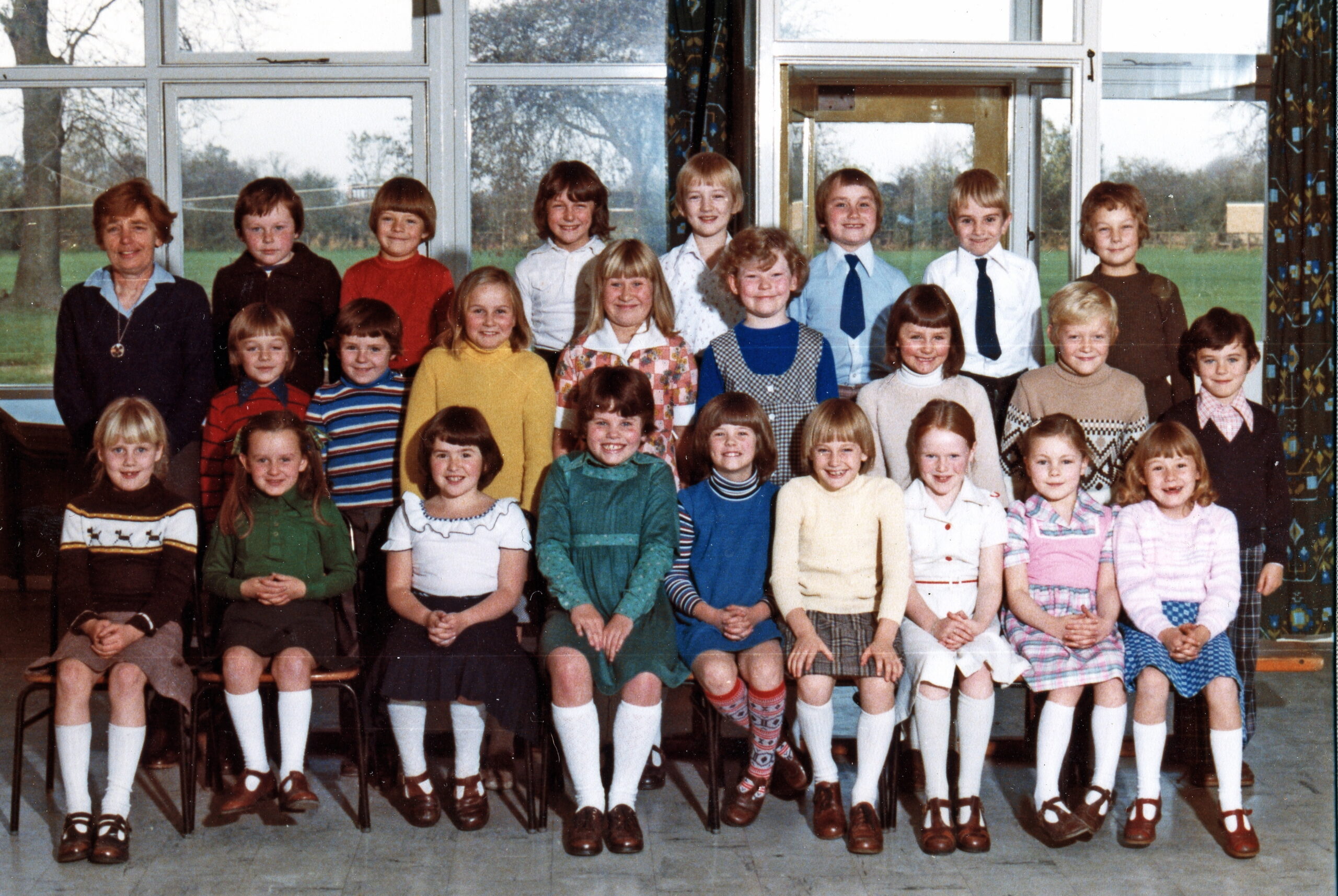
Below is a class in the ‘new’ school possibly 1978
Top Row: Shaun Fisher, Paul Creaser, Jonathan Bovil, Stephen Graham, Bryan Clark, Peter Blower, Billy Malcolmson
Middle Row: Christopher Wheelwright, Aaron Daubney, Judith Hall, Amanda Wilson, Gillian Cooke, Gillian Hall, Stephen Kitchen, Brian Jarrett
Bottom Row: Ellen Clyne, Georgina Townsley, Heidi Wriggleworth, Beverley Higgs, Sarah Martinson, Suzanne Evans, Gillian Brownbridge, Sandra Coates, Marie Cunningham