Although strictly speaking Spaldington was not historically part of Howdenshire – it is part of the parish of Bubwith – it is only a few miles from Howden and most inhabitants saw – and still see – Howden as the nearest large settlement. This is an ongoing history of Spaldington, initially concentrating on its ownership and the history of its halls.
Early history
The name possibly means Spaldington: ‘a farm or village on the Spalding’. Spalding may be a river name – from the Old English *spald ‘a trench, a ditch or a fenland river’ and could refer to the River Foulness. Or it could mean the ‘people living by the Spald’.
Domesday mention
In 1086 The Domesday book entry tells us that Spaldington was owned by the Count of Mortain:
The manor of Spaldington was held by the Count, and was farmed by Nigel, with 6 sokemen and 1 bordar there. The manor had sokeland, which comprised 6 bovates in Newsholme [in Wressle], 5 bovates in Willitoft, 1½ carucates in Foggathorpe, 2 carucates and 5 bovates in Laytham, 2 carucates and 6 bovates in East Cottingwith. However, 6 carucates of land in Spaldington were sokeland of the manor of Wressle.
After Domesday
The de la Hay family lived at Spaldington from at least the 13th century. In Kirkby’s Inquest, 1277-1307 the manor of Spaldington was a part of the lands of Peter de Mauley owner of Mulgrave Castle. Spaldington was then tenanted by Walter Bathell and John del/de la Hay,
The Nomina Villarum, 1316, shows the lords of the manor were Petrus de Hay and Jacobus de Bosevill.
Peter de la Hay who died 1431
A record dated 21 Dec 1379 refers to Peter, son and heir of Thomas de la Haye of Spaldington :
‘Grant and quitclaim made before the Corporation of the City of York, by Peter, son and heir of Thomas de la Haye of Spaldington, to William de Bowes, of his rights on the manor of Streatlam and Stainton.
Peter de la Hay of Spaldyngton was a witness to a grant dated at Saltmarshe on September 21st, 1398.
Peter de la Hay of Spaldington made his will on August 8, 1426. It was proved in 1431
His eldest son Thomas made his will on July 1st 1426, It was proved in 1427.
Thomas de la Hay died 1427
Thomas had married a daughter of Sir William Babthorpe of Babthorpe near Hemingbrough, by whom he left five daughters . In his will, dated July 1, 1426, he calls himself Thomas del Hay, son of Peter del Hay de Spaldyngton and directs that his body to be buried in the church of Ellerton, near Elizabeth his mother. He mentions his brother Robert del Hay, and Joan his own wife, and his children.
On 7th August 1427, Pope Martin V, in reply to a petition from the parishioners of both Aughton and Bubwith churches and Peter de la Hay, granted permission that, when they were hindered in winter by floods, snow and hail from reaching their parish churches, they could use the chapel of St James in Spaldington for mass and other offices ‘while the hindrances last’.
1486 Richard Blanshard of Spaldington, farmer, left a will, in which he left several bequests to the chapels of Spaldington and Willitoft.
John Vavasour died by 1481
One of Sir Thomas’ daughters, Isabel, married John Vavasour , a younger son of Sir Henry of Hazlewood near Tadcaster .
A deed of 1481 [ by which time John and Isabel had died] explains how Sir Robert Hildyard knight, son and heir of Katherine one of the daughters and heirs of Thomas de la Haye, esquire, Elizabeth Knyght, widow, the third of the daughters and heirs of Thomas, and Alice Thwaytes widow, fourth daughter and heir of Thomas, transfer to John Vavasour junior, serjeant-at-law, and his heirs, all their right in the manor of Spaldyngton and Willytofte, and 20 acres of land in Holme.
So Spaldington was now owned by this branch of the Vavasour family
John Vavasour 2 d 1506 (‘junior’ in the 1481 deed), was the son and heir of John and Isabel de la Haye.
He was born around 1440, probably at Spaldington.
He studied law at the Inner Temple and is first recorded as practising in 1467. By 1478 he had been recognised as a serjeant-at-law. He operated at Westminster and received fees and retainers from many sources.
He married Elizabeth Talboys / Tailboys whose family were from Kyme in Lincolnshire but they apparently separated by 1484.
By 1486 , soon after Henry VII had become king, he became Recorder of York. The king visited York twice in two years, the second time with 10.000 men in a show of strength after the attempt to put Lambert Simnel on the throne. John was loyal to the king and was knighted following the rebellion.
There are many references to John’s association with York in the city records He served as Recorder of York for four years. then in February 1490 was promoted to become one of the King’s Judges at Westminster.
He had a reputation as something of a miser and his will was dated 11th January 1493-4 which was, in fact, over ten years before his death. His servant Turpin is referenced in some of the less than complimentary stories about him
At the beginning of his will John names a variety of places where he would be willing to be buried. These all depended on the location of his death. In the event that he should die at Spaldington, then he wished to be buried at Ellerton Abbey.
He directed his executors to make, found and ordain one chantry at Spaldington, to be funded from his land at Newland. They should put aside £200 for this purpose.
The chantry was subsequently founded by John’s nephew and heir, Sir Peter Vavasour – it was licensed in 1510. John left £100 to the Prior of Ellerton. However, he had previously given the Prior money for books and vestments – he directed that the cost of these should be deducted from this sum. Furthermore, if John was not eventually buried at Ellerton, the Prior should only be given £60. £200 was given for prayers for John’s soul, this amount to be paid as soon as he was buried. He also directed that a priest should sing for him for 30 years, in whichever place he was buried. For this he should be paid 8 marks.
If his servant, John Turpin should still be with him at his death, he should be given 5 marks and another £20 should be shared amongst his servants.
Most interesting of all is the bequest to his wife, Elizabeth. John suggests that, if she makes any demands on his will, she should be given 40 marks worth of his lands. But, if she doesn’t make any demands, then she should get no part of his goods, nor of his lands. He gives his reason as being that she already took £700 from him, presumably when she left the marital home.
John’s ex-wife, Elizabeth Vavasour, nee Tailboys, died in 1509. It seems that after John’s death in 1506, Elizabeth married her second husband, Sir John Greystock, thus taking the title of Dame Elizabeth Greystock of York.
Elizabeth wrote her will on 14th May 1502 and it was proved on 16th July 1509. In her will, alongside bequests to family members, she also left money to ‘pouer prisoners oute of prison, relevinge of ympotent people, blynde and lame, and in other dedes of mercye and charitie’.
Elizabeth was buried in her tomb at St Helen’s Bishopsgate, London.
As John had no children, Spaldington descended via his brother William who married Alice Mallory.
Sir Peter Vavasour b c 1493 d 1557
The next heir was their son Sir Peter who married Elizabeth daughter of Sir Andrew Windsor. He died 5th March 1556 and was buried at Bubwith.
Spaldington chantry
In 1510 Peter Vavasour obtained a licence “to found a chantry for one chaplain in the chapel of St. James, in the hamlet of Spaldington, in the parish of Bubwith, Yorks.; to pray for the King and Queen Katharine, and for the said Peter and Elizabeth his wife, and for the soul of Sir John Vavasour; according to the ordinance of the said Peter and Henry Mathewe, prior of Ellerton”. Henry Matthew, prior of Ellerton, was to be its chaplain.
He was also granted mortmain licence to alienate lands to the said chaplain of the annual value of 9 marks.
In the clerical tax list of February 1525/6, Robert Flete was listed as the chaplain of Spaldington and at the Dissolution of the Chantries in 1548, the chapel was valued at £4. 13s. 4d, per annum.
Following the Abolition of the Chantries Acts of 1545 and 1547, the vicar of Bubwith reported to the Chantry Commissioners that the chantry within the manor house of the Vavasours in Spaldington had been overlooked. Sir Peter Vavasour responded that his was a private chapel and not a chantry, and won his case.
But the testimony of one witness, Bartholomew Abbott of Bellasize, in the case is interesting :-
Barthillmeu Abbott of Bellassisse in the countye of Yorke, gent, of the age of xxxixti sworne and examynede deposithe. He saithe yt he being a childe aboute the age of tenne yeres was in Sr Peter Vavasor his housse at Spaldington in the countye of Yorke and ther wentt to the scolle emonges his children with one Sr Johne Bakloke then chaplayne to the said Sir Peter; and by causse this deponentt thought hym sellffe and his felowes sore handeled wished hym sellff and them to have a new master, whiche Mr. Vavasor permitted hering, sayd they shuld have a new Master and so shortlye after the said Sir Peter dyd putt hym awaye and hyred an other priest called Sir John Dame which ther taught bothe Mr. Vavasores children and this deponentt , which Sir John Dame was shortly after putt awaye by the said Sir Petere & one other hyred by him & none of them called chauntre priestes, nor any chauntre founded within the chappell of Spaldington a ffor said to his knolege, nor yett to thys daye that ever he harde of any ther.
Children of Peter and Elizabeth
Peter and Elizabeth had four children – sons John, George, Thomas and a daughter Ann.
Their daughter Ann married Thomas Langdale of Houghton
Their son George lived at Willitoft and from him the Willitoft Vavasours were descended
Thomas Vavasour MD c 1512-1585
Their son Thomas born c 1512 is mentioned in many histories of the Elizabethan period. He was educated at home, as we see above and then at Cambridge. He moved then to study in Europe taking the degree of doctor of medicine at Venice. On the 20th November, 1556, he received a licence to practise from the College of Physicians.
He lived in York and was a prominent Roman Catholic. In 1572 it was said that he had harboured Edmund Campion, the Jesuit martyr. Grindal, archbishop of York, writing to Lord Burghley on 13th November, 1574, refers to Dr. Vavasour, who, he says, was an old acquaintance of his lordship, and had been allowed to remain in his own house at York, for nine months until the archbishop and the lord president of the North committed him to a solitary prison in the Queen’s castle at Hull.
The archbishop says that the doctor was the same man he had been, especially in his younger years, sophistical, disdainful, and eluding argument with scoffing, when he was not able to solve the same with learning.
He was released to his own house in York but after Mass was again said there he was returned to captivity at Hull. This was where other Catholic recusants were held in harsh conditions and it was later said that it was as a result of his ministrations to them that he died on 12th May 1585 . He was buried at Drypool near Hull.
John Vavasour probably d 1573
Their eldest son John, the heir, married three times., firstly to Katherine ? Eleson of Gunby, secondly to Cassandra Loudon of South Cave and thirdly to Julian Aske.
By his first wife he had two sons, John and Peter and a daughter Elizabeth
John’s heir was his surviving son by his first wife, Peter, who was childless. By a deed dated 20 February 1573, Peter Vavasour of the Middle Temple, London, esquire, settled Spaldington and other properties on his sister Elizabeth and her husband Thomas Dolman and her children.
John’s third wife was Julian Aske of Aughton near Bubwith. John and Julian had a large family including six sons.
Their first son George did not have any male heirs. Their second son Ralph – born c 1546 married Frances Darnell.
Ralph and Frances had two known children Sir John – who owned Spaldington by 1617 and who died in 1641 and Alexander who married Ursula Portington of nearby Portington.
At some unknown time, between 1573 and 1617 therefore Spaldington had passed from the Dolman family back to the Vavasours. In fact Thomas Dolman and his wife Elizabeth Vavasour only had one child, a daughter Jane who married Robert Constable.
There are records however of a tithe dispute between Sir John and a member of the Dolman family who lived at Duncotes near Balkholme. The two families had a greed to pay the tithes on Spaldington Moor, an area of around 1000 acres in alternate years. Sir John was said not to have paid when it was his turn.
Sir John Vavasour d 1641 married Mary, the daughter of John Gates of Howden.
I cannot find anything further about Sir John other than a quote from Yorkshire Catholic historian Hugh Aveling as follows:
Sir John Vavasour knt. was not a Catholic, and in court repeatedly for adultery and marital disputes
He died in 1641 and was buried at Bubwith. He was succeeded at Spaldington by his eldest son Peter. Younger son John married the daughter of Valentine Clarke of Spaldington.
Peter Vavasour
Peter and his wife Ann, daughter of Sir Thomas Gower of Stittenham near Malton in North Yorkshire, had two sons.
John born 1633 married Catherine Ackroyd of Foggathorpe. Their only child, a daughter Mary died unmarried in 1655. John died c 1678.
and Thomas born 1636 married Dorothy daughter of Sir Ferdinand Leigh of Middleton near Leeds and they also had a daughter Mary. It was through Mary that the Vavasour ownership of Spaldington continued
Thomas Vavasour 1636- 1679
Thomas, after the death of his brother, was the last male heir of the Spaldington Vavasour family.
An inscription recorded in 1877 within the altar rails of Bubwith church read
In hoc tumulo Reconditum
Ossa Thomae Vavasour de
Spaldington Armiger qui
obiit decimo quarto die
Februarii Anno D. 1679
Annoque aetatis 43
[ In this tomb are buried the
bones of Thomas Vavasour of
Spaldington, armiger, who
died the fourteenth day of
February, A.D. 1679
In the year of his age 43]
The Trafford connection
Thomas’ daughter and heir, Mary Vavasour, married Sir Ralph Assheton of Middleton, Lancs, Baronet.
Their eldest daughter Anne, married Humphrey Trafford, Esq., 5th Aug 1701, in Manchester. [ This is the same family who have given their name to several modern features – eg Old Trafford and the Trafford Centre]
Humphrey and Anne had a daughter, Elizabeth Trafford, who married Mail Yates, of Mail, Lancs, and who had three daughters , Anne Assheton Yates. Mary Yates who married Henry Aspinall and Catherine who married Robert Campbell.
Three sisters
On the death of Elizabeth in 1788 the ownership of Spaldington was split into three parts.
1. Anne Assheton Yates married Henry Nooth, a Colonel in a Cavalry Regiment, who took on his marriage the name of Vavasour in 1791, and was created a baronet in 1801. He died in 1813 at Melbourne Hall. His widow, the former Anne Asheton Yates, died in York in 1818 aged 88.
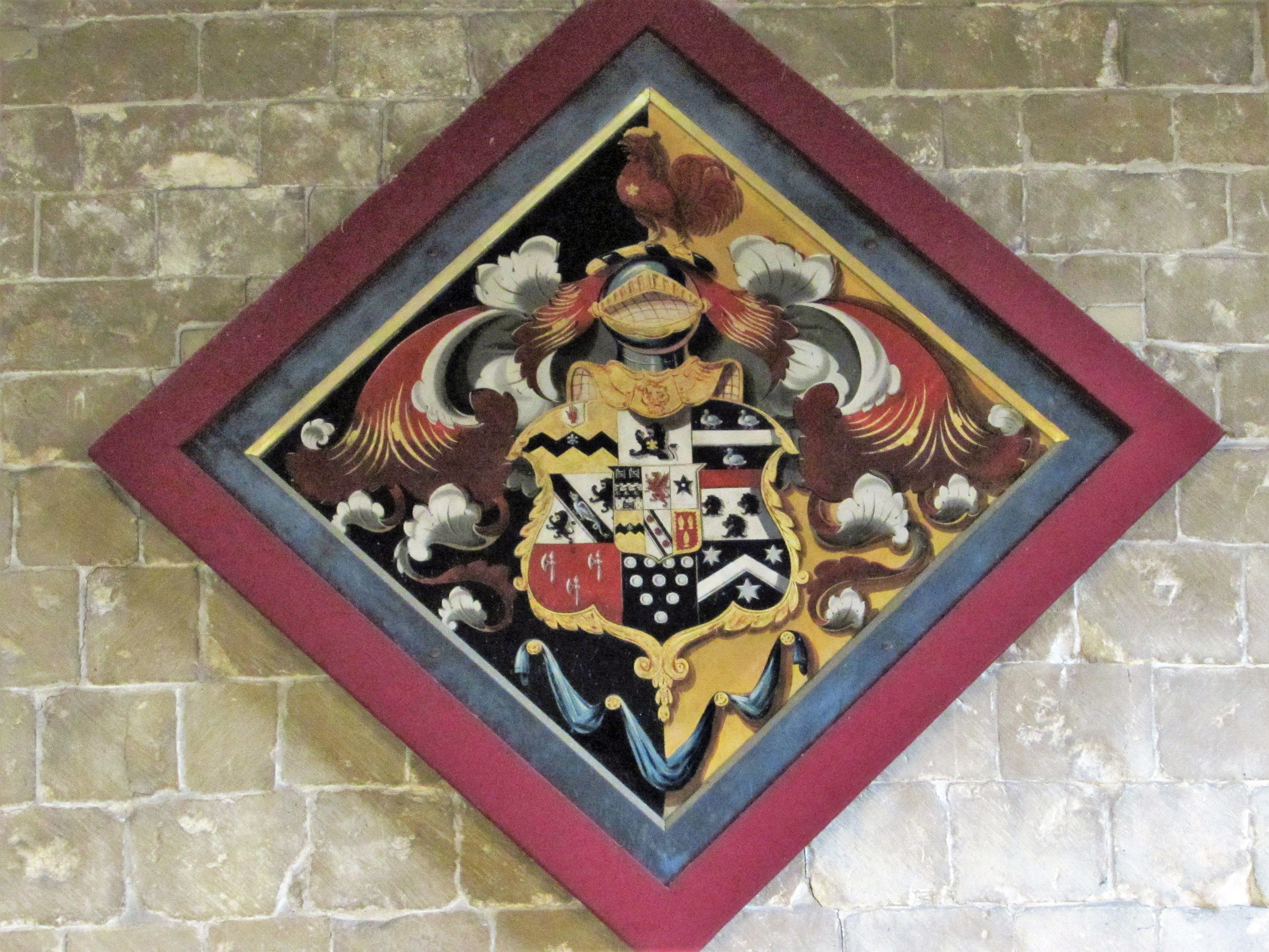
Above is the wooden hatchment of Henry Vavasour, [died 1813[ on the wall of Bubwith Church which represents the arms and descent of his family.
Their eldest son, born in Dorset in 1768 was Henry Maghull Mervyn Vavasour [born Nooth] who was a career soldier. He died at Melbourne Hall in 1838 and was buried at Bubwith. His son Henry Mervyn born 1814 died aged 98 in 1912.

This is a picture of Henry M Vavasour taken in 1890
2. Mary Yates
Mary married lawyer Henry Aspinall . She died in 1794 and he inherited her third of Spaldington which included the hall and much of the land north of the village. He put it up for sale in 1809 and died in 1810.
I cannot find any evidence as to who lived in Spaldington Hall in the 1800s.
Lord Howden
In May 1809 the following advertisement appeared in the Hull Advertiser
FREEHOLD ESTATE, consisting of the Spacious MANSION HOUSE, called SPALDINGTON HALL, and several FARMHOUSES, with suitable OUTBUILDINGS, and 966 acres. of Fertile LAND, in a ring fence, divided into convenient Farms. Also, ONE-THIRD part of the MANOR of SPALDINGTON.
It was bought by eminent soldier General Sir John Francis Cradock who also bought Grimston Hall. In 1819 he was granted the Irish title of Baron Howden of Grimston and Spaldington. He was the only son of John Cradock, formerly Archbishop of Dublin and Primate of Ireland.
So in 1822 we read that ‘The hall at this place was formerly the seat of the ancient and honourable family of Vavasour, but now the property of Lord Howden, it exhibits a fine specimen of architecture of the time of Queen Elizabeth. ”
Baron Howden was granted the English title in 1831. He died in 1839 and was succeeded in the title of Lord Howden by his son, John Hobart Cradock who immediately remodeled Grimston Park as an “Italianate palace” with large pleasure grounds and a riding school.
But Lord Howden and his wife divorced and the estate including Spaldington was sold in 1851 to fellow diplomat Albert Denison, 1st Baron Londesborough.
For example a newspaper report of 1822 reports a death at Stanton, near Burton-upon- Trent, Staffordshire, at an advanced age, Wm. Nadin, Esq. formerly of Spaldington Hall, and father of the late Mrs. Waterworth, of Wressle Castle
Spaldington Hall
In medieval times the de la Hay family probably lived originally in a house which stood within the moat shown on the bottom right of the map.
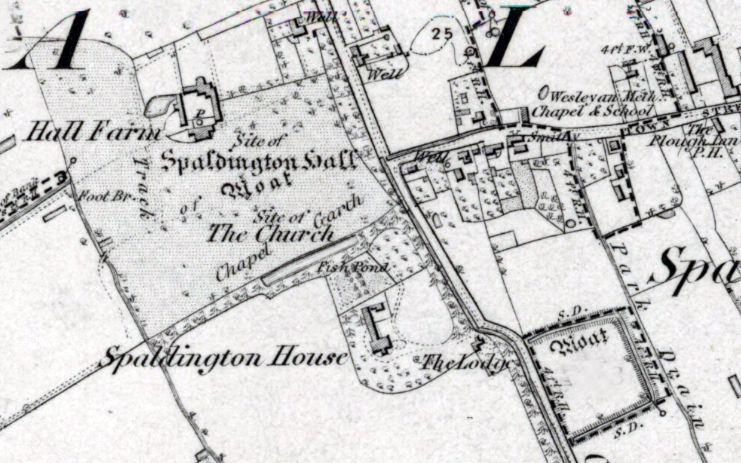
Snowden Dunhill, born 1766 was brought up in Spaldington from around the age of 6. He later became infamous as a thief and was transported to what was then Van Dieman’s Land [ Tasmania]. He wrote his memoirs which were published in 1834 and are available as a reprint. Here is an extract from them describing the hall.
Spaldington is a secluded and purely agricultural village. My earliest recollections are connected with the old hall at that place, a fine building, erected in the time of Queen Elizabeth. This house, with its peaked roof, ornamented with large round stones, its moats, its rookery, and the reputation of being haunted by a fairy, is yet strongly impressed upon my memory.
He also tells the story of how one day, when only six years old, he saved the life of a little companion with whom he was playing by the side of the moat round the Old Hall . The child fell into the water, sank, and rose for the last time, when little Snowden, with great pluck, jumped in after his playmate, and caught him by the dress. The two children struggled in the water, and the drowning boy nearly dragged little Snowden under. But Snowden maintained his hold, and succeeded in dragging his comrade to the bank. When, in 1833, towards the end of his life, Snowden was in Hobart in Tasmania it was apparently this little boy, then a sailor, who recognised him and brought his manuscript back to Howden.
The fairy he mentions was known as Robin Roundcap and his story is part of the folklore of Yorkshire.
Robin Roundcap
One source relates that
‘Robin Roundcap haunted Spaldington Hall and was a hearth spirit of the true hobgoblin type. He helped thresh the corn and performed other domestic chores, but when he was in the mood for mischief he would mix the wheat and chaff again, kick over the milk pail, and extinguish the fire. He is said to have been confined in a well for a stipulated number of years through the prayers of three clergymen. This well is known as Robin Roundcap’s Well’
I also found this account in the Goole Times from 1875
Not far from the Howden station, is the rural village Spaldington, in which place, not very many yean ago, w»a standing old mansion in the Elizabethan style, known as Spaldington Hall.
The hall was said to be haunted by a genuine ghost of the old school, half ghost and half fairy. This ghost was always known by the name of Robin Roundcap, and was believed to have been the ghost of a family jester in the time of James I. Tradition said that for some mischievous pranks played on his master he was kicked downstairs, and broke his neck. This kind treatment he resented haunting his master during his life, and the house after his death. It is related was very fond of frightening the maids, of hiding their shoes, kirtles, household utensils, and farming implements – in short, if anything was lost or broken, it was put down to Robin’s account.
He was credited with wonderful powers of imitation, aud whatever noisy operations were going on the house, or outbuildings, the same noise would heard in the next room, or somewhere not far off. When the boys were chopping sticks, at the other side of the heap they would see sticks flying, but without seeing the axe or directing it.
Robin would frequently reply to questions, sometimes volunteer statements, but was seldom seen with the naked eye, and never twice had he the same personal appearance. The story was, once upon a time a poor unfortunate packman was going up the house to make an honest penny, when he encountered Robin in a form that so frightened him that threw down his pack and ran away,
It would appear Robin was no Good Templar, for was charged with drinking the ale barrels dry and a particular fancy he had for eating pasties, cakes, tarts, or, in fact, anything good or sweet. Ill-natured people would have it the servants had the lion’s share of the plunder. One of his freaks was that of getting into the brick oven and putting footprints on all the large rye loaves when baking, or of pushing in large rusty nails to spoil the servants’ knives. The worst freak was get into the churn and spoil the butter and although they tried to burn him out by inserting a red-hot poker, but this only served to prove his laughter, without any beneficial result to either cream or butter.
At last the farmer—who was then occupying the house—became so provoked by the doings of Robin, he resolved to leave the house aud remove to another a short distance from the farmstead, that he might be able to attend the farm without the annoyance he had been subject to so long. When the furniture was being removed to the new abode, the farmer met an old neighbour, who said, *’l see you are flitting when, the astonishment of both, Robin bawled out from within—“ Yes, we are flitting”. “Well,” said the farmer, “we
The good vicar was next consulted, and he kindly offered himself, “by book and by bell”, to appear in person at the old mansion, to show cause why his unjust spirit should not be conjured down, and set at rest lor ever.
We are not able to give particulars of the charm used by the clerk in holy orders. Robin begged that it should only be for a year and a day. ln the end, matter was so far compromised, that he was only to be conjured down into an old draw-well, for three generations, which was accordingly enacted, and willow stake driven through him, which was said afterwards to became great tree.
About fifty years ago, the rising generation were anxiously looking forward to his return. But, alas, for poor Robin before his day came, the old mansion was taken down, and a modern house built in its place, so modern and that there was not a decent corner for the ghost to lodge in.
Demolition
Whilst under the ownership of Lord Howden the old Elizabethan hall was pulled down in 1838. It was replaced by a new building within two years which is now known as Old Hall Farm.
In 1845 old hall farm was occupied by Thomas Stogdale who was renting from Lord Howden. He was farming 300 acres and employing 4 labourers in 1851. He was married to Ellen and they had two sons.
Catherine Eleanor married Robert Campbell of Arknish House in Argyll and had two daughters Catherine and Sarah Charlotte. She was the owner and probably the builder of a new hall at Spaldington which was on her property, south of the old hall. One source suggests it was built in 1810, the year Lord Howden bought the old hall.
With Immediate Possession, with or without TWELVE ACRES of GRASS LAND, a very desirable RESIDENCE, comprising Drawing, Dining, and Breakfast Rooms, with suitable Lodging Apartments; also, Butler’s Pantry, Coach House, Stables etc. There is also a large Orchard, and an excellent Kitchen Garden.
Catherine died in 1838, the same year as her her daughter Catherine and her sister’s son Henry M M Vavasour who died at Melbourne. Also of course this was the year too that the Old Hall was pulled down.
Her daughter Sarah Charlotte inherited her Spaldington property and on the tithe award of 1849 is shown as owning and occupying the house . She had married Nathaniel Jekyll of Pitcombe House in Somerset but after he died she sold up in 1830. In 1838 she was given official permission to be known solely by the surname Campbell.
She died in 1853 at Bath and left her Spaldington property to her cousin Henry Mervyn Vavasour. She left a bequest to create a charity for the poor who lived on her lands.
In 1857 it was described as ‘The present hall, the property of Sir H. M. Vavasour, and residence of Robert Goldthorp, Esq., is a large brick building, with stone dressings, erected in 1810’.
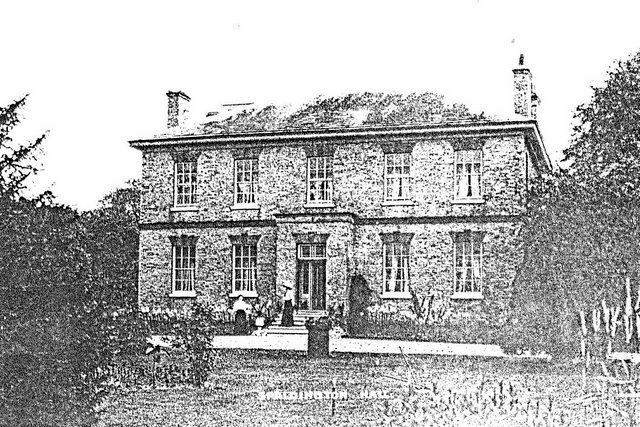
Robert Goldthorpe did not live in the house for very long but seems to have made a good impression.
We read that in 1856 — R. Goldthorpe, Esq., of Spaldington House, has lately distributed to each widow, and to the deserving poor of Spaldington, a pair of blankets, as a Christmas-box. At this inclement season, nothing could have been more suitable. During the past year this respected gentleman presented a very handsome Bible and prayer book for the use of the established Church in Spaldington. Other charitable and local projects have met with his liberal aid and support. May he long live to enjoy the hearty good wishes of the poor and all who have the pleasure of knowing him.
He was a widower and when he remarried in 1863 he left the district, moving to Surrey where he died in 1870.
THE SPALDINGTON ESTATE, including the Mansion known as Spaldington Hall, with its Gardens and Pleasure Grounds, surrounded by a Freehold Domain of 2,510 acres of superior land, divided into 12 capital farms, interspersed with woodlands and plantations affording coverts for game, lying in a ring fence, only two miles from the Howden Railway Station, within an easy distance of the city of York, and being in a thoroughly rural district, yet of easy access from the manufacturing towns of the West Riding, particularly eligible as a residence or investment for a banker, merchant, or country gentleman.
Spaldington Hall, a modern-built residence in grey brick, with stone dressings, and slated, is pleasantly situated, overlooking an enclosure of park- like pasture, and is approached by an entrance lodge and carriage drive through ornamental plantations, lawn, and pleasure grounds ; it contains an entrance-hall, dining, drawing, and breakfast rooms, seven bed rooms and dressing rooms on the first floor, besides attics, housekeeper’s room, ample domestic offices, stabling, etc.
On another part of the estate a second residence has recently been erected, in the Gothic style, and large sums have been expended in the erection and repair of the farmhouses, homesteads, cottages, and the buildings generally are of a most superior character, and in excellent order.
The Estate comprises 2,540 acres, of which about 800 are fine pasture lands and orchards, 50 acres woodland, and the remainder arable. The soil is a strong, deep loam, and tbe portions requiring it having been under-drained in the most effective manner under Government Inspection, it is capable of producing very large crop of both grain and roots, while the size and regularity of the enclosures render it especially suited for steam cultivation, and it is most accessible to good markets, the roads and river Ouse affording every facility for the delivery of produce. Deep seams of coal exist under the whole of thia district, though at present unworked. The compact character of this Estate is favourable for the preservation of game. It is at present well stocked with partridges and hares, and has excellent covert for pheasants. The country is hunted by the Holderness and York and Ainsty hounds, and good trout fishing may be had in the vicinity.
The farms included Fir Tree House [described above as newly erected], Town End Farm, Sandwood House Farm, Yoke Gate Farm, Sykes Farm, Warham Farm.
The estate was next passed to Mrs Harriet Ellis, nee Cunliffe of Addingham. On her death in 1867 at the advanced age of 87 she left her property at Addingham and Spaldington to her nephew John Pickersgill on the understanding that he would take the surname Cunliffe.
John Pickersgill Cunliffe was a banker. Unfortunately he died suddenly in a rail accident in 1873 and left Spaldington to his eldest son Harry.
Harry married in 1881 and there is a report of his homecoming with his new bride in August.
On Tuesday the village of Spaldington, near Howden, the was all astir in honour of the coming of Mr Harry Pickersgill Cunliffe and his bride to take up their the residence at the Hall. A triumphal arch of evergreens was erected at the entrance to the grounds, bearing the word “Welcome.” The grounds themselves were in beautiful order. On the arrival of the carriage Mr and to Mrs Cunliffe alighted, and were received by the Rev W. G. Wilkinson, vicar of Bubwith, who addressed to them a few words of hearty welcome, after which he called in upon Mr J. Steeper, [ of Fir Tree farm] who presented Mr Cunliffe with an illuminated address, expressing the congratulations of the tenantry and others on their marriage, and wishing to Mrs Cunliffe and himself continued happiness and prosperity. A beautiful bouquet was at the same time presented to Mrs Cunliffe by Mrs Steeper. Mr Cunliffe, in a graceful and appropriate reply, expressed the pleasure he felt in receiving such a hearty welcome, and hoped that their residence in Spaldington might be to the mutual advantage of themselves and all the inhabitants of the village, in whom he should ever take the deepest possible interest. Hearty cheers followed, as and two pieces of music were sung in capital tune by the children, under the able leadership of Mr Clark, the schoolmaster.
The Cunliffes were at Spaldington in 1884 but then seem to have sold the estate and moved to Staughton Manor near St Neots. Their son was killed in the First World War.
Thomas Blossom Oliver
The estate was later bought by Thomas Blossom Oliver. He was a real Victorian entrepreneur. His father had a hand-worked flax mill at Staddlethorpe near Gilberdyke. He and his brother took this over and Thomas first bought a small farm on which to grow flax. He bought more farms, eventually owning 18 including those around Spaldington and Willitoft. At his death he owned around 7000 acres. He had 5 threshing sets, 2 steam ploughs and about 100 horses. In the early 1900s he had six of his farms connected by telephone. He supported the building of a Wesleyan chapel at Willitoft and was a active member of the chapel at Gilberdyke.
He and his wife Mary lived in the newly built Fir Tree farm while his father lived in Willitoft Hall. When he died suddenly at the comparatively young age of 54 he left £106,000.
He left the income from his estate to his widow but divided the property between his brother and sisters.
Mary and her niece Lily Higginbotham moved into Spaldington Hall and lived there until at least 1913. Mary was obviously a benevolent lady giving out prizes and Coronation mugs at village celebrations.
Mary and Lily moved back to their native Lancashire and much of the Spaldington estate – 1168 acres – was requisitioned in 1915 by the Admiralty for an airship station. Apparently the officers lived in the hall.
Education
Spaldington had a strong early Methodist tradition. Both the Bell and Guy families, later to live in Portington Hall and become friends of John Wesley were from Spaldington whilst the Methodist magazine includes obituaries for John Barker [ b Spaldington 1733 and Simpson family members.
The Methodists probably met originally in members’ houses but in 1820 they built their own chapel in the village.
The 1851 religious census for Spaldington chapel was filled in by villager Richard Dowson, a shoemaker and farmer. He wrote that on 30th March 1851 there were 52 people attending the morning service and 15 at Sunday school. In the evening the figures were 25 and 5.. The average morning attendance was 90 and 50 in the evening. The chapel had 115 free seats and 52 others which gives a capacity of 167.
And interestingly he wrote that the building was also used as a day school. Francis Jackson aged 20 was listed as the schoolmaster. But he moved to Howden and was working by 1861 as a post office messenger.
Meanwhile in 1855 Sir Henry Vavasour commissioned architect William Milford Teulon to design a combined school and chapel [Anglican] at Welham Bridge with a house attached. An article in the Ecclesiologist was critical of the design, in particular of the chimney which was also a bell tower and clock.
 Welham Bridge chapel from a contemporary print
It seems probable that Sir Henry also gave the new chapel three pieces of seventeenth silver. These were a Communion cup, a paten and a flagon.
The cup has a conical bell-shaped bowl with a moulded baluster stem and plain circular foot. It is inscribed, on the foot : “Welham Bridge Chapel.” The hallmarks are for London, 1631.
The paten is a plate on a central circular stem and foot. It has the sacred monogram in a glory at its centre, and the inscription : “Welham Bridge Chapel.” . It is hallmarked for London, 1691.
The flagon is a tall peg tankard, and is not an English vessel. It has a domed cover with a thumb-piece formed by a winged cherub. The barrel is chased all over with a scroll ornament, and on the inside four pegs divide the contents of the vessel into five equal parts. At the centre of the cover the letters I H S, in monogram, have been engraved, surrounding which are the words: ” KIERSTEN IACOBS DATTER SOLI DEO GLORIA 1640 HINRICK HOE.”
These pieces were moved to Bubwith church after the chapel closed and are now in the undercroft at York Minster.
Welham Bridge school opened
The first master of this school was John Plummer and a report in July 1855 in the Yorkshire Gazette reads as follows
Spaldington.—The first annual examination of the children of the National School, at Spaldington Outsides, was held on Thursday afternoon in Mr. John Smith’s barn, which had been neatly fitted up for the occasion. The improvement shown by the children gave great satisfaction to a large assembly of parents and friends, and reflected much credit on the talents and industry of the respected master, Mr. John Plummer. A most excellent tea entertainment was provided by the liberality of the neighbouring farmers, to which ample justice was done, both by old and young. In the evening prizes were distributed, and a suitable address, on the duties both of parents and children, delivered by the Rev. G. M. Webb, vicar of Aughton.
But by spring 1861 Mr Plummer was gone and the new master was Jesse Carter, originally from Colchester who was living at Welham Bridge with his mother and sister.
He needed more pupils and advertised later that year for boarders
WELHAM BRIDGE CHURCH SCHOOL The Master of the above School receives into his Family, to BOARD and EDUCATE, SIX BOYS under Ten Years of Age. The situation is particularly healthy.
Maybe no one responded as in 1862 Jesse advertised for a new post as schoolmaster or clerk
A Trained Church Schoolmaster is open to an engagement as above. —Address Master, Church School, Spaldington, Howden.
Jesse and his family moved to Holme on Spalding Moor where he worked as an assurance agent for the rest of his life.
In the 1890s the Chapel at Welham Bridge was sometimes used by the Wesleyans
It eventually became a small holding. The following advert appeared in October 1946.
Welham Bridge R Hornsey and Sons will sell by auction on the premises the desirable small holding “Chapel House”. The Property consists of a brick and slate dwelling house, containing: On the ground floor. Sitting Room. Living Room. Kitchen and Dairy; and the first floor, 3 Bedrooms: having outside, Milk Dairy. Wash-house, Coalhouse. Yard with covered copper, greenhouse, 5-stall Cowhouse, Cartshed Loose Box. large Timber Building with c.i. roof and lean-to Cart shed. Together with orchard and grass field, the whole extending to an area of 6 acres.
The Gillard family moved there from the Hull area and had a small shop which attracted trade from cars travelling to and from the coast.
Chapel becomes school
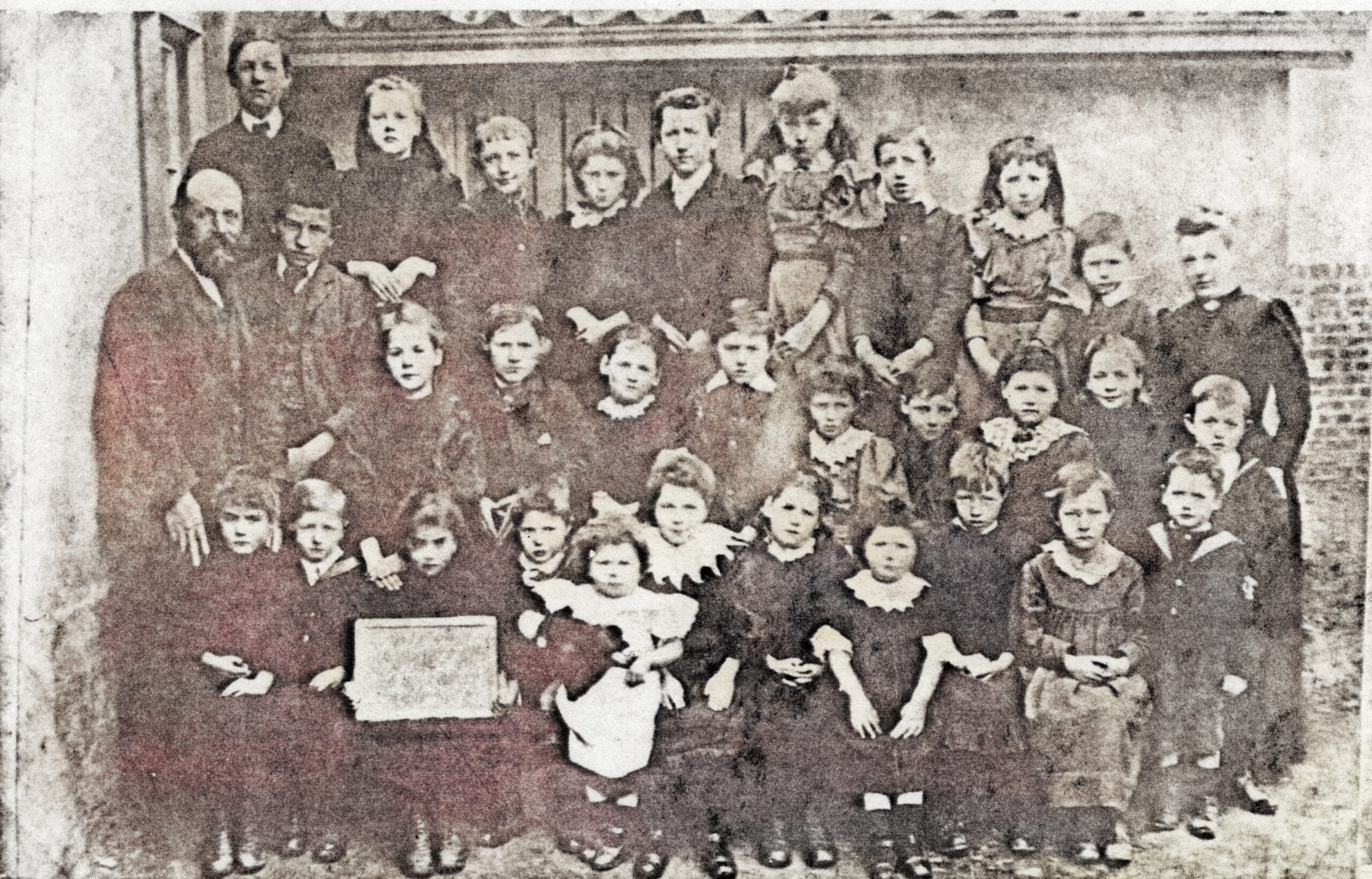
Quite what education was then available in Spaldington in the 1860s is unclear although it is known some children went to Eastrington. In 1870 an education act was passed which specified that where there was no elementary education available a school board should be elected to levy a rate and provide a school. So a school board was set up to provide a school for Spaldington, Willitoft and Gribthorpe. Those elected in April 1875 were
W. Brantley. Willitoft. Richard Sykes Spaldington, John Thomas Hill, Gribthorpe, Thomas Ask, Spaldington, Charles Boast Spaldington; John Steeper, Spaldington and Robert McNeillie, Spaldington,
A few weeks later an advertisement by the Spaldington School Board appeared asking for tenders for
The earliest reference to a pub at Spaldington was in 1793 when William Hesslewood had a licence to sell ale at Spaldington. We do not know whether this ale house had a name but for many years the village had an inn called The Plough. The Dove family were the publicans there for much of the nineteenth century
In 1788 John Dove married Ann Barnard at Bubwith. In 1796 he was described as a wright on the baptism of his son Charles
The earliest record of The Plough by name is in 1810 when a sale of timber was advertised ‘at the house of John Dove, the Plough Inn’
There is a will of John Dove of Spaldington dated 1814. His widow Ann then held the licence in the 1820s.
Their son Thomas [ born 1790] was the next landlord. He was there in 1841 when a sale of 160 oak trees growing at Spaldington took place at the House of Mr. Thomas Dove, the Plough Inn, Spaldington
By the 1890s William Kenniwell was landlord. He was in trouble in 1896 when he appeared at Howden court for supplying diluted whisky. He had been out and left his wife in charge. The inspector had asked for a pint of Scotch whisky. He admitted the offence saying
that on getting up on the morning in question, his wife reminded him that they had only a short supply of Scotch whiskey, and as he could not go and order any he told her put little water to what they had’.
He was fined 40s including costs.
James and Elizabeth at Spaldington had at least five children but then tragedy struck. Two days before Christmas in 1873, while at Selby market, James suddenly collapsed and died aged only 38. This left Elizabeth with a mill and a large family as well as being pregnant with her daughter Minnie [who went on the marry Harry Gossop].
Spaldington Mill got a new owner in 1878, Robert Harris originally from Alkborough advertised that he had bought it and was looking forward to ‘public patronage’. He and his wife Sarah had a son Ernest Thorpe born there in 1879 but in January 1880 Robert died in Sheffield aged 25
In the 1881 census Mathew Falkingham is the miller. He is married to Mary and has 3 children Sarah, James and Reginald. But by 1886 when their son James dies he is working as a labourer in Goole, and by 1911 is farming in Camblesforth.
The mill was demolished or fell down between 1890 and 1900
In 1892 William Taylor , a cowkeeper was living at Mill house.
The First World War
The vast airship station was built within a few weeks and the quiet village suddenly had a vast and busy new neighbour. Brind Common farm was demolished and Spaldington people socialised with the station personnel.
After the war the station was used by the Air Ministry as an airship training base and the R38 which crashed into the Humber off Hull in 1921 was based there. Soon afterwards the base was decommissioned and sold to a consortium.
The Roll of Honour in the Methodist archives lists twenty-two people from Spaldington who served but came back from the war. It is not easy to identify them all and some of the abbreviations are unknown but I have added some information about the names where I could find it.
Those who served were:
John George Broader Army Service Corps [ horse transport]
F. Cawkwell East Yorkshire Regt.
Tom?. Drury C.H.
D. Drury East Yorkshire Regt.
W. Penrose Lancaster and York Regt.
G. Walsh Royal Field Artillery
C. Hague Royal Navy
W. Broader West Yorkshire Regt.
[possibly William Henry Broader Army Service Corps. [ William’s army records show pay deducted for maintaining child, William, by Jane Ann Fines born 11th Nov 1912. Jane married Charles Atkinson in 1918.
J. Vickers Royal Field Artillery
G. Kenniwell Royal Naval Air Service
J. Kenniwell East Yorkshire Regt.
Charles Fines Canadian Infantry
D.Moore Durham Light Infantry
H. Danby H. I.
E. Snell Border Regt. (?)
F. Witty East Yorkshire Regt.
W. Moore R.N.S.C.
F. Greensmith Royal Navy
F. Holmes V.J.C.
J. Wiles V.J.C.
J. Oliver V.J.C.
J. Tutty V.J.C.
Eight men with Spaldington connections died. Out of these eight six died in England and were buried in local churchyards
They were [ in alphabetical order}
Charles Harold Atkinson
Born Hemingbrough. Emigrated to Canada. Joined Canadian army. Wounded in chest at Paschendale. Returned to England in 1917. Married Jane Fines in 1918 and daughter Nancy born. Family lived at Spaldington. Charles died in military hospital of pneumonia in 1919. Buried Hemingbrough
Cyril Clark
Cyril Clark was the son of the former head of Spaldington school. His funeral was reported in the newspaper in September 1916
EASTRINGTON MILITARY FUNERAL. On Friday the funeral took place of l’te. Cyril Clark, London Regt., youngest son of Mrs Clark, Sycamore House, and the late Mr John W. Clark, who died at Whalley Military Hospital, Lancs., on Monday from wounds received in action.
The body arrived the previous day, and rested during the night in the chancel of St. Michael’s Church, from the tower of which the flag flew at half mast. Deceased was a native of Spaldington, where his father for many years was headmaster of the council school.
The service was fully choral, and Mr Thompson was the organist. Military personnel lined the pathway from church to the grave, and at the close of the service three volleys were fired over the grave, and Bugler Walsh from a distance sounded the “Last Resting Call. ‘
The chief mourners were Mrs Clark (mother), Mr Ernest John Clark (Dewsbury, brother), Mr and Mrs Atkinson (brother in law and sister. West Newton Grange, Hull). Mr Tom Clark (brother-in-law and sister). Mr Tom Clark (brother, Home Farm, Spaldington, Miss Effie Clark (sister), Mrs Clark (sister-in-law), Mr Martin Walton (cousin, Leeds). Mr Robert. Smith (Grange Farm, Stamford Bridge, uncle), Mr and Mrs E. Smith (Howden, aunt and uncle), Mr Arthur Smith Miss Smith Farm. Warter, cousins), Mr and Mrs Snarr (Howden, cousins), Mrs Smith (Blacktoft, cousin), Palmer Powls, Master P. Powls, and Miss Connie Powls (cousins), The arrangements were carried out by Mr R. T. Nurse.
George William Fines
These are the army details of George Fines whose family lived at Spaldington Grange. He had emigrated to Canada as had his brother Charles. His sister Jane married Charles Atkinson who had also served in the Canadian army [see above]
Private 47995, 15th Battalion, Canadian Infantry (Central Ontario Regiment.) Died 23rd November 1915. Aged 26. Born 16th July 1889 in Blacktoft, Yorkshire. Farmer by trade. Single man. Son of the late Charles and Jane Fines of Spaldington, Yorkshire. Enlisted aged 25 years. height 5 feet 9 inches, girth 37½ inches, complexion medium, eyes grey, hair light brown; religion Church of England. Enlisted and passed fit 28th May 1915 at Military Camp, Niagara, Canada. Buried in WULVERGHEM-LINDENHOEK ROAD MILITARY CEMETERY, Heuvelland, West-Vlaanderen, Belgium.
George Holmes
Private 53110, 52nd Company, Machine Gun Corps (Infantry). Died 12th February 1917 . Born Spaldington, enlisted Howden. Formerly 23889 East Yorkshire Regiment
George died in 1917.
The newspaper report of February 1917 is as follows.
MILITARY FUNERAL AT HOWDEN. We regret to announce the death of another Spaldington soldier, Private George Holmes (Machine Gun Corps), youngest son of Mr and Mrs William Holmes, Ivy House-, which took place at the Military Hospital, Grantham, last week from pneumonia. Deceased was only 19 years old. The remains were laid rest in St. Peter’s Churchyard last The Rev A. Waring officiated, and the interment took place with full military honours.
The Holmes family later moved to Gilberdyke
Samuel Leetham East Yorkshire Regt.
Private 3/16192, 8th Battalion, East Yorkshire Regiment. Joined up Jan 1915. Shot and wounded in bowel. Shipped home and died in Cambridge military hospital Aldershot on 19th August 1916 .
He was aged 36, born at Spaldington, enlisted Howden. Son of Matthew and Jane Leetham of Spaldington.He was the husband of Gertrude Leetham nee Canty and father of five children He is buried at Bubwith
George Herbert Oliver Royal Field Artillery
Driver 1073, 2nd Northumberland Brigade, Royal Field Artillery. Died 6th June 1916. Aged 23. He contracted bronchitis as a result of getting wet and was in hospital. He recovered and returned to duty. But he was then gassed and discharged as unfit to serve. He was the son of William and Annie Mary Oliver. He was buried at Holme on Spalding Moor
S. Taylor East Yorkshire Regt.
Possibly Thomas William Taylor born Spaldington 1895
Thomas William Taylor
Birth Place: Spaldington, Yorks
Residence: Selby
Death Date: 14 Jul 1917
Death Place: France and Flanders
Enlistment Place: York
Rank: Private
Regiment: Prince of Wales’s Own (West Yorkshire) Regiment
Battalion: 10th Battalion
Regimental Number: 16073
Type of Casualty: Died of wounds
Henry Witty East Yorkshire Regt.
Private 17920, 6th Battalion, East Yorkshire. Died 13th May 1917. He had been declared unfit for service and sent home to Willitoft from Egypt with tuberculosis. He was buried at Bubwith
After the war
The whole of the land and farms which had been requisitioned [this was not the whole village] were put up for sale in March 1923. The farms, grazing lands, single fields, small holdings and plantations in the parishes of Spaldington, Wressle. and Willitoft were divided into 28 lots. But only three farms changed hands, and 393 acres of land sold.
In the summer of 1924 the Vickers Airship Guarantee Company bought the airship station. It was in a very dilapidated state but after repair and cleaning it was ready for the construction of the airship R100. This is a large topic on its own.
In June 1931 the R100 was gone and the air station estate including Spaldington Hall was put up for sale again. It was bought by Mr J E Mortimer who lived at Knedlington. He had hopes of it becoming an aerodrome but these came to nought and in 1935, having dismantled the hangars for scrap he sold the old air station to the `Land Settlement Association.
Miscellaneous information
1875
A balloon which was part of the Great Yorkshire Gala at York had to make a sudden landing at Spaldington.
SPALDINGTON TOWNSHIP.
Post Office at J. Swinden’s. Letters via Howden, arrive at 7-30 am., and are despatched at 5-25 p.m. Pillar Box cleared at 5-40 p.m.
Miscellany of trades
Broader John, carrier to Howden (Saturday)
Chaplain William, head gamekeeper and caretaker, Spaldington hall
Clark John, master, Board school
Croft John, blacksmith, &c.
Edmondson Thos. William, merchant (Leeds), Spaldington hall
Keniwell John Wetherill, vict., Plough Inn
Moore Seth, joiner and farmer
Reed William, cowkeeper
Swinden John, grocer and carrier to Howden (Saturday), Post Office
Taylor William, cowkeeper, Mill house
Tutty Charles, cowkeeper
Wiles George, hind, Town End farm
Farmers.
Atkinson Robert, Warram farm
Atkinson William John (and overseer), Yokegate farm
Boast Charles, Spaldington cottage
Hall Wm. (bailiff), Fir Tree & Town End farms
Martin John & Benjamin, Sandwood cottage
McNeil Robert, Grange farm
Nutt Richard, Sykes house
Nutt William, Villa farm
Overend Martin
Purdon John, Mount Pleasant
Seward John Amery, Sandwood house
Smith Samuel, Johnson’s farm
Taylor Robert, The Old hall
West John, Moor farm
.