Portington
Portington today is a small settlement consisting of a few farms and houses. It is about a mile from the larger village of Eastrington.
Portington was first mentioned in the Domesday book in 1086. It formed part of the berewicks of Howden and belonged to the Bishops of Durham. At that time Portington consisted of c. 31.5 acres.`Portington’ is a Saxon name meaning `Porta’s farm’ or ` farm belonging to a town’.
The Portington family
The Portington family can be traced back to the reign of Henry III when John de Portington and his wife Matilda were recorded. Their son, Robert, married Agnes, daughter of Adam de Bataille of Balkholme. Portington then passed to Thomas Portington who is mentioned as a witness to a land grant by Robert Wodehall to the monastery of St Cuthbert in 1296.
Nicholas and Lady Sybil
Thomas’ son, Nicholas Portington was alive at the beginning of the 14th century. In 1312 he was accused of raping Lady Sybil Metham, the widow of neighbour John de Metham. Lady Sybil however was a lady of some spirit as well as being a considerable heiress. She was the daughter and heir of Adam de Hamelton. Her uncle became Chancellor of England. Her mother was Amicia de Markenfield
After another marriage and several adventures she did eventually marry Nicholas Portington as her third husband; her second having been murdered by her sons , apparently in revenge for his murder of their mother’s lover!
Nicholas Portington was named in 1327 [along with William de Palmes] as one of those responsible for the raising of support from Howdenshire for the war against the Scots. Little else is known of him but when the Herald Glover visited Eastrington church in 1584 he recorded that he saw a tombstone inscribed:
`Orate pro animabus Nicholai de Portington Militis, qui istam Capellam fieri fecit’.
The inscription no longer exists but the architecture of the Portington chapel on the north side of Eastrington church is consistent with its being built in the 14th century. On the floor of this chapel is the incised figure of a knight in armour, possibly Nicholas Portington.
Whether then the builder of the chapel was the Nicholas Portington who married Lady Sybil or his son it is likely that the money for the work came from the heiress.
The next head of the family was Edmund’s son, Thomas. He is mentioned in 1398 as a witness to a land grant involving Elizabeth Saltmarshe, a minor. One of Elizabeth’s trustees was William de Walby of Portington. Thomas de Portington was fully involved in local affairs and was present in 1425 at a meeting of the commissioners of nearby Wallingfen common, with his son John.
He died two years later and was buried in Eastrington church with his wife Agnes.The inscription, as recorded by Glover in 1584, read;
`Hic jacet Thomas de Portington, armiger et Agnes, uxor eius qui obit Dni MCCCCXXVII’.
It is likely that the incised slab of a knight and his lady on the floor of the Portington chapel is that of Thomas and Agnes.The female figure is wearing a wimple which would be the correct fashion for the time.
`Judge Portington’
Thomas’ son, John is often referred to as `Judge Portington’. He was an eminent lawyer and his connections and legal knowledge often proved of service to the Prior and Convent of Durham. He was appointed judge of the common pleas in 1444 and justice of the King’s bench in 1452. In 1455 when Ralph Cromwell, Lord Treasurer of England under Henry 6th died, Sir John Portington was one of the executors of his will.
`Judge’ Portington is said to have married three times. His first wife was Bridget, daughter of John Sherfield. It was rumoured that he murdered his second wife, Margaret, daughter of Richard Milson.
He died in 1456 and his tomb is in Eastrington church. Also carved on the tomb is the figure of his third wife, Dame Elena. She was Elena Crosse and died the year after her husband. In her will, dated 1457 she left bequests to her sons.
[On the death of her husband Elena is said to have become a nun ]
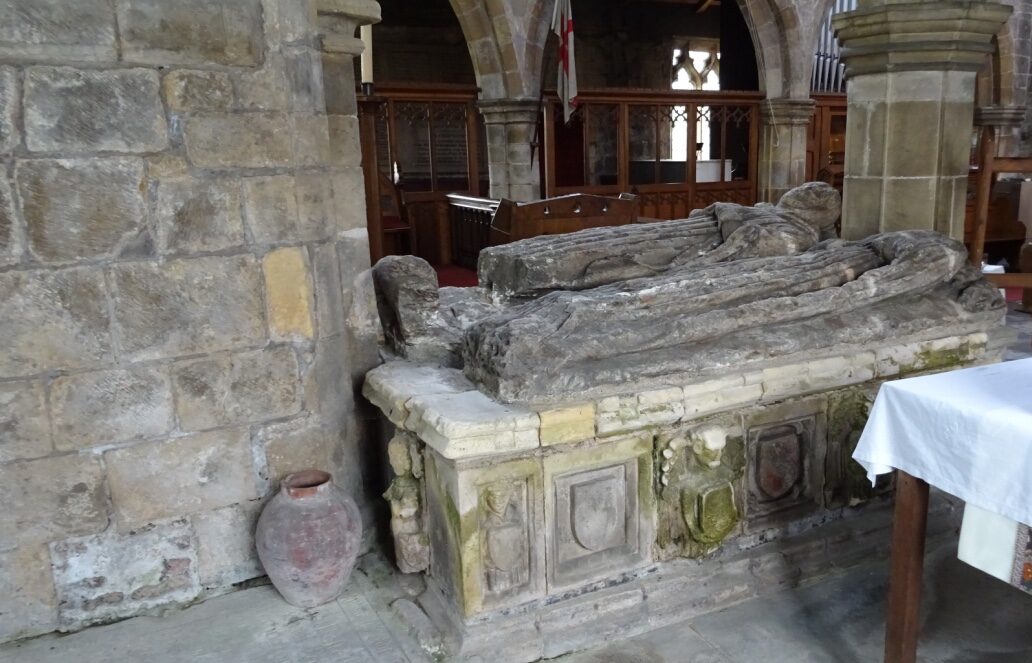
Portington tomb in Eastrington church
The Judge’s sons
- John Portington
He was the son of Lady Margaret. John died without producing an heir, after marrying Margery, daughter of Sir William Armyne.
- Thomas Portington
He was the son of the Judge’s third wife. He studied at Cambridge and then entered the church.His career was helped by his father’s patronage and the services he performed for the Durham bishopric. Thomas Portington was Provost at Hemingbrough, rector of Goodmanham and Treasurer of York Minster from 1477 until his death in 1485.
When Edward Saltmarshe, a member of the nearby Howdenshire family and relation of Thomas by marriage died in October 1481, he made his will `In a certain lofty room in the house of the venerable man Master Thomas Portington, master of arts and treasurer of the cathedral church at York, situate within the close of the said Cathedral church’.
Also in 1481 Thomas Portington obtained special permission from the Archbishop of York for the holding of divine services in the private chapel at Portington, for the benefit of himself, his brother Richard and Richard’s wife, Julian. When Thomas died in 1485 he was buried at Shitlington where he was rector.
- Richard Portington
Portington then passed to Richard, the Judge’s fourth son. Richard Portington had married Julian Lesley [ or Leslie]. She was the heiress of Sir Thomas Lesley of Felton in Northumberland and of Sawcliffe in Lincolnshire. Sawcliffe, brought into the ownership of the Portingtons by Julian Portington, is four miles north of Scunthorpe and exists today only as a single farm. The farmhouse stands on ancient foundations and it was here that the house stood which became the home of the head of the Portington family for several generations. Richard Portington died in 1509.
The family in the 16th century
Richard’s son John succeeded him. He was the eldest of 6 children, several of whom married into Lincolnshire families which suggests that the Portington family was then living at Sawcliffe.
John himself married the daughter of Giles Foster. Their eldest son, Thomas, married first Julian Aske of Aughton.She was the daughter of John Aske, elder brother of Robert Aske who later became the leader of the Pilgrimage of Grace.
He too appears to have made his home at Sawcliffe. He had become the High Sheriff of Lincolnshire by 1528 and was taken and held captive by the rebels in 1536. He later served on the grand jury which brought in a true bill against the ringleaders of the Lincolnshire rebellion. He later married Anne Ayscough. He died in 1540.
Henry Portington
The next head of the family was Henry Portington, eldest son of Thomas’ 12 children. He married Matilda [ Maude], daughter of Sir Robert Tyrwhit.
John Portington thus became head of the family in 1560. He married Anne Langton, daughter of John Langton of Langton.They had seven children. John died in December 1579.
Joan Portington
He names as one of his executors ‘my son -in-law Michael Wharton, gent’. His daughter, Joan had married Michael Warton [1] before 1572/3 when their eldest son, also Michael [2] was born.
Michael [1] was the son of Laurence Warton and Agnes Yarborough
Michael Warton[1] died in April 1590. In his will he left a gelding to Thomas Portington.
Joan Warton remarried, to Ralph Rokeby of Lincoln’s Inn and died in 1608.
Anne Portington, John’s widow, remarried. Her second husband was Edward Skerne of Bonby in Lincolnshire.They lived at Portington. In 1584 when a visitation was made Edward Skerne styled himself as ‘of Portington’. He died in 1591
Thomas Portington was the eldest of at least seven children and although he appeared to have inherited property from his father he was in financial difficulties soon after his father’s death.
Perhaps because his father had left legacies to provide for Thomas’ sisters and for his widow
Michael Warton, his brother in law acquired from him land in Adlingfleet and Ousefleet [1583], the manor of Reighton and part of Speeton [1586] and the manor of Eastrington als Spens with 200 acres in Thorpe, Belby and Howden in 1588
After Michael Warton’s death Thomas sold even more property, to his ‘new’ brother in law Ralph Rokeby. In 1591 and again in 1594 he transferred the titles to land at Portington to Edward Holbeche and Ralph Rokeby. These land transfers included not only the titles to several cottages and 60 acres of land around Portington but the Portington windmill and the manor itself in 1594 [ to Holbeche]
The Portingtons also held the title of lords of the manor of Eastrington [ via Thomas’ sister Ursula Portington who had married Alex Vavasour]
The 17th century
Thomas Portington had married Elizabeth Skipwith, daughter of Sir William Skipwith of Ormesby. They had the following children: Henry [ christened 1595 at Sawcliffe], John, Anne, Elizabeth, Frances and Ursula [ was Ursula dau of John or Thomas]
Henry Portington
He was 17 in 1612. He married and had a daughter, Joan who died as an infant. He himself died in 1625 and was buried at Eastrington on 27th May. He was succeeded as head of the family by his uncle Michael.
Michael Portington 1
Michael Portington married Ann, daughter of Edward Beaumont of Carlton on 7 April 1597 at Eastrington.
He died in Nov 1631 and was buried at Eastrington on 7th November.
Michael Portington 2
Michael Portington 2, was baptised 4th Aug 1605. He married Dorothy, daughter of George Wentworth
They had sons Michael [born 1628] and John [born 1632] but both died young. Henry, the eventual heir was born in July 1631. There were also two daughters, Dorothy and Mary.
Michael fought for the king but had died before the Portington estate was sequestered. He was buried at St Dennis church, York 1st July 1644. He had been lord of the manor of Eastrington
Henry Portington
The heir was Henry Portington, aged 13, who would inherit the manor of Portington on the death of his mother, Dorothy Portington.
Thomas Wentworth [his uncle?] was the guardian of Henry Portington who petitioned the Puritan government on his behalf. Henry had to pay a fine of one sixth the value of the property, a sum of £140 [this makes the property worth £840]. It had been paid by paid by 1651.
Portington hall
Sir Harold Wilberforce Bell who lived in Portington hall in the mid 20th century believed that the present Portington Hall was built by Thomas Portington in 1582 and that about the same time Sawcliffe too was rebuilt, the two houses, he said, being similar in style.
The new hall replaced the family manor house of the 13th century, which stood within a moat. The moat still survives, to the south west of the present hall but the original manor house was demolished at the end of the 19th century.
The new hall was built in the Elizabethan style, in a rough `E’ shape. The main range was flanked by two wings and the centre of the `E’ was formed by the porch which was originally higher than it is today. Much of the detail of the hall was lost in the 19th century when panelling, fireplaces and the main staircase were removed.
However it seems Sir Harold was not correct and that it was Henry Portington who built the present hall since, in 1672 when a tax was put on the number of hearths a house had, the Portington returns include the entry ‘Henry Portington 9 hearths, 7 ‘for his old house’. This suggests that the present hall was built in the time of Charles II.
The last of the ‘Portington’ Portingtons
Henry died in 1679 [aged 48]. Administration was granted to his widow Elizabeth who was appointed guardian of his children Grace, Michael [ b 1664], Anne, John, Henry, Dorothy and Jane
In 1682 the Eastrington parish registers record the burial of Elizabeth Portington of Portington, Henry’s widow. As she was not buried in wool as specified by act of parliament [an act passed in 1680 which specified that woollen shrouds should be used in order to help the ailing woollen industry.] It was recorded in the register that `money was paid to the poor according to the forfeiture approved by act of parlt’.
Henry’s son, another Michael, was the last of the Portingtons to live at Portington. He died in 1696 and his tombstone lies in the family chapel in Eastrington church. It is re-used [a palimpsest] and originally commemorated a member of the Bosville family of Caville.
The inscription now carved on it reads:
‘Here resteth the body of Michael Portington of Portington esq who married Barbara, the second daughter of Garvis Nevill, esq, departed this life without issue the 17th of March in the 32nd year of his age, Ano dni 1696′.
Who owned Portington next?
The answer to this question is not at all straightforward as both Eastrington and Portington were owned by several different families.
Ursula Portington, the daughter of Thomas, had married Alexander Vavasour of nearby Spaldington and thus the title of lord of the manor of Eastrington, held by the Vavasours passed into the Portington family.
After the death of Michael Portington the ownership of part of Portington now passed to the Warton family of Beverley. This was as a result of the marriage of Joan Portington and Michael Warton in the late 16th century. This is why when part of Eastrington church chancel collapsed in 1632 a plaque tells us that Michael Warton repaired it.
The male line of the Wartons subsequently died out and a portion of Portington [probably where the Grange is now] descended, via Mary Warton’s marriage to Sir James Pennyman in 1692 to the Pennyman family.
The Pennyman family owned parts of Eastrington and of Portington until 1770 when Mary’s son, Sir Warton Pennyman died.
But the manor of Portington itself was owned in three parts. Two thirds were owned by William Burton who built Hotham Hall in the 1720s and one third by the Bell family [through Ann Johnson who had married Richard Bell and lived in Kirkella. The family tree thereafter is hard to trace.
Additions to the hall
In 1753 Richard and Ann settled the Portington property on Thomas Bell, who was possibly Richard’s brother. In 1759, Thomas agreed a division of the manor with William Burton, securing the part of the estate which included the hall, and it may have been soon after this that he added the north wing and refitted the interior.
It is not certain but this may have been theThomas Bell of Kingston upon Hull, gentleman who died in 1773 leaving his son Richard his heir with large bequests to his daughter Ann.
The origins of Henry Bell of Portington
Portington eventually passed to [did he buy it?] Henry Bell (1730-1816). I cannot connect the various Bell families together but I do know that Henry born c1730 was born at Lincoln Flats near Bubwith and was the son of another Henry. This Henry in 1714 had married Mary Dales, granddaughter of John Dales of Beverley Parks and was described as the younger son of Thomas Bell. The settlement talks of the tithes of Kilnwick.
In 1741 the Yorkshire poll book for Bubwith parish lists at Sparrington [the old name for Spaldington] Henry Bell whose freehold property was at Kildwick le Woulds.
In 1744 Henry Bell, yeoman along with his married daughters Jane and Elizabeth leased his tithes at Kilnwick. These were part of the marriage settlement when he married his late wife Mary.
He married again to Jane who was the mother of Henry b 1730. She died in 1760. Within the year Henry’s wife the former Jane Blanshard died in 1761. Both were buried at Howden.
Henry Bell of Portington 1730 to 1816
Henry Bell first married Jane Blanshard of Thorpe in 1755. They had two daughters, Elizabeth, who married George Blanshard of Breighton and Margaret who married Thomas Surr of Newland, near Eastrington.
On his first wife’s death Henry married again, the former Mary Guy of Spaldington. They had a daughter, Ann who married Samuel King of Hull and three sons; Henry [1767], Thomas [1770] and John [1772].
Both Henry and Mary Bell were keen followers of the teachings of John Wesley. In fact tradition held that John Wesley stayed the night [his last in Yorkshire], at Portington on 29th June 1790. Wesley was 88 then and died in March the following year. He was certainly in the area at the end of June, preaching in Hull on Friday 25th and celebrated his 88th birthday on Monday 28th June. On 29th he wrote that he `crossed over through Epworth to Owston‘ and so could have been at Portington in the interim but it is not mentioned in his diary.
He did not return to Yorkshire before his death. It was also said that Henry Bell’s son John travelled with Wesley. Mrs Bell gave land for the building of Howden’s first Wesleyan chapel in 1786.
She died in 1813, aged 77 and her husband in 1816, aged 86. They were both buried in the Portington chapel of Eastrington church, although there was said to be some local opposition to this at the time.
A memorial tablet on the North wall of the chapel records that Henry Bell and his second wife Mary `were both of them friends and followers of the late John Wesley and participated with him in sincere attachment to the church of their fathers, rejoicing to see the revival of those great doctrines of the Reformation, which in their early years had almost sunk into oblivion‘.
It is also interesting to note that the tablet records that the three sons of Henry Bell `succeeded him in the manor and estate of Portington in this parish to which estate pertain the maintenance and repair of the northern part of this chancel and the right of sepulture within it‘.
In his will Henry Bell left his property divided between his two surviving sons, John and Henry and to Mary Bell, the widow of his son Thomas Bell, who had died in 1807 aged only 36.
In his bequest to John he included not only ‘the house where he now dwells with outbuildings and garth’ but `also my messuage or dwelling house called the Old Hall with the homestead belonging thereto, my Old Orchard and the cottage called Kettlestrings House with the orchard and croft.. ……..
And I do particularly request that he, my said son John, his heirs and assigns will permit and suffer the people called Methodists to use the preaching House at Portington late Kettlestrings Barn as and for a schoolhouse and place of public worship’.
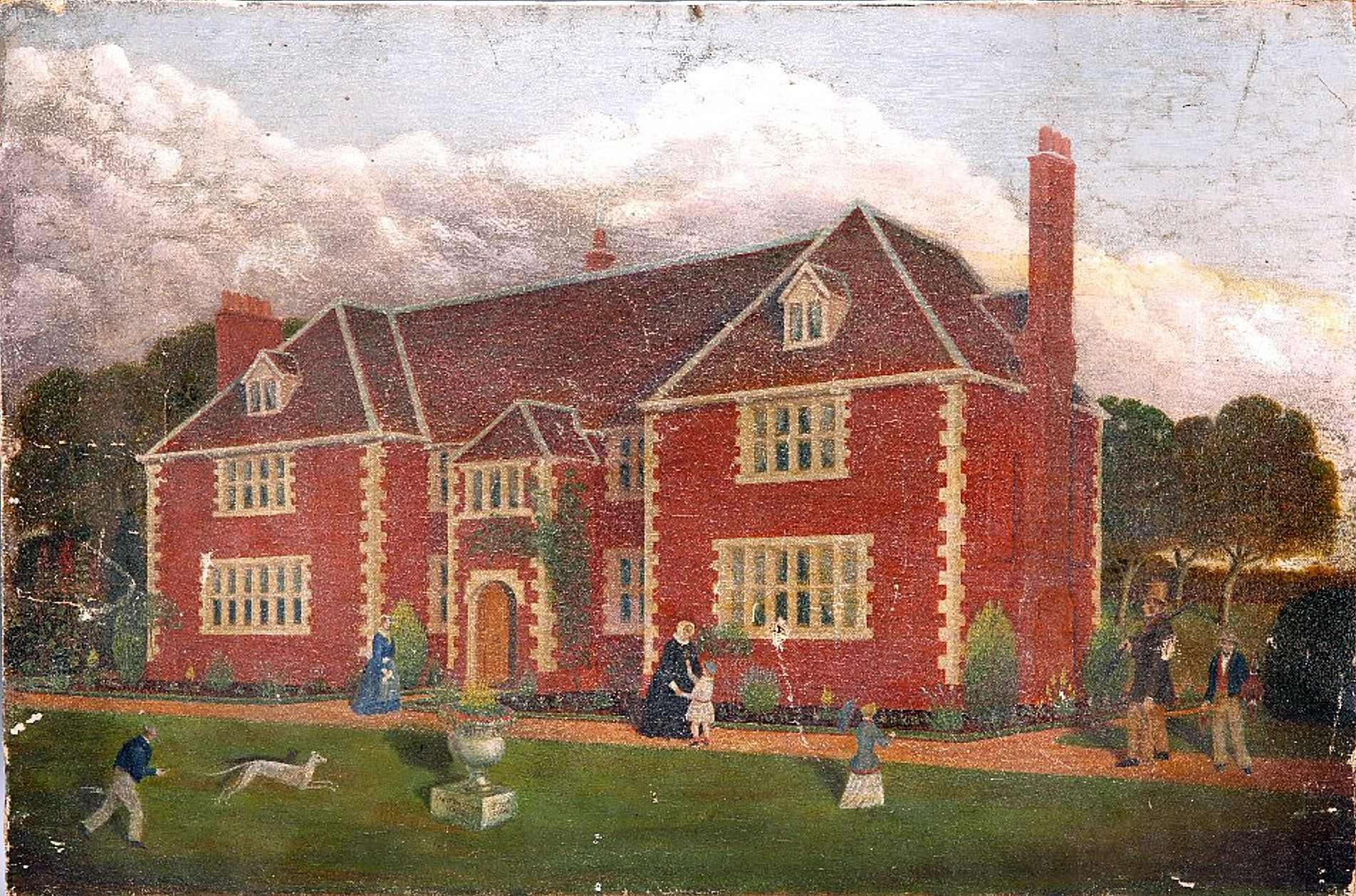
This ‘ naive painting of the hall probably dates from the early nineteenth century
The Bell family
The next generations of the Bell family had various problems and by mid century the family, while still living locally were not at Portington.
Henry Bell [2] 1767- 1839
Henry, the eldest of the three Bell sons lived at Portington Grange [he possibly built it] died in 1839 aged 71. He was ‘a Christian Minister and Methodist’. His wife, Eleanor, was the daughter of Edward Wade of Sturton Grange. She died in Oct 1851 aged 84.
His obituary tells us
‘Henry was born at Spaldington in the year 1767. He was first placed under the tuition of a Methodist named Mr. Paul Andrew; however, he later was ‘removed to the care of … Rev. Joseph Milner of Hull, by the particular desire of his mother, who was very anxious that he might have such an education as would prepare him for the ministry in the established Church’. This did not work out well because Henry wasn’t interested in religion at the time.
Therefore, instead of entering him into the clergy, Henry’s father, having purchased ‘the village and estate of Portington, took him home to assist in his enlarged agricultural pursuits’. At this point Henry was around 18 years old, putting the year around 1785. Henry was sent to live with his sister Ann and took on the ‘management of the farm at Spaldington-outsides, from which his father had removed to his estate at Portington’.
In the year 1785 Henry ‘accidentally went into the Wesleyan chapel in Manor-alley’, Hull and experienced a religious conversion to Methodism upon hearing the sermon of Rev. Robert Johnson. On 29 Feb 1792, Henry married Eleanor Wade at Aberford (just east of Leeds). Eleanor was the ‘third daughter of … Mr. and Mrs. Wade of Stourton-Grange’ near Leeds who were also keen Methodists. Henry ‘became actively engaged in conducting various meetings, which were established for social prayer in the neighbourhood; and had often at these seasons to endure the hootings of a turbulent rabble, and sometimes to run the risk of personal injury’. In this period Methodism was opposed by many.
Henry was remembered as being a man of great kindness, ‘tempered by prudence and judgment’ and ‘had an established name for wisdom and equity’. He was a Methodist Class Leader for nearly fifty years and would often go walking among his fields ‘so that he might there hold communion with his God’. Henry also acted as a Local Preacher for around fifty years and frequently gave sermons in his own and adjoining Methodist Circuits, as well as ‘in more distant places’. He did good publicly but apparently ‘much of his benevolence was performed in secret’, visiting the sick and helping the needy.
He stood high in the estimation of the neighbourhood ‘as a skilful and experienced agriculturalist; and his farm exhibited a pattern of neatness and exact cultivation. He was frequently employed in matters of arbitration, and in the valuation of the various kinds of agricultural produce’ and seems to have been highly regarded for his integrity.
In 1829, whilst visiting his nephew the Rev. John King of Hull, Henry ‘fell the height of twelve feet into the kitchen area’ during the ‘darkness of the evening’. ‘The immediate consequences were not serious’ and Henry was able to continue with his farm business and religious work – however, the article records that ‘the foundation … of the disease from which he so long suffered was undoubtedly then laid’. Around two years after his fall, his memory began to fail, to the distress of his family. Eventually he suffered a further attack, having gone ‘as usual, into the fields; and returned speechless’. He could not speak again after this point and ‘epileptic fits now followed in frequent succession; and about a year before his death, he became unable to walk, even with assistance’. The obituary of Henry’s daughter, Mrs Helen Leak, gives a harrowing first-hand account of how terrible this period was for the family and also describing the tragic death of her sister Margaret during this time.
Henry Bell died after his long illness on 3 Feb 1839, aged 72, the only witness being ‘his faithful servant, Elizabeth’. His headstone describes him as ‘Henry Bell of Portington Grange, Esq.’. We know that at some point he had moved from running the family’s old Spaldington farm into the “Grange” farmhouse at Portington (his father being resident at Portington Hall until his death in 1816).
Their son, Henry Wade Bell, also of Portington Grange and later of Caville Hall died in 1855 aged 62.
Two of their grand-daughters, Mary Ann Thorp died aged 14 on Feb 12th 1843 and her sister Ellen Maria Thorp, died on Mar 5 1844 aged 20.
By 1856 Thomas Bell was living at Caville Hall, the son of Henry Wade Bell and Eleanor Bell. He was born 1829 and died in 1912
Thomas Bell 1771-1807
Thomas Bell was Henry Bell’s second son and died in 1807. He married Mary Smith, eldest daughter of James and Ann Smith of Temple near Birkin. She died in June 1849 at Morley at the home of her daughter Jane and was survived by 2 sons and 3 daughters out of 8 children.
A plaque in Eastrington church reads
Sacred to the memory of / THOMAS BELL of Portington / who departed this life March 21st 1807 / aged 36 / He was the second son of HENRY and MARY BELL of Portington / Grange and like his parents was a consistent member of the Religious Society, Established by JOHN WESLEY. His character / was marked by piety, urbanity and kindness which secured / him the esteem of his contemporaries: who after a lapse of / forty two years, still cherish his memory with respect / Here also lie the remains of / MARY BELL / his wife who died June 10th 1849, aged 79 / She was the eldest daughter of JAMES and ANN SMITH of Temple in the Parish of Birkin near Selby and was a Wesleyan Methodist / of no common piety. Through a protracted life, she directed / the ardent energies of a strong and cultivated mind to the / moral, religious and intellectual welfare of others / hence her influence remains / and “She being dead yet speaketh” / THOMAS and MARY BELL were the parents of eight children / JAMES BELL, their eldest son, died at Temple Decr 2nd 1836 / aged 40 years, and was interred at Haddlesey Chapel in the / Parish of Birkin. The ashes of two infants slumber in this place / Two sons and three daughters still survive to bless their / parents memory, and erect this tribute / to their worth.
John Bell 1772-1843
John Bell was, according to his memorial in Eastrington church, ‘a member of the Methodist society from the age of fourteen to the end of his life’.
His memorial in Eastrington church reads
To the memory of / JOHN BELL / of Portington, Esq., who died / Octr 17th 1843 aged 71 / He was the third son of HENRY BELL / of Portington, Esq. / and MARY his second wife / He married MARY ANN daughter of WM. BAXTER / Esq., of Owstwick in this County by whom he had / six children, three sons and three daughters of / whom one daughter and one son preceded him / to the grave namely HANNAH the youngest / who was married to the Rev JAMES TREVITT and / who died Feby 6th 1840 aged 26 years and was / buried at Skeffington in Leicestershire and / JOHN the oldest who died October 3rd 1842 aged 44 / and was interred at Misson in Nottinghamshire / the rest survive him / He was a member of the Methodist Society from / the age of fourteen and to the end of his life / In the prime of earliest youth / Wisely he left the broad way and the green / And with those few was eminently seen / Who labour up the hill of heavenly truth / He laboured with zeal and diligence to sow in / the minds of others those seeds of piety which / had flourished in his own and having been the / means of turning many to righteousness / during a long and active life, he derived in / the hours of weakness and suffering, strong / consolation from those truths which he had / steadfastly believed and faithfully declared / Also of the above named MARY ANN / who after a life of sincere piety / departed this life in peace / August 5th 1856, aged 76 years.
He and his family lived at Portington Hall. He was also a commissioner and surveyor of enclosures. These included the enclosure of Blacktoft, Hive and Gilberdyke [act 1830, award 1833]
With the death of John Bell, Portington now passed to William Henry Bell, John’s second son, who was born in 1802. In 1833 he married Jane Wilberfoss of Wetwang. He had a house at Drypool [part of Hull] and lived there as well as at Portington [where his mother lived]. He and Jane had three sons, Frederick, Albert and Harold, the last of whom was born in 1849. All three sons had their mother’s maiden name Wilberfosse as a second name but in adulthood Harold by deed poll took the name Wilberforce as an additional surname and became known as Harold Wilberforce Bell.
However William Henry died in 1852 . Mrs Mary Ann Bell, John’s widow, aged 71 was living at the hall in 1851. She died 4 years later in 1856.
William Henry was in severe financial difficulties when he died, partly because he was a great supporter of the Polish cause. The following notice appeared in the Hull newspapers
THE CASE OF MRS. W. H. BELL. The attention of the Public is respectfully called to the peculiarly distressing circumstances in which the Widow of the late Mr. W. H. Bell has been left, in consequence of the death of her Husband, and the involved state of his affairs. She has Six Children dependent upon her, with only Twenty Pounds per Annum for their support. A list of Subscribers now lies at the Bank of Messrs. Pease and Liddells, and any subscriptions will be thankfully received by them, or B. M. Jalland, Esq., the Rev. JOhn King, or Mr. John Ostler, High-street.
She and her children were later living in Driffield.
So although Captain Harold as he later became, said he lived there as a child it can only have been for a brief time. More of the [Wilberforce] Bell family later.
Edward Sale Bell, John’s third son, lived at Burland and died in 1875.
He married Mary Ann Bains in 1837.
Mary Ann was the daughter of Charles and Mary Ann Bains. There is a memorial to her parents on the wall of Newport chapel. It reads as follows:
This tablet is erected to the memory of Mr Charles Bains of this place whose mortal remains are here interred. He spent his life in the service of his country being for many years quarter master of the Royal Horse Artillery. He distinguished himself in all the successive campaigns in which the armies of this country were engaged from 1791 to the General Peace in 1816. He was born near Aberdeen and retired after the war to spend the evening of his days in this place where he died on the 23rd September 1838 in the 68th year of his age, distinguished as much by the piety and benevolence of his deportment in peace as by his merit and bravery in war. Therefore be ye also ready for in such an hour as ye think not the Son of man cometh. Also Mary Ann wife of the above Charles Bains who died July 10th 1840 aged 62 years. Her end was peace.
Portington in the mid nineteenth century
I have tried to work out who was living in the three main Portington farms as well as the old and new halls after this but it is not easy. And of course several families were living in cottages and working on the farms. But so far…
Portington Hall
In 1841 John Bell and his wife Mary Ann were there with servants. John was described as a farmer. He died in 1843
In 1851 Mary Ann Bell was there with a visitor and a servant.
William Henry Bell , son of John and Mary Ann died in 1852 and the hall was sold. What was the ‘old hall’ across the road seems to have been thereafter known as the Manor Farm.
In September 1866 the death was reported of John Dunn, Esq., of Portington Hall. John was a member of a prominent Howden family.
In 1884 at York, Walter Freeman, of Bilton Court, near Knaresborough, married Mary, only surviving daughter of the late Joshua Dunn, of Portington Hall – Joshua was John’s brother.
In 1871 census Portington hall was occupied by the splendidly named Barnabas Penrose Smith, antiquarian born at Airmyn aged 48 and his wife Emma. He was the father of Harry Smith who owned Portington Grange. He died in 1881.
By the mid 1880s Portington hall was to let.
Henry Liversidge
TO LET, PORTINGTON HALL. near Howden, five minutes from Eastrington Station. Large and well-stocked Garden, Greenhouse and Fishpond; Stables and Coach house Paddock and Lodge.—Apply to Wm. Liversidge and Sons, Selby.
It became home to Henry Liversidge who in 1887 married Alice Goodson. Their daughter Kathleen was born at Portington in 1888. A second daughter Alice Portington was born in 1889 but died aged 10 months. A son Robert was born in 1892 in York and a daughter Dorothy in 1894.
1891 the hall was empty apart from a cook.
In 1901 John Vigar Frost and his wife were living in the hall. Their son George was at Grove Farm [ more of them later].
It seems that although the Liversidge family did not live in the hall Henry still had events there.
So in 1908 we read
What promises to be a very successful undertaking was inaugurated on Zmd.y afternoon, at Portington, near Howden, when coal-boring operations were formally commenced, the machinery being set in motion by Mrs. Dibb, wife of the Rev. A. W. Dibb, vicar of Eastrington, in the presence of a large number of the people of the district and others interested. The boring machinery has been set to work in the grounds of Portington Hall, the propertyof Mr. Henry Liversidge, jun., York. Work bas been commenced as the result of indications of coal having been discovered in the district. Some years ago, when Mr. Liversidge was in residence at Portington Hall, he discovered coal while looking for water on the estate, and since then mining engineers have continually recommended that boring sbould be commenced. In association with & number of gentlemen interested in such ventures, Mr. Liversidge has now been able to start boring operations. A company bas been formed, named the East Riding Coal Boring Syndicate, of which Mr. Liversidge is chairman, and a contract has been entered into with the New Calyx Drill and Boring Company, London, to bore a depth, of 600 feet. Mining engineers have great of the enterprise, there being many indications of the presence of coal at no great depth. Black shale has been found in an old well in the gardens of Portington Hall at a depth of forty feet.
And the following year we read
Aug 1909
MAGISTRATE FINED. AND EASTRINGTON INCENSED.
Mr Henry Liversidge, jun., well known West Riding Justice of the Peace, of Portington Hal], near Howden, was charged with being drunk in charge of horse at Eastrington. Mr Mellor, appeared for the defence. P.C. Long was on duty in Eastrington on June 22nd, with P.C. Spriggs. They were on the road leading to the N.E.R. station, when their attention was drawn to defendant, who was mounted on a horse. He was in the middle of the road, trying to get his horse to move. He reeled and nearly fell off the horse. He righted himself again, but reeled once more, and eventually Mr Kirkwood assisted him further up the road. The Clerk: He did not fall off? —No sir. Defendant proceeded as far as the parish room, where he sat for some time —from five to ten minutes—and he kept reeling nearly on to the ground. Subsequently he dropped off the horse into a hedge bottom. Corroborative evidence was given by P.C. Spriggs. The defence was a total denial of charge, which Mr Mellor characterised as a cruel one. Liversidge had been entertaining the village cricket team in connection with the feast, and, being tired, rode a spirited mare, which, becoming restive, threw him. Nine witnesses were called and spoke of Mr Liversidge’s sobriety, and several said there was not the slightest foundation for the suggestion that he was drunk. The magistrates, after two hours’ hearing, considered that the officer could not have been mistaken in what he had seen, and that evidence of the prosecution had not been shaken. Defendant was fined 10s and costs. Mr Meller intimated that would be an appeal.
VILLAGERS PROTEST. An unusual scene was witnessed at Eastrington at night, when the villagers and residents of the district turned out on the green to show their sympathy with the Squire of Portington. There a was large attendance, which showed the popularity of Mr Liversidge, and the following resolution was adopted: That, in the opinion of the inhabitants this district, the verdict of the magistrates of Howden is unjust, and they wish to tell Mr Liversidge of their confidence and respect. And, further, that the action of the magistrates is unjustifiable on the evidence, and they hope that he will continue occupy the position he holds for the good of the district.
Around the same in 1909 time a report appeared of an unusual service at the Hall
The fine old mansion of Portington, known locally as ‘ the Hall’ never looked better than on the evening of Sunday, the 9th after Trinity., Typically English, both in iteelf and in its surroundings, and environed as it is with prosperous farmsteads and comfortable cottages, the whole embowered by tall and superbly-proportioned timber, it appeared a picture once common enough in Merrie England, but now, alas, growing more and more rare. And to give a setting to this picture on this balmy summer evening, there were gathered on the grass’of the lawn about 300 of the tenantry and villagers of the vicinity.
The purpose and occasion of the event were unique—the vicariate of the neighbouring village of Eastrington being vacant owing to the lamentable decease of the Rev. L. S. Calvert, the Anglican worshippers hereabouts were in somewhat of a quandary as to how and where they should assemble together for praise and worship as had been the custom and wont both of themselves and their forebears from time immemorial.
In the dilemma a suggestion was, it appears, made to the local squire of Portington—Captain Henry Liversidge—who at once acted upon it and issued an open invitation to all and sundry to assemble for public worship at bis residence, and as no ordained clergyman was available, he announced that he himself would give an address ‘* On Life.”
On my arrival the service had commenced, and the scene that presented itself to my view was such as I described above. Beyond a small reading desk, plainly yet tastefully draped, also a small organ, there was nothing to suggest the motive of the gathering, and yet the service, though simple, was beautiful in its simplicity. Mr. R. P. Jones, of Howden, read the chosen lessons whilst the service proper was taken by Captain Liversidge. The hymns were accompanied by the Gilberdyke Brass Band, The address, which occupied nearly halfan hour, was followed with interest. The service was brought to a close by the singing of another hymn, followed by the Benediction. To the observant stranger two things were obvious. First, that the dominant note at this service was one of reverence, and secondly, that the attitude of the villagers towards Captain Liversidge is one of respect and friendship.
But only two years later Henry [Harry] Liversidge died in Nice. His obituary in the Selby newspaper was unsparing in its view of his character.
News reached Selby this m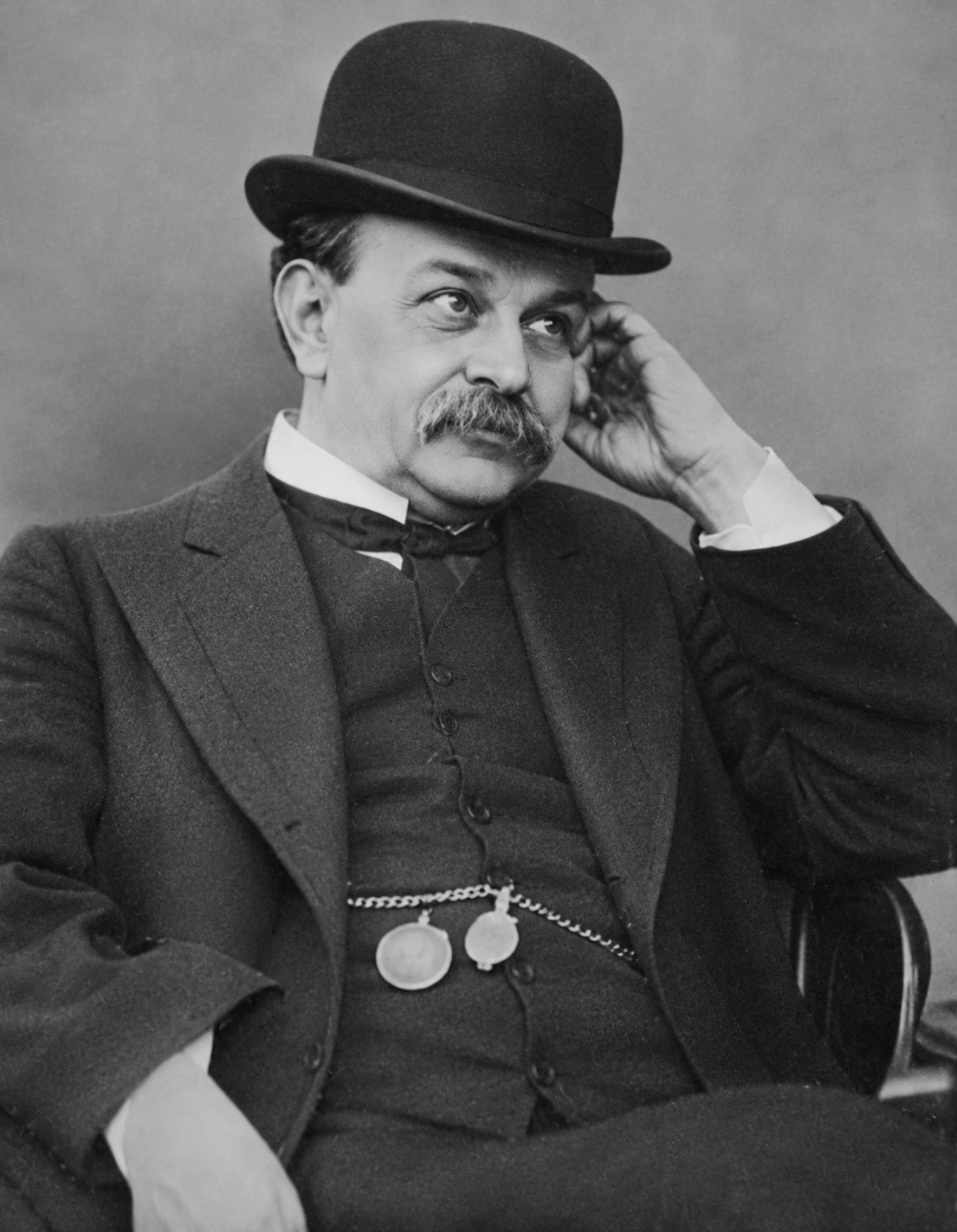 orning by telegram, of the death in the South of France of Mr. Henry Liversidge, of Portington Hall, near Howden. Mr Liversidge, who was the only son of the late Mr H Liversidge, of Eversley Garth, Sherburn in Elmet, was about 48 years of age, and was educated at Wesley College, Sheffield, his father being a leading member of the Methodist body in the Selby circuit. When quite young, Mr. H. Liversidge was taken into partnership with uncles, the firm being Liversidge and Sons, merchants, of Selby and made a Justice of the Peace for the West Riding. He was a notable public advocate of bi-metallism.
A fortnight ago, Mr. Liversidge went on the continent and while there he was taken ill with haemorrage of the lungs, and died. He leaves.a widow and family.
At one time he was spoken of the Parliamentary candidate for Barkston Ash. He was a county councillor. Perhaps his greatest achievement was the the light railway which eventually served the villages of Wistow Cawood, and has been of great benefit to the residents of that district. On the occasion of the opening he was presented by the inhabitants with silver plate in appreciation of his services. | His last public anpearance in the district was at the official inquiry into question of a water supply at Howden.
Mr Liversidge has for long been one of the best known people in the district in which he lived. There were great potentialities for good in his nature but there were cross currents in his life that defeated his leanings towards a career of usefulness
At one time for example he was a popular speaker at agriculture gatherings and had he showed greater powers of concentration he might creditably have entered public life. But various escapades made people refuse to take him seriously – his eccentricities included some open air services in the grounds of Portington hall at which he officiated in cassock and surplice.
After the Liversidges
Portington hall had several owners/tenants after the death of Henry Liversidge.
I have found a record of George Hall buying the ‘old hall’ in 1920 and his widow selling it in 1925. I think that this was in fact the present hall.
George Arthur Hall
George Arthur Hall of Hull bought what was described as the Old Hall in 1920. On his death in 1925 his widow put the hall up for sale. It was described as
DELIGHTFUL OLD-WORLD RESIDENCE of historical associations, pleasantly situated amid picturesque surroundings and secluded fine trees.. The House has a pleasing brick and stone elevation, approached by a carriage drive, and comprises:—Entrance Hall, Dining, Drawing, and Morning Room-, Principal Bedrooms, Servant’s Bedroom, Bathroom, Lavatory and w.c, and 2 Attics. The Domestic Offices consist, 2 Kitchens, etc. The delightfully wooded grounds are a special feature of the property and are tastefully arranged with lawns flower beds paddock and gardens, Etc., comprising in all an area about four acres. There is a useful range of Stabling and good gardener’s cottage. The House is centrally heated and compactly arranged for easy working.
In 1926 Portington hall was bought by Major Percy F. Wilberforce-Bell M.C., formerly of the Queen’s Own Royal West Kent Regiment, and later Military Secretary and A D.C. to the Governor of Newfoundland. But he and his wife did not live there and it continued to be occupied by tenants, including Mrs Byrom.
The report of the death of Captain Harold Wilberforce Bell in 1927 explains the family connection. At some point Major Percy transferred ownership to his brother Harold.
1927 There recently passed away at Windsor, at the age of 78, Captain Harold Wilberforce-Bell, Military Knight of Windsor, and formerly of the 1oth The King’s Hussars. Captain Wilberforce-Bell came of family formerly well-known in Hull and tho neighbourhood, formed indeed a link between two centuries of history. He came of a stock distinguished for their piety, as the memorials testify upon the walls of Eastrington Church, for the Bell family were formerly Lords of the Manors of Portington and Eastrington, where they succeeded tho ancient family of Portington; and Captain Wilberforce-Bell’s father, William Henry Bell, of Southcott House, Hull, was the second son of John Bell, Esquire, of Portington. His mother was Jane, daughter of Mr Thomas Wilberfoss, of Wetwang House who was descended from William Wilberforce, the Emancipator.
Captain Wilberforce-Bell’s greatgrandfather, Henry Bell, Squire of Portington, was a personal friend of John Wesley, and it was in his coach that the famous reformer went from Hull to Epworth, on June 27th, 1790, on the completion of what was to prove his last tour in Yorkshire. Born in 1849, Captain Wilberforce- Bell was only about 4 years old when his father died Hull. But in after years he liked to recall his connection with that unhappy European event, the partition of Poland, for his father was a staunch supporter of the Polish cause. When travelling in France and Spain in the ‘thirties of last century, William Henry Bell had met many refugees from the tyranny imposed upon the Polish nation, and when he returned to England he closely identified himself with Lord Dudley-Coutts-Stewart, and was one of the original founders of the Polish Society. He was instrumental in establishing a branch of tho Society at Hull, where he kept practically open house for Polish officers and other refugees, and afforded them much financial and other assistance.
Both Captain Wilberforce-Bell and his sister, who died only two months before her brother, remembered meeting some of these Polish emigres. But the cause so warmly exposed was already a lost one, and Poland had to wait for its independence again until nearly 100 years had elapsed. While Captain Wilberforce-Bell was yet a child his father died, and it was found that his generosity had involved him in serious financial difficulties.
Portington Hall and estate were sold, but the generosity of friends softened the blow which had fallen upon the family and many belongings were saved. Captain Wilberforce-Bell enlisted in the 1oth The King’s Hussars, and shortly afterwards embarked for India. Nine years later took part in the second Afghan war, when he was in General Sir Donald Stewart’s personal escort. The campaign over he proceeded with his regiment to South Africa, where he was in time for the disastrous Boer War of 1881-82. Returning to England he married in 1884, at St. Mary Abbotts, Kensington, Lucy, daughter of the late Reverend Frederic Wilson, D.D., Vicar of Sledmere, Yorkshire.
On his retirement from the army he settled at Grafton, in Wiltshire, but in 1919, on being appointed by His Majesty a Military Knight of Windsor, he took residence in Windsor Castle, where he died on August 22nd last. A lover of St. George’s Chapel and all that pertained to its beauty and associations were a never-failing source of joy to him.
He was buried at Windsor. Captain Wilberforce-Bell is survived by his widow and four his six children. Of his three sons, the eldest, Major Harold Wilberforce-Bell, formerly of The Connaught Rangers, is now in the Foreign and Political Department of tho Government of India the second, Reginald Herbert Wilberforce Bell an officer in the 105 th Canadian Fusiliers, was blown up by an enemy mine at Ypres in 1915, and died in England shortly afterwards in 1916; while third is Major Percy F. Wilberforce-Bell. Of the two surviving daughters the younger is the wife of Major J. N. Chaworth-Musters, D.S.O., of Annesley Park, Nottingham.
Sir Harold Wilberforce Bell
Sir Harold had a distinguished career in India before returning to England in June 1939. He and his wife were active in local government, charitable work and he wrote a well researched history of Eastrington church.
In the 1940s the Archbishop of York carried out an exorcism in the hall as Lady Wilberforce Bell believed there was the ghost of a lady in the hall. A later owner, Mrs Joan Davies said that she too had seen a white lady.
Sir Harold died in 1956 He left his malacca cane bearing the gold inscription of Henry Bell ‘once the property of John Wesley’ to his brother Percy His oak chair “reputed to be the Council chair of the Emperor Charles V of Spain and first Emperor of the Holy Roman Empire to his friend Lord Middleton of Birdsall House Malton expressing the wish that on the death of the Lord Middleton the chair should pass to the University College Hull to known as the President’s Chair and to be used by the President all formal occasions His contemporary miniature painting (once the property of the King of Delhi) of Mumtaz Begum the wife of the Emperor Shah Jehan to his friend the Hon Bruce Chaloner.
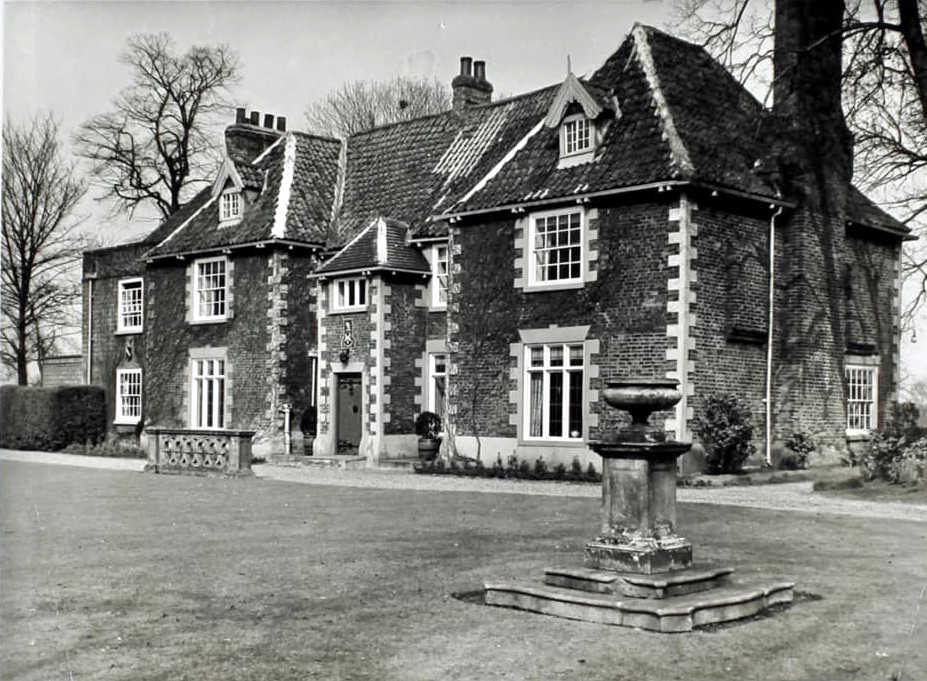
Portington Hall 1953
Portington Old Hall/Manor House/ Manor Farm
Before the present hall was built in the seventeenth century the Portington family lived in their hall across the road which was surrounded by a large moat.
The moat is listed. The listing says
The site dates from the 11th century, and includes a large, raised rectangular platform area with dimensions of 160m north-south by 135m east-west. The platform is surrounded on its four sides by moat ditches. Overall the site has dimensions of 180m north-south by 150m east-west. The `U’ shaped moat ditches range from 7m to 10m wide, across their tops, and are between 1m and 1.75m deep. The ditches are intact and are surrounded by an exterior bank which is up to 8m wide and 1.5m high. There is an original entrance in the centre of the northern moat arm which is 5m wide, and another entrance 10m wide in the opposing side, although this may not be an original feature. Within the raised platform area to the south west, there are the remains of two interior moat channels which nearly meet at right angles. The channel leading due north from the main southern moat arm is interpreted as a fish pond, and measures about 50m in length, by 10m in width, and is up to 1.5m deep. The second channel is at right angles to the western moat arm, and measures about 75m long, 6m-8m wide and 0.5m deep.
Modern farm buildings lie at the point where the two interior channels may once have met. On the eastern side of the moat island there now stands a farmhouse dating from the 18th and 19th centuries. The farmhouse is situated close to the original entrance to the moat island at the centre of the northern moat arm. Although the fabric of this building includes both Georgian and Victorian features, it was apparently built upon earlier foundations, possibly dating to the 16th century. This farmhouse is associated with other farm buildings which occupy parts of the raised central island area.
The map below dates from 1754 when William Burton and Thomas Bell agreed to divide Portington. It shows the large moat and the sites of both old and new halls.
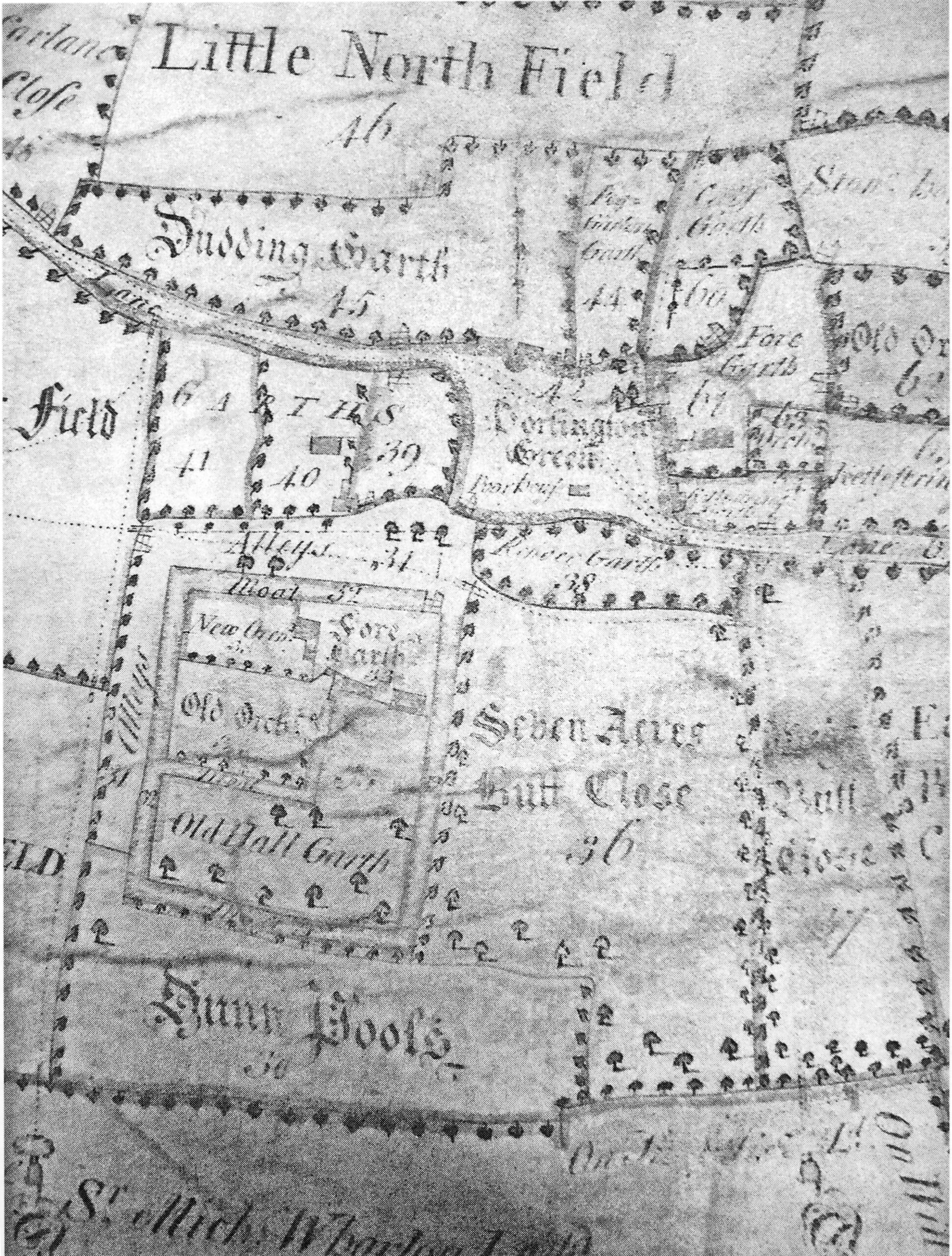
Henry Bell divided his property on his death in 1816 between his two surviving sons John and Henry and his son Thomas’ widow Mary, nee Smith.
Mary died in 1849, aged 79 in Morley at the home of her daughter Jane, the widow of Samuel Webster
In December 1852 offered for sale was. – A very valuable FREEHOLD ESTATE, situate in the Township of Portington the Parish of Eastrington, the County of York, consisting of the Old Hall and Gardens, capital Messuage and Farm Buildings, Seven Cottages or Dwelling-Houses, and 202 a. 2r. 21p. of Land, divided into convenient Inclosures, in a Ring Fence, and now the occupation of Mr. T. H. Champney, Mrs. Bell, and others.
Also, ONE-TIIIRD PART of ’the MANOR or reputed MANOR OF PORTINGTON. The Estate may viewed on application to Mr. Edward Sale. Bell, of Burland, Land Valuer.
Thomas Horatio Champney, originally from Ellerker, did not stay at Portington after the sale. He married and emigrated firstly to Tonga and then Australia where he died.
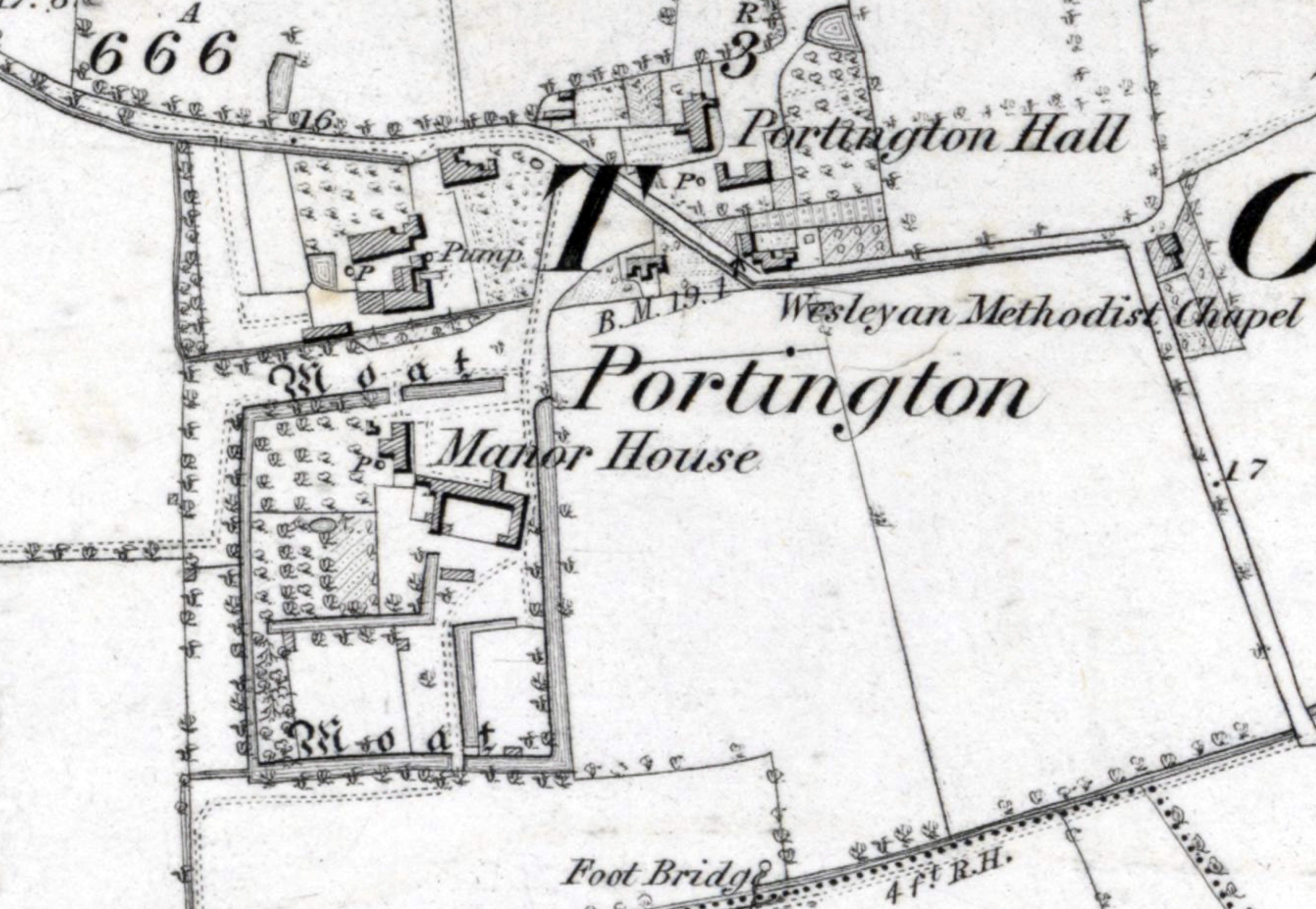
The 1854 Ordnance Survey map below shows the present hall, the moat across the road , the farm buildings and the old hall now described as the Manor House.
Manor Farm
It was occupied in the 1920s by Mr Shaw
1947
Manor Farm Portington
SALE Instructed by Mr C. E. Patchett (who has sold the farm) — : 2 Cart Horses, aged, 1 Cart Mare, aged, 1 Cart Horse, eight years, 13 Cart Mares. Nos. 1 to 6 used to all gears; broken to chains; Nos. to 7 are powerful, good cleanly legged horses of excellent type. CATTLE: Roan Cow, fourth calf due April, Friesian Geld Cow. 8 Black Polled Irish Bullocks. 21 yrs., 2 Friesien Cross Bulling Heifers. . Black Heifer, 20 months, Friesian Bull Calf, 5 months. 60 pigs 58 Grand Saddleback Store Pigs, handy weights. TRACTORS & TRACTOR IMPLEMENTS:, FORDSON TRACTOR (1940) on rubbers with pulley, FORDSON TRACTOR (1940) on spade lug wheels, Martin 9-tined Tractor Cultivator; Cockshutt 3-furrow Tractor Plough, new; Oliver 2-furrow Tractor Plough; set of 5 Tractor Chisel Harrows; set of 3 Tractor Chisel Harrows; pair Heavy Tractor Chisel Harrows; 6ft. M.H. Binder with tractor pole, as new; Bamlett . Tractor Grass Reaper, as new; Tractor Hay Sweep; good heavy Car Pig Trailer; pair Pneumatic Tyres and Wheels. 32in. 1 61n., and Axle; Fordson Tractor Hood; 2 Circular Paraffin Tanks and Tap; 11 h.p. International Petrol Engine; 11 h.p. Lister Petrol Engine; Straw Elevator, Sharp, as new; Two-knife Straw Chopper ‘ for power; Bamford No. CC (large size) Combined Grist Mill and Oat Roller; Cake Mill for power; small Oat Roller for power; Harrison-McGregor Root Cleaner and Pulper. IMPLEMENTS: 2 P.A. Heavy Carts, with s. and s.; 3 good Block Rullies, with pole and shafts, to carry 3 tons; 2 Block Shaft Rullies, to carry 2 tons; Iron-tyred Milk Float; M.H. Tillage Drill, as new; Pole Cambridge Roller; Shaft Slape Roller; Bamford Lion Horse Rake; Blackstone Swathe Turner as new; Winnowing Machine; Cooke’s 2-row Scuffler and Horse Hoe. with discs; Cooch Potato Sorter; various Ploughs and Harrows; Weigh and Weights; Winding-up Barrow. Thatching Ladder; 2 Load Ladders; 2- wheeled Sorbo-tyred Milk Trolley; . Gearing for 6 horses; Cart Saddles; set 1 Breaking Tackle; quantity Small Tools. The Auctioneers call special attention to the Sale, in which are Horses excellent type, good Cattle, and very good selection of modern Implements, many of which are in new condition.
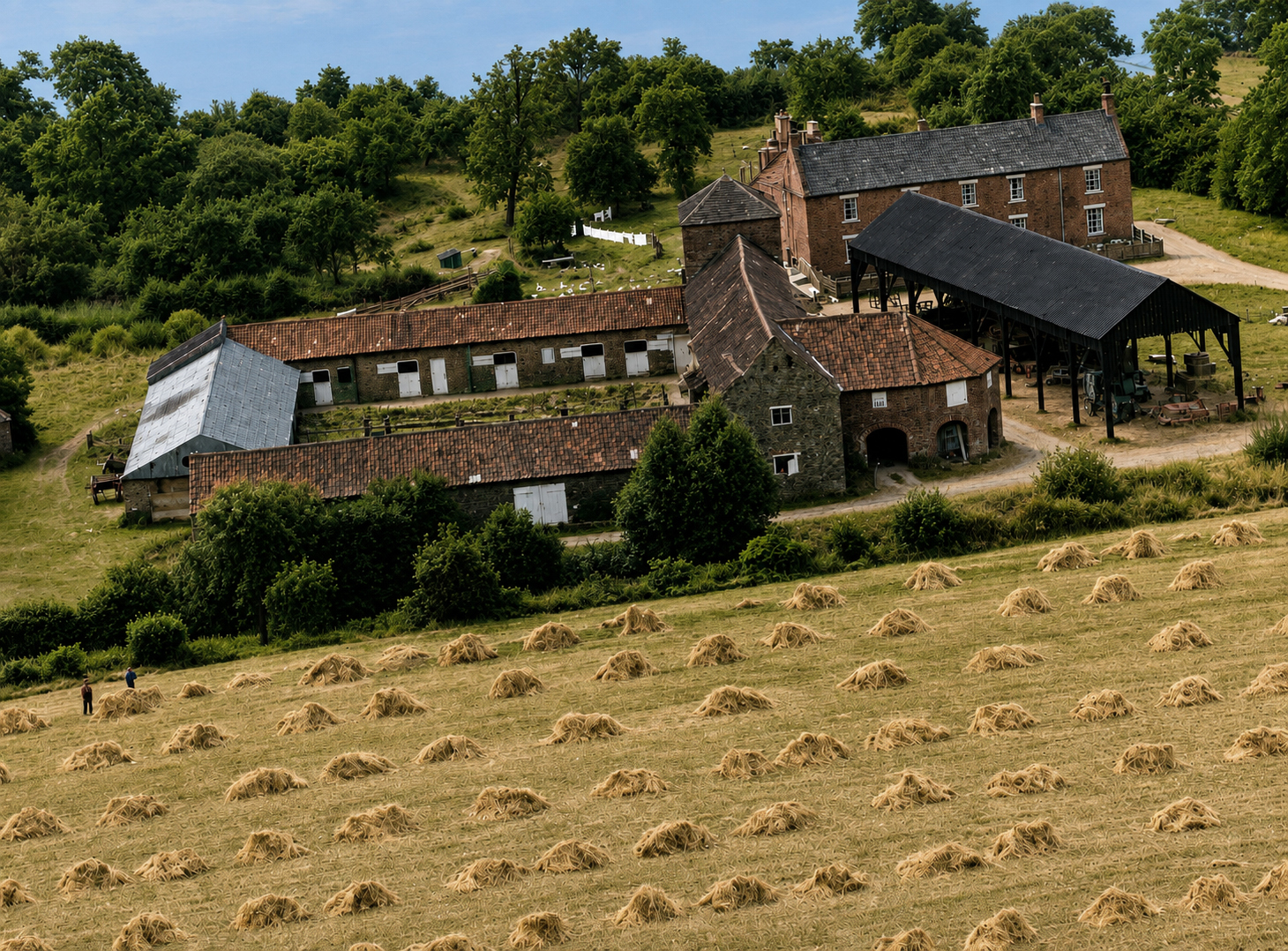
Portington Manor Farm
Grove Farm
This was for a time a commercial rhubarb farm operated by George Frost. His parents lived in the hall. Several villagers from Eastrington were employed there. It closed when George Frost died suddenly.
January 1908
PORTINGTON GROVE FARM, Messrs Thomlinson are – instructed by the Exors. of the late Mr. George Frost (market gardener), to Sell by auction, on the above Farm Premises, on Friday January 10th, 1908, the whole of the Valuable farm stock and implements, comprising 5 useful Working Cart and half bred horses, and 10 very promising cart and harness young horses: Three 4 yrs. old, two 3 yrs. old, two 2 yrs. old, and three yearlings, all unbroken ; been bred on the farm, by Shire breeds and . Farm implements viz.:— Larger Mortar Grinding Mill, by Shaw & Son, Leeds, for power ; Richmond & Challoner Metal Straw Chopper, Bamford’s Patent Grinding Mill, Lever Morticing Machine. Gears for six horses. etc. Five large old Wood Sheds, used for Rhubarb forcing ; & large quantity of 9 inch and 10 inch diameter Sanitary Pipes, with flanges, been used for flue purposes, and Old Bricks, etc.One wooden office fitted with Desks, Metal Stove, &c., Boarded Floor, and made in sections and bolted together. 8 acres Rhubarb sets, Victorias, in half- acre plots.
Associated with this sale was the sale of furniture and effects of Mr William Smith who was foreman to late G. Frost, of Portington Grove, and was an expert woad grower being the only farmer in the district growing woad. Mr Smith is returning to Boston, Lincs
Grove Farm was later the home of Jonathan Scutt jnr. It was offered for sale in 1947
FREEHOLD FARM known as GROVE FARM, PORTINGTON, extending to an area of 230 ACRES and in the occupation of Mr J. Scntt. junior. The house, pleasantly situated, with ornamental and kitchen gardens, orchard and foreman’s cottage. The Farm buildings are well planned and substantially built. The arable land is good bodied loam and is noted for yielding and good quality cereals, root and clover crops, and the grass is rich, early, well-watered for feeding
Grange Court
Henry Bell of Grange Court died in 1839
In 1840 the estate was offered for sale as follows
ALL THAT VALUABLE FARM CALLED THE PORTINGTON GRANGE ESTATE, Late the Property of Mr. Henry Bell, Deceased, CONSISTING of a good MESSUAGE or DWELLING-HOUSE,’with Barn, Stables, Outbuildings, Orchard, and Gardens adjoining. Likewise Three Labourers’ COTTAGES and Gardens, and divers CLOSES or Parcels of gcod Arable and Meadow or Pasture LAND, interspersed with Thriving Plantations. The whole lying in a Ring Fence, and containing TWO HUNDRED AND ELEVEN ACRES, or thereabouts, situate in the Township of Portington, the Parish of Eastrington,.
Together with an undivided Third Part of the MANOR. Also a small ALLOTMENT on Bishopsoil near to the above. The Premises are Freehold and Tithe-free, with the Land- Tax redeemed, and are a proper state of cultivation (to a great extent under-drained), and at only a short distance from the Hull and Selby Railway Station. Possession may be had any time, and further Particulars, on application to Mr. BELL, of Cavill Hall, near Howden; or to Mr. DYSON, Solicitor, Howden.
By 1851 Frances Morley Hodgson, his wife and young family were living at Portington Grange. It appears he was leasing it.
It was offered for sale in 1862
as that Valuable Freehold ESTATE called PORTINGTON GRANGE, and One-Third of and in the Manors Lordships or otherwise Eastrington and Portington. The Portington Grange Estate is situate at Portington, in the East Riding of the County of York, and, with the Site of the Dwelling- House, Barn, Machine Shed, Stables, Mistals, and other Outbuildings, Fold Yards, Bullock and Cow Sheds, comprises 211 Acres or thereabouts. There are also THREE houses on the Property suitable for Farm Labourers. TheEstate is in a most capital state of cultivation, is in a ring fence, and the Dwelling-House and Farm Buildings situated almost in the centre of the Property. There is a Pew in Eastrington Church attached to the Property. the estate is leased to a most respectable Tenant for a period of 21 years, commencing from the 16th Day of dec 1856
Francis and Eleanor had 12 children [ 2 died as babies]
He sold his farm stock in 1880 and retired to York and died in 1894
Thomas Brearley 1835-1890 and Thomas Percival ‘ Percy’ Brearley 1868- 1952
Thomas Brearley was from Batley where his father had established a very large woollen mill, Robert Brearley and Son. He had four sons
Thomas bought the Grange and also soon afterwards, in 1882, Brackenholme. The 1881 census for Portington Grange has William Laytham as farm bailiff and Harry Brearley boarder 17, agricultural pupil. Harry was Percy’s older brother and later farmed at Brackenholme.
In 1881 the following advertisement appeared.
To Joiners, Plumbers, Plasterers, and Slaters.
Parties desirous of TENDERING for the whole or any of the above WORKS required in the ERECTION and completion of a Block of BUILDINGS, COTTAGES, &c., at Portington Grange, Howden, may see the drawings and specifications, and obtain bills of quantities for the same at my offices, in Batley, from Monday, May 30th, to Thursday, June 2nd, both inclusive, and at Portington Grange Farm from Friday, June 3rd, to Monday, June 6th, inclusive. Sealed tenders to be sent to my offices not 6 p.in. on the last-named day. No allowance made for estimates Walter Hanstock, Branch Road, Batley
Walter Hanstock, a Batley architect subsequently designed several buildings on the estate.
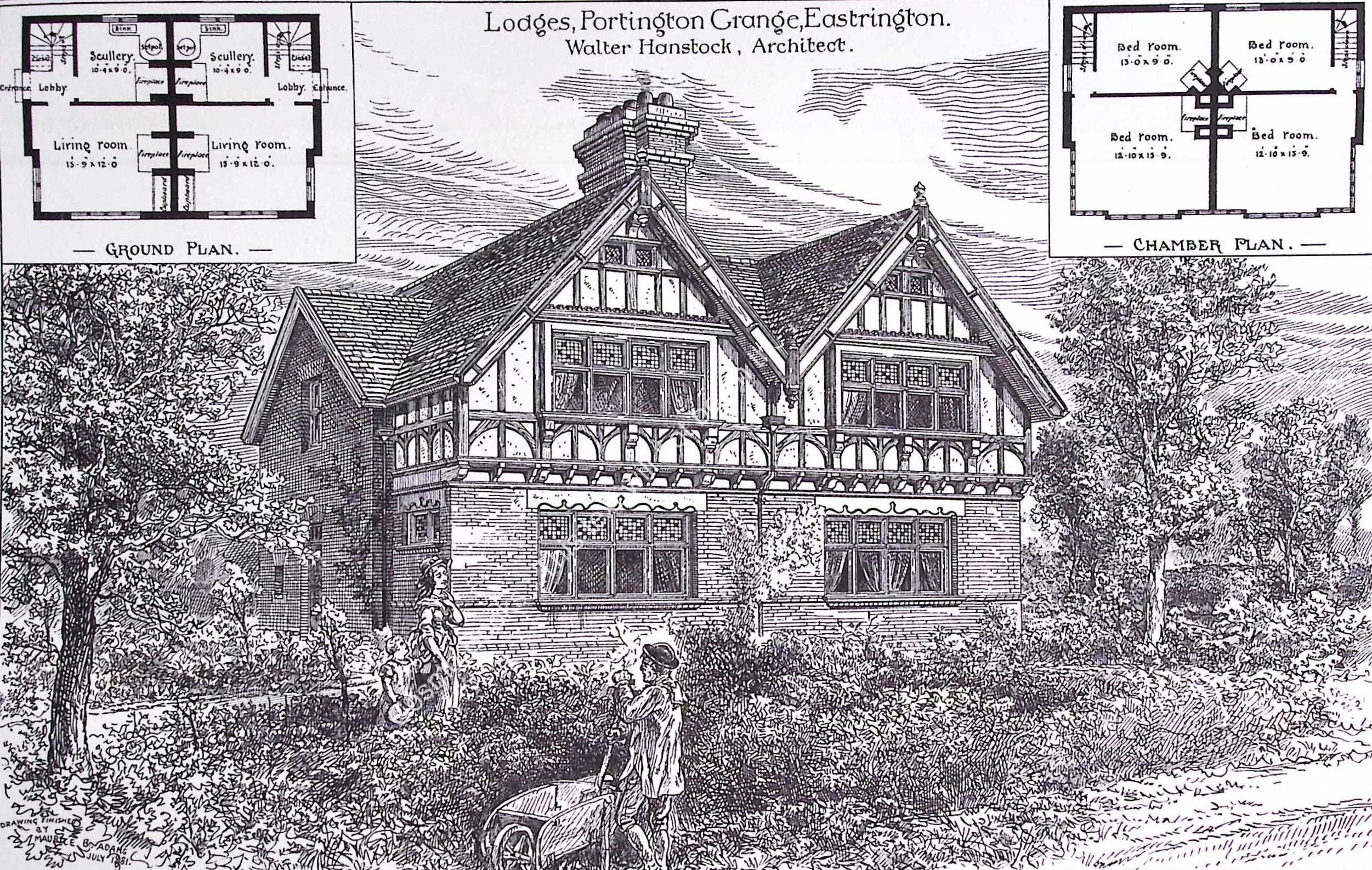
Plans, coming of age marriage and loss
There are newspaper adverts from the 1880s mentioning horse breeding at Portington and it seems likely that Percy was by then living there. He was born deaf. But the year 1889/90 saw several changes.
Friday 22 March 1889
Parties desirous of tendering for the whole or any of the above works required in the erection of a farm residence a Portington Grange, Eastrington near Howden. See the Drawings and Specifications,at my offices by april 4th, 1889, No allowance for estimates. Walter Hanstock
Howdenshire Gazette Friday 14 June 1889
On Tuesday there was a large gathering at Portington Grange, to celebrate the coming of age of Mr T. P. Brearley, youngest son of Mr Brearley. The workmen employed on the Portington and Brackenholme estates were invited, with their wives, there being also present several heads of departments from Messrs Brearley’s mills, at Batley, and in addition to the members of Mr Brearley’s family, there were a number of invitcd guests and personal friends from the immediate neighbourhood, and also from other parts of the country. A variety of entertainments were provided for the visitors, commeucing with a cricket match, in which some good scores were made. Tea was provided in the large granary, to which over 160 sat down. After the health of Mr Brearley and his son had been proposed and responded to, the company again returned to the adjoining field, where a capital programme of athletic sports was gone through, including flat races, egg and spoon race (for women), sack and obstacle races, &c. Many of these events afforded great amusement to the onlookers . The prizes, which were numerous and were afterwards presented to the successful competitors on the lawn in front of the house, by Mrs Brearley, in the presence of a large assemblage of spectators. Dancing followed in the granary, and was kept up with great spirit , until midnight. The weather was beautifully fine, and there was no drawback from beginning to end, the day’s proceedings being thoroughly enjoyed by all who took part. The whole celebration afforded a pleasing illustration of the happy relations existing between the employers and the employed, and the day will be long remembered as a red-letter day in Portington. The refreshments were provided by Mrs A. Kilham, of Howden, and were served up in first class style.
1889. On the 14th November, at the Congregational Church, Howden, by the Rev. J. Lewis, Thomas Percival Brearley, of Portington Grange, youngest son of Thomas Brearley, The Moss, Harrogate, to Lucy, eldest daughter of John Stow Fitch, of Howden.
February 1890
We regret to announce the death of Mr. Thomas Brearley, J.P., of Harrogate, and late of Batley, which took place at his’ residence, The Moss,” Harrogate, on Saturday, after a long illness, at the comparatively early age of fifty-five years. The deceased gentleman was the son of the late Mr. Robert Brearley, founder of the well-known firm of Robert Brearley and Sons, woollen manufacturers, Queen Street Mills, Batley, and after his death, about twenty years ago Mr. Thomas Brearley became the head of the firm, upto to about four years ago when, owing to failing health moved to Harrogate, and afterwards retired from the business, which is now carried on by his sons. ‘was best known in connection with the Hospital, in the establishment of which he took a lively interest and was the largest subscriber contributing £1,000 towards the erection of the hospital. He was its first president, and has retained that position ever since. Mr. Brearley has also been a liberal supporter of the Wesleyan cause in Batley. Naturally of a retiring disposition, and all his generous acts were without any ostentation or display, but his loss will be severely felt. He has had a long and painful illness, which he has borne with great fortitude and patience. The remains of the deceased gentleman were interred at the Batley Cemetery.
Grange Court
An interesting obituary survives from 1938 for James Bellwood who was born in Howden.
An old townsman, Mr James Bellwood, has just died and was buried at Ossett cemetery last week, aged 76. Mr Bellwood was born and educated in Howden and apprenticed to the joinery trade. For several years he was employed in erecting the new stations when the Hull and Barnsley Railway was being built. He also helped build Grange Court, Portington, and Brackenholme Hall. He then left for Batley, and for 30 years worked at Ossett for Mr Horsnell.
By 1891 he was living in Ossett
The Brearleys lived at Portington until 1906 when they sold to Harry Smith for £9750. Percy Brearley eventually moved to Bridlington and died in 1952.
Harry Smith 1854- 1932
Harry was born in Leeds, the son of Barnabas Penrose Smith and the former Emma Martin. Barnabas was a woollen draper, born in Airmyn. But Emma died in 1856 and the family moved to Airmyn where Harry and his father and brother Tom lived with Barnabas’ mother Mary [formerly Penrose] and brother Penrose, a cowkeeper. In 1871 both boys were lodging in West Bromwich with a curate who obviously took pupils. Tom was a 22 year old medical student who later was a doctor in Caistor. Harry was 17 and a scholar.
Harry, we know, fell in love with Marian/Mary Ann Small who lived in The Villa, Laxton with her father Alfred. Alfred had founded the Goole and Marshland Gazette in 1854 in Goole but had sold up and retired to Laxton. We know he was well off as Marian went on several trips with him to Europe. In 1978 Ousethorpe Manor near Eastrington was demolished and amongst other papers were the love letters Marian sent to Harry from the European hotels as well as from Laxton [which she wrote whilst her father was at church!].
The couple married in 1879 at St George’s Hanover Square. Harry was then a farmer living at Grove Farm Portington. By 1881 they had a daughter Dorothy Mary and also living with them was Mary Ann’s father Alfred and his sister Justice.
By 1891 the Harry and Mary Ann were at Thorpe Hall near Howden with their children Dorothy, Emma Martin, Elizabeth Justice Bell [ known as Ruby], Alfred Penrose Smith and Marion Marguerite.
Alfred senior died in 1897 at Thorpe Hall. Justice was still living there in 1901 aged 87. Her initials JS are on the building she had built on Churchside in Howden.
In 1903 daughter Ruby married John Griffiths Edwards, of Hay Creek, Oregon, and Aherdovey, North Wales at Howden. I was very surprised to find that Hay Creek and the Edwards played a large part in Oregon history. Here is an article from 1960 but there is a lot more to read about Jack Edwards.
Jack Edwards
A man known to few Central Oregonians of the present was once tall in the horizon on Central Oregon ranges. He was John Griffith Edwards, a native of Wales who founded not one but two stock empires. The first was in Wyoming, where in 1879 Edwards entered the cattle business on a fork of Green River, watched his venture fade as his stock died in a severe winter, then entered the sheep business to become the centre of a range war.
From Wyoming, where he fought warring Utes as well as stockmen, Jack Edwards came to the Oregon country, to the highlands of Hay Creek in the vast triangle bounded by Prineville, Madras and Ashwood. On Hay Creek, Dr. David M. Baldwin in 1873 had established a big ranch later sold to C.A. and J.P. Van Houton and H. Longcoy. In 1898, Jack Edwards moved into Hay Creek as half owner of the Baldwin Sheep and Land Co.
He remained to make that ranch the greatest Merino sheep breeding station in the world. More than 20,000 sheep grazed on the hills that sloped up into the green pines of the Ochocos, where Blizzard Ridge dominated a frontier range. The Hay Creek Ranch once boasted a market of 500,000 pounds of wool a year, and an annual harvest of 2500 tons of alfalfa, in a region which it was once said alfalfa could not be grown. The ranch covered 70,000 acres of land on which grazed thousands of sheep.
Jack Edwards in 1903 was married to Elizabeth Justice Bell Smith, of Yorkshire, England. He brought his bride to America, and they moved into the long, rambling ranch house at Hay Creek. That house became famous as a centre of Oregon hospitality. Portland society made it a rendezvous. To the friendly doors came governors and mayors, cultural and business leaders and visiting celebrities.
There was a time when the Hay Creek Ranch was the unofficial capitol of Central Oregon. Edwards sold his holding in 1910, and moved to Portland, but he long remained active. In 1945, Jack Edwards died. His wife died this past year.
Now the memories of Jack Edwards, rancher and sheep king, are back in the news. A charitable trust fund of some $600,000 he conceived nearly 20 years ago is to be distributed. At present, allocations will be limited to income earnings of the trust. Only charities operating in Oregon will be considered for benefits.
In 1906 Harry bought Portington Grange.
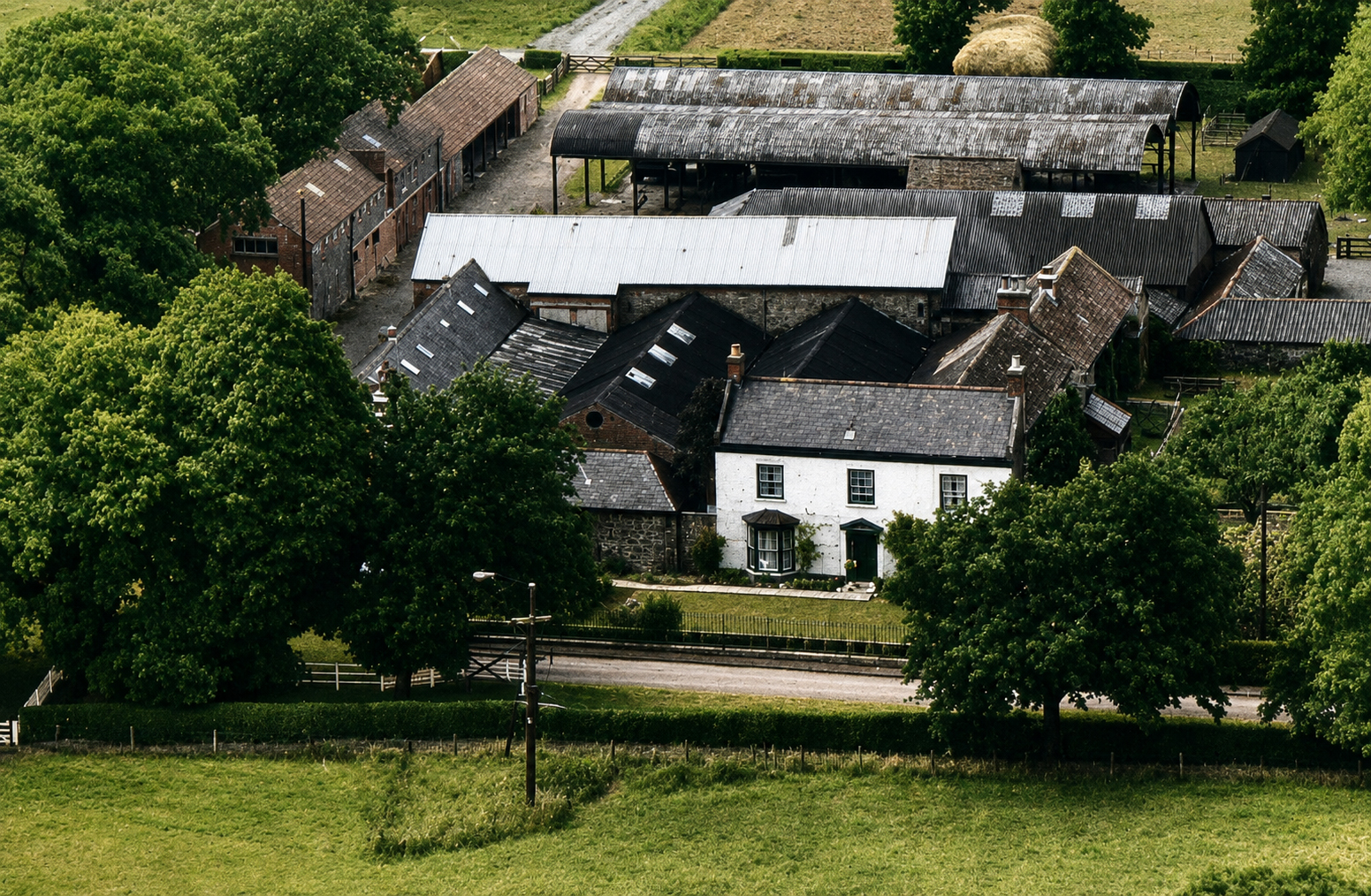
Portington Grange
By 1911 Harry was at Grange Court with daughter Emma Martin who was described as poultry manager, Not certain where the rest of the family was but certainly there are passenger records for Dorothy visiting her sister Ruby. Alfred emigrated to US in 1906 and was a civil engineer. He died in 1922 in Minnestota.
Mrs Mary Ann Smith was well known for breeding and showing Pekinese dogs – the most famous of which was Puck of Portington. Harry died in 1932
He was described ‘one of tbe largest farmer* and landowners in the district. and had bee at n Grange Court for 27 years, and formerly resided at Thorpe Hall, Howden. A man of kindly and disposition, he was a generous donor to charitable and other objects in Eastrington and the district, and was for many years president of tbe Eastrington Agricultural Society. He leaves a widow and four daughter, one of whom, Miss Martin Smith, owns the famous Portington herd of Freisian cattle, which have won prizes in all parts of tbe country.
Mrs Mary Ann Smith died in June 1937.
In 1925 Marion Marguerite Smith had married Edward Septimus Dorning. He was from Liverpool and had served as a captain in the Liverpool regiment. Their daughter Romola Dawn Justice [known as Dawn] was born in 1929. Edward was referred to as Major Dorning and headed the local home guard in the war. He travelled extensively to the US and Nigeria. In 1949 Dawn married Hubert K Turner. Major Dorning died in 1959 at Colwyn Bay. He and his wife had moved there four years earlier when the Portington estate was sold.
Emma Martin Smith never married. She ran a ‘model’ dairy and supplied milk locally. Her dairy was often in the news,. For example in 1929 it was reported that
A British Friesian cow in the herd of Miss Martin Smith, of Portington, has achieved fame in producing more than 3,000 gallons of milk in a single lactation of 365 days. Up to 360 days, her output has produced 3061 gallons, and she was then still giving seven gallons daily. Sudbourne Flossiwijk, which is the cow’s name, is the ninth among the Friesian breed in this country to reach the 3,000-gallon mark. She is now completing her fifth lactation, and the total of these works out to an average per lactation of 2,214 gallons, which is a new British record. It is computed, moreover, that in her latest lactation, Miss Martin Smith’s cow has produced milk fat equivalent to 1,0431 b, of butter. The animal won the reserve championship in the Royal Show milking trials of 1927, and also at the Yorkshire Show test in 1928, and was also high up at last year’s Dairy Show in London.
In 1939 at a show at York it was reported that supreme honours went to Miss Martin Smith’s three-year-old bull, Portington Brutus, a big upstanding sire from the Portington herd, of Beccles ancestry, with a famous dairy record. Also a winner was a young bull fourteen months old called Portington Rastus,
In 1954 Grange Court was put up for sale.
Freehold and agricultural estate of 262 acres [56 grass]. Gentleman’s residence. 5 rec. and study, 6 bedroom., modern. bathroom. Charming garden. Capital home FARM Farmhouse. 2 Cottages, and first rate and extensive buildings. Including modern cowsheds for 38. 2 good covered yards. Large Dutch barn. Mains water and elecricity. Vacant possession 6th APRIL. 1955. An attractive, easily worked and secluded country house with first-class home farm. Also a Small country house Tudor House (4 beds.), with 1 acre and modern Bungalow.
Emma Martin Smith moved to be with her sister and husband in North Wales but sadly died soon afterwards in 1955. Her sister Marion Marguerite Dorning died in 1973 and left £150,000.
Portington chapel
In 1816 when Henry Bell died he left instructions in his will that Methodists should be allowed to continue to worship in Kettlestring’s barn. This was on the opposite side of the road to the hall.
Fifty years in March 1866 later his descendants honoured his wishes and built a small chapel, possibly near the site of the barn.
It was described as ‘a handsome memorial Wesleyan chapel erected by the members of the family of the late Mr Bell, of Portington. At its formal opening for divine worship Rev Richard, Green, of York, formely of Howden, delivered two most appropriate sermons and the chapel was filled to overflowing. A small tablet in front of the edifice bears the following inscription :—
‘‘This chapel was erected AD. 1866, to the memory of the late Henry Bell, of Portington , Whose zeal and virtues still live in the memory of his descendants. He died Jan. 18, 1816, aet 86.”
It was sold in 1917
For several years the Weslevan Chapel which has the reputation of being the smallest chureh in the East Riding, has been closed and the congregation absorbed in that of the parent Wesleyan church at Eastrington. The trustees placed the disposal of the building and site in the hands of Mr E. S Flint, Eastrington, and it has just been sold by private treaty to the Misses Bell, owners of the estate on which it stands and we hear is to be converted into a cottage after the war.
This did not happen and the chapel fell into disrepair but has since been incorporated into a house