Whitgift church
The first church
Whitgift is first mentioned in the twelfth century when it was said that the fishery there had been given to Selby abbey by the king, William the Conqueror, almost one hundred years earlier.
The village probably owed its very existence to its position on the riverbank and the ferry which linked the north and south banks of the Ouse.
The first church on the site was built about1130, probably by the monks of St Mary’s abbey at York who held Whitgift from the Lacy family, earls of Lincoln. This first church was, like the present one, most likely dedicated to St Mary Magdalene as Whitgift Fair was held on her Saints day [July 22nd] before the present [second church] was built.
Permission for Whitgift to have a two day fair and market to be held on July 22nd and 23rd was granted in 1232 by the abbot of St Mary’s.
However it is said that brawling and unseemly behaviour led to the banning of fair in 1367 by the Archbishop of York although the phrase ‘It’s as bad as Maudlin Fair’ survived to describe a disturbance until well into the twentieth century.
Murder and destruction
But back in the thirteenth century there was an argument about who exactly ‘owned’ Whitgift. It was claimed by ‘John the Frenchman’, the rather unpleasant and unpopular rector of Adlingfleet [John was in fact most probably an Englishman who had spent time abroad and is referred to variously as John Franciscus or John le Franceys]. During violent clashes in 1248 between John’s men and those of the Abbot of Selby [Snaith parish was in his jurisdiction] a monk was killed. John’s men subsequently demolished Whitgift church and many of the stones were carried off to Adlingfleet where John used them to build him self a camera [chamber]. He also built a great new church at Adlingfleet of which the nave survives. He died in 1255 and according to a contemporary chronicler, ‘deserved to be mourned with dry tears’.
It is difficult to know what exactly remained of Whitgift church at this point. Although it was described as ‘nuper prostrata’ [recently ruined] Canon Richardson writing in 1950s in ‘Some Useful Consumers of Waste’ suggested that in fact some of the foundations were left and the existing church could be built upon them. Certainly some stones from the first church were re-used when the second one was built [for example behind the pulpit there is the outline of a cross; the stone was probably originally an old coffin lid]
Sanctuary
And even if there was no church the churchyard was still seen at this time as a place of sanctuary. A record survives describing how William, son of Richard de Whitgift ‘fled by reason of a trespass committed by him against the King’s peace’ to the churchyard as it was ‘a cemetery dedicated to God’.
Young William claimed that once there he believed ‘he might be defended and saved by the liberty and immunity of the church’. However the men pursuing him ‘withdrew him by force and arms from within the cemetery and bound him with chains and carried him thus bound to prison in the castle of York’. But after an appeal to the king it was ordered that he should be taken back to the churchyard and ‘replaced in the same state as he was in before’.
A new church 1304
Then in 1304 the present church was built. It is possible to be certain of the exact date as this was when Henry de Lacy granted to Selby abbey ‘the cemetery in the vill of Wytegift consecrated a long time ago, as it is enclosed by ditches as far as a certain place where our fair is held yearly at the Feast of the Blessed Mary Magdalene’
The grant said that the church was to be built so that ‘the present and future inhabitants in the vills of Ousefleet, Wytegift, Essetoft, Redenesse and Swyneflet’ as well as some inhabitants of areas of Fockerby and Haldenby ‘which aforesaid vills are within the boundaries of the parish of Snaith, will hear divine office and will receive and have the church’s sacraments’
The new church was paid for partly by Selby abbey, partly by Henry Lacy, earl of Lincoln and, by means of an early church rate, local landowners contributed too.
The impressive chancel arch, tower arch, the nave arches and columns and the arch of the part-submerged doorway at the east end of the tower base can all be dated as having been built then, in the so called ‘Decorated style’ of the 1300s.
Subsidence and new tower
But the base of the tower subsided. It can be clearly seen how the lower large blocks of stone slant down from the west towards the nave. At some point, probably in the 1400s, the slant was corrected by building the walls up until a level platform was created and then the present tower was built on top- in the ‘perpendicular style’ of the time. It is also interesting that the inside walls are lined with brick, a use which this area of Yorkshire borrowed from the Low Countries.
This subsidence also possibly explains why ‘the springs’ of the nave arches can be seen still attached to the chancel arch but have broken away from the arches themselves.
The church, standing as it does next to the river has always been subject to flooding. This probably caused the subsidence and it is even possible that the first church part-collapsed because of subsidence and ‘John’ wasn’t totally responsible.
Elizabethan times
The next addition to the church seems to have been in Elizabethan times when in England generally little church building took place. The date 1589 was built into the battlements of the south aisle which suggests that the aisle was built then. It is possible that this construction might be associated with the then Archbishop of Canterbury, John Whitgift, who, although he was originally from Grimsby, said that his ancestors were from Whitgift.
Meanwhile Whitgift had evolved into a separate parish by the sixteenth century, separate from Snaith although the vicars still called themselves curates in the seventeenth century.
Registers
The parish registers were begun in 1562 and were then recopied and bound by William Dalbye, the curate in 1599 and continued. They left Whitgift briefly in the confusion of the post civil war period when they were removed from the parish in 1648 by a ‘Jesuit named Babthorp’ and recovered from York seven years later. They not only contain the records of the births, marriages and deaths of the parish but subsequent vicars have added notes which they believed would be of general interest
Eighteenth century
The next work on church took place in the early eighteenth century. The date 1727 appears on centre beams of nave roof. The work may have been paid for by the Stephenson family of Whitgift Hall who donated silver plate then. It is difficult to say whether any other work was done besides the re-roofing although newspaper articles of 1899 when chancel was rebuilt suggest that the church ‘with the exception of the tower and chancel arch ‘appears to have been entirely rebuilt and at a higher level and modernised about 170 years ago [ ie the 1720s]; and the nave arcade being rebuilt, fortunately without alteration’.
Ministers
Whitgift has had several well-educated and long serving ministers, some of whom are buried there.
For example there is a memorial to Rev William Romley, ‘19 years minister’ who died on 9th April 1774 and another to Rev Henry Simpson, ‘nearly 58 years minister of this church’ who died on February 11th 1832 in the 80th year of his age.
Rev Simpson, as did some of his predecessors, also ran a school, ‘Whitgift academy’ and it is thought that some boys boarded in the vicarage attics
Rev William Williams was another who served the parish for most of his days, arriving in 1848 and remaining until his death in 1896 at the advanced age of 90. It is said that he usually preached 40 minutes sermons. and when it was was suggested that he preached shorter ones he said his conscience wouldn’t allow it.
The Hull Daily Mail reported May 14th 1896
DEATH OF THE VICAR OF WHITGIFT. The death took place yesterday morning of the Rev William Williams, vicar of Whitgift, near Goole. The deceased, who was 91 years of age, and lived at Reedness Vicarage, was originally a Nonconformist minister, but was ordained in the Church of England in 1842, and five years later was appointed Vicar of Whitgift. He had thus held the living for the long period of 49 years. He was much respected by the parishioners.
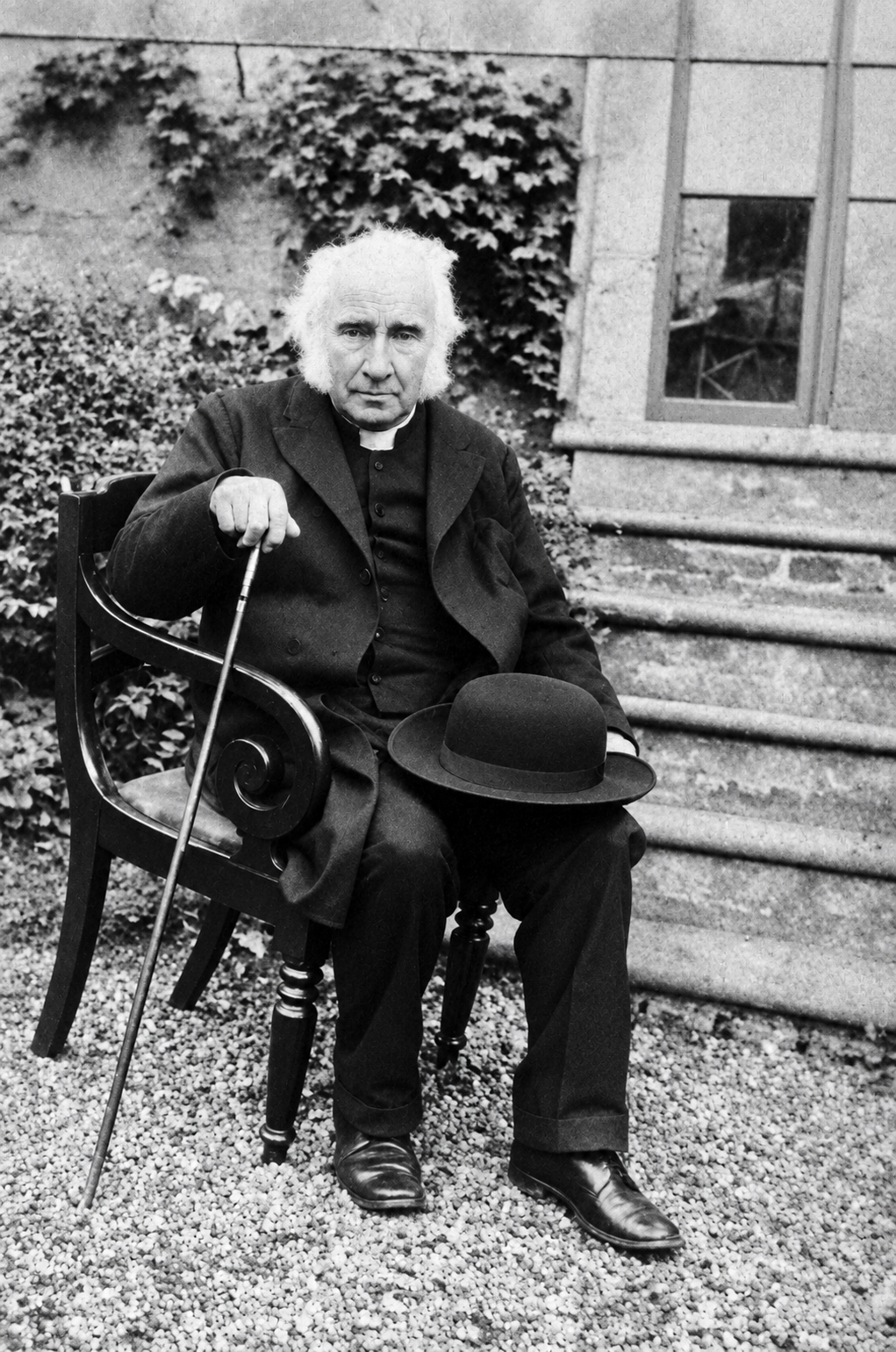
Rev Williams’ son Rev William Bunter Williams also became a clergyman.
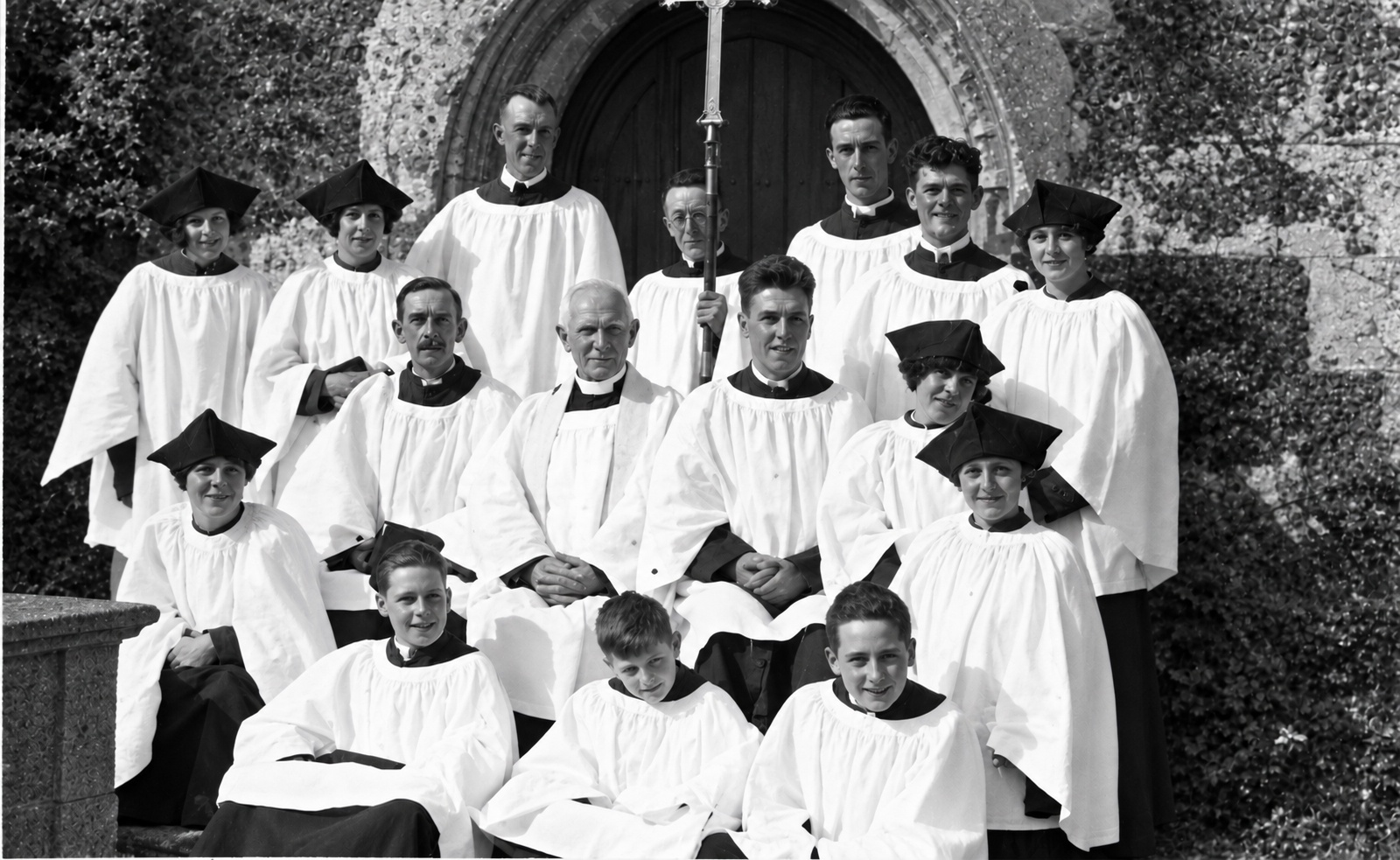
He was followed by the Rev Joseph Herring, remembered as a kind, grey-haired man who lived in comparative poverty and invariably wore a broad brimmed hat. He retired in 1938
Hull Daily Mail Wednesday 27 July 1938
Vicar of Whitgift to Retire.—After being vicar of Whitgift, near Goole, for 42 years the Rev Joseph Herring retires next week. Mr Herring is 76 years old. and has the longest service of any incumbent in the district. Born at Waddingham. Lincolnshire, Mr Herring was ordained 1889, and for seven years was charge of St. Mary’s Church Old Goole. On October 1, 1896, he was instituted vicar of Whitgift, only the fifth incumbent in the last 200 years.
He is shown here with his choir. He died in 1942 at Redbourne in Lincolnshire
The new chancel 1898
But by 1898 Whitgift church was again in need of major repairs. The Goole Times reported that summer that ‘the venerable pile, one of the landmarks of Marshland’ was about to undergo a major rebuilding, the legacy of which is still with the parish today.
It was decided that there would be built an entirely new chancel ‘which is to take the place of the barn-like erection which has served the purpose of both chancel and schoolroom’.
The newspaper wrote glowingly of how ‘the new chancel is to be in the fifteenth century style of English architecture and will be built of rubble masonry with stone dressings. It will have two full light tracery windows in the south side and one on the north side, the east window being of four lights. The roof will be handsome open timbered covered with lead. The stalls, prayer desk and other fittings will be of oak.
The nave will also be restored, considerable additions are to be made to the roof and the raising of the chancel arch is also contemplated. New stone windows are to replace the unsightly modern ones which do duty at present. The whole church is to be seated with open benches’.
The architects were Messrs Smith, Broderick and Lowther of Hull [although by 1899 Mr Smith had been replaced by Mr Walker] while the contractor was Mr Stead of Scunthorpe’
Laying the stone
The foundation stone was laid on July 12th when it was reported that‘ the ceremony of laying the foundation stone of the new chancel took place on Tuesday. Considering that the hay harvest was in full swing there was a very good attendance. Rev W H Carr vicar of Goole and rural dean was the officiating clergyman assisted by the Rev J Herring, vicar of Whitgift.’
‘At the appointed time Miss Bell of Reedness manor stepped forward to lay the stone and was presented by the builder with a silver trowel inscribed ‘presented to Miss Bell, Reedness manor on the occasion of laying the foundation stone of the new chancel of Whitgift church July 12th 1898’
In the cavity of the stone was placed a bottle containing copies of the Goole Times, the Goole Herald and the Yorkshire Post.
The amount required to pay for the work was £1,250 although close upon £820 had already already raised including £250 from Mr Bladworth of Whitgift Hall and £50 each from Mrs Bell and Mr Bennett ]
Reopening of Whitgift church
The work went well and the church was reopened the following April, again the timing being apparently difficult for local residents as the Goole Times of April 21st noted.
‘Amid signs of the greatest enthusiasm and interest the reopening of the restored Whitgift church took place on Wednesday when his Grace the Archbishop of York consecrated the new chancel. Despite the fact that the day chosen was market day in Goole and in that respect most inconvenient to the farmers of the locality the church was well filled.’
It is also interesting that the reporter pointed out that ‘The congregation too included many of the local Nonconformists who have cheerfully contributed to the building fund.
The new chancel, with its floor of ‘Godwin’s encaustic tiles’ was much admired as were all the other details of the work. There were new altar rails while the interior of the nave and aisles had been restored; ‘the roofs being enriched with tracery and cornices and other mouldings’. The new seating was of pitch pine while the old seating had been re-used as a dado round the walls of the church.
Although the interior was not quite finished nearly all money had been raised leaving a deficit of just £200. However Mr Bladworth came to the rescue and presented a cheque for £200 that very day.
Thomas Bladworth
Hull Daily News Saturday 8 June 1901
OBITUARY Mr T Bladworth of Whitgift Hall. The death occurred at his residence Whitgift Hall near Goole early yesterday morning of Mr Thomas Bladworth the Lord of the Manor of Whitgift The deceased gentleman was in his 78th year and was one of the largest farmers in Marshland district and had lived at Whitgift Hall for 50 years farming very large portion of the land the district, though for the last eighteen or twenty years he had led quiet life on account of declining health. Prior to that he was a member of the Goole Guardians for great number of years, the chairman of the Whitgift Parish Meeting. He was a staunch Churchman being a churchwarden of Whitgift Parish Church for a very long time. He also interested himself in the recent restoration of that edifice towards which he contributed large sums of money Deceased who was a thorough Conservative leaves a widow two sons and daughter to mourn his loss.
The clock
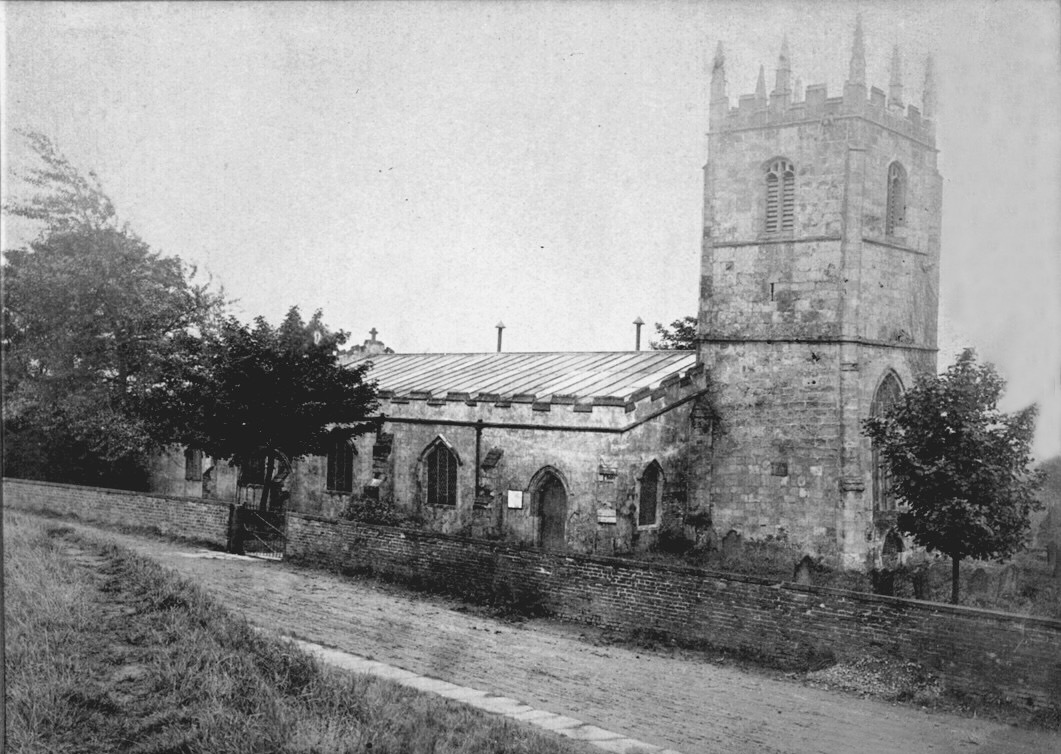
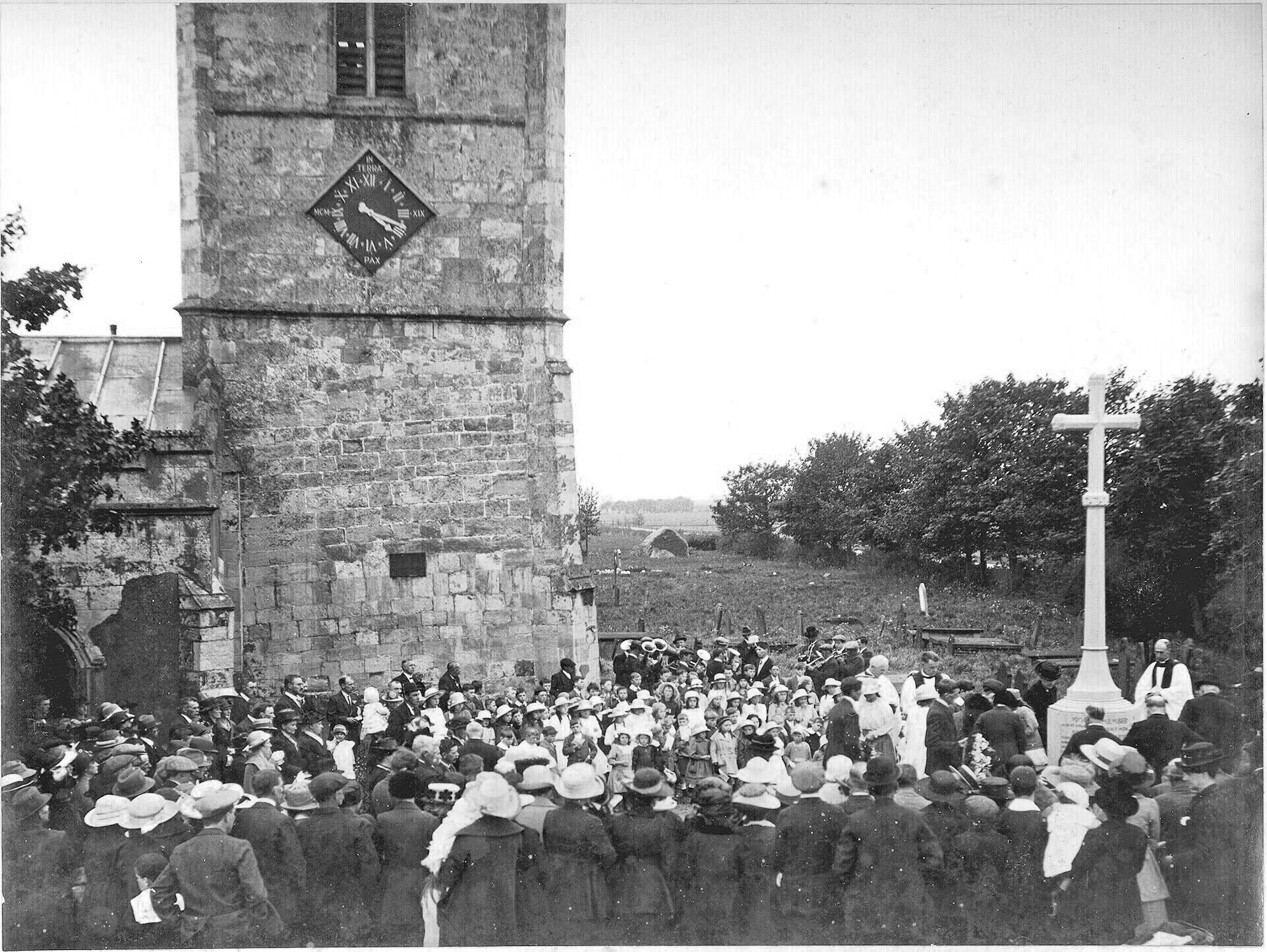
Whitgift church, as the first picture shows, did not have a clock until after the First World War when in 1919 Miss Gladys Bladworth set in motion the new clock on the tower presented to the village as a thank-offering for peace by Mr J L Empson. The clock, with its inscription ‘In terra pax’ would probably have existed in total obscurity if, whether by simple accident or alcohol fuelled inaccuracy, it had not shown thirteen rather than twelve on its dial. Many are the stories about how this occurred and local tradition has it that ‘Lord Haw Haw’ referred to it in his infamous wartime propaganda broadcasts. And of course every sailor passing Whitgift on the Ouse watches out for the clock that shows thirteen and thus spreads its fame around the ports of the world.
The second picture shows the dedication of the Whitgift. war memorial in 1921. The clock face does not show 13!!!
Hull Times 5 August 1939
WHITGIFT DEDICATION.—On Sunday evening the parish church of St. Mary Magdalene was practically full, the occasion being the dedication of a sanctuary prayer desk in memory of the late Rev W. Williams, vicar of Whitgift for close on 50 years, and a ‘cadence table as a thank offering for the 42 years’ incumbency of the Rev J. Herring, who was present at the service. This must be nearly a record —nearly 100 years and only two vicars. A full choir rendered beautiful service, under the supervision of Mr Sheppard, choir master and organist. The actual dedication was taken by the rural dean, Canon Knighthall, of Goole, who also preached an eloquent sermon.
Rev McPherson, shown below, with choir, was the vicar of Whitgift during the war years
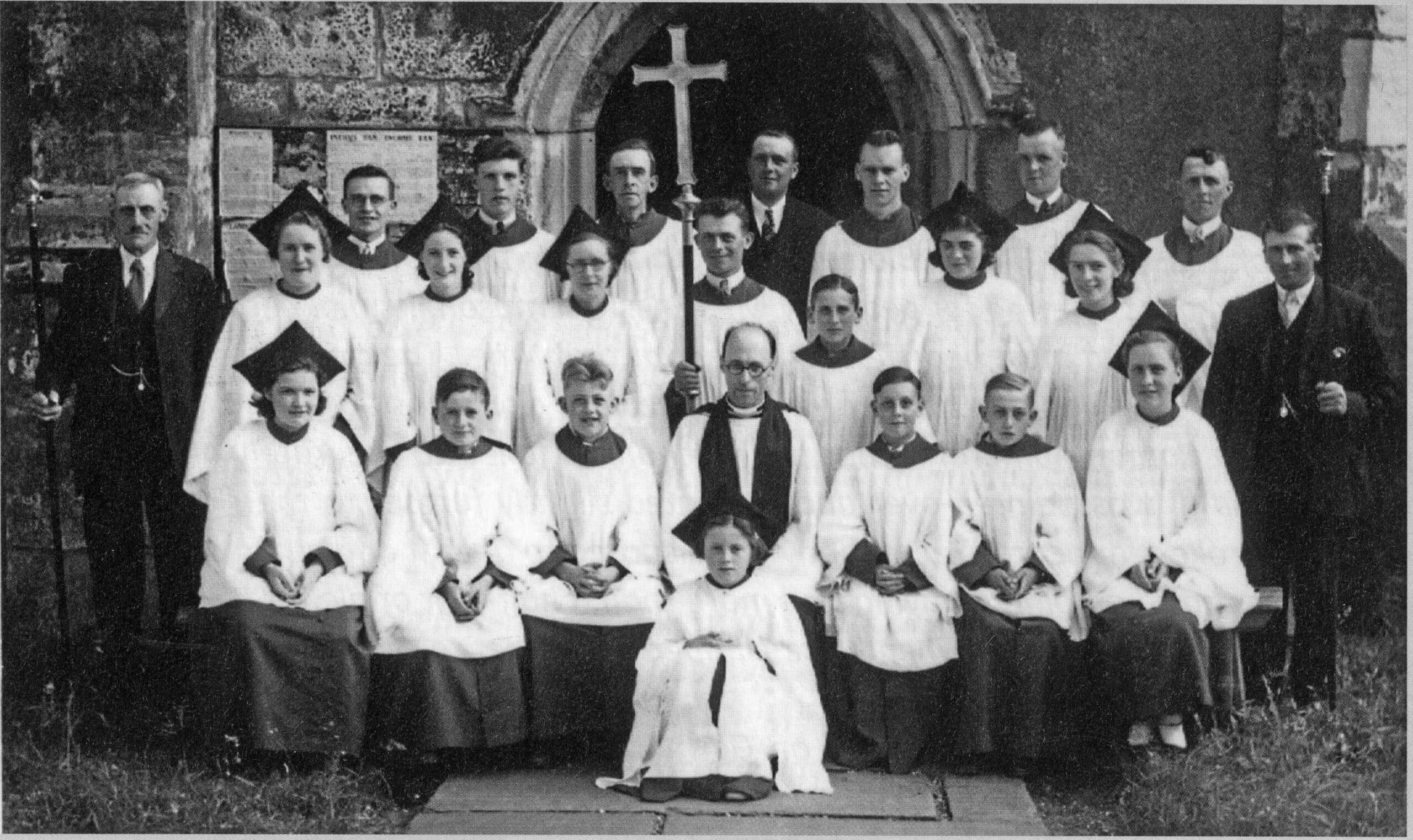
Hull Daily Mail 22 January 1949
Appointment.—The Rev Thomas Stanley McPherson, vicar of Whitgift, near Goole. since 1938, has been appointed chaplain of St. Judo’s Church. Andreas, Isle of Man. He will take up his new duties at the end of March.
Rev Harry Kenner
Rev Richardson
Rev Wilson Buckle
A few Whitgift notes
13th century ‘ William son of Richard de Whitegifte fled by reason of a trespass committed by him against the King’s peace to the churchyard of Whitegifte which is a cemetery dedicated to God in order that he might there be defended and saved by the liberty and immunity of the church other men pursuing him withdrew him by force and arms from within the cemetery and bound him with chains and carried him thus bound to prison in the castle of York. After an appeal to the king it was ordered that he should be taken back to the churchyard and ‘replaced in the same state as he was in before’
From the registers.
1607 from the registers: ‘ in this year there began such an extreme frost beginning ye 1st November and so continuing freezing so extremely to about Twelve day being ye sixth day of januarie. After men women and children horses and wagons loaded went on ye water at Ouse here at Whitgift ferrie and so continued until ye 14th day of Februarie after going away in such safetie to ye pleasure of God and ye benefit of men without any danger at all. God be thanked.’
3rd Dec 1614 Sir John Sheffield, son of the President of the council of the North, his two brothers Edmund and Philip and their servants drowned when attempting to cross Whitgift ferry
Robin Portington bitten by an ape on the ferry
1648 registers stolen by Babthorp, a Jesuit and recovered 1655
1642 Charles I used this ferry when he crossed from York to Nottingham to raise his standard
John Wesley used it: eg
May 1753 Sat 19th- I preached at Pocklington again and rode on to Whitgift Ferry. It rained a great part of the way and just as we got to the water a furious shower began, which continued above half an hour, while we were striving to get John Haime’s horse into the boat; but we were forced to leave him behind…..
1857
Nov. The Goole Packet Empress commanded by Captain Wright was approaching Whitgift jetty in the darkness when the captain saw the Whitgift ferryboat in his path. The ferry contained two ferrymen and four passengers. The Empress stopped engines and went full astern but the ferryboat came into contact with her bow and capsized resulting in one ferryman and three passengers drowning.