Howden church bells
The tower at Howden was built in three stages. The first part was probably only as high as the adjoining nave roof. The next part, upto the top of the long perpendicular window was probably begun during the time of bishop Skirlaw who left £40 towards the building or completion of it in his will in 1403. The wording suggests that it was definitely a bell tower –
In fabricatione campanilis ecclesiae de Hoveden;
The final topmost part was added towards the end of the 15th century. The bells were at the top of the tower and their sound carried across the surrounding countryside. It is unknown how many bells there were although it is known that one was known as the Great Bell.
When Robert Aske of Aughton led the Pilgrimage of Grace during the reign of Henry VIII in 1539 the signal for the uprising was to be the ringing of the Great Bell. But when people saw hedges lit in Lincolnshire they lit their beacons at Holme and Hunsley and it was reported that the bells of Howden rang backwards – the signal for danger. And the rebellion began.
Little else is known about the bells – how many were there etc. Although of course at this time the choir and chapter house were still standing and the tower stood in the centre of a magnificent cruciform church.
The church began to deteriorate after the Reformation as there was no money to maintain the choir and chapter house [the parish maintained the nave and tower]. In 1696 the choir fell down and the chapter house roof fell in 1750
Churchwardens’ accounts
In the later years of the 16th century the churchwardens accounts mention the bells frequently. There are expenses such as buying ‘pulles’ for the bells, buying cotterills [apparently a Yorkshire word meaning iron pins] and buying grease and tallow The ringers were paid for special occasions and one entry suggests there were five ringers. But later records suggest six bells. There were certainly six bells when in 1775 two bells broke and the six old bells were then recast into a peal of eight
Examples of the entries
1595
item to ould Turner, joiner, for fowre pulles for the bells – 12d
Item to Richard Mawe for lieinge downe stones in the churche 2/4d
Item to Thomas for helping him for thre daies & a halff – 21d
Item to him for one daie for helping to rayse the bells 6d
Item to Wareinge of Selbe, 30 Oct., 1595, for mendinge the cloke 13s 4d
Item to Stonner for helpinge him fowre daies 2s
Item 7 Nov., 1595, paid ould Turner for fowre pulles for the bells 16d
Item to John Petch for half a year for keeping the cloke and ringing curfew
Item to him for six cotterills for the bells
Item to Steven Scorborough, wright, for his half year fee dewe 17th Nov 1595
Item to him for mendeinge the bells, more than covenant 2s
Item for grease to the bells 8d
Item 17th Nov to the wringers that staied all night
Item to Stephen Scorbroughe for makeing three frames for the bells 16s
Item to William Evans for wood for them 9s
1596 -7
Item to John Petche for mendinge 2 belltiers & maikinge 3 bolstors and 4 cottrells and mendinge 3 cottrells —
Item to John Petche for his labour about the bells and one iron stay & stapples for the great Bell whele 2/6
Item to John Petch for halffe a year for keeping the cloke and wringing curfews 10/-
Item to John Petch for sex cotterills for the bells 2/-
1601.
Item paid to Mr Martom for chiming the bells the seconde of October — 3/4
Item paid to John Petch for mendinge a greate shackle and a greate bar of the fourth bell and a goodgin of the ladye bell and a shackle of the four bell — 2/10
1602
Item given to wringers when the Kinges majestie was proclaimed—2s
The great bell
The great bell was tolled for a death. This custom survived for several centuries. In the sixteenth century the charge made for this was 12d.
Receats of John Watkinson, churchwarden, 1596, for burials in the church and for ringinge the greate bell.
1596
Item of Uxor Mayson for the bell ringinge for her husband John Mayson 12d
Item of William Barker for the bell ringinge for Grace Mydelwood, wife of Richard Mydelwood 12d
Item of John Thominson for the bell ringinge for one John Collinson 12d
Item of Lawrence Herrison for the bell ringinge for Elizabeth Mayson, daur of John Mayson 12d
Item of Uxor Bowes for the bell ringinge for her husband 12d
Item of Peter Dowson for the bell ringinge for his sonne 12d
Item of Nycholas Arlushe for Robart Awdus buriall in the churche & for the bell ringinge 4s 4d
Item of the said Nycholas Arlushe for his wyfe buriall in the churche & for the bell ringing 4 s 4d
Item of Mr Consett for his sonne buryall in the churche & for the bell ringinge 4s 4d
Item of Thomas Frankland for the bell ringinge for his brother John Frankland 12d
Item for the buriall of M Bradley child in the churche and for the bell ringinge 2/5
New bells 1775
Much of the following material comes from old newspapers
Nothing is known about the bells in the 17th and early 18th centuries. But then in 1775 we read in James Savage’s History of Howden [1799]
“In the year 1775, two of the bells being broke, the parishioners chose two persons who with the churchwardens, were to act as a committee and to agree with some able bell founder to recast the six old bells into a peal of eight. Who accordingly agreed with Messers Pack and Chapman of London, who sent the peal of eight which were opened on Friday 14th July 1775 and have given satisfaction to the whole parish and all who hear them.”
The vicar then was James Godmond, and Isaac Brabbs and Edward Day churchwardens
Yorkshire Gazette 1775. —October 3rd—Rung upon the new bells at Howden, by the ringers of the Cathedral, a complete peal of tripples, called Howden’s Morning Pleasure, consisting 5,040 changes, in three hours and three minutes, which gave universal satisfaction.
These 1775 bells were hung on full wheels and were heavy, with the largest bell, the tenor weighing 27 cwt , the smallest 5cwt. All the bells had inscriptions cast into the metal, the same inscriptions were cast onto the present bells.
June 1819
On Monday last, a complete peal of Grandsire Triples, in six courses, consisting of 5040 changes, was rung at Howden, in three hours and two minutes, by seven of the York Minster ringers, and one of the Howden, viz. lst bell, John Wadsworth ; 2d, John Nixon ; 3d, Wm. Ruddock, sen. ; 4th, John Smales ; 5th, Wm. Ruddock, jun.; 6th, George Waud ; 7th, David Bell, (who conducted the peal;) 8th bell, George Autey, the Howden ringer.
Leeds Intelligencer Sept 1829
Change Ringing —On Sunday morning, the Society Change Ringers, in this town, paid a friendly visit the Society of Ringers at Howden, where they ascended the steeple, and rung com pie peal of Kent Treble Bob Major, consisting of changes, which was correctly brought round in three hours and one minute, by the following persons: —Mr. Joseph Tebbs, treble; Mr. John Hudson, second ; Mr. Wm. Preston, third Mr. Win. Groves, fourth ; Mr. John Mortimer, fifth; Mr. Wm. Gawkrodger, sixth ; Mr. Christopher lies, seventh ; and Mr. James Naylor. tenor.
The peal was conducted by Mr. Joseph Tebbs, and was the first in that method, ever rung the East-Riding of this county.
February 1837
Same day, at Howden, much respected and deeply regretted by his surviving relatives and friends, Mr. John Bickerton aged 77. His remains were attended to the church by the stewards and several members of the Friendly Society, of which he had been one for half a century. Previous to the funeral procession leaving the church, Pope’s funeral ode, “Vital Spark,” &c, was admirably sung, accompanied by the organ. The deceased, as a counter-tenor singer, was unrivalled in this part of the county; his great compass of voice was heard to the greatest advantage, and most effective in Handel’s choruses, which were so frequently sung in Howden church for a considerable number of years; and as a further proof of the high estimation in which his vocal talents were held, he was engaged by the West-Riding choristers to assist at the grand oratorio performed in Howden church, in the year 1807. Being one the oldest ringers, a dumb peal was rung after the funeral, according to immemorial custom [ this meant the bells were muffled]
February 1842
HOWDEN Shrove Tuesday. According to the usual custom the fire engines are tested on this day, and a free indulgence is given to all those pastimes, which constitute the pleasures of the juveniles classes of society The great bell is tolled at twelve o’clock at noon, when the national and other schools are immediately closed, the apprentices of the town have a holiday, and all kind of business ceases ; a sort of little carnival ensuing for the remainder of the day
January 1845
HOWDEN. On New Year’s Eve. according to annual custom, the ringers of the parish church., ascended the tower half-past eleven o’clock, and commenced ringing the old year out, bring at intervals as the clock struck twelve, and welcomed in the new year with merry peal of changes on the melodious peal of eight bells. The effect of a peal of bells at midnight, in a rural district is exceedingly singular.
December 1846
Funeral of Philip Saltmarshe, Esq. The remains of this much-lamented gentleman were removed from his late seat, at Saltmarshe, near Howden, on Friday and deposited in the family vault, in Howden Church. At half-past ten o’clock, the great bell of the parish church beginning toll, announced the approach of the hour when his remains were to consigned to the silent tomb.
The 1860s
Yorkshire Gazette June 1865
The Church Bells.—In April last, whilst one of the usual peals ringing for divine service, the fifth bell suddenly fell to the floor of the belfry with a tremendous crash. Upon it was ascertained that the staples projecting from the top, by which the bell was suspended, were broken off close to the crown. The vicar and churchwardens subsequently inspected it, accompanied by Mr. George Thompson, of Howden, who offered to re-hang the bell by means of iron bands passed through holes to be drilled in the upper part of the bell. A practical founder having stated that the crown may be taken out without affecting the tone, Mr. Thompson’s offer was accepted and the bell was suspended in its place on Friday last, and at eight o’clock rang out the “curfew ” in evening of that day.
But in August 1869 as part of massive restoration of the church it was found that three of the eight bells were found on examination to be cracked, and were recast.
Inscriptions on the bells as recorded c 1873
Bell 1 This bell recast by J Taylor and Co Loughborough 1869 William Hutchinson vicar Francis John Maw John Saville churchwardens
Bell 2 Pack and Chapman 1775 fecit
if you have a judicious ear you’ll own my music is sweet and clear
Bell 3 Pack and Chapman 1775 fecit
such wondrous power to Musick’s given it elevates the soul to Heaven
Bell 4 This bell recast by J Taylor and Co Loughborough 1869 William Hutchinson vicar Francis John Maw John Saville churchwardens
Bell 5 Pack and Chapman 1775 fecit
peace and good neighbourhood
Bell 6 Pack and Chapman 1775 fecit
ye ringers all that prize your health and happiness be sober, merry, wise and you’ll the same possess
Bell 7 Pack and Chapman 1775 fecit
in wedlock bands all ye who join with hands your hearts unite so shall our tuneful tongues combine to laud the nuptial rite
Bell 8 This bell recast by J Taylor and Co Loughborough 1869 William Hutchinson vicar Francis John Maw John Saville churchwardens
Twentieth century
Bells rehung
July 1909
HOWDEN CHURCH BELLS.—At cost of between £300 and £400 the bells in, the tower of St. Peter’s Parish, Church Howden have been re-hung, and they were dedicated for use Friday evening by the Rev G. T. Purchas. The ringers gave a performance on Friday night, and on Saturday night the Goole Church ringers were busy on them.
July 1909
HEARD IN HOWDEN STREETS. That the bells the Parish Church were rung by the Howden ringers for the first time since re-hanging on Friday evening.That the same evening the Rev G. W. Purchas (vicar) held a short Dedication Service. That on Saturday night the Goole ringers rang several peals. That the bells sound much clearer and louder than formerly. That this is probably accounted for by being on an iron frame instead of the ponderous beams, which would deaden the sound. That the clock is undergoing thorough repairs by Messrs Potts and Sons, of Leeds, who supplied, it nearly 40 years ago
September 1909
HOWDEN RURAL DISTRICT COUNCIL At the monthly meeting held Saturday, With regard to the Parish clock, Messrs Potts and Son, of Leeds, had contracted to do the necessary work for £25 6d, but one of their firm had made an inspection of the clock, and had advised other work, which was necessary owing to the alteration in the hanging of the bells, which would cost an extra £10 10s. This would, of course, said the Clerk, be a special charge for Howden.
May 1910
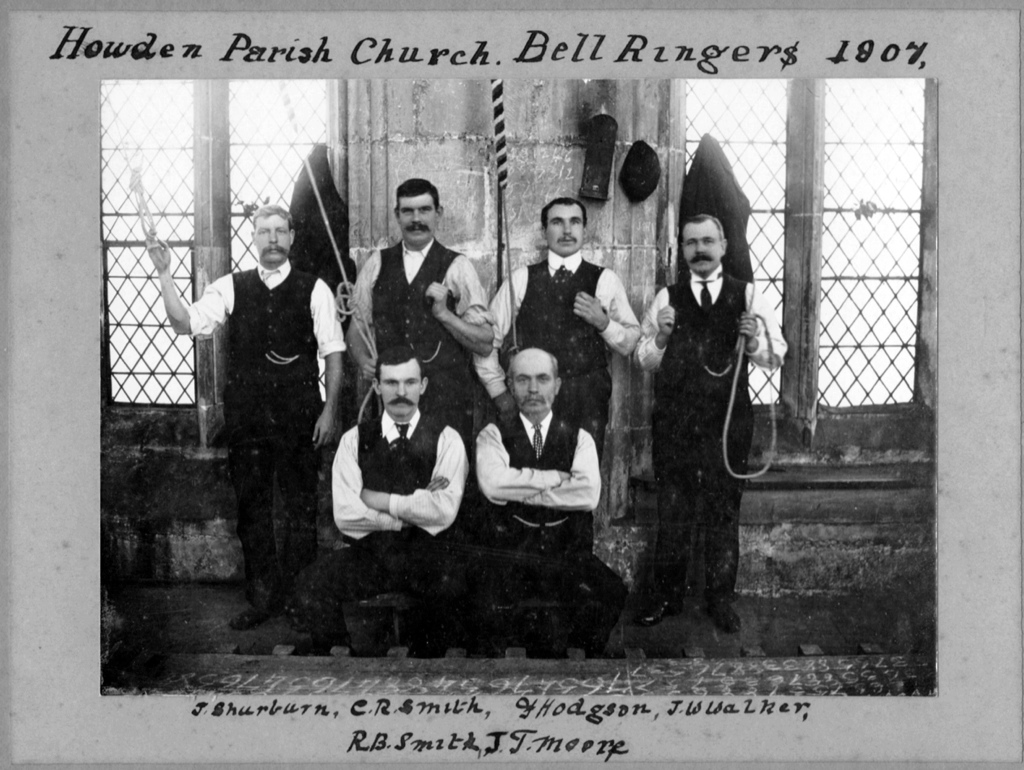
That the Howden bell-ringers are congratulated on their excellent change ringing, —half muffled and half clear—on the evening of the King’s funeral, this the first,occasion such a novel peal has been heard in the town. That the ringers were Messrs T. Moore (treble), Sherburn, Smith, Hodgson, Goulden, Walker and P. Powls (tenor).
November 1910
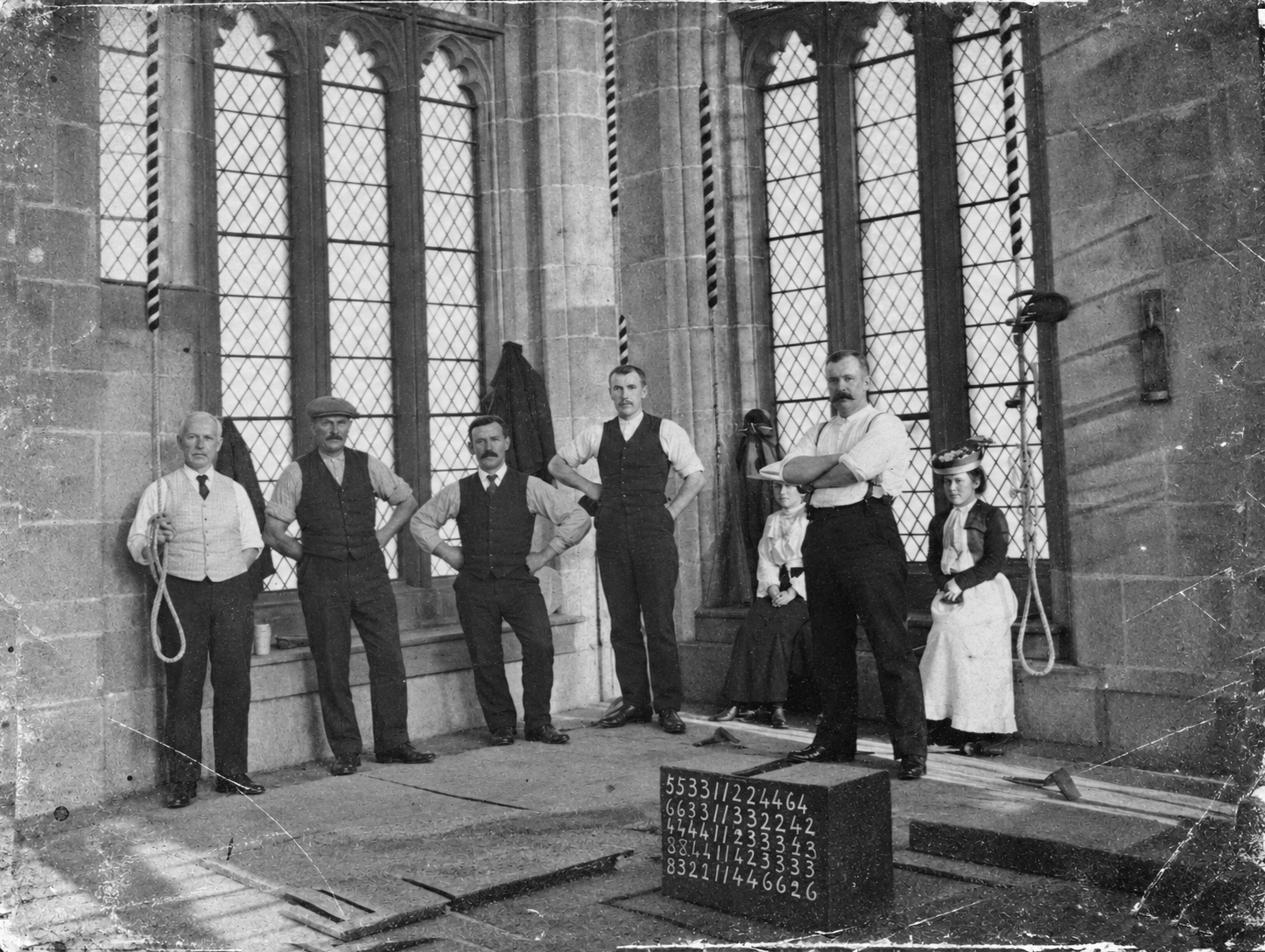
CHRISTMAS BELLS AT HOWDEN ‘ From time immemorial it has been the custom to ring the bells of the Parish Church on Wednesday nights before Christmas, commencing the first Wednesday after the 5th of November. There is a legendary tradition that on a certain very dark night a benighted traveller making for Howden lost his way. In those days there were no roads nor gas, and the poor fellow heard the sound of the bells. This raised his spirits, and he made another supreme effort before giving himself up for lost. Following the direction of the sound, he pushed his way forward over hedge and ditch until he reached the town. His adventure became known, and since it has been the custom to ring the bells’
February 1914
BELL RINGING.—On Saturday the Goole and District Combination of Bell ringers, to the number of about thirty, paid a visit where were rung several touches of grandsire triples, Stedman’s triples, and Bob minors. The ringers were from Selby, Hull, Goole, Hatfield, Snaith, and Howden. After ringing at intervals all the afternoon the party were entertained to tea at the mission room by the Rev A Waring (Vicar), after which they again ascended the tower and resumed ringing. The visitors expressed themselves highly pleased the fine peal of bells, and spent an enjoyable day.
The war
1 December 1917
MEMORIAL SERVICE.—On Sunday morning the bells of St. Peter’s Church rang muffled peals and a special service was held in memory of Private John Camp, son of Mr Charles Camp, sexton of the church, who fell in action three weeks ago. The deceased was formerly a choir boy, and lately one of the ringers.
PRESENTATION.—On Sunday afternoon at the Parish Church Mr J. T. Moore, who has been compelled to resign his position as a ringer owing to ill-health after 41 years service, was presented with a bell shaped inkstand, standing on a black |marble slab. It bore the inscription “ Presented to Mr J. T. Moore by the vicar, churchwardens, | and ringers of Howden Parish Church, as a token of their appreciation and in memory of 41 years’ service as a ringer.” The Rev A Waring said that Mr Moore had spent most of his life as a ringer. The ringers had worked under great disadvantages during the war. Seven had joined the forces—two had made the supreme sacrifice, whilst one was disabled for life. Mr R. B. Smith, in handing over the gift, said how much he regretted parting with Mr Moore, and expressing his appreciation of his services. Mr Moore, who is far from well, said he would always prize the gift. 720 bob minor peals were rung on the muffled bells previous to the men’s service.
Loss of R38
August 1921 . Loss of the R38 when it crashed into the Humber off Hull. Many of the crew were well known in Howden from where it had been based and had begun its final flight
HOWDEN HONOURS THE DEAD. Although the memorial service is fixed for Wednesday the Union Jack flew at half-mast from St. Peter’s Church tower on Sunday. Half muffled peals were rung on the bells. The ringers turned up in full strength and had the assistance of Mr Frank Hodgson, a former ringer. On Wednesday full muffled peals will be rung.
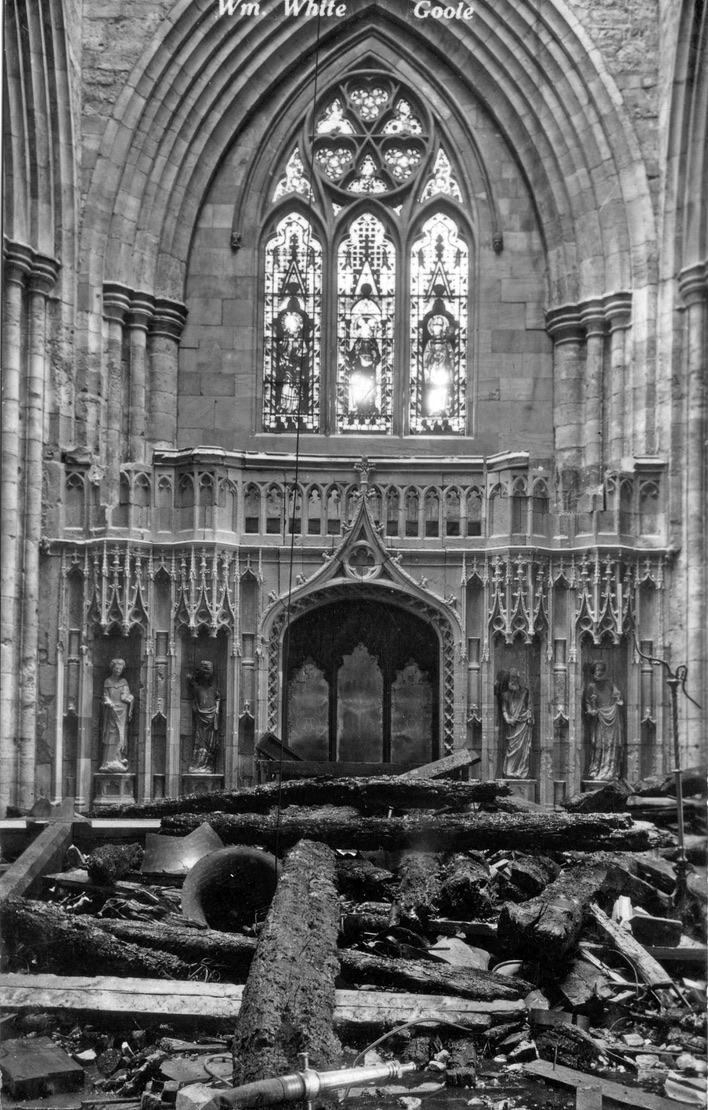
The fire of 1929
The picture shows the broken bells the morning after the fire
1932
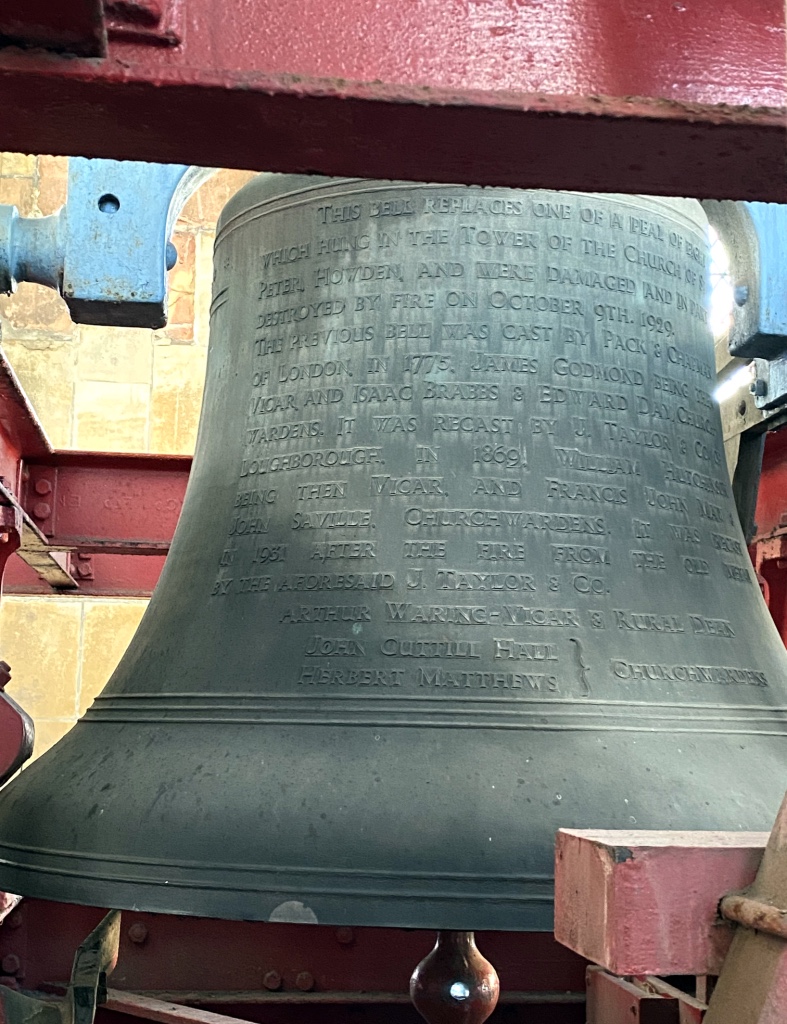
The peal of eight bells damaged when they fell into the sanctuary during the fire, have been recast and re-hung by Messrs Taylor and Co., of Loughborough. The original inscriptions have been repeated on seven of the recast bells, and upon the tenor is recorded the following inscription
This bell replaces one of a peal of eight which hung the tower the Church of St. Peter Howden and were damaged and in part destroyed by fire on October 9th 1929
The previous bell was cast by Pack and Chapman of London, in 1775, James Godmond being then vicar, and Isaac Brabbs and Edward Day churchwardens.
It was recast by J Taylor and Co. Loughborough. 1869, William Hutchinson being then vicar and Francis John Maw and John Saville churchwarden
It was recast 1931, after the fire from the old metal, by the aforesaid J Taylor and Co.
Arthur Waring, vicar and rural dean, John Cuttill Hall and Herbert Matthews, churchwardens.”
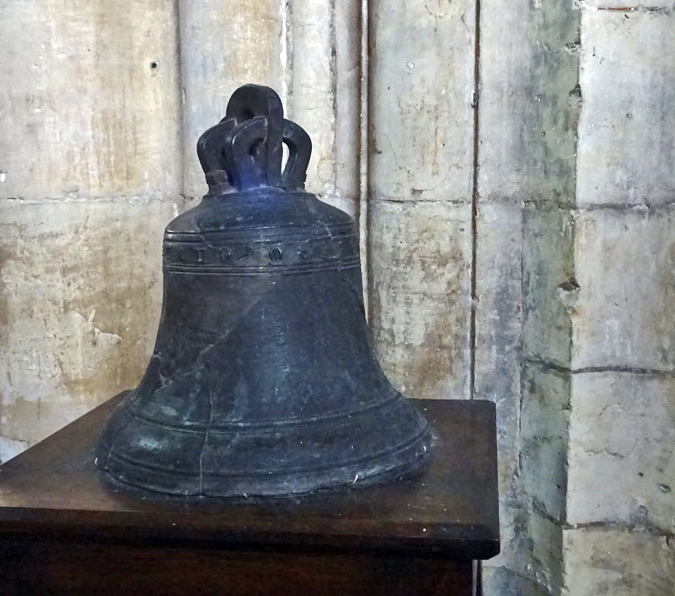
The Scholar/ Corn Market bell
Near the organ is an interesting bell on a stand. It is badly damaged but very old.
It bears the inscription Thomas de Wald me facit. After some research I have found two more bells with the same inscription. One was in the tower of Brotton church North Yorkshire and the other was at Elvington and it appears that it is still there. Both, it is suggested, were/are fourteenth century making it the oldest bell in the church There are various references to it in the newspapers.
In 1909 it was reported that ‘ the bell which is doing duty at the parish Church during the re-hanging of the peal, is known the Corn Market bell, and was rung regularly when the market was held on Corn -market Hill. That the ringing of this bell is still quite fresh in the memory of many residents’
Another newspaper report also from 1909 says ‘Howden Parish Church has had rehung in its tower an ancient Sanctus bell, which for 136 years is reported to have been laid aside in the old belfrey. It formerly was used as the Corn Market bell, and occupied one of the western turrets at Howden Church’
Later in May 1933 there is a bit more about the bell
Near the ancient iron-bound oak chests at the west end of St, Peter’s Church has just been placed another object quite as interesting and quite as ancient. This is the “‘Scholar Bell,’” which bears the inscription, ‘‘Thomas de Wald Me Fecit,” and may have been used since the foundation of the Grammar School by Bishop Skirlaugh in the 15th Century. The bell was found beneath a heap of rubbish in the belfry when the bells were rehung in 1909. It was hung in a frame and was rung for daily services up to the great fire in 1929, when it fell and was broken to pieces. The bell stands on a neat oak pedestal made by Mr J W Walker caretaker and his son from old oak preserved from the fire, the front panel from the old clergy reading-desk, and side panels from the old Sanctuary screen.